
TL;DR
- AI keyword research makes SEO faster, accurate, and intent-driven.
- Machine learning helps discover long-tail keywords and topic clusters instantly.
- AI tools improve keyword mapping, content planning, and competitive analysis.
- Marketers can improve rankings by using smart prompts and automation.
- The future is predictive SEO; AI will forecast trending keywords before they peak, giving you a first-mover advantage.
Introduction
Keyword research has always been the foundation of SEO. But in 2026, the rise of AI tools has changed how marketers discover, organise, and optimise keywords. Instead of relying only on manual data, AI tools now provide predictive insights to help you target the right queries faster.
Whether you’re planning blogs, landing pages, or product pages, understanding how AI in keyword research works is now essential for staying ahead in India’s rapidly evolving and highly competitive digital landscape.
This guide covers everything you need to transform your keyword research process, including AI tool selection, step-by-step workflows, prompt templates, and future-ready strategies.
Why AI Keyword Research Matters in 2026
Search behaviour is evolving, with voice search, conversational queries, and intent-rich questions rising among users. AI helps decode all this complexity.
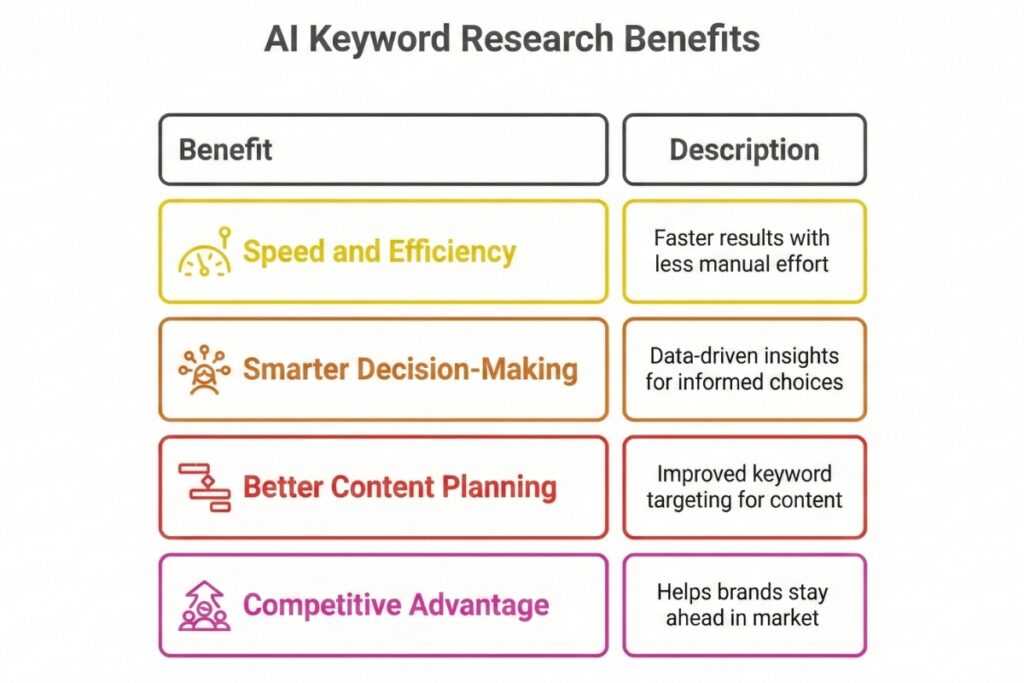
1. Speed and efficiency
AI tools process huge volumes of data within seconds. What earlier took hours identifying keywords, grouping them, and mapping search intent now happens instantly.
2. Smarter decision-making
Instead of relying only on search volume, AI reads patterns, context, and semantics. This means you get keyword suggestions that match real user intent, not just raw numbers.
3. Better keyword planning for content
AI can cluster topics, suggest outlines, and prioritise keywords based on difficulty and competition, giving you a complete roadmap for ranking.
4. Helps Indian brands stay competitive
Businesses across India are rapidly adopting AI-driven SEO, making the digital landscape more competitive than ever. To stay visible and capture search demand, brands need to start using AI tools for SEO that offer faster insights, smarter keyword planning, and stronger intent understanding.
How AI-Powered Keyword Research Works
AI relies on machine learning, NLP (Natural Language Processing), and predictive modelling to understand what users mean, not just what they type.
1. NLP for understanding phrasing and questions
AI models understand grammar, synonyms, regional phrasing, and even Hinglish-based queries common among Indian audiences.
Example:
A user searching “best laptop under 50000” may also mean:
- “budget laptops India”
- “laptops for students under 50k”
AI recognises this context and builds broader keyword clusters.
2. Predictive ranking models
AI forecasts which keywords are likely to grow based on:
- Seasonality
- Search spikes
- Competitor activity
- SERP trends
This gives you future-ready keyword plans.
3. Automated clustering and topic grouping
Instead of manually grouping hundreds of keywords, AI tools organise them by:
- Intent
- Topical relevance
- Funnel stage
- Industry category
4. Semantic matching
AI understands how Google interprets keywords contextually. This helps you choose terms that align with real ranking patterns, not just guesswork.
Why AI-Powered Keyword Research Is Different from Traditional Keyword Research
AI-powered keyword research stands apart from traditional methods because it removes most of the manual work and guesswork that used to slow marketers down.
Earlier, you had to rely on spreadsheets, individual tool checks, and manual validation to understand keyword intent or group related terms. This often led to fragmented insights and incomplete keyword maps.
With AI, the entire process becomes faster, smarter, and far more accurate. Tools automatically analyse search intent, cluster related keywords, predict trends, and highlight opportunities within seconds.
Here’s a quick comparison table showing how traditional and AI-driven keyword research stack up against each other.
| Factor | Traditional | AI-Powered |
| Speed | Slow | Instant |
| Accuracy | Manual validation | Predictive accuracy |
| Keyword Clustering | Manual grouping | Automated AI mapping |
| Long-tail Discovery | Limited | Extensive |
| Intent Detection | Basic | Contextual AI/NLP |
| Insights | Static | Dynamic & evolving |
| Competitor Analysis | Separate process | Built into AI tools |
Which AI Tools Should You Use for Keyword Research
Choosing the right tools is the foundation of effective keyword research, especially when you want fast insights and accurate keyword planning.
This essential tool stack will help you work faster, make smarter decisions, and build stronger SEO strategies.
1. ChatGPT for Keyword Idea Generation
ChatGPT is excellent for discovering blog topic ideas, identifying search intent, generating seed keywords, and creating FAQ or question-based keyword lists. It’s one of the easiest ways to find keywords, especially when you need quick inspiration or structured keyword groups.
Example Prompt You Can Use in ChatGPT:
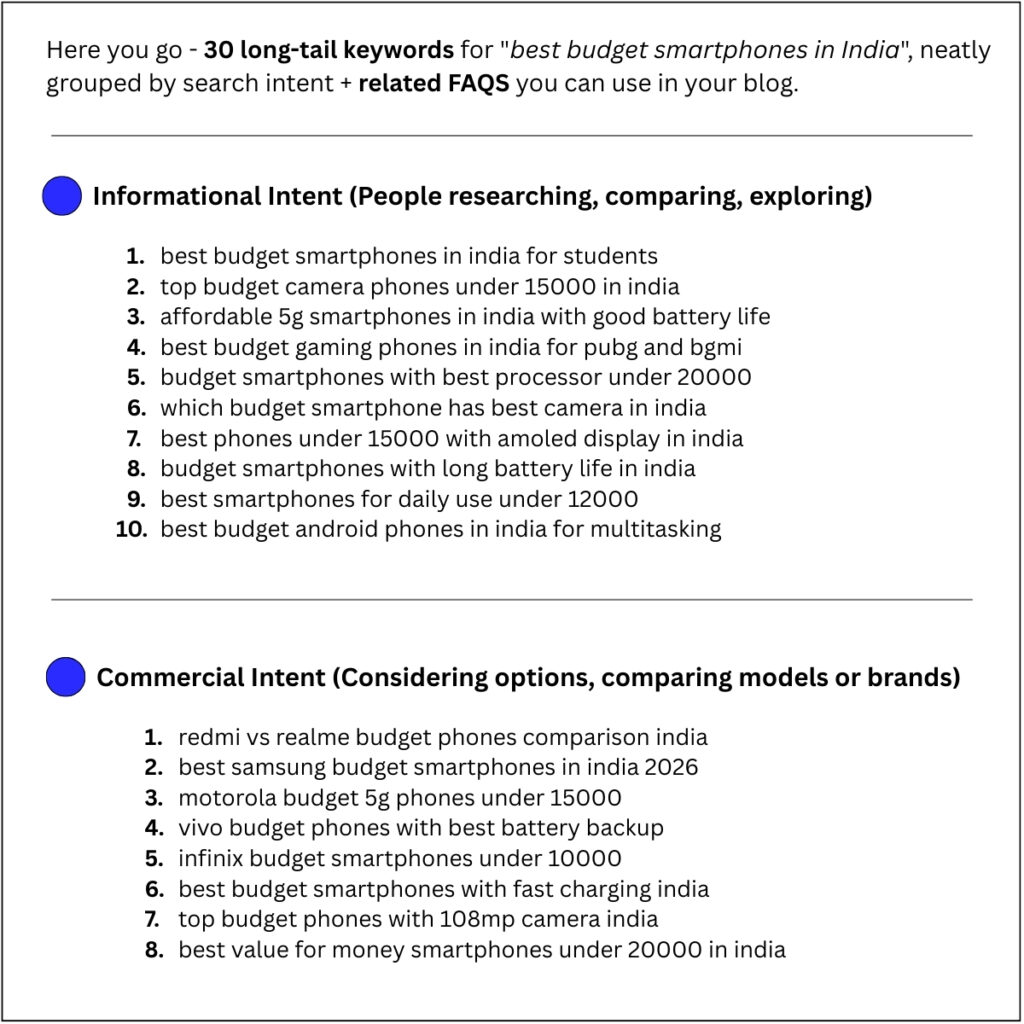
“Generate 30 long-tail keywords for ‘best budget smartphones in India’, grouped by search intent (informational, commercial, transactional). Also, suggest related FAQ questions.”
Here’s what ChatGPT’s output looks like:
2. Google Gemini for Topic Clustering
Gemini is powerful for:
- Building topic clusters
- Analysing user intent
- Creating hierarchical keyword maps
- Generating variations for regional/Indian markets
Example Prompt You Can Use in Google Gemini:
“Create a topic cluster for ‘digital marketing courses in India’. Include main pillar topics, subtopics, long-tail variations, and search intent for each cluster.”
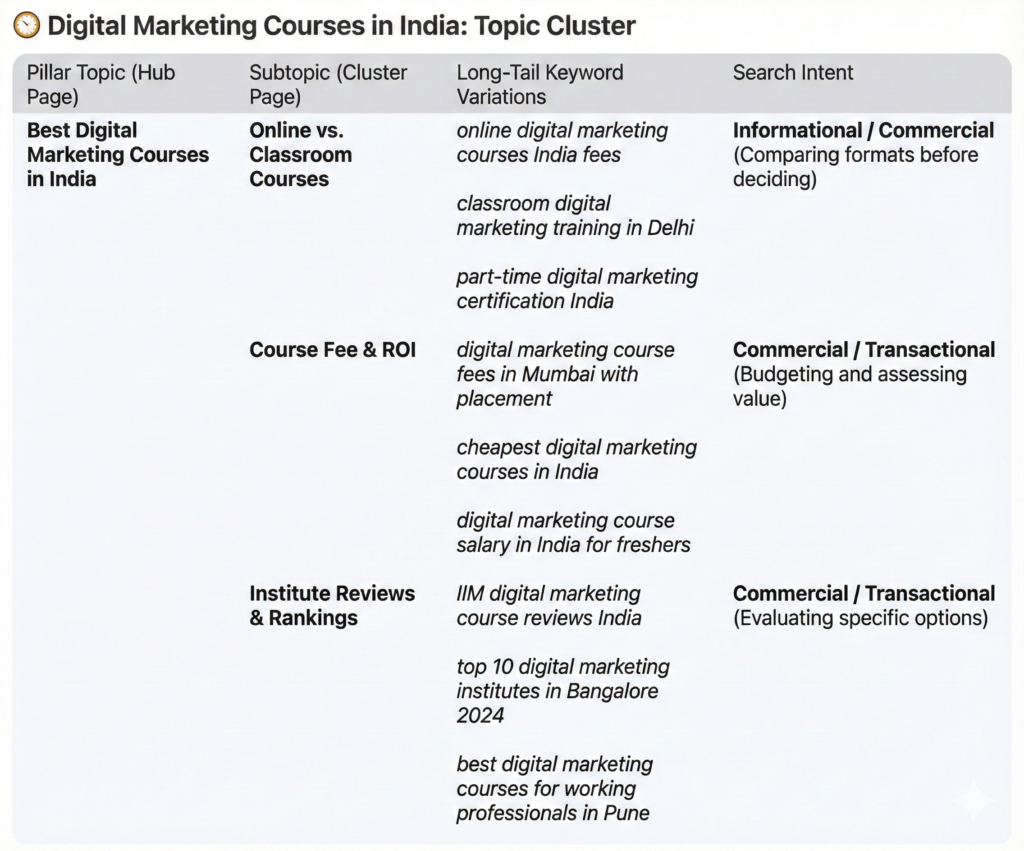
This prompt demonstrates how Gemini can instantly organise keywords into structured clusters, map out parent–child relationships, and provide variations tailored to Indian search behaviour. It’s especially helpful when planning pillar pages, supporting blogs, or content silos.
3. Semrush & Ahrefs AI Assistants
These platforms now offer AI-enhanced:
- Keyword difficulty scoring
- Competitor insights
- SERP opportunity gaps
- Semantic keyword recommendations
They combine manual accuracy with AI speed.
Example Workflow Using Semrush or Ahrefs AI Assistants:
Enter a seed keyword like “best credit cards in India” into Semrush or Ahrefs, then activate the AI assistant to analyse keyword difficulty, suggest semantic variations, and highlight competitor gaps. The tool will also show SERP opportunities, such as keywords competitors rank for, but you don’t. This way, you can easily spot quick-win topics.

This example shows how these platforms blend solid data with AI-driven insights, helping you prioritise keywords based on real ranking potential.
4. Surfer AI & Frase AI for Content Mapping
Useful for content writers and strategists, these tools help:
- Map keywords to articles
- Create SEO-optimised outlines
- Maintain topical depth
- Ensure internal linking structure
Example Workflow Using Surfer AI or Frase AI:
Enter a target keyword like “personal finance tips for beginners” into Surfer or Frase. The tool will instantly generate an SEO-optimised content outline, map related keywords to each heading, recommend word count, and suggest internal linking opportunities. You also get topical depth insights showing which subtopics your competitors cover and where your content can outperform them.

This makes it ideal for agencies and writers who want precise, data-backed content mapping without spending hours manually organising keywords.
5. AnswerThePublic/AlsoAsked for AI Question Keywords
These tools are excellent for identifying:
- Question-based keywords
- Long-tail variations
- Real user language
They are ideal for today’s rising voice search market.
Example Workflow Using AnswerThePublic or AlsoAsked:
Enter a topic like “mutual funds India” into AnswerThePublic or AlsoAsked. The tool will instantly generate question-based keywords such as “how to start mutual funds in India”, “which mutual fund is best for beginners”, and “is SIP good for long-term investment?”. It also reveals long-tail variations and real user phrasing, making it incredibly useful for targeting voice search and conversational queries in the Indian market.
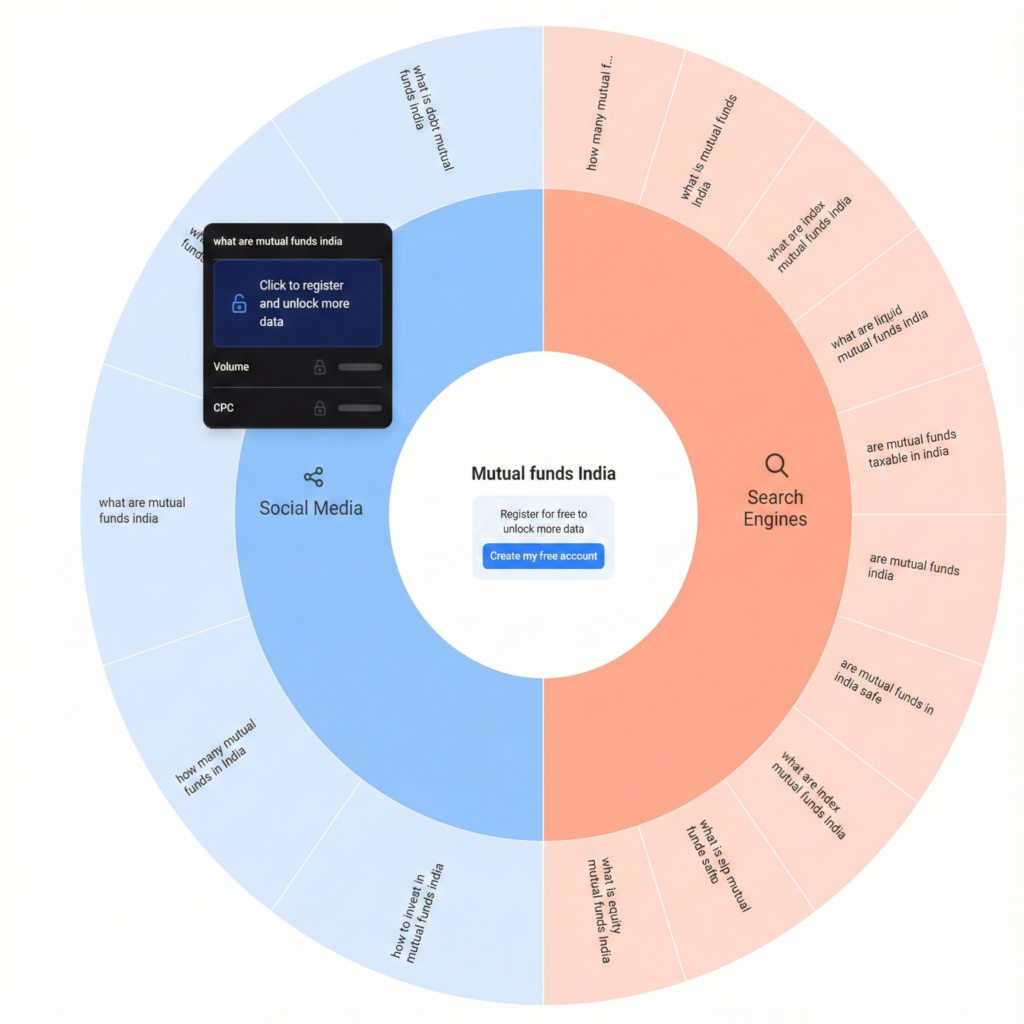
This helps readers see how these tools extract real user questions that can directly shape blog topics, FAQs, and content clusters.
6. MarketMuse for Search Intent Prediction
MarketMuse’s AI engine analyses SERPs and forecasts ranking potential.
It helps discover opportunities competitors might miss.
Example Workflow Using MarketMuse:
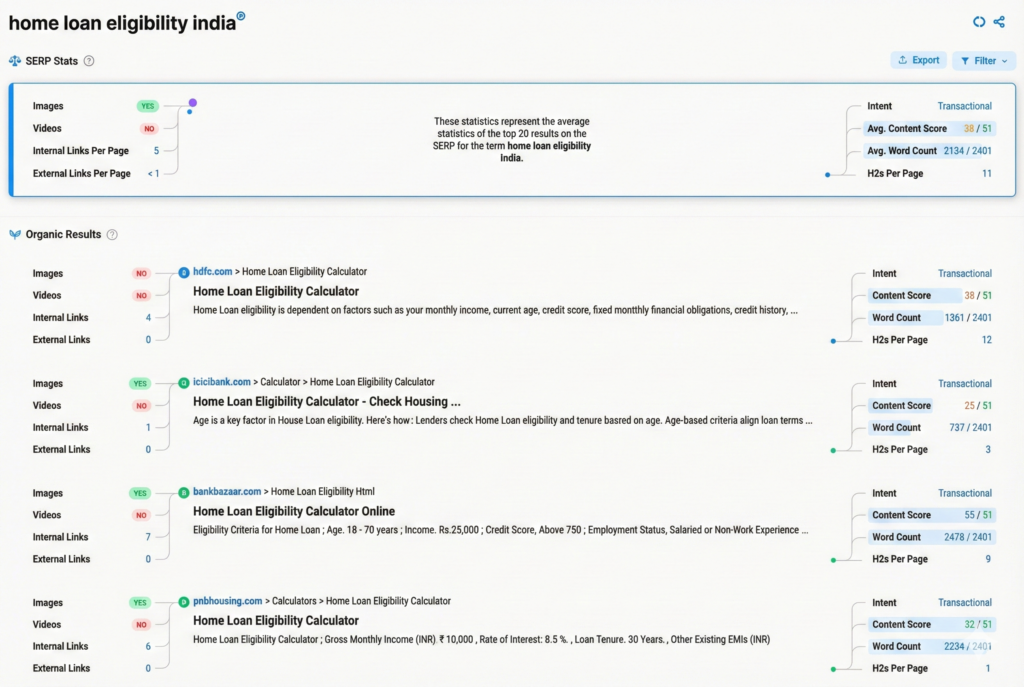
Search for a term like “home loan eligibility India” in MarketMuse. The tool will analyse live SERP data, evaluate content quality across competing pages, and predict how likely you are to rank with a new or updated page. It also highlights keyword gaps, related subtopics, and intent signals showing whether users are researching, comparing, or ready to apply. This makes it easier to optimise content for real user intent rather than relying only on volume or difficulty.
See how MarketMuse turns SERP analysis into intent-driven keyword opportunities.
Step-by-Step AI-Driven Keyword Research Strategy
This proven workflow takes you from initial concept to complete keyword strategy in under 30 minutes, a process that traditionally required 4–6 hours. Follow these steps to maximise AI efficiency while maintaining strategic oversight.
Step 1: Start with a Seed Topic
Example: “budget smartphones for students in India”.
Input this into ChatGPT or Gemini with this prompt:
Generate 50 keyword variations for ‘budget smartphones for students in India’, including:
– Price-range specific terms
– Feature-focused keywords
– Brand & budget combinations
– Student-specific use cases
Step 2: Auto-Generate Variations & Clusters
AI will group the keywords into themes like:
- Price-based searches
- Comparison keywords
- Feature-specific (camera, battery, gaming)
- Review keywords
This clustering saves hours of manual work.
Step 3: Extract Intent Automatically
AI tools classify intent as:
- Informational
- Navigational
- Commercial
- Transactional
Use this mapping to plan funnels and landing pages.
Step 4: Prioritise Keywords with Data
AI tools like Semrush and Ahrefs highlight:
- Seasonal trends
- Opportunity gaps
- Keywords with low competition
- Future-ready topics
This replaces manual filtering entirely.
Step 5: Auto-Generate Content Ideas & Outlines
Tools like Surfer AI and Frase create:
- Headings
- Keyword placements
- Interlinking opportunities
- FAQs
- Metadata suggestions
Step 6: Identify Internal Linking Opportunities Automatically
Using AI tools like ChatGPT can help identify where to place links.
Step 7: Track and Improve Using AI Reports
AI-based SEO platforms like Semrush can help monitor competition and SERPs in real time. You get alerts when rankings drop or new keyword opportunities appear.
How to Generate Long-Tail Keywords with AI Tools
AI significantly improves long-tail keyword discovery by understanding conversational language.
1. Use ChatGPT/Gemini to Expand Every Seed Keyword
Type:
“Generate 50 long-tail keywords for ‘laptops for programming students in India’.”
2. Generate Hinglish Variations
Examples to use on ChatGPT:
- “best coding laptop under 60000”
- “budget laptop for IT students”
AI understands regional and colloquial terms.
3. Use intent-based long-tail generation
Ask:
“Give me transactional long-tail keywords for gaming phones under 30000.”
You will get very specific, buyer-ready search terms.
4. Convert questions into long-tail keywords
Tools like AnswerThePublic convert:
- What
- How
- Why
- Which
questions into powerful keyword ideas.
Mistakes to Avoid in AI Keyword Research
AI makes keyword research faster and smarter, but only when used correctly. Avoid these common mistakes to get real SEO results.
- Blindly trusting AI outputs: Always validate keywords with SERP data using tools like Semrush or Ahrefs.
- Chasing volume over intent: High search volume doesn’t always mean high conversions. Prioritise intent.
- Over-reliance on a single tool: Use 2-3 complementary tools for comprehensive coverage.
- Using vague prompts: Generic prompts produce generic keywords. Be specific about intent, region, and price range.
What is the Future of Keyword Research With AI
With AI, the future of keyword research is moving towards a more predictive, intelligent, and dynamic search ecosystem. Instead of simply analysing what people are searching for today, AI tools can forecast what users are likely to search for in the coming weeks or months, helping brands stay ahead of trends before they peak.
Content will no longer have to remain static. AI systems can continuously recalibrate pages based on changing user intent, SERP fluctuations, and new ranking patterns. Instead of relying on occasional audits, your content will adapt in real time, ensuring it stays aligned with what users are actively searching for.
Using AI, you’ll also get instant signals on content gaps, new answer opportunities, competitor movements, and emerging subtopics. This helps marketers optimise faster and make sharper decisions.
In short, AI turns keyword research into a proactive, future-ready strategy rather than a reactive one.
Conclusion
AI-powered keyword research isn’t the future; it’s the present standard.
It helps marketers uncover smarter insights, understand user intent, and build content that ranks faster.
As AI evolves, keyword research will shift from manual number-checking to predictive, contextual, and deeply strategic planning. If you want to stay ahead in SEO, now is the perfect time to use AI for keyword research and transform your results.
Ready to upgrade your keyword research and SEO performance? Contact us today for data-backed keyword research and SEO services.
FAQs
1. What is AI-powered keyword research?
It refers to using machine learning tools and NLP algorithms to discover, analyse, and prioritise keywords more accurately and quickly than traditional methods.
2. How can I use AI tools for keyword research?
You can use AI to generate seed keywords, expand long-tail lists, build topic clusters, identify search intent, and create content plans instantly.
3. What is the best AI tool for keyword research in 2026?
There’s no single “best” AI tool that can do it all. Using a mix of tools helps perfect keyword research. ChatGPT, Google Gemini, Semrush, MarketMuse, Surfer AI and Frase rank among the most reliable options for Indian markets.
4. Can ChatGPT or Gemini generate SEO keywords accurately?
Yes. Both tools use NLP and large datasets to suggest accurate keywords and map search intent effectively. However, additionally using SEO tools like Semrush validates intent using SERP data.
5. How does AI in keyword research differ from traditional methods?
AI reduces manual work, improves precision, predicts search trends, and groups keywords based on meaning, not just numbers.
6. How do I use AI prompts for keyword research effectively?
Use clear, detailed prompts such as:
“Generate 50 long-tail keywords for X with informational intent, targeting Indian users.”
7. What is the future of keyword research with AI?
It will become predictive and intent-driven, with tools that provide insights into ranking probability, content gaps, and emerging search trends.