
Bottom-of-funnel (BOFU) content marketing is the practice of creating targeted content specifically for prospects who are ready to buy, meaning people who already know they have a problem and are actively comparing solutions. Unlike awareness-stage content, BOFU content is not about education or discovery. It is about conversion: giving the right person the final nudge they need to choose you.
If your content strategy is generating traffic but not sales, the missing piece is almost always a weak BOFU layer.
TL;DR;
- BOFU content targets prospects who are actively evaluating solutions and close to making a purchase decision.
- Unlike TOFU content, which focuses on awareness and education, BOFU content is designed to drive conversions.
- High-performing BOFU content includes case studies, product demos, pricing pages, comparison pages, testimonials, and free trials.
- Effective BOFU content addresses buyer objections, demonstrates value, builds trust through social proof, and includes a clear call to action.
- BOFU keywords typically include commercial intent modifiers such as “pricing,” “best,” “services,” “demo,” “trial,” and “vs.”
- Key BOFU metrics include conversion rate, cost per acquisition (CPA), customer lifetime value (CLV), and CTA engagement rates.
What Is Bottom-of-Funnel (BOFU) Marketing?
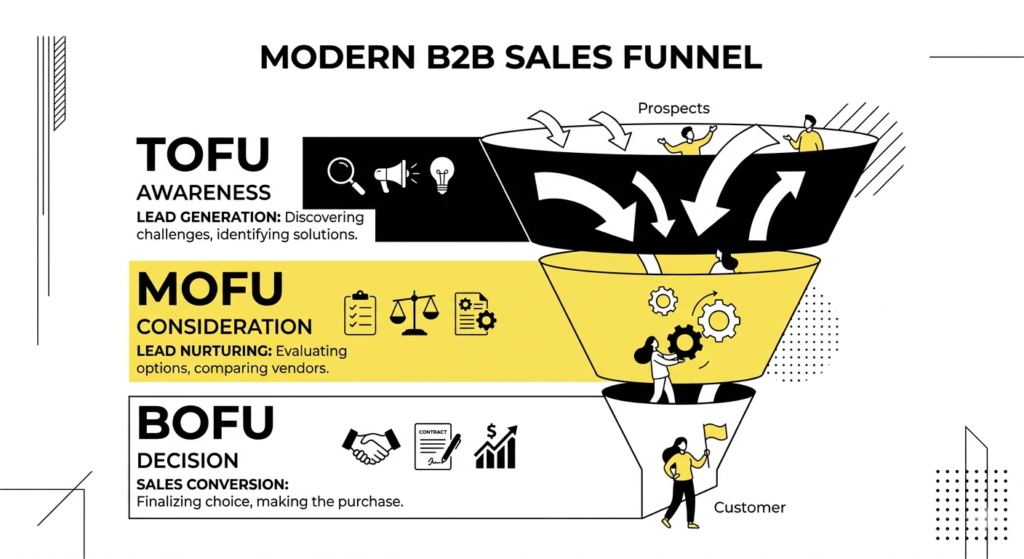
The marketing funnel has three stages – awareness at the top, consideration in the middle, and decision at the bottom. BOFU, or bottom-of-funnel, is that final decision stage.
By the time a prospect reaches the bottom of the funnel, they are not browsing. They have done their research. They know what kind of solution they need. They are now comparing vendors, evaluating options, and looking for reasons to say yes or no to each one.
BOFU marketing is everything you do to show up at that exact moment, with content and offers that make choosing you the obvious decision.
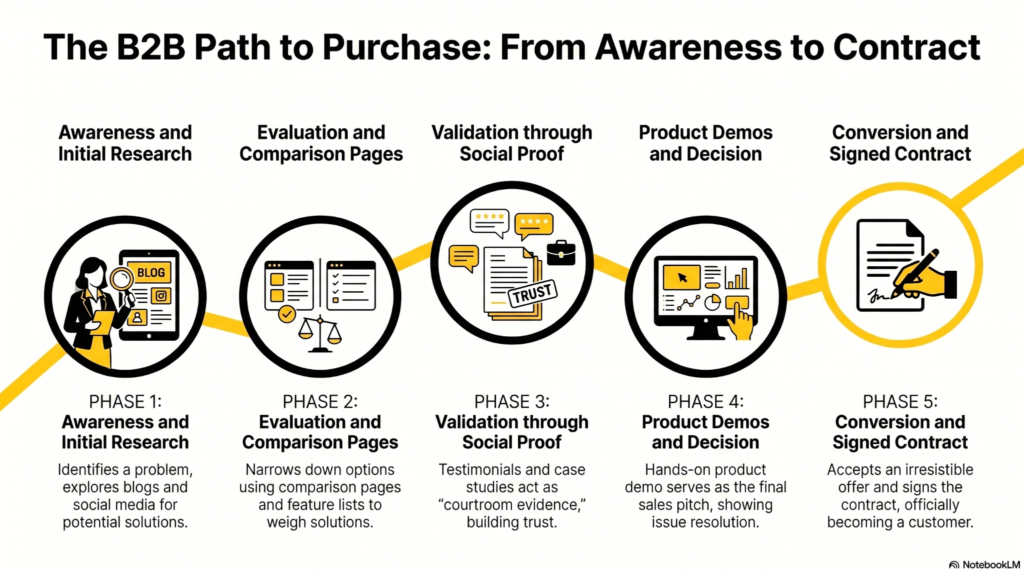
In practical terms, this means product demos, detailed comparison pages, case studies, testimonials, pricing pages, and conversion-focused landing pages. Each piece is designed to address a specific concern a near-ready buyer might have.
| “Most B2B content budgets are heavily skewed toward awareness. The irony is that BOFU content, that is the stuff that actually closes deals, is often the most neglected and the fastest to produce ROI.”— Nikita Gupta, Content Manager, Justwords |
Why BOFU Content Marketing Matters for B2B Sales
Simply put, a prospect who reaches your BOFU content is already halfway sold. They are not asking “do I need this?” They are asking “is this the right one for me?”
That shift in intent changes everything.
As content marketing expert Marcus Sheridan argues:
| “You want to start at the bottom of the funnel with your inbound content strategy with those ready to buy, and then, later on, work your way to the top of the funnel.” |
There are three main reasons why BOFU content should be a priority:
High Intent = High Value
BOFU visitors convert at significantly higher rates than top-of-funnel traffic. At Justwords, when we audited content performance for a SaaS client, we found that their BOFU pages, which made up less than 10% of their total content, were driving over 60% of their demo requests. The math on BOFU investment is hard to argue with.
It Completes the Sales Cycle
Your blog posts and guides do the important work of attracting and educating prospects. But without BOFU content, that investment never pays off. Awareness content brings people to the door; BOFU content gets them to walk in.
It Builds Long-Term Customer Relationships
Well-written BOFU content sets expectations correctly, reduces buyer’s remorse, and lays the groundwork for customer loyalty. A customer who converted because your content honestly addressed their concerns is far more likely to stick around and refer others.
The 5 Key Elements of Effective BOFU Content
1. Laser Focus on the Near-Ready Buyer’s Pain Points
BOFU content is not for everyone, and that is the point. It should speak directly to someone who has already evaluated their options and is now at the final decision stage.
The question to ask yourself: What specific doubt or hesitation is stopping this person from buying right now?
At Justwords, when we create BOFU content for clients, we always start with a sales team interview. The questions buyers ask just before converting are gold. They tell you exactly what objections the content needs to neutralise.
Common near-purchase concerns in B2B include: “Will this integrate with our existing stack?”, “What does onboarding actually look like?”, “Can I see results from businesses like mine?”
Your content needs to answer these.
2. Lead with Benefits, Anchor with Features
At the BOFU stage, benefits come first. Not features. Not specifications. Benefits.
What does the buyer’s work life look like after they use your product? What problem goes away? What result becomes possible?
Once you have established that, you earn the right to explain the features that deliver those benefits. This is where product-led content becomes powerful. That’s because you are connecting each capability to a real outcome the buyer cares about.
For example, when we pitch our content quality guarantee at Justwords, we don’t lead with our editorial process. We lead with the pain point: clients coming to us frustrated after spending months on content that never ranked or converted. Then we explain the system that ensures that doesn’t happen with us.
3. Specific Social Proof
The backbone of effective BOFU content is trust. Use social proof, such as testimonials or case studies, that resonate with your target audience. Customers always want to know that others have taken the product and benefitted from your service. It confirms to them that they are making the right choice.
Effective BOFU social proof is specific. It names industries, quantifies outcomes, and mirrors the situation of your target buyer.
“We increased organic leads by 340% for a B2B SaaS company in the HR tech space within 8 months” is the kind of social proof you need. It is credible, verifiable, and relevant to any similar buyer reading it.
Usually at this stage, case studies outperform testimonials. But even a well-structured testimonial that mentions a specific challenge and a specific result carries more weight than a vague endorsement.
4. Product-Led Content That Shows
BOFU is where your product needs to take centre stage, but through the lens of the buyer’s problem, not a list of features.
This could be a video walkthrough showing exactly how a specific pain point is solved within your product. It could be an in-depth “how it works” page that walks through the exact process from onboarding to outcome. It could be a comparison page that honestly addresses how you stack up against competitors.
The common thread: every piece of BOFU content should make the buyer feel like they already understand what it is like to be your customer before they sign up.
5. An Unambiguous Call to Action (CTA)
At the BOFU stage, ambiguity is a conversion killer.
Your CTA should tell the prospect exactly what happens next: “Book a 20-minute demo”, “Start your free trial”, “Get a custom proposal”. No vague “Learn more” or “Get in touch” because these introduce friction at the worst possible moment.
Pair your CTA with a low-risk offer where possible. Free trials, money-back guarantees, no-commitment demos or anything that reduces the perceived risk of saying yes.
BOFU Content Examples That Actually Convert
Free Trials and Product Demos
The free trial is a classic BOFU move because it removes the biggest barrier in B2B buying: uncertainty. Letting a prospect experience your product firsthand is more persuasive than any copy you can write about it.
Product demos serve a similar function, especially in high-value, high-complexity sales. A well-run demo is not a feature tour; it is a personalised answer to the buyer’s specific use case.
Case Studies
Case studies are arguably the highest-value piece of BOFU content you can produce. They work because they shift the persuasion from you to a neutral third party – a customer who has already been where your prospect is now.
The format matters here too. The best case studies follow a clear structure: here was the problem, here is what we did, here is the measurable result. Specificity is everything. Industry, timeline, numbers – include them all.
Comparison and Versus Pages
“[Your brand] vs [Competitor]” pages are among the highest-intent searches in any B2B category. A prospect searching this is moments away from a decision. Being there at that moment with an honest, well-structured comparison is a significant competitive advantage.
These pages work best when they are fair. Acknowledge where competitors are strong. It builds credibility, and it means your strengths read as genuine rather than self-serving.
Exclusive Offers and Limited-Time Incentives
A well-timed offer can convert a fence-sitter. Extended trials, onboarding support, and discounted first quarter are some such risk-reducers.
The key is to keep them honest and time-bound, and to deploy them only at the BOFU stage, not broadcast them to your entire audience.

Also Read: 5 types of content that will attract paying customers
BOFU vs TOFU: Understanding the Difference
| Top of Funnel (TOFU) | Bottom of Funnel (BOFU) | |
| Primary goal | Awareness and education | Conversion |
| Keyword intent | Informational, high volume | Transactional, lower volume, high intent |
| Target audience | Broad | Specific, near-ready buyers |
| Content formats | Blog posts, guides, social content, webinars | Demos, case studies, comparison pages, pricing pages |
| Relationship to revenue | Indirect | Direct |
| Conversion timeline | Long | Short |
These two stages are not in competition. They work together. TOFU brings people into the funnel; BOFU converts them. Neglecting either one breaks the chain.
The analogy we use at Justwords: top-of-funnel content is the attraction, BOFU content is the closing argument. A courtroom lawyer who makes a compelling opening statement but stumbles at the close doesn’t win the case.
BOFU Keyword Strategy: Stop Chasing Volume
One of the most common mistakes B2B content teams make is applying top-of-funnel keyword logic to BOFU content.
BOFU keywords are transactional by nature. They signal buying intent, not curiosity. They will have lower search volume, but the traffic they bring converts at a fundamentally different rate.
Examples of TOFU vs BOFU keywords:
| TOFU | BOFU |
| what is account-based marketing | account-based marketing agency for SaaS companies |
| email automation | best email automation software for B2B SaaS |
| CRM software benefits | HubSpot vs Salesforce for mid-sized businesses |
| cybersecurity best practices | managed cybersecurity services for healthcare companies |
| how to improve employee onboarding | employee onboarding software pricing |
BOFU keywords contain strong commercial modifiers such as:
- agency
- services
- pricing
- cost
- demo
- trial
- consultant
- hire
- vs
- best
- for [specific industry/use case]
Those modifiers immediately signal that the searcher is evaluating vendors or solutions rather than simply learning about a topic.
And these BOFU keywords may drive a fraction of the traffic, but they bring actual buyers.
How to Measure BOFU Content Performance
Conversion Rate
This is the primary metric. What percentage of visitors to your BOFU pages are taking the desired action, such as booking a demo, starting a trial, or requesting a proposal? A low conversion rate signals a mismatch between what the page promises and what the prospect needs to hear.
Cost Per Acquisition (CPA)
How much are you spending to convert one customer through your BOFU content? High CPA often means either the wrong traffic is reaching your BOFU pages, or the pages themselves are failing to convert qualified visitors.
Customer Lifetime Value (CLV)
BOFU does not end at the first conversion. Customers who converted because your BOFU content set accurate expectations tend to have higher CLV. Tracking this tells you whether your content is attracting the right buyers, not just any buyers.
Engagement Signals
Time on page, scroll depth, and CTA click rate are the metrics that tell you whether your content is holding attention. If visitors are bouncing quickly from a product page or case study, the content is not resonating with the audience arriving at it.
7 Practical Tips to Improve Your BOFU Conversion Rate
Here are some tips to make your BOFU pages super solid and primed for conversions:
- Interview your sales and customer success teams: The objections they hear most often are the exact gaps your BOFU content needs to fill. No amount of keyword research replaces this.
- Map each content piece to a specific objection: Don’t create BOFU content in the abstract. Each page should address one clear barrier to purchase.
- Go transactional with your keywords: Target searches like “best [solution] for [specific industry]”, “[your brand] vs [competitor]”, “[service] pricing”, “[product] reviews”. These low-volume, high-intent searches are where your buyers actually are.
- Use AI to audit your landing pages, but feed it real data: At Justwords, we use AI tools to identify gaps between a page’s messaging and the ideal customer profile (ICP). It works best when you give it your ICP details, your competitors’ positioning, and your product’s actual differentiators.
- Build a retargeting layer: Prospects who visited your demo page or pricing page and left without converting are not lost. They are warm. Retargeting them with a specific message (not a generic brand ad) is one of the highest-ROI moves in B2B marketing.
- Make your social proof industry-specific: If you serve multiple verticals, create case studies and testimonials for each. A fintech buyer wants to see fintech results, not a generic “we helped a client grow revenue” case study.
- Reduce friction on the CTA: Every additional field on a form, every extra click before the demo loses you conversions. We run quarterly CTA audits for clients and consistently find that simplifying the conversion path drives measurable lift.
The Justwords Take on BOFU Content
We work with B2B brands across categories such as SaaS, professional services, healthcare tech and edtech, and the pattern we see is consistent: companies that invest in BOFU content strategically close more deals with less ad spend.
But BOFU content cannot be created by reading the top five Google results and rewriting them. It requires knowing your buyer deeply – their specific hesitations, the language they use, the competitors they are evaluating, and the outcomes they actually care about. That knowledge comes from your sales team, your customer success team, your product team, and from genuinely understanding the category.
That is how we approach BOFU content at Justwords. And it is the approach we recommend to every client who asks why their content is getting traffic but not conversions.
Want to build a BOFU content strategy that actually converts? Talk to us.
Frequently Asked Questions About BOFU Content Marketing
1. What makes content “bottom of funnel”?
BOFU content is defined by its audience and intent. Any content that targets people who are actively evaluating a purchase decision, whether that’s a case study, a pricing page, or a product comparison, is bottom-of-funnel content.
2. How is BOFU different from a sales page?
A sales page is one type of BOFU content. BOFU is broader. It includes any content asset that supports the decision stage, from case studies to demo videos to testimonials. A sales page is usually the final conversion point; BOFU content also includes what gets the prospect to that page.
3. How many BOFU content pieces do I need?
At minimum, you need content that addresses your top three buyer objections, content for each key transactional keyword cluster in your category, and at least 2–3 strong case studies. Most B2B brands are under-invested in BOFU. Even 5–10 strong pieces of content, updated regularly, can significantly move conversion rates.
4. Does BOFU content work for long sales cycles?
Yes, arguably more so. In long B2B sales cycles, BOFU content does the work between touchpoints: keeping your brand credible, answering the questions a prospect hasn’t asked yet, and giving internal champions material to share with stakeholders.