Google Ads is better when people are already searching for what you sell. Facebook Ads (now run through Meta Ads, which covers Facebook and Instagram) is better when people would buy from you but haven’t yet thought to look. Google captures demand that exists. Meta creates demand that does not exist yet. For most Indian businesses selling something buyers already search for, Google Ads earns the first rupee of budget and Meta earns the second.
The complication is that the two platforms are hard to compare on the numbers most dashboards show. A Facebook click costs a fraction of a Google click, yet cost per click (CPC) says nothing about which platform produces customers. A cheap lead who never picks up the phone is the most expensive lead in your account.
This article compares Google Ads and Facebook Ads on cost, conversion rate and ROI, using current benchmarks and India-specific data. It then gives you a way to decide which platform fits your sales cycle, and how to sequence your budget so neither platform wastes it.
Key Takeaways
- Google Ads reaches people with active buying intent. Meta Ads reaches people who match your customer profile, whatever their intent at that moment.
- Meta clicks and leads cost less. Google leads usually arrive closer to a purchase decision, so cost per lead alone can mislead you
- Conversion rates look similar on paper (8.18% for Google Search, 8.54% for Facebook lead campaigns), but a “conversion” means different things on each platform.
- Services, B2B and high-consideration purchases usually start on Google. Visual, impulse and D2C products usually start on Meta.
- Judge both platforms on cost per qualified lead and cost per customer, measured against your break-even CPA.
Google Ads vs Facebook Ads: Demand Capture vs Demand Creation
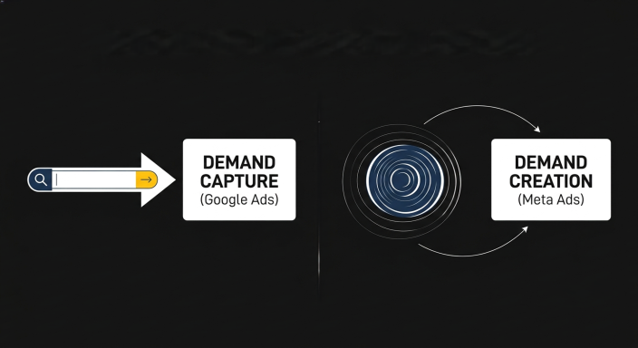
The biggest difference between Google Ads and Meta Ads comes down to when you reach the customer.
Someone types “dental implants cost in Delhi” into Google. That person has a problem, a budget in mind and a shortlist forming. Google Ads puts your business in front of them at that exact moment. In India, this matters a lot because Google accounted for 97.76% of search referrals in August 2026, according to StatCounter. Nearly every search-led buyer walks through one door.
Meta works from the other direction. Nobody types a query. A person scrolling Instagram sees your ad because their age, location, interests and behaviour match your customer profile. The reach is enormous: DataReportal estimated India’s potential Facebook ad audience at 384 million and its Instagram audience at 414 million in January 2025. That scale suits launches, new categories and impulse purchases. It also means most people who see your ad are not shopping at that moment.
There is also a naming point worth clarifying before comparing the platforms further. Facebook Ads and Meta Ads are the same product. Advertisers buy both through Meta Ads Manager, and one campaign can run across Facebook, Instagram and Messenger. We are using the two names interchangeably in this article.
Google Ads vs Facebook Ads Cost: What You Will Actually Pay in India
| Metric | Google Search Ads | Facebook (Meta) lead campaigns |
| Average cost per click | $5.42 | $1.80 |
| Average conversion rate | 8.18% | 8.54% |
| Average cost per lead | $66.69 | $27.66 |
Google clicks cost more because you are bidding for intent. The bidders on a keyword like “term insurance plan” include every insurer with a large marketing budget. Indian benchmarks put average search CPCs anywhere from ₹3 in fashion ecommerce to ₹460 in health insurance, with most industries falling between ₹20 and ₹150. But you should treat these numbers only as planning ranges. Your keywords, location and Quality Score will move them, and a well-structured PPC campaign spends the first month finding out where.
Meta, on the other hand, is cheaper at the impression level. And India is one of the cheapest markets in the world for it. Lebesgue’s 2026 ecommerce data puts the average Meta CPM (cost per thousand impressions) in India at $1.36 (~₹130), against $16.08 in the US. Having said that, cheap is not permanent. Triple Whale’s latest benchmark found that Meta CPMs rose 13.24% year over year for the August 2025-July 2026 period.
Cost per click is only the first link in the chain. Cost per lead depends on both CPC and conversion rate, while cost per customer depends on how many of those leads actually become customers. That means a higher CPC does not automatically make a platform more expensive. A platform charging ₹20 per click with a 2% conversion rate costs ₹1,000 per lead. A platform charging ₹60 per click with a 10% conversion rate costs ₹600. Despite paying three times more for each click, you pay less for each lead because the higher conversion rate more than offsets the higher CPC.
Google Ads vs Facebook Ads Conversion Rate: Similar Numbers, Different Leads
WordStream’s benchmarks put the average conversion rate at 8.18% for Google Search in 2026 and 8.54% for Facebook lead campaigns. On paper, the platforms are level. In practice, the two numbers measure different behaviour.
A Google conversion usually follows a deliberate sequence – the person searched, compared results, clicked and then filled a form or called. A Facebook lead conversion often happens inside the app, on a pre-filled form that takes two taps. Lower effort means Facebook can produce more leads at lower cost. But that lower friction can also mean lower intent: some people submit a form impulsively and barely remember doing so when your sales team calls.
That gap is why Meta leads often need more qualification, faster follow-up and a sharper offer. A well-run Meta campaign with a strong offer and a quick callback can still outperform Google for the right product. The fix is to measure differently, and good social media advertising treats lead quality as a design problem from day 1. That means adding qualifying questions in the form, a clear price signal in the creative and a response time measured in minutes.
Google Ads vs Facebook Ads ROI: Match the Platform to Your Sales Cycle
Start with one number: your break-even cost per acquisition (CPA). This is the maximum you can spend to acquire a new customer without losing money on that sale. A D2C brand with a ₹2,000 average order and a 40% gross margin earns ₹800 on that first order. Spending more than ₹800 to win that customer loses money, unless repeat purchases close the gap. Every platform decision that follows should be tested against this figure.
With that in mind, the right platform depends on how customers discover, consider and buy your product or service:
| Your situation | Start with | Why |
| Buyers search for your service (clinics, loans, insurance, education, B2B software, local services) | Google Ads | The intent already exists. You pay to be present at the moment of decision. |
| Visual or impulse product (fashion, food, beauty, home décor, apps) | Meta Ads | Discovery drives the purchase, and creative does the selling. |
| New category with little search volume | Meta Ads first, Google later | Nobody searches for something they don’t know exists. Build awareness first, then capture the searches it creates. |
| Long, high-value sales cycle (real estate, enterprise software) | Google for intent, Meta for retargeting | Buyers take weeks to decide, so you need presence at the search stage and visibility afterwards. |
| Budget for one platform only | Google if search demand exists, Meta if it does not | Concentrated spend gives the algorithm enough data to optimise. |
If you want a single test, pull the monthly search volume for your 10 most commercial keywords in Google Keyword Planner. Healthy volume means Google should go first. Thin volume means Meta has to create the demand before Google can capture it.
Four Mistakes That Make Either Platform Look Like a Failure
- Judging by cost per click or cost per lead alone: Both metrics stop at the form fill. The number that matters sits further down the funnel, at qualified leads and closed sales.
- Sending paid traffic to a weak page: A generic homepage wastes the click. The landing page has to repeat the promise the ad made, in the same words.
- Ignoring what happens after the lead: Leads go cold quickly, particularly from Meta forms. If your team takes too long to call back, a good campaign may look worse than it actually is.
- Switching platforms off too early: Both platforms need time to gather data before they optimise. Judging a campaign after one week is like judging a salesperson after one call.
Use Both, in the Right Order
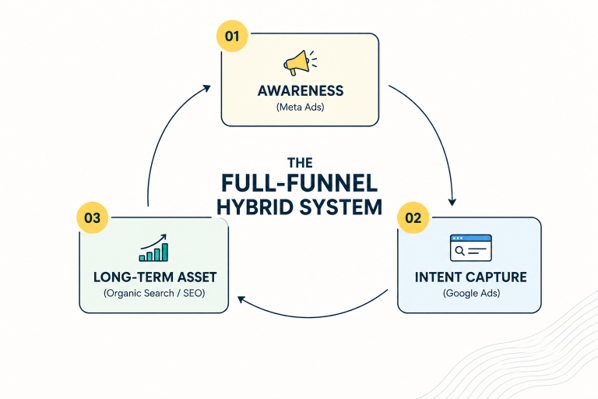
The strongest accounts rarely choose between the two. Google captures the buyers who are already searching. Meta builds awareness among the buyers who are not and retargets the visitors who left without converting. Buyers warmed by Meta then search for your brand name later, which makes your branded Google clicks cheap and your Google leads warmer.
One limit applies to both: paid traffic is rented. The moment the budget stops, so does the traffic. Organic search is the asset you own. It can keep bringing visitors without paying for every click. Paid media sits best on top of that kind of foundation, which is why Justwords plans PPC, SEO and content marketing as one system through its digital marketing services, with every rupee measured against pipeline. Brands that build both get found through paid today and chosen through organic for years.
Ask One Question Before You Spend
Is your buyer searching or scrolling this week? If they are searching, buy that traffic first, because every search that ends on a competitor’s ad is a lead you paid to lose. If they are scrolling, invest in the creative and the offer, and measure results to the sale rather than the form fill. Set your break-even CPA before the first rupee goes out, and hold both platforms to it.
If you would like help working that number out and deciding where the first budget should go, our PPC services start with exactly that conversation.
Also Read: How to Choose a PPC Marketing Agency for Maximum ROI
FAQs
1. Are Facebook Ads and Meta Ads the same thing?
Yes. Facebook Ads is the older name. Today, advertisers buy Facebook, Instagram and Messenger placements through one system, Meta Ads Manager. And most agencies use “Meta Ads” for all of them.
2. Which is better for a small business, Google Ads or Facebook Ads?
Start with Google Ads if customers already search for your product or service. Start with Facebook Ads if your product is visual, new or bought on impulse. Running one platform well beats running two thinly.
3. Is Facebook Ads good for lead generation in India?
Yes, particularly for education, real estate and local services. India’s Meta CPMs are among the lowest globally. Add qualifying questions to lead forms and call back quickly, because in-app forms produce many low-intent submissions.
4. Which platform is better for B2B?
Google Ads usually captures B2B demand more reliably, because buyers search for solutions when a problem becomes urgent. Meta works well for retargeting website visitors and promoting webinars, reports and events to defined professional audiences.
5. Can I run Google Ads and Facebook Ads together?
Yes, running both often performs better if you have the budget. Google captures existing search demand while Meta builds awareness and retargets visitors. Track both to the same CRM, so that you can compare cost per customer rather than cost per click.
6. How much should I spend on Google Ads or Facebook Ads?
Work backwards from your goal. Multiply the customers you want by your break-even CPA, then divide by your lead-to-sale rate to size a monthly budget you can defend.