
TL;DR
- Google’s E-E-A-T (Experience, Expertise, Authoritativeness, Trustworthiness) isn’t a ranking factor on its own, but it strongly influences how Google judges content quality.
- Experience = “I’ve done this.” Content backed by real-world usage, tests, case studies, photos, or personal results.
- Expertise = “I know this.” Knowledge proven through credentials, training, research, or deep technical explanations.
- Experience builds authenticity. Expertise builds credibility. Together, they create trust, which is the strongest signal Google rewards.
- To rank in 2025: show real human work + demonstrable knowledge, backed by sources, transparent authorship, and trustworthy business signals.
- Win with content that is lived, learned, and proven.
In December 2022, Google added a new “E” to its previous E-A-T guidelines. The new “E” which stands for “Experience” was added to distinguish websites that carried genuine, expert content—written by authors who had actually experienced what they were writing about — from websites that simply published regurgitated versions of what their authors had read somewhere else.
But this has also created confusion. Many users are still grappling to understand the difference between ‘Experience’ and ‘Expertise’ in Google’s E-E-A-T guidelines and whether they should optimize for both.
That’s exactly what this blog is about. We’ll help you understand the real difference between Experience and Expertise, and show you practical ways to optimize your content for both of these search quality rater guidelines.
What is Google’s E-E-A-T in SEO?
Google introduced E-A-T, which stands for Expertise, Authoritativeness, and Trustworthiness, in 2014 as part of its Search Quality Rater Guidelines.
Google’s Search Quality Rater Guidelines is a document that helps it evaluate websites based on how useful, reliable, and trustworthy their content is.
But, in December 2022, Google added a new term “E” denoting Experience. Why? Because many websites looked “expert” on paper, but didn’t really have the practical experience to prove it. They were often theoretically correct but failed to provide genuinely helpful insights — because the authors had not actually done what they were writing about.
This change tried to identify and reward authentic, trustworthy content from people who have experienced or done what they are talking about.
Here’s what Google said while announcing the change:

Google wants proof you walk the talk. More experience = more trust.
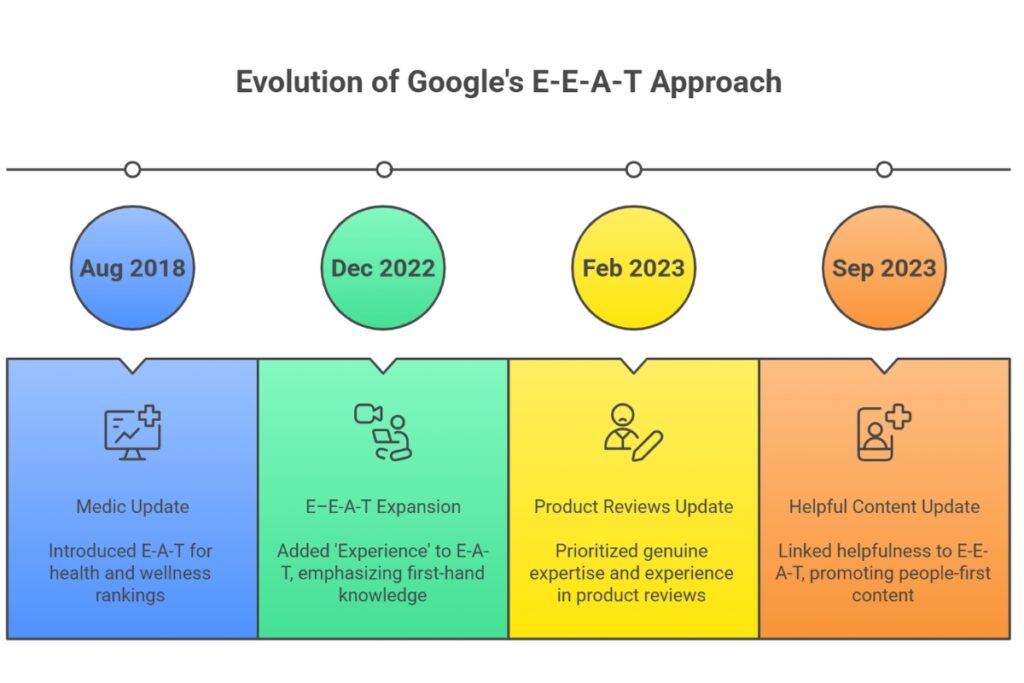
While Google’s E-E-A-T isn’t a direct ranking factor, following its principles helps ensure your content meets Google’s standards for quality and relevance.
Pages that consistently demonstrate strong E-E-A-T earn SEO trust signals, which in turn influence rankings. When your content reflects real experience, accurate information, and clear trust indicators, it tells Google that your site is worth ranking higher.
Here’s what Google’s E-E-A-T guidelines simply mean and why it matters for SEO goals:
| Element | Meaning | Why It Matters for SEO |
| Experience | Shows that the creator has firsthand practical involvement with the topic. Essentially “doing”. | Proves authenticity and adds real-world value. |
| Expertise | Shows the knowledge, skill or qualification of the content creator in a subject gained from education or training. Essentially “knowing”. | Builds credibility and enhances user trust. |
| Authoritativeness | Indicates the topical authority of the website in terms of backlinks, domain rating, URL rating, etc. | Signals reliability and influence on Google SERPs. |
| Trustworthiness | Demonstrates accuracy, transparency, and honesty in content. | Forms the foundation for ranking, user retention, and user confidence. |
E-E-A-T is especially important for YMYL content. These are topics that can affect someone’s health, finances, or safety. So, accuracy and credibility form the core of such content, and can have real consequences.
Also Read: How to Build Topical Authority and Why it is so Important
What’s the Difference Between Experience and Expertise in E-E-A-T?
The two E’s (Experience & Expertise) form the heart of Google E-E-A-T guidelines. Many people use these terms interchangeably. But not Google.
Experience in E-E-A-T
Experience is all about first-hand involvement. Did the author actually use the product they are reviewing? Did the travel blogger actually visit the places they are talking about? Google values content grounded in real-world interaction.
Examples of demonstrating “Experience”:
- Product reviews with insights from a user who has used that product
- Travel guides with unique information from someone who actually visited the location
- Case studies from your own projects or clients
- Personal experiments with documented results
- Before-and-after comparisons from your own work
Expertise in E-E-A-T
Expertise, on the other hand, is about credible knowledge on a subject. This could mean professional credentials, certifications, or demonstrable skill in a subject.
Simply put: Expertise means you deeply understand your field and have the necessary qualifications to write about it authoritatively.
Where Expertise is super important:
- YMYL topics (Your Money or Your Life) like medicine, finance, legal advice, and health — where expertise is non-negotiable
- Technical subjects requiring specialized knowledge like engineering, scientific research, or complex financial planning
- Professional services where credentials directly impact quality and safety
Key principle:
Write about what you genuinely know. When you lack formal credentials, collaborate with verified experts to review or co-author your content.
| Factor | Experience | Expertise |
| Definition | First-hand, real-world application | Knowledge, training, education |
| Ideal for | Case studies, reviews, personal stories | Technical guides, research-based content |
| Example | “I tested this SEO tool for 30 days.” | “How SEO tools work based on algorithm updates.” |
Experience vs Expertise: Why Both Matter for SEO
Although E-E-A-T is not a direct ranking factor in the sense of “if you do this, you’ll rank higher immediately,” it is a part of the core framework used by Google’s Search Quality Raters to assess content quality.
Why Experience Matters in Content for SEO?
Content aligned with the “Expertise” factor of E-E-A-T often performs better because it’s relatable, credible, and actionable. Users and Google both love content written by people who have actually done the thing.
Real example from our client work:
A fintech startup’s blog featured posts written by writers who had strong theoretical expertise – technical analysis, market theories, risk management principles, and so on. But none of it showed real crypto trading experience. No examples, no wins or losses, no real world market scenario. In short, it did not resonate with their audience.
When we shifted the content to experience-based storytelling, like “How I made $15,000 by trading Ethereum in 3 months” with actual trade history, traffic increased dramatically. This single blog post brought more traffic than all the blog posts combined.
How to demonstrate experience in your content:
- Built a plugin? Mention it with specifics about the development process
- Solved real problems for users? Share exactly how you did it
- Tested a strategy? Include your results and what you learned
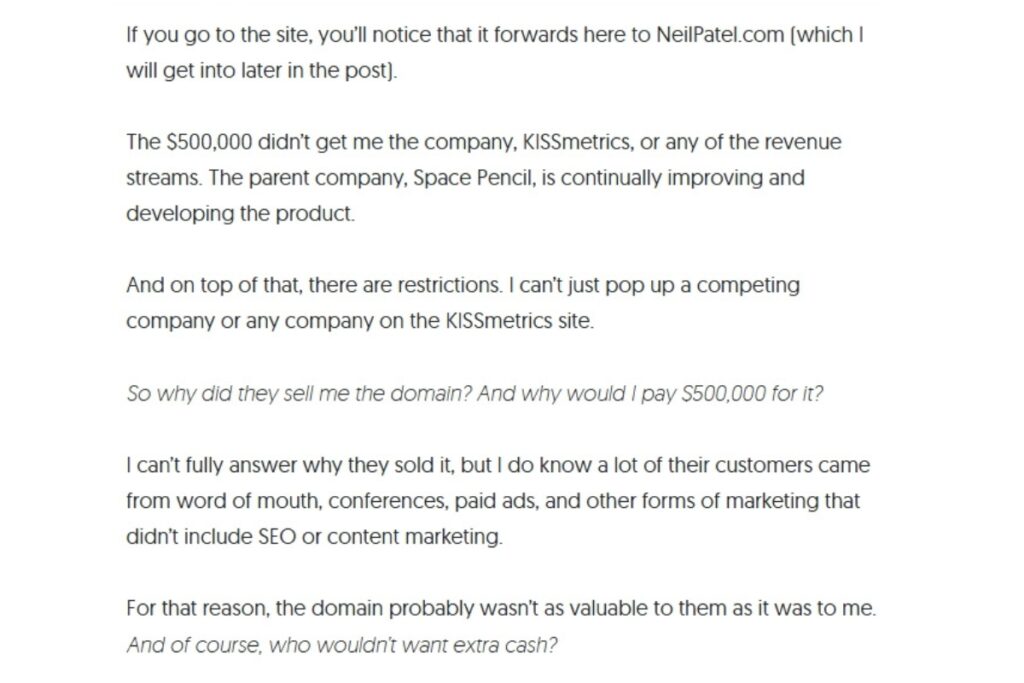
Example: Check how Neil Patel shares his personal experience purchasing a domain in his blog post titled “Why I Spent $500,000 Buying a Blog That Generates No Revenue” and the lessons he learned.
Why Expertise in Content Matters for SEO?
Expertise means you’re not just guessing, but you know the field inside out. Google looks for credentials, citations, detailed tips, and clear, accurate answers.
It means, Google’s asking: Why should anyone trust you on this subject? And, it makes total sense, especially for YMYL topics where a single piece of advice can significantly impact someone’s health or wealth.
Show off your knowledge. Don’t just say, ‘This works.’ Explain why. Deep dives, stats, and step-by-step guides show you’re not a rookie.
For example, check how Healthline clearly lists medical reviewers to demonstrate Expertise.

Combine both E’s, and your content screams: “I’ve been there, I know this stuff, and you can trust me.” That’s the sweet spot Google wants.
How to Demonstrate “Experience” in Content
Here are some of the ways you can demonstrate experience in your content:
- Include personal examples and real outcomes.
- Use screenshots, customer stories, or behind-the-scenes processes to make your experience visible.
- Turn learnings into case studies, like ‘What We Learned from Testing XYZ Strategy.’
- Encourage subject-matter authorship and let the person who did the work tell the story.
How to Demonstrate “Expertise” in Content
Some ways you can demonstrate expertise in your content include:
- Write about what you truly know and stick to topics you have studied, practiced, or tested firsthand.
- Show your background via author bios, credentials, or relevant experience right on the same page.
- If your writers aren’t specialists, get subject-matter experts to fact-check or endorse your content.
- Back claims with trusted research, data, or industry standards.
How to Improve Content for Google E-E-A-T
Justwords’s REAL Framework
At Justwords, we’ve built a simple audit framework to check if your content strikes the perfect balance of Google E-E-A-T. And, the framework goes like: R-E-A-L. You can use the REAL test to audit each piece of content before publishing.
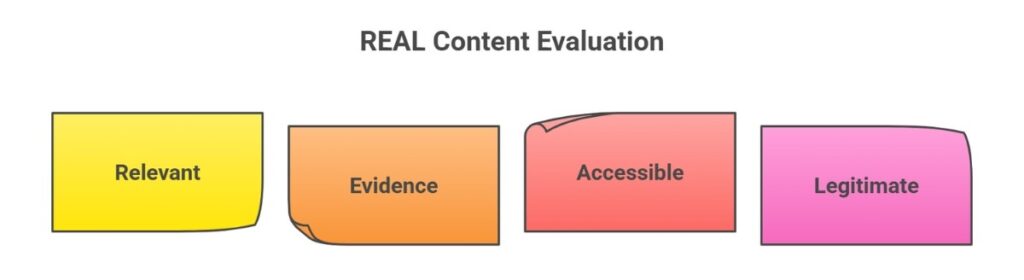
- Relevant: Does the author’s background match the topic? (Experience + Expertise)
- Evidence: Are there real stories, data points, screenshots, or case studies to prove it?
- Accessible: Are the author’s credentials visible? Are the stories easy to follow?
- Legitimate: Are claims backed up? Is the author real and credible? Have any conflicts of interest been disclosed?
Evaluate Your Content Using ‘Who, How and Why’ – Google’s Own Guidance
Google recommends asking three simple questions when creating content: Who, How, and Why. These help you stay aligned with what Google’s ranking systems reward, i.e., authentic, people-first content.
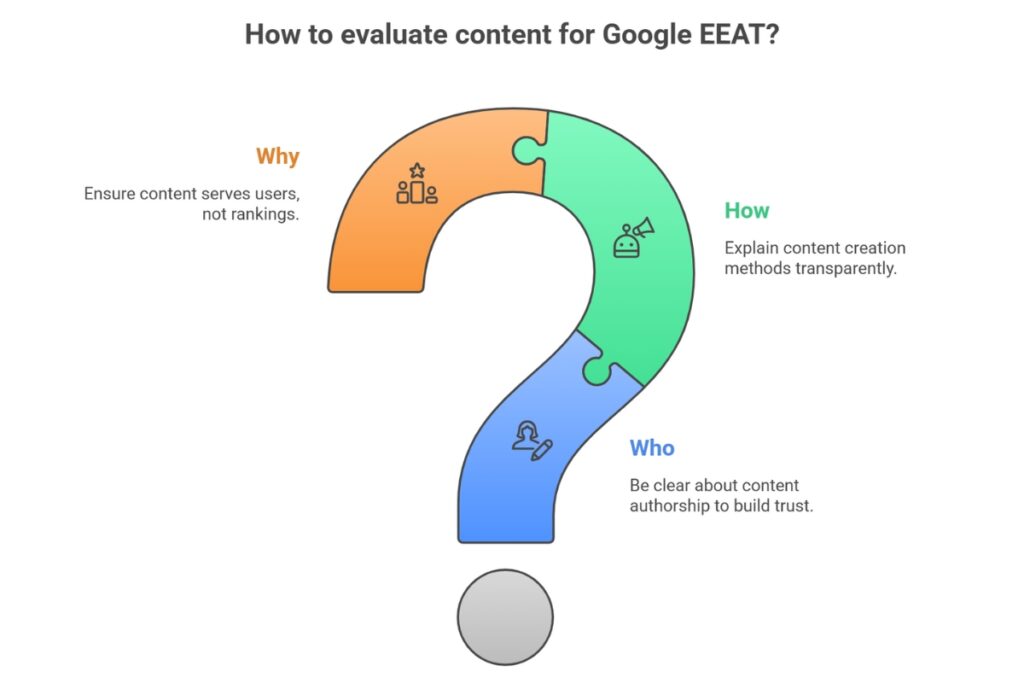
Who
- Be clear about who created the content.
- Add author bylines, short bios, or links to the author’s background.
How
- Explain how the content was created.
- If it’s a product review, mention how many products were tested and what methods were used.
- Describe the role of AI tools transparently, if involved.
- Don’t generate AI content for manipulating search rankings. It violates Google’s spam policies.
Why
- Be honest about the purpose of your content.
- Content should exist to help users, not to manipulate search rankings.
- Content created to serve real people naturally aligns with Google’s E-E-A-T and earns long-term trust.
Also Read: Google’s 2025 Guide: Should You Use AI in Content Creation
7 Google E-E-A-T Best Practices for Content Marketing
1. Put Real People Behind Your Content
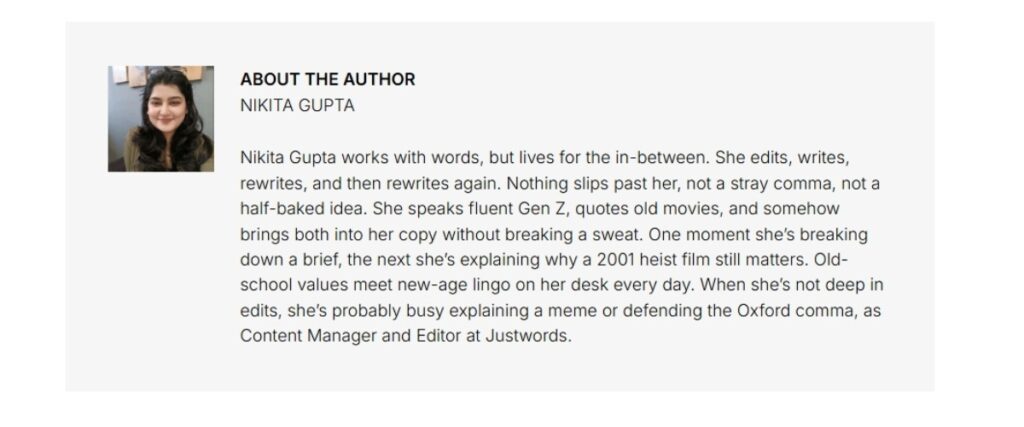
Don’t hide behind the ‘admin.’ Let real experts and experienced voices speak! You can choose people who do the work and know the topic. Then, you can add their author bios in the content byline. It’s because readers and Google both trust humans and not faceless pages.
For example, have a look at how we include the author bio at the end of every blog post:
2. Go Beyond What’s Already Out There
Don’t just copy what’s already ranking! You need to give value by adding what’s missing. The best practice is to bring new data, real results, and expert insights to your content. You can share your own research, lessons, or unique methods to demonstrate practical experience.
3. Build Strong Brand Reputation
People trust reputable brands. So, you need to build a reputation and earn that trust with great products, honest service, and visible reviews. You can leverage various platforms like Yelp, Google, or Trustpilot to proudly display your reviews. Always make sure to be transparent with your customers.
4. Show Business Trust Factors
Before anything else, build trust with the basics first. For an ecommerce website, things like terms & conditions page, privacy policy page, cookie policy page, returns policy page, etc., are a must to add. These details prove that you’re a legit business.
In Google’s words:

5. Fix Your Site’s Technical Health
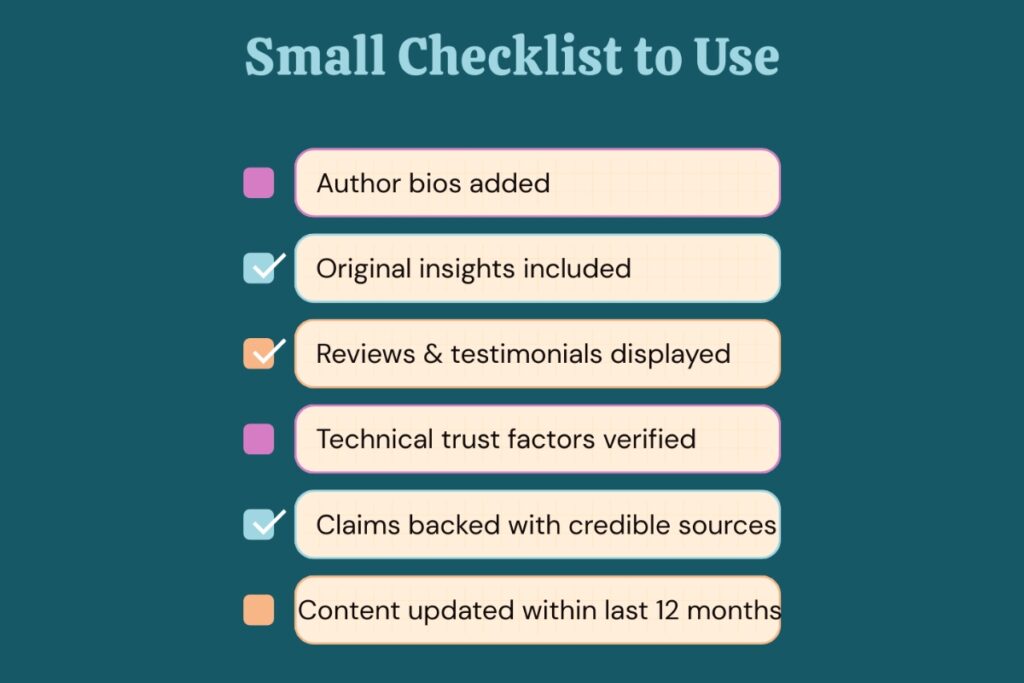
Along with business trust factors, technical trust factors should also be a top priority to strengthen your SEO trust signals. Site vitals like HTTPS security, site speed, mobile responsiveness, UI & UX, and clean navigation can directly impact your content marketing efforts.
6. Back Up Your Claims With Credible Sources
If you’re making any claims in your content, the right approach is to always prove them. You should link to trusted studies, reports, or expert insights. And, if it’s your own data, you should explain how you got it.
7. Update Your Outdated Content With E-E-A-T Elements
Outdated content hurts credibility. Being an expert in the subject, you need to keep your pages fresh and current. Reviewing your articles every 6 to 12 months counts as the best content marketing practice to comply with Google’s E-E-A-T guidelines.
And, DON’T STOP THERE! You should track your content’s performance after these updates with tools like Semrush and Ahrefs to see what’s working and what needs a revisit.
Common Mistakes Marketers Make with Google E-E-A-T in SEO
Let’s now discuss what could damage your E-E-A-T! Building trust takes time. Losing it doesn’t. Google’s Quality Rater Guidelines flag low-quality pages that show weak content or no E-E-A-T. Even one poor page can hurt your site’s credibility.
Below is a list of common E-E-A-T red flags:
- Low-effort, unoriginal, or inaccurate content
- Misleading or clickbait headlines
- Negative online reputation
- Missing author or site details
- Too many distracting ads
- No external mentions or backlinks
You can also take professional help from an SEO agency to audit your website for SEO and fix issues.
Conclusion
With AI-generated content (ChatGPT, Claude, etc.), it’s easier than ever to produce content. But AI cannot replace lived experience or genuine expertise. Google’s E-E-A-T framework is evolving, and experience and expertise now play a critical role in search rankings. As part of Google ranking factors 2025, content that combines both earns user trust and Google’s recognition. Winning in content and SEO in 2025 isn’t about who knows the most — it’s about who’s done it, tested it, and shared it authentically.
FAQ
What is Google E-E-A-T in SEO?
Google E-E-A-T in SEO is about demonstrating the ‘Experience’, ‘Expertise’, ‘Authoritativeness’, and ‘Trustworthiness’ in your content, especially if you’re creating content around YMYL (Your Money, Your Life) topics.
How does Experience differ from Expertise in Google E-E-A-T guidelines?
Experience signals authentic, first-hand insights that resonate with readers, whereas expertise signals credible, skill-based authority that builds trust. Simply put, Experience is about “doing”, while Expertise is about “knowing”.
Why does Google prioritize Experience in 2025?
A greater emphasis on Experience in 2025 reflects Google’s attempt to keep search results human-centred and authentic in an increasingly AI-generated content landscape. Anyone can write ’10 Tips for Baking Bread’ by researching online, but someone who’s been baking for years can share nuanced insights, common mistakes, and practical wisdom.
How can content creators improve SEO with E-E-A-T signals?
Content creators can follow a set of best practices that adhere to Google E-E-A-T guidelines. Always verify that your content demonstrates experience, builds expertise, establishes authority, and enhances trustworthiness.
What are Google E-E-A-T best practices for content marketing?
You can show first-hand experience with original photos, data, and specific details that prove you’ve done what you’re writing about. Build credibility through comprehensive author bios highlighting relevant credentials, cite authoritative sources while ensuring your site is secure (HTTPS) with clear contact information.
Does E-E-A-T affect all types of content equally?
No, E-E-A-T has a much stronger impact on YMYL (Your Money or Your Life) content like health, finance, legal, and news topics, where inaccurate information could harm people. However, following E-E-A-T guidelines on any topic signals better content quality and leads to higher chances of ranking.
How do I audit my website for E-E-A-T compliance?
Review your author bios and credentials, check if content demonstrates first-hand experience with original media and specific details, ensure proper source citations and HTTPS security, and verify you have clear contact information and transparent authorship.
You can also compare your content against top-ranking competitors in your niche to identify gaps in expertise demonstration, authoritative signals like backlinks, and trust elements like updated dates and disclosure statements.