- Google I/O 2026 introduced AI search agents, generative SERPs, Gemini Spark, and Universal Cart, which shift Search from a query engine to a system that acts on users’ behalf.
- Search is evolving from a list of links into an AI system that can monitor, compare, recommend, and eventually transact on behalf of users.
- These changes push SEO toward GEO (Generative Engine Optimisation), where content must be structured, trustworthy, and easy for AI systems to extract and cite.
- Ecommerce brands need accurate Merchant Center feeds, consistent product data, and readiness for agent-mediated commerce workflows.
- Brands with strong structured data, expert-led content, accurate product feeds, and consistent information across the web are likely to benefit most from the shift.
Google I/O happens every year. But most years, it involves incremental model upgrades dressed in keynote language.
This year was different. Google I/O 2026 wasn’t a set of feature announcements. It was Google laying out, with unusual clarity and specificity, the architecture of how search, content discovery, and online commerce will work from here.
The headline from CEO Sundar Pichai: “We’re firmly in our agentic Gemini era.” What that means in practice is that Search is evolving from a tool you query into a system that acts. It will compare, monitor, book, and dynamically build interfaces in real time, all without the user necessarily clicking through to your site.
If you are working on SEO, content, or digital strategy for your brand, you need to understand what was actually said and what it means for how you work.
In this blog post, we present the full picture: the announcements, the numbers, what’s already live, what’s coming, and the concrete actions that separate the brands that will adapt well from the ones that won’t.
The Scale of What’s Changed
Let’s start with the numbers, because they establish the stakes.
According to Google CEO Sundar Pichai, AI Overviews now has over 2.5 billion monthly active users. AI Mode, launched just one year ago, has already surpassed 1 billion monthly active users, with queries more than doubling every quarter since launch. Last quarter, Google Search queries hit an all-time high.
Read that again. Search volume is increasing, not declining, as AI takes over more of the interface. People aren’t searching less because AI answers their questions. They’re searching more because AI has made search more capable of actually helping them. What has changed is what a “search” looks like and what a “result” means.
AI Mode queries are getting longer, more conversational, and more multimodal. SEO content optimised for short keyword queries is increasingly out of alignment with how users actually search. The average AI Mode query is now reportedly 2–3x longer than a traditional search. Users have learned to give context, specify constraints, and ask follow-up questions. The query “project management software” has evolved into “what project management tool works best for a remote team with external client access and time zone differences.”
That shift alone rewrites what your content needs to do.
6 Announcements in Google I/O That Actually Matter
1. The Search Box Itself Is Getting Redesigned for the First Time in 25 Years
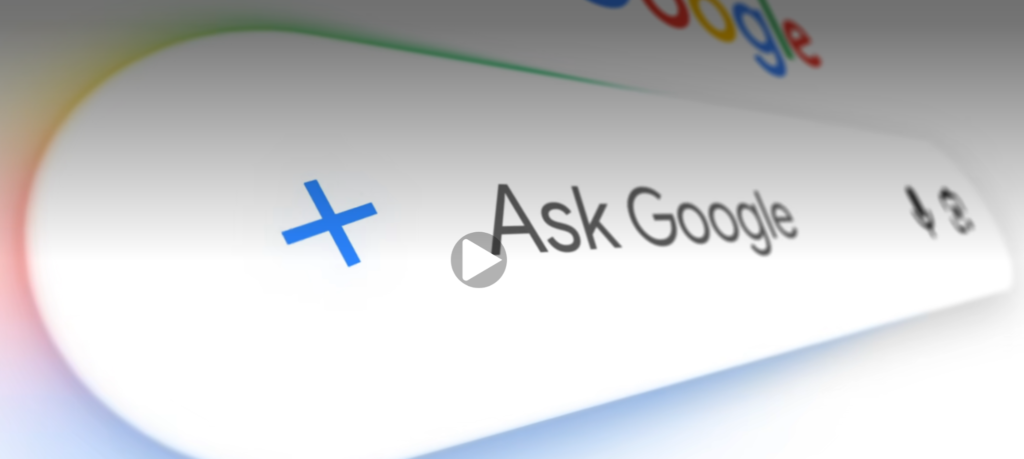
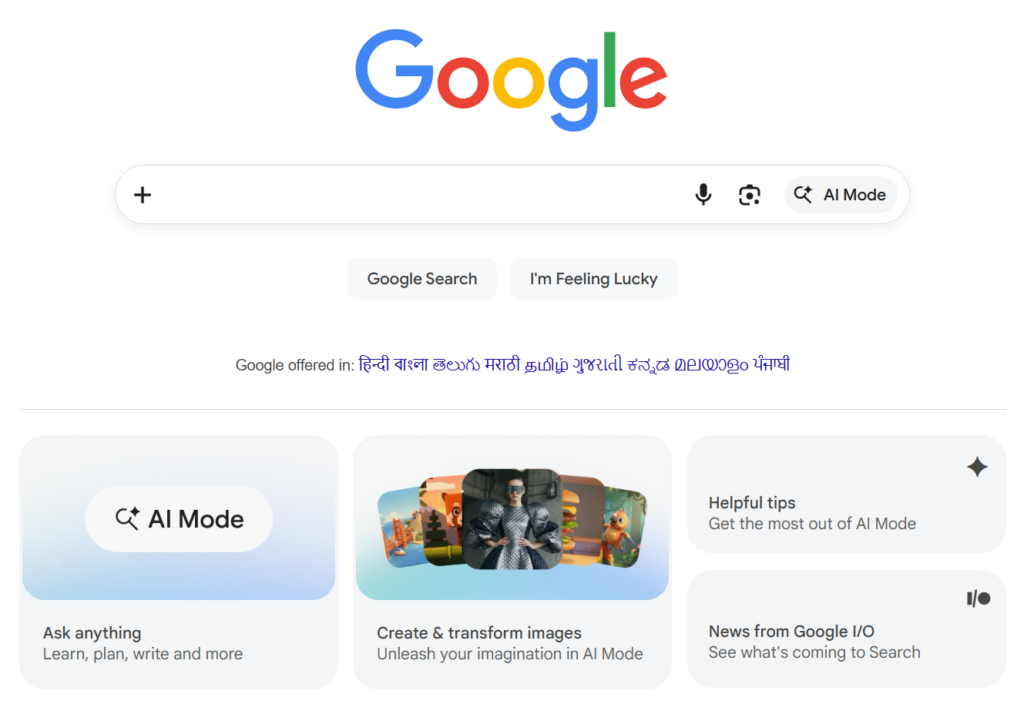
Google introduced the biggest upgrade to its Search box in over 25 years, now completely reimagined with AI. It’s multimodal (accepting text, images, files, videos, and Chrome tabs), dynamically expands to give users space to describe complex needs, and offers AI-powered suggestions that go well beyond autocomplete.
This is much more than cosmetic redesigning. It’s Google training hundreds of millions of users, at the interface level, to ask longer and more specific questions. The SEO implication lands immediately: content built for 3-word queries is structurally misaligned with where user behaviour is being actively steered.
2. Generative UI: The SERP Is Now Built Per Query
With the power of Gemini 3.5 Flash and Google Antigravity, Search can now build the ideal response in the right format for each specific question, completely on the fly. Custom generative UI, including interactive visuals, tables, graphs, or simulations, will be assembled in real-time.
That means the SERP is no longer a fixed canvas. Two users on the same query may see materially different layouts and sources.
For content teams, this means a static audit of “what ranks for our target keyword” is increasingly insufficient. The question isn’t just whether you rank; it’s whether your content is structured in a way that AI can extract, compare, and build with. A beautifully written paragraph that buries the key fact in prose is less useful to a generative UI than a clearly structured table with explicit data points.
For ongoing tasks, such as wedding planning, home moves, or health routines, Search can go a step further, building custom persistent dashboards or trackers. Think of these like mini apps for your own specific tasks, rolling out first for Google AI Pro and Ultra subscribers.
3. Information Agents: Search That Never Sleeps
Google is entering the era of Search agents, starting with information agents that operate in the background 24/7, scanning blogs, news sites, social posts, and real-time data on finance, shopping, and sports, and then sending users synthesised, actionable updates when something matches their specific criteria.
The strategic implication here is significant. Search stops being a session and becomes a standing instruction. A procurement manager sets an agent to watch for supplier pricing changes. A consumer sets one to monitor when a specific property type hits their budget in a target area. A marketer sets one to alert them when a competitor announces a new product.
For high-consideration categories like auto, finance, travel and insurance, this collapses the funnel further into the AI layer. The brands that perform best will be those with the cleanest presence across SERP and answer surfaces.
Information agents need freshness and accuracy above all else. If your pricing page is months out of date or your product features don’t reflect your current offering, agents monitoring your category will miss you and surface competitors who have their information in order.
4. Gemini Spark: The Agent That Acts
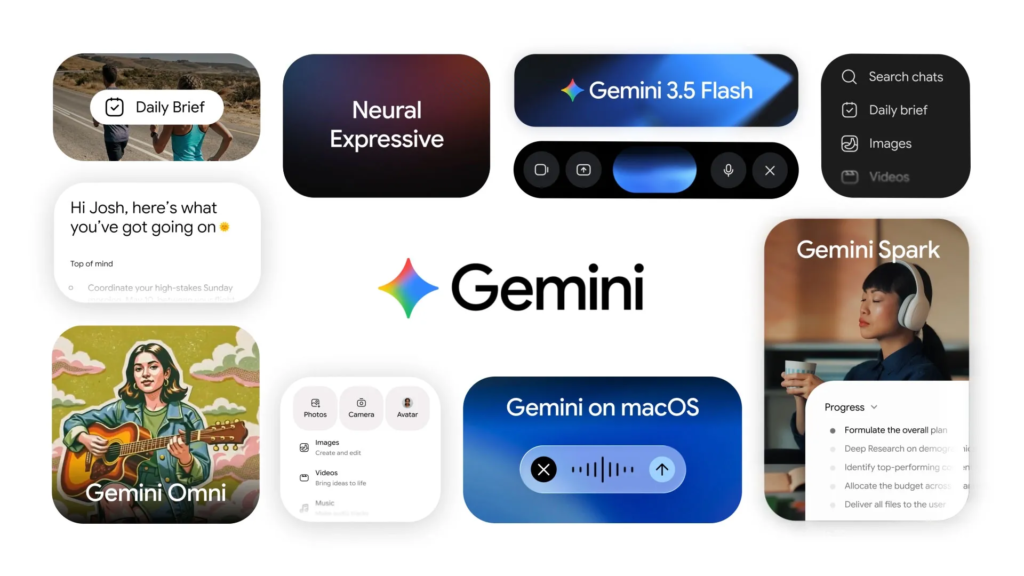
Gemini Spark is Google’s first major consumer agent, a 24/7 personal AI that runs on dedicated cloud infrastructure, integrates with third-party tools via MCP, and will operate inside Chrome as an agentic browser later this summer. Beta lands with US Google AI Ultra subscribers next week.
Down the line, users will be able to text or email Spark directly, create custom sub-agents, and even authorise payments while specifying the budget and merchants.
This is the announcement that marketing teams should be briefed on carefully. An agent that browses, compares, and transacts on a user’s behalf changes the economics of attention fundamentally. The “qualified conversation” may happen between Spark and your product page before any human consciously decides to look. Brand consistency, structured data accuracy, and clear pricing become the variables that determine whether you are recommended or passed over.
5. Universal Cart: Google Owns More of the Purchase Funnel
Universal Cart is an intelligent shopping hub that allows users to add items while browsing Search, chatting with Gemini, watching YouTube, or reading Gmail. The moment a product is added, the cart finds deals, monitors price drops, flags product incompatibilities, and understands payment method perks via Google Wallet.
For many favourite brands, users can check out right on Google in just a few taps with Google Pay, or transfer items straight to the retailer’s site. The Universal Cart runs on Gemini models, so it gets smarter as the models improve.
For e-commerce brands, the message is unambiguous: if your product feed isn’t clean, current, and structured through Merchant Center, you will be invisible in this ecosystem. The cart is now the new storefront.
6. Gemini Omni: Video Generation from Any Input
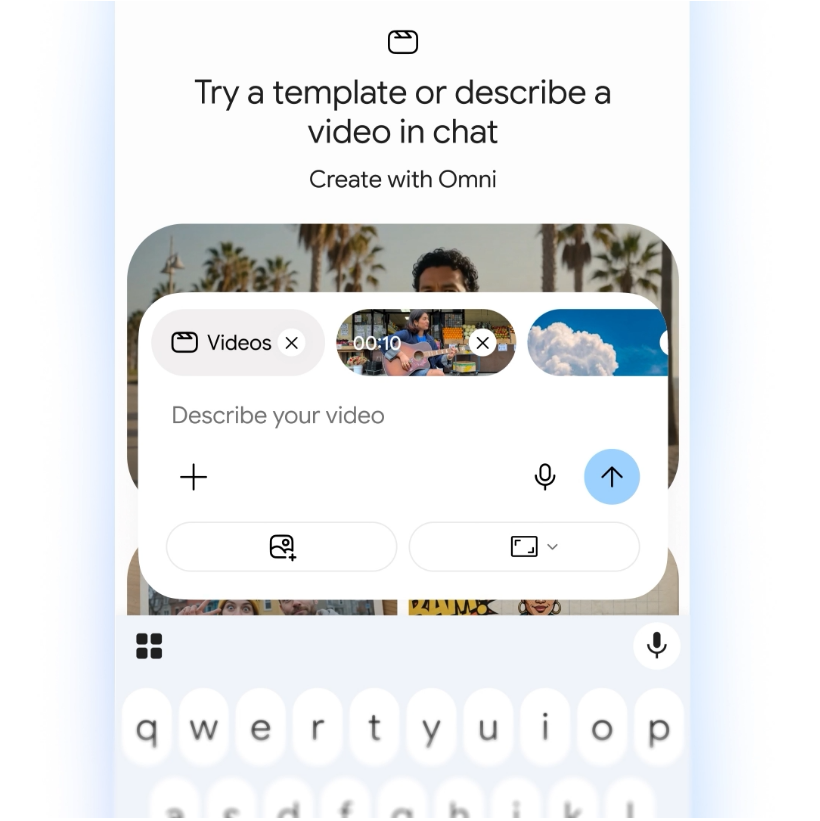
Gemini Omni is a new model that creates anything from any input, starting with video. It combines images, audio, video, and text as input and generates high-quality video grounded in real-world knowledge. It has an improved intuitive understanding of forces like gravity, kinetic energy, and fluid dynamics, allowing more realistic scenes. Every video carries an imperceptible SynthID watermark.
Gemini Omni Flash is rolling out to all Google AI Plus, Pro, and Ultra subscribers globally through the Gemini app and Google Flow, and is also available at no cost in YouTube Shorts and YouTube Create.
For content marketing teams, this cuts two ways:
- The opportunity: Rapid video production for YouTube, Shorts, ads, and product explainers at dramatically lower cost and faster iteration cycles.
- The competitive pressure: Every brand now has this. The volume of video content across the web is about to increase substantially. Differentiation shifts toward brand specificity, human editorial judgment, and genuine expertise – the things the model can’t bring on its own.
What This Means for SEO: The GEO Shift
The SEO community now has something that’s worth taking seriously: GEO (Generative Engine Optimisation). It means optimising content to be cited, synthesised, and recommended by AI agents, and is distinct from optimising to rank in a traditional SERP.
Content built around question-and-answer structures, comparative claims, and entity-rich passages will absorb more of the new query volume than thin keyword-targeted pages.
SEO strategy needs to move beyond short keyword queries and account for conversational, multimodal, and prompt-based discovery. Websites still matter, but they increasingly need to function as structured data sources for Google, AI systems, product feeds, and brand validation.
Critically, Google has been explicit that traditional SEO fundamentals still apply. To be eligible to appear in generative AI features, a page needs to be indexed and eligible to show in Search. Crawlability, quality content, and E-E-A-T signals remain the foundation. GEO is built on top of SEO, not instead of it.
What’s different is the bar on top of that foundation. Being indexed is necessary but no longer sufficient. Content also needs to be:
- Structured enough to be extracted: AI agents building comparison tables and generative UI need explicit data (e.g., pricing, features, eligibility, trade-offs) stated clearly, not embedded in paragraphs of prose. Schema markup (Product, FAQ, HowTo, LocalBusiness, Review) is how you signal structure to AI systems.
- Specific enough to be cited: Generic content that says what everyone else says won’t be selected as a citation when more specific, evidenced content is available. Original data, named experts, first-hand experience, and documented proof make content citable. Assertions without evidence don’t.
- Deep enough to signal authority: Topical depth across a subject area matters more than individual page optimisation. Google’s source selection favours sites that have demonstrated consistent authority on a topic, not sites that published one well-optimised page. Building interconnected content clusters, with core concept, use cases, comparisons, implementation, FAQ, and case studies, signals genuine expertise to AI systems that traverse across a domain.
- Consistent enough to be trusted: When information agents cross-reference your website against your Google Business Profile, your product feed, your third-party reviews, and your industry directory listings, they’re building a picture of reliability. Inconsistencies in pricing, features, or availability across these surfaces reduce your trustworthiness in the eyes of the systems surfacing you.
What This Means for Content Marketing
The content marketing shift post-I/O 2026 can be summarised in one sentence: the goal is no longer to only rank; it’s to be the source AI trusts.
That changes what you commission, how you brief, and how you measure.
- What you commission changes: Thin content that aggregates what others have said, programmatic content that produces variations of the same article at scale, keyword-stuffed landing pages that say very little – these are the formats that AI systems have the least reason to cite and that face the harshest downside from Google’s increasing focus on information gain. The formats that perform in an agentic search environment are: original research, genuine expert opinion, specific comparison content with honest trade-offs, implementation guides grounded in real experience, and detailed FAQ content that matches actual user questions.
- How you brief changes: Every content brief should now answer two questions before anything about keywords or word count – what specific decision does this content help someone make, and what information would an AI agent need to extract from this page to include it in a useful comparison or recommendation? If you can’t answer those questions, the brief isn’t ready.
- How you measure changes: Some marketing teams are already adding AI Overview citation tracking, brand search volume monitoring, and entity visibility to their standard SEO reporting alongside traditional rankings and traffic. This is a necessary correction for a world where a significant portion of your content’s influence will never generate a click. If your content is being cited in AI Overviews for competitive queries and you don’t know it, you’re flying blind on some of your best-performing assets.
The Off-Site Dimension Nobody Talks About
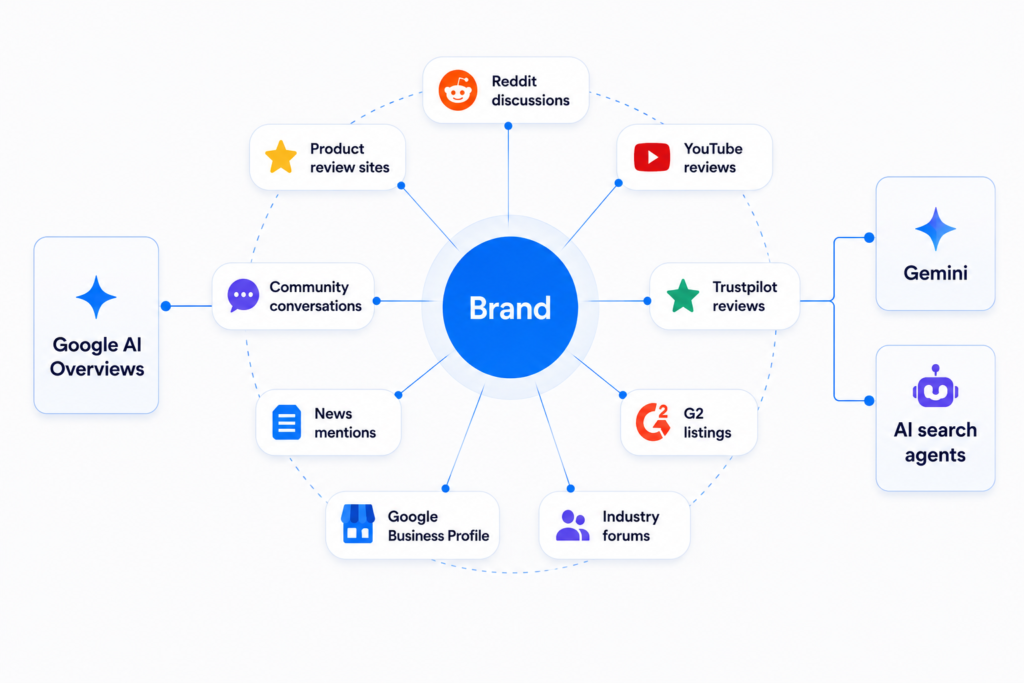
One thing the I/O announcements make clear that most SEO coverage underweights: AI systems scan Reddit threads when constructing answers to research and comparison queries, and brands that show up in upvoted, relevant discussions gain visibility across multiple discovery channels, including Google AI Overviews and other AI search environments.
Information agents monitoring a category don’t just read brand websites. They read everything – reviews, forums, comparison platforms, community discussions. The brand that ranks #1 organically but has a thin or negative presence in community discussions may be outflanked by a competitor with a smaller site but a stronger, authentic footprint in places real users congregate.
This is the “operational truth” concept: your brand’s information needs to be consistent and credibly present not just on your own properties, but across every surface AI systems draw from. Your G2 profile, your Trustpilot reviews, your product mentions on IndiaMART or Clutch, relevant subreddit discussions – these are now part of your SEO surface, whether you’ve thought of them that way or not.
The Content Purge Is Already Happening
The first confirmed core update of 2026 ran from March 27 through April 8. The SEO community’s consensus is that content which synthesises existing information without contributing original analysis, first-hand experience, or depth gets filtered out faster and recovers slower. Publishers that saw gains share a common trait: they were producing content that helped users complete a task or understand a topic fully, not content calibrated to keyword density.
I/O 2026 accelerates this trend by making Gemini 3.5 Flash the default model for AI Search and expanding the surfaces where AI-mediated answers appear. The “content purge” – sites with low information gain losing visibility – isn’t a future scenario. It’s a process that’s actively underway.
A Practical Action Plan
Breaking this into time horizons makes it manageable:
Next 30 Days: Protect What You Have
- Fix your structured data: Run a schema audit across your core commercial pages. Product, FAQ, Service, and LocalBusiness schema are the highest priority. If an AI agent can’t parse what your page is and what it claims, the page is structurally disadvantaged.
- Audit your key facts for consistency: Pick your five most important commercial claims (pricing tiers, key features, service areas, opening hours), and check that they say the same thing across your website, Google Business Profile, and major third-party listings. Fix every discrepancy you find.
- Start citation tracking: Manually run 20–30 of your most important queries in AI Mode. Note which sources are cited in the AI Overview. Whether you appear, how you’re described, and who else is there. This is your baseline.
Next 90 Days: Build the Structural Advantage
- Identify your topical gaps: For your core subject area, map the content you have against the full range of questions users ask at every stage of the decision process. Build a gap list. Create the missing pieces, starting with the highest decision-intent gaps.
- Upgrade your E-E-A-T signals: Add named, credentialed authors to your most important pages. Add first-person experience signals – specific details from practitioners, not generic claims from “the team.” Add original data where you can. Even a small customer survey produces citable first-party evidence that models can’t replicate.
- Develop your decision-format content: Identify two or three queries where your audience is actively evaluating options. Build a genuinely honest comparison page for each. One that acknowledges trade-offs, names real constraints, and helps someone make a better decision. This is the format AI agents cite most reliably.
Next 6–12 Months: Build for the Agentic Web
- Invest in video infrastructure: With Ask YouTube reshaping how video content gets discovered, and Gemini Omni making production cheaper, YouTube is no longer optional for most content strategies. Develop a systematic process for turning your best content into a well-structured video with proper chapter markers, transcripts, and descriptions.
- Expand your off-site presence intentionally: Identify the communities, review platforms, and forums where your category is discussed. Build a genuine, non-promotional presence in them. The brands that are trusted voices in community conversations will be cited when AI systems look for authentic validation.
- Prepare for agent-mediated commerce: If you’re in a transactional category, get your Merchant Center feeds current, your UCP (Universal Commerce Protocol) integration on the roadmap, and your product data consistent across all surfaces. The Universal Cart and agentic booking capabilities are rolling out this summer. Being ready matters.
The Bottom Line
This is not a panic moment. Most of what Google has announced at I/O 2026 is still rolling out, and traditional SEO fundamentals haven’t been thrown out. Google has explicitly said that being crawlable, indexed, and producing useful content is still the baseline.
What these announcements are expected to do is remove the remaining margin for mediocrity. By early 2027, the high-intent buyer journey in categories like software, finance, travel, and real estate will look fundamentally different. More of it will happen inside AI-mediated surfaces – information agents monitoring on behalf of users, Gemini Spark comparing options, Universal Cart tracking prices.
The brands that have always prioritised genuine usefulness (specific, expert, well-structured, factually reliable content) are not facing a crisis. They’re facing a validation. The systems now in place reward exactly what good content has always been supposed to do: help people make better decisions, faster, with more confidence.
The window to get ahead of this (before the agents are fully deployed) is right now. Because the brands building the right content infrastructure today will be the ones getting cited next year.
At Justwords, we help brands build content infrastructure that works in the agentic search era, from structured content strategy to AI visibility audits. Let’s talk if you are figuring out what this transition means for you.
FAQs
1. Is Google making SEO harder after Google I/O 2026?
Google is making SEO more quality-driven and systems-oriented. Success now depends less on keyword targeting alone and more on maintaining trustworthy, consistent information across your website, feeds, reviews, and business profiles. Low-value, repetitive content is becoming easier for Google to filter out.
2. Is traditional SEO dying because of AI Overviews and zero-click searches?
No, but the role of SEO is changing. AI Overviews and AI Mode reduce some clicks by answering questions directly in Search. Yet overall search behaviour is expanding as users ask longer and more complex questions. Visibility, citations, and trust are becoming as important as traffic itself.
3. How can brands gain visibility in AI search (like Gemini or ChatGPT)?
Brands need content that AI systems can easily extract, verify, and compare. That means stronger structured data, detailed expert-led content, clear product and pricing information, and visibility across trusted platforms like YouTube, Reddit, review sites, and industry communities.
4. What is an Information Agent in Search?
Information Agents are AI systems that continuously monitor topics on a user’s behalf instead of waiting for someone to search repeatedly. They can track things like product launches, pricing changes, travel deals, or industry updates and proactively surface relevant information.
5. How will AI Search and agentic browsing impact search ads?
Search ads won’t disappear, but AI systems will increasingly mediate how users discover products and services. More comparisons and purchase decisions may happen inside AI experiences before users ever visit a website or click a traditional ad.
6. Is SEO becoming more about branding than just rankings?
Increasingly, yes. AI systems evaluate reputation across multiple surfaces, including reviews, forums, creator mentions, and community discussions. Being recognised as a trusted source is becoming more valuable than simply holding a ranking.