
- Most SEO agencies sound identical in a pitch. The questions you ask (and how they answer) are the only reliable filter.
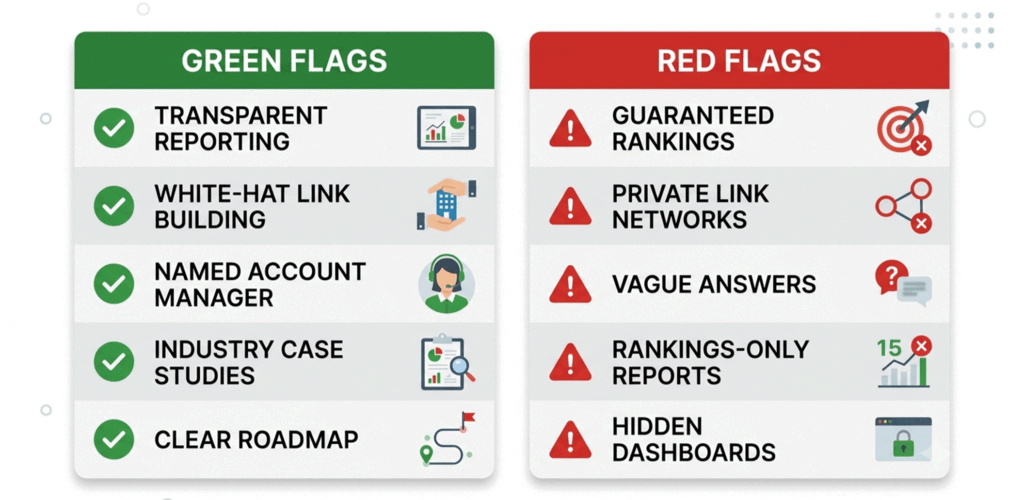
- Never hire an agency that guarantees rankings. Google has explicitly stated this is impossible. Agencies that do are either lying or planning to use tactics that will get your site penalised.
- Ask to meet the people who will actually work on your account.
- Reporting should show organic traffic and lead attribution, not just keyword positions.
- The right agency asks more questions than it answers in the first meeting. That is a green flag.
Why an SEO Agency’s Pitch Tells You Almost Nothing
Every SEO agency has a deck with traffic growth graphs, a list of recognisable client logos, and confident language about strategy, results, and partnership. These things are baseline expectations now. They eliminate the worst options but tell you almost nothing about whether this agency is the right fit for your specific business.
The only way to actually evaluate an SEO agency before signing is to ask pointed, specific questions and know what a genuinely good answer looks like versus what a rehearsed, evasive one sounds like.
That’s why we are not creating an exhaustive checklist of 50 questions. We give below the set of questions that most reliably separate agencies worth hiring from the ones that will only waste 6–12 months of your budget.
The Questions to Ask Before You Choose an SEO Agency
Question 1: “Walk me through exactly what you would do in the first 90 days.”
The first 90 days separate agencies that have a real process from those that improvise. A competent answer is specific: weeks 1 and 2 are a technical audit and competitor gap analysis; week 3 is keyword strategy and content planning; month 2 is first deliverables plus initial fixes implemented; month 3 is a performance baseline with leading indicators. A vague answer such as “the first few months are about setup and research,” with no concrete milestones, is a structural red flag.
One Justwords client who spent $3,000 on SEO reported that his agency “claimed the first 3 months were all about setup” with no tangible deliverables to show for it. That pattern is unfortunately common. A serious agency can tell you what they will deliver and when, before you sign.
Green flag: Specific phases, named deliverables, and a timeline you can hold them to.
Red flag: “SEO takes time” with nothing concrete attached to it.
Question 2: “Show me a case study from a business similar to mine.”
SEO is not one-size-fits-all. The strategies that work for a D2C e-commerce brand are fundamentally different from those that work for a B2B SaaS company, a healthcare provider, or a local services business in Pune. An agency that cannot show you relevant, specific work (ideally in your industry or with a comparable business model) is showing you that they have no proven pattern to apply to your situation.
A healthy retention rate for an SEO agency is 80%+ annually. If clients are consistently leaving after 3–6 months, that is a significant red flag. When reviewing case studies, also ask how long those client relationships lasted. Results that vanished after six months are not results.
Green flag: A case study with real before/after metrics like organic traffic growth, keyword movement, and lead attribution from a business with a recognisable similarity to yours.
Red flag: Generic traffic graphs with no industry context, or case studies that end abruptly with no explanation of what happened next.
Question 3: “Who exactly will be working on my account?”
The bait-and-switch between sales and delivery teams is the most consistent complaint in client-agency relationships across every market, including India.
You meet an impressive senior strategist during the pitch. They understand your industry, ask sharp questions, and paint a compelling picture of what is possible. Then, three weeks after signing, a junior account manager you have never spoken to is running your campaigns. Many agencies overload account managers with 30 to 50 clients each. At that volume, no individual client gets meaningful strategic attention.
Ask to be introduced to the specific people who will handle your account before you sign. Ask what their experience level is, what other accounts they manage, and what happens to your account if that person leaves. If the agency cannot answer this clearly, the answer is telling.
Green flag: Named people, specific roles, and a clear explanation of who owns strategy versus execution on your account.
Red flag: “Our team will handle it” with no names, no introductions, and no clarity on seniority.
Question 4: “What does your link-building approach look like?”
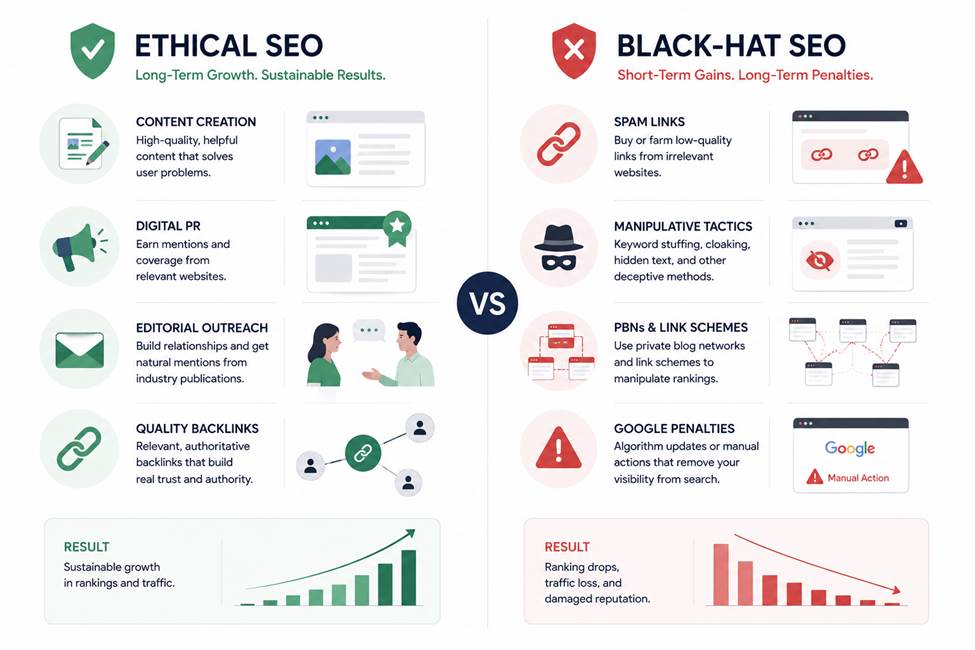
Link building is where agencies most commonly cut corners. Because good link building is slow, relationship-driven, and genuinely difficult. Bad link building is easy to fake and quick to sell.
When you ask an agency how they plan to improve your rankings, and they respond with “that is our proprietary process” or “we use a special network,” walk away. Legitimate agencies explain their methodology because they know the value is in execution, not in hiding information. If an agency cannot tell you where your backlinks will come from, the quality of those sources, and how they vet them, they are almost certainly buying low-quality links from networks that will eventually trigger a penalty.
What you want to hear: editorial outreach, digital PR, guest content on genuinely relevant publications, and creation of linkable assets. What you do not want to hear: “we have a network of sites,” “directory submissions,” or anything that sounds like volume over relevance.
Green flag: A specific, explainable methodology with examples of the kinds of sites they target for your category.
Red flag: Proprietary language, vague promises about “authority links,” or any mention of bulk link packages.
Question 5: “What are you reporting on and what does a bad month look like in your reports?”

An agency that only reports keyword rankings is optimising for the metric that makes them look best, not the metric that tells you whether the engagement is actually working. Rankings move constantly and are not a reliable indicator of business outcomes.
Reporting should cover organic traffic (volume and trend), traffic quality (bounce rate, time on page, pages per session), conversions from organic (leads, form fills, calls), and month-on-month change with clear commentary on why. Ask specifically what they do when a tracked keyword drops significantly, or when traffic plateaus.
An agency that doesn’t provide clear monthly reports on KPIs is a major red flag. A true partner gives you full access to your own data. That access is important because your Google Analytics, Search Console, and any dashboards built during the engagement belong to you, and not the agency. If an agency creates reporting systems that you cannot access independently, that is a control problem.
Green flag: Traffic, conversions, and revenue attribution in a report you can read and query independently.
Red flag: Rankings-only reporting, dashboards you cannot access, or explanations that require the agency to interpret everything for you.
Question 6: “What would you tell us NOT to do, or where would you NOT spend budget at our stage?”
This is the most underused question in SEO agency evaluations and often the most revealing.
An honest agency tells you what’s not worth your money at your stage. If they try to sell you everything on the first call, they are optimising for their revenue, not your results. A good answer sounds like: “Local SEO isn’t relevant for your SaaS model” or “Your technical SEO is fine, the real gap is content.”
An agency that can name a specific service they would not recommend for you (and explain why) is demonstrating strategic honesty. One that responds to every question with a more comprehensive package is demonstrating something else.
Green flag: “Given where you are, we would prioritise X over Y because…” with a clear, reasoned explanation.
Red flag: An answer that touches every service they offer, with no trade-offs acknowledged.
The One Non-Negotiable: Guaranteed Rankings
No legitimate SEO agency guarantees specific rankings. Google has stated this in their own guidelines.
Only 30% of penalised websites recover their previous rankings within one year. An agency guaranteeing position 1 is either planning to use tactics that risk a Google penalty (one that may take years to recover from) or simply saying what you want to hear to close the deal. Either way, it is the fastest way to identify an agency you should not hire.
A credible agency will promise to improve your organic visibility, traffic, and lead generation using ethical, documented methods. They will not promise a specific rank on a specific date.
What the First Meeting Should Feel Like
Here is the most underrated signal of all: a good SEO agency asks you more questions in the first meeting than it answers.
What are your primary business goals? Who are your actual competitors (not just the ones you think about, but the ones ranking for your keywords)? What does your current organic traffic look like? What has been tried before and what happened? Where does most of your revenue actually come from?
An agency that skips this and moves straight to the pitch is telling you they already know what they plan to do, regardless of your situation. That is the exact opposite of a strategic partner.
Conclusion
Choosing the best SEO agency is about finding the agency whose process, transparency, and track record hold up under specific, direct questions.
The questions above are designed to surface the things that determine whether an SEO engagement actually works: a real process, honest reporting, the right people on your account, ethical methodology, and a strategic approach calibrated to your actual business.
If an agency can answer all six of these questions clearly, with specificity and evidence, that is a very good sign. If it cannot, no amount of impressive client logos should override that.
FAQs About Hiring an SEO Agency
1. How do I choose the right SEO agency in India?
To choose the right SEO agency, ask for industry-relevant case studies, meet the people who will work on your account, verify their link-building methodology is white-hat, and confirm reporting covers traffic and conversions, not just rankings.
2. What questions should I ask an SEO agency before hiring?
The most revealing questions are: what happens in the first 90 days, who works on your account, how they build links, what they report on, and what they would advise you not to spend budget on. Vague or evasive answers to any of these are a red flag.
3. Is it a red flag if an SEO agency guarantees rankings?
Yes, unambiguously. Google’s guidelines explicitly state that no one can guarantee rankings. Agencies that do are either planning black-hat tactics that risk a penalty or making a promise they cannot keep.
4. How long should an SEO contract be?
Avoid long-term contracts with no exit clause. A credible agency will offer a minimum commitment of 3–6 months (enough time to show early results) with a clear exit process. A 12-month lock-in with no performance clause benefits only the agency.
5. What should an SEO agency report on each month?
Organic traffic volume and trend, keyword ranking movement, conversions from organic (leads, form fills, calls), and a clear explanation of what changed and why. Rankings-only reports are insufficient.
6. How do I know if an SEO agency is using black-hat tactics?
Ask directly how they build links and what sites they target. If they cite “proprietary networks,” “a network of sites,” or cannot name specific outreach methods, that is a warning sign. Also watch for sudden, dramatic traffic spikes followed by drops; these often signal penalty-prone tactics.
7. What is a realistic SEO timeline in India?
Organic results typically begin to compound between months 4–9, depending on domain authority, competition level, and content volume. Technical fixes and content improvements show early signals in the first 2–3 months. Any agency promising significant results in under 90 days warrants scepticism.
8. Should a small business in India hire an SEO agency?
Yes, small businesses should hire an SEO agency if the alternative is distributing SEO across team members who lack the expertise. The strategic, technical, and content capabilities required for effective SEO are rarely present in a small business’s internal team. The key is matching the agency’s experience and retainer model to your actual stage and budget.