
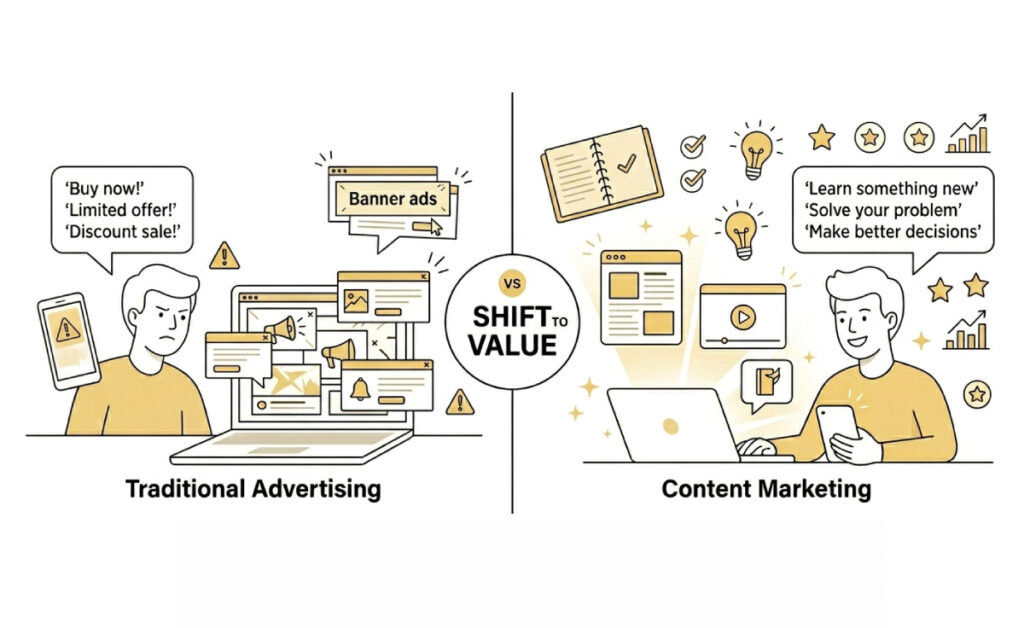
No one likes being sold to. Not in the pushy, interruptive way that traditional advertising perfected over decades.
That is exactly why content marketing has become the default growth engine for businesses that want to earn customers, not buy them. As of 2026, 81% of marketers say content marketing is a core business strategy, and 91% of global brands report using it in some form.
The shift is simple to understand: content pulls customers towards a product or service by consistently answering their questions, solving their problems, and building trust over time. That is the heart of content marketing for businesses. And it explains why so many brands, from solo founders to enterprise marketing teams, are investing heavily in it.
If you are still on the fence about making content marketing a business priority, this post will give you the clearest possible answer, backed by data and real-world experience.
TL;DR
- Content marketing builds trust first, which leads to better conversions.
- It attracts higher-quality leads with stronger intent to buy.
- It delivers long-term ROI through compounding organic traffic.
- It strengthens SEO and visibility, including in AI-driven search.
- It supports all marketing channels and drives sustainable growth.
What Is Content Marketing?
Content marketing is the practice of creating and distributing valuable, relevant content to attract a clearly defined audience with the goal of driving profitable customer action.
It is the opposite of traditional advertising. Instead of interrupting people with a sales message, content marketing earns attention by offering something genuinely useful: guidance, education, entertainment, or expertise.
The content you create should help customers understand their problem, evaluate their options, and make better purchase decisions. When done well, that content also makes clear (without being pushy) that your product or service is the right solution.
Content marketing spans blog articles, videos, podcasts, case studies, email newsletters, social media content, whitepapers, and more. But the underlying principle is consistent across every format: create value first, earn trust second, convert third.
From our 16 years of experience providing content marketing services, we have found that the businesses that get the most out of content marketing are the ones that treat it as a long-term asset, not a short-term campaign. The brands we have seen build the most durable growth are those that committed to content consistently across formats and channels, and stayed patient long enough to let it compound.
Benefits of Content Marketing: 9 Reasons Why It Should Be a Business Priority
Below, we list the reasons why you should use content marketing for your business.
1. It Earns the Trust of Your Target Audience Before They Are Ready to Buy
Content marketing works by creating trust first and pulling the audience towards a purchase second.
Here is how it works in practice: a brand creates content that directly answers the questions its target customers are asking. By offering genuine value without immediately asking for anything in return, it builds a small but meaningful amount of trust with the reader. That reader comes back. The trust deepens. And eventually, when they are ready to buy, your brand is the one they already know and respect.
In a business, trust is the cornerstone. If you have a customer’s trust, you have the customer.
According to Content Marketing Institute, content marketing drives 3 times as many leads on average as traditional marketing, and costs 62% less to execute. Those figures reflect the trust advantage: inbound leads who arrive through content already understand your offering and come with higher purchase intent than someone who clicked an ad.
83% of B2B marketers say content marketing helps build brand awareness, while 77% credit it with generating demand and leads.
2. It Improves Lead Quality and Conversion Rates
All businesses want good leads. But not all leads are equal. A cold lead who clicked on a paid ad has very different purchase intent from a warm lead who found your brand by reading your content, came back to read more, and signed up for your newsletter.
Content marketing generates more of the second type.
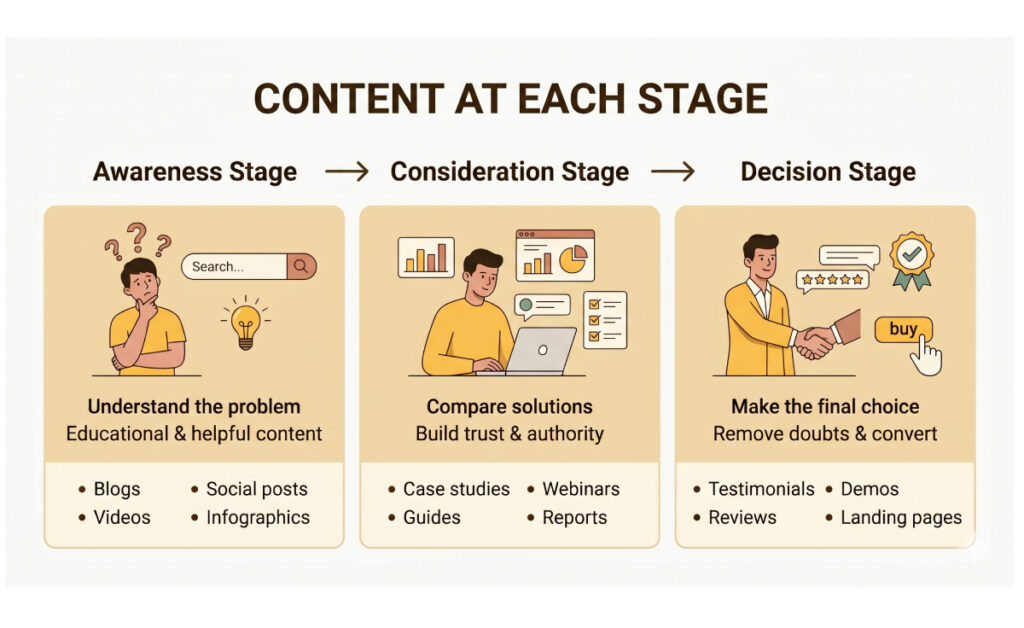
A well-designed content marketing strategy creates content for every stage of the buyer’s journey:
- Awareness Stage: The buyer has identified a problem and is searching for solutions. They are not ready to buy yet. Content here should educate, inform, and help. Avoid anything overtly promotional. Your goal is to enter their consideration set by being genuinely useful.
- Consideration/Evaluation Stage: The buyer is now researching and comparing options. They want specific information rather than general guidance. This is where you start presenting your product or service in more detail, helping them understand why your approach is the right one.
- Decision Stage: The buyer is ready to purchase and is scrutinising their final options. Content here should build confidence: case studies, testimonials, comparisons, and detailed product information that answers last-minute objections and reassures the buyer that they are making the right choice.
A great content strategy does not stop at purchase either. Post-purchase content (onboarding guides, tips, community content) builds loyalty and increases lifetime customer value.
According to Hubspot, brands with active blogs generate 68% more leads per month. Buyers often read a company blog during purchase evaluation. This means your content is actively influencing buying decisions, whether you are present in that moment or not.
3. It Delivers Better ROI Than Paid Advertising Over Time
Should you invest in paid ads or content marketing? The honest answer is: both have a role. But if your budget is limited, content marketing delivers compounding returns that paid advertising simply cannot match.
Paid advertising generates results immediately and stops the moment you stop paying. It is a tap that runs when you turn it on and dries up when you turn it off. For businesses without large, sustained budgets, that is a fundamental structural problem.
Content marketing, by contrast, is an asset. A well-written article that ranks on Google continues to attract traffic and leads months or years after it was published. The ROI compounds over time as your content library grows and your domain authority increases.
The average content marketing budget has increased to 26% of overall marketing spend in 2025, reflecting recognition of its long-term value even among cost-conscious businesses.
The long-term model is straightforward: invest in quality content, earn organic rankings, generate consistent traffic, and convert that traffic into leads and sales without paying Google for every click.
For one of our clients, a workplace injury management startup, we invested in research-driven blog content targeting the specific questions their customers were searching for. Many of those posts now generate thousands of monthly visits consistently. That traffic did not exist before content marketing, and it continues compounding without ongoing ad spend.
4. It Amplifies the Performance of Your Other Marketing Channels
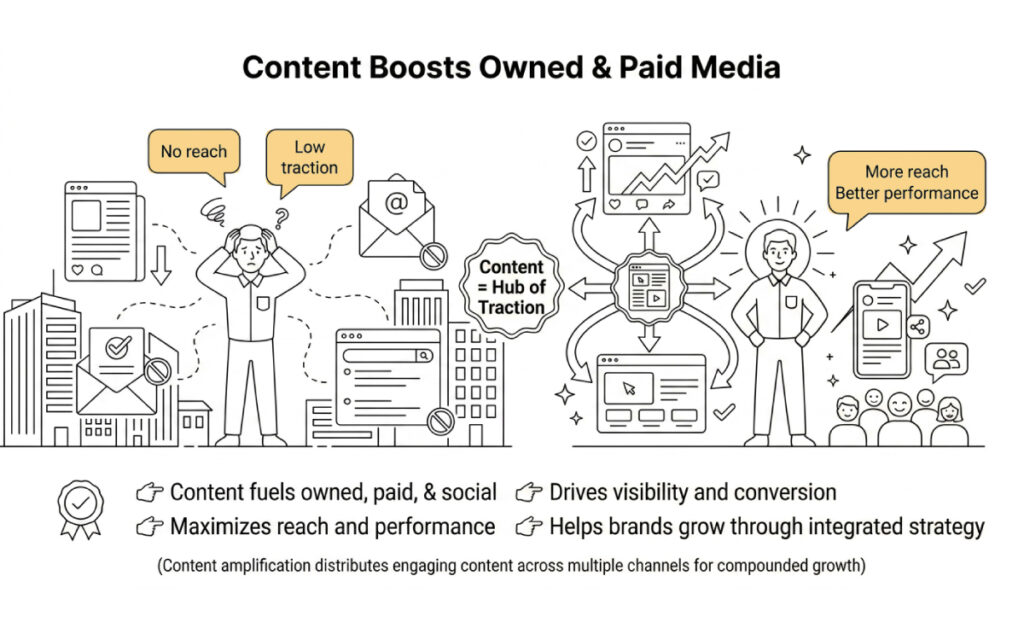
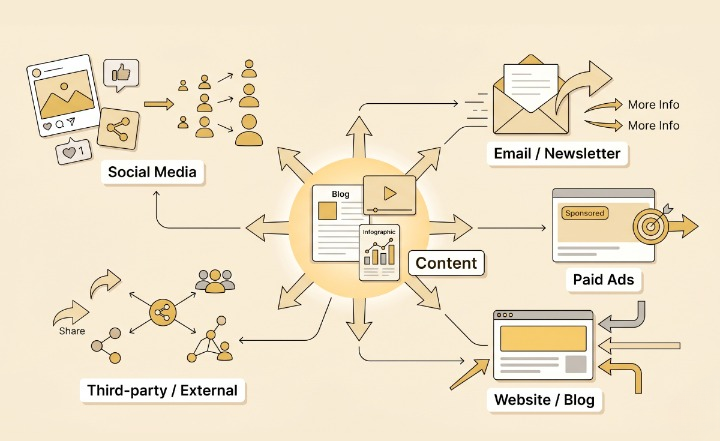
Content marketing does not operate in isolation. Every piece of content you create becomes fuel for your other marketing channels.
A well-researched blog post becomes the basis of an email newsletter, a LinkedIn article, a series of social media posts, a short video, and a paid ad creative. The content does not just generate direct traffic. It makes every other channel more effective.
This multiplier effect is one of the most underappreciated benefits of content marketing. When you invest in quality content, you are building marketing infrastructure that your entire team can use across channels (social, email, paid, PR) to create more reach and better results from the same asset.
89% of B2B marketers use social media platforms to distribute their content, treating content as the foundation that powers their social strategy, rather than producing social content separately.
5. It Builds Domain Authority and Improves Search Rankings
Domain Authority (DA) is a measure of how credible and authoritative your website is in the eyes of search engines. A higher DA helps your pages rank faster, and rank higher, than those of competitors with lower authority scores.
Content marketing is one of the most effective ways to build domain authority over time. Here is the simple model:
Quality content → Backlinks → Higher DA → Better rankings → More organic traffic
When you consistently publish authoritative, well-researched content, other websites link to it. Those backlinks signal to Google that your site is a trusted source in your niche. Your authority compounds over time, making every future piece of content easier to rank.
Google uses over 200 factors to rank websites. But two consistently dominate: high-quality content and link-building. Content marketing addresses both simultaneously.
| Remember: Creating more content does not automatically mean better rankings. Quality and strategy matter far more than volume. Content marketing has three interdependent components – strategy, creation, and distribution. Skipping any one of them limits the whole. |
6. It Helps You Understand Your Customers More Deeply
One of the most underrated benefits of content marketing is the data it generates about your audience.
When you publish content and measure its performance, you learn which topics your audience cares about most, which formats they prefer, which questions they are actively asking, and at which stages of the buyer journey they are engaging with your brand.
That insight is invaluable. It tells you whether you are targeting the right buyer personas, whether your content is meeting real search intent, and where the gaps in your content strategy are. It also shows you which content types are driving conversions so you can invest more in what works and stop producing what does not.
Data from your content marketing programme is, in effect, market research that is generated continuously and at no additional cost.
7. It Directly Supports Your SEO & AEO Strategy
SEO without content is not a strategy. It is a framework with nothing inside it.
Google’s core goal is to match the right content with the right user at the right moment. To do that, it needs pages on your site that are relevant to the queries your customers are searching for, structured in a way that is easy to crawl, and authoritative enough to rank above competitors.
Content marketing produces all of that systematically and at scale.
The key is building content around genuine search intent, not just keywords. In 2026, the top two frustrations among content marketers are getting content to rank (77.6%) and meeting user and search intent (70.6%), which means the brands that get both right have a significant competitive advantage.
Google’s Helpful Content system and E-E-A-T guidelines place more weight than ever on content that demonstrates real experience, expertise, and trustworthiness. Content marketing that meets those standards does not just rank; it holds its rankings against competitors who are producing thinner, less authoritative content.
There is also the dimension of AEO (Answer Engine Optimization). Google AI Overviews, Bing Copilot, ChatGPT and AI-powered search tools now pull content from across the web to generate direct answers. The content that gets cited in AI-generated answers is authoritative, well-structured, and deeply relevant to the query. Content marketing, done properly, is exactly what positions your brand for that visibility.
8. It Builds a Strong, Positive Brand Reputation
Customers form opinions about brands long before they are ready to buy. Content marketing gives you the opportunity to shape that opinion proactively, and on your own terms.
As stated before, 83% of marketers say they increased brand awareness with the help of content marketing. That figure reflects a simple truth: when you consistently publish useful, high-quality content, people begin to associate your brand with expertise and helpfulness – two qualities that directly influence purchase decisions.
About 70% of customers say they prefer to learn about a brand through its content rather than through advertising. When a customer discovers your brand through a genuinely helpful article, they carry a very different perception of you than a customer who saw your display ad. The content-first introduction creates goodwill that advertising cannot manufacture.
That goodwill compounds into loyalty. And loyalty, in a competitive market, is the most durable competitive advantage there is.
9. It Levels the Playing Field for Small Businesses
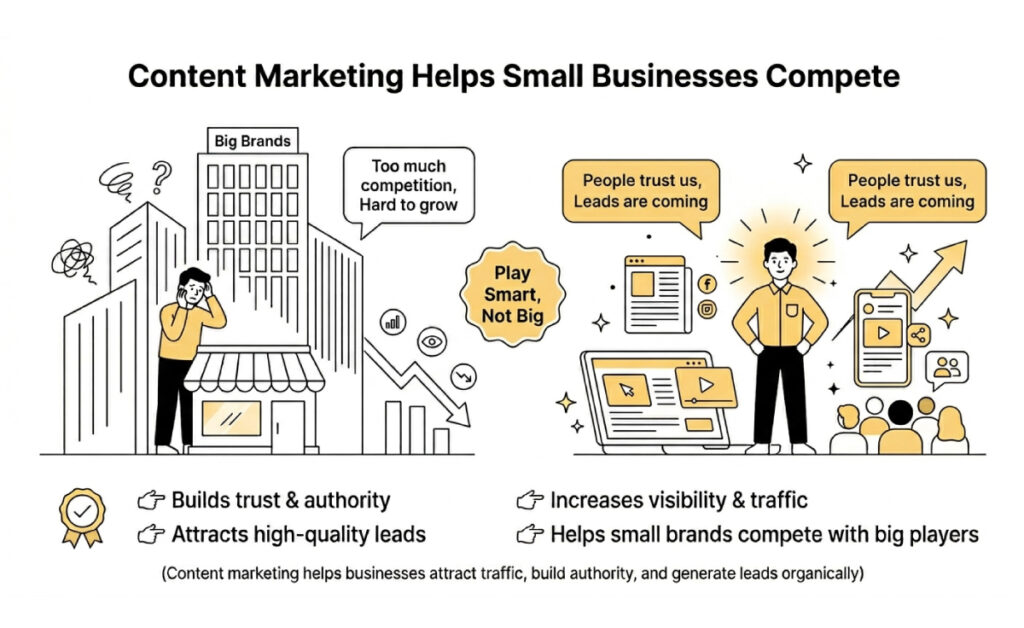
If you are a small business competing against larger, better-funded competitors, content marketing is one of the most powerful equalisers available to you.
Big brands have bigger ad budgets. But they do not necessarily have better subject matter expertise, deeper customer relationships, or more authentic voices. Content marketing lets you compete on those dimensions, not on budget.
Among small businesses, content marketing usage rose to 78% in 2025, a recognition that content is the most accessible, highest-leverage growth channel for brands that cannot outspend their competition.
A small business that publishes genuinely expert, specific, useful content can outrank a large competitor for high-value search queries. A local brand with a strong content voice can build the kind of customer trust that no amount of paid advertising can replicate.
Content marketing allows even the smallest brands to:
- Build online visibility that grows over time without requiring continuous ad spend.
- Establish authority in a niche where larger competitors are less specific.
- Demonstrate the values, culture, and uniqueness of the business in a way that differentiates it authentically.
- Shorten the sales cycle by pre-educating and pre-qualifying buyers before they ever contact you.
A real example from our work:
We worked with a small electronics repair startup starting from 2019 and built a content programme around the specific, technical questions their customers searched for most. The biggest challenge was making highly technical content accessible to everyday readers. Our approach: informational content targeting search-intent keywords, transactional content pushing readers toward a conversion, and brand storytelling reflecting the company’s unique culture and service quality. Many of those articles now generate consistent monthly traffic, and the brand has built the kind of online authority that took its larger competitors years to achieve through other means.
Our approach to content marketing:
The approach here was to create content that was based on informational keywords, transactional keywords and brand concepts. The intent of the first two was to get in traffic, and conversions while the last was about creating stories reflecting the brand’s value, culture, uniqueness.
An advantage of working with a client like this was that it solved a very specific (and painful!) customer problem. Prospective customers are always looking for valuable information on how to repair their phones online or to learn more about what to do when their devices are not working anymore. Research shows that customers instinctively trust the brands that offer them knowledge-driven content. This is where we knew research-driven blogs would help establish trust and eventually convert the visitor to a lead.
We decided to create extremely rich blogs that offered value, knowledge, and useful information to the target audience. We then focused on distributing these blogs through social media and other channels. Over time, this helped us build authority and credibility for our client, which led to higher rankings and more leads. Many of these blog posts have done exceedingly well with 1000+ views every month.
What Does a Good Content Marketing Strategy Look Like?
Content marketing is not just about writing blog posts. A complete content marketing strategy has three components. And skipping any one of them limits the whole:
- Content Strategy: Defining your target audience, their buyer journey, your content pillars, keyword and topic research, and the formats best suited to each stage. Strategy comes first. Content created without it is just noise.
- Content Creation: Producing high-quality content that genuinely serves the search and information needs of your audience at each stage of the journey. Quality always beats volume. One excellent article outperforms ten mediocre ones.
- Content Distribution: Actively getting your content in front of the right audience through SEO, social media, email, paid amplification, and earned media. Publishing without distribution is one of the most common (and costly) content marketing mistakes.
Companies with a documented content strategy see 33% higher ROI than those without one. That gap reflects the difference between businesses that treat content as a strategic asset and those that treat it as a creative exercise.
Bottom Line
Content marketing is not a trend. It is the most sustainable, highest-leverage approach to growing a business online. And its importance is only increasing as paid advertising becomes more expensive and AI-generated content makes genuine expertise rarer and more valuable.
The global content marketing industry is forecast to reach $107.5 billion by the end of 2026, a figure that reflects how seriously businesses of all sizes are treating it as a growth driver.
The brands that win with content marketing share three things in common: they invest in quality over volume, they stay consistent over the long term, and they treat content as a strategic business asset rather than a marketing afterthought.
If you are ready to explore what content marketing can do for your business, start with a clear strategy. Know your audience, understand their journey, and create content that genuinely serves them at every stage.
Not sure where to begin? The Justwords team has been building content marketing programmes for businesses for over 16 years. Talk to us, and we will help you find the right starting point.
Frequently Asked Questions About Content Marketing
1. Why is content marketing important for small businesses?
Small businesses rarely have the budget to outspend competitors on paid advertising. Content marketing is the great equaliser. It allows smaller brands to build authority, earn search rankings, and attract qualified leads on a fraction of the budget that larger competitors spend on ads. Over time, a well-executed content strategy generates compounding returns that paid channels cannot replicate.
2. Does content marketing really work?
Yes, it works consistently and measurably. Content marketing drives three times as many leads as traditional marketing and costs 62% less. The caveat is that results take time and require a genuine commitment to quality and consistency.
3. Why do businesses need content marketing in 2026?
In 2026, AI-generated content has flooded the internet with low-quality, generic material. That makes genuinely expert, authoritative, well-researched content more valuable and more visible than ever. Google’s Helpful Content system and E-E-A-T guidelines actively reward content that demonstrates real expertise and trustworthiness. Businesses that invest in quality content marketing are better positioned in both traditional search and the emerging landscape of AI-generated answers.
4. How does content marketing help businesses grow?
Content marketing grows businesses by expanding organic visibility, generating qualified inbound leads, building brand authority, and reducing customer acquisition costs over time. Unlike paid campaigns, the returns compound. Each new piece of content that ranks or earns links increases the value of everything that came before it.
5. What are the benefits of content marketing in digital marketing?
Content marketing supports every dimension of digital marketing simultaneously. It improves SEO rankings, generates backlinks, powers social media, feeds email campaigns, and reduces paid advertising costs. It also builds the brand trust and authority that makes all other marketing channels more effective.
6. How does content marketing generate leads?
Content marketing generates leads by attracting targeted organic traffic through search – readers who are actively looking for solutions your business provides. Because they found you through content that answered a real question, these leads arrive with higher purchase intent and convert at significantly better rates than cold outbound leads.
7. How does content marketing improve SEO ranking?
High-quality content gives Google relevant, authoritative pages to match with user queries. It also earns backlinks from other websites, which signal authority to search engines. Over time, a strong content library builds domain authority, which makes every new page easier to rank and helps existing pages hold their positions against competitors.
8. What are the benefits of content marketing for startups?
For startups, content marketing offers a route to visibility without requiring large advertising budgets. It builds brand credibility from the ground up, establishes the founders or team as subject matter experts, attracts early organic traffic, and creates a compounding growth asset that scales alongside the business.
9. How does content marketing increase sales?
Content marketing increases sales by generating higher volumes of qualified leads who arrive with greater purchase intent, shortening the sales cycle by pre-educating buyers, building trust that reduces purchase hesitation, and creating loyalty that drives repeat purchases and referrals.
10. Is content marketing worth it?
For the vast majority of businesses, yes. And particularly over a 2–3-year horizon. The upfront investment in strategy and quality content creation pays back through compounding organic traffic, sustained lead generation, and lower customer acquisition costs. The brands that struggle with content marketing ROI are usually those that underinvest in quality or abandon the strategy before the compounding returns kick in.
11. How long does content marketing take to work?
Most businesses start seeing measurable organic results within 3–6 months of a well-executed strategy in the form of improved search rankings and increased traffic. Meaningful lead generation impact typically builds over 6–12 months. The full compounding effect of a strong content library, where rankings, authority, and traffic all reinforce each other, generally becomes clear within 12–24 months.
12. What are examples of content marketing formats?
Content marketing formats include blog articles, long-form guides, case studies, video tutorials, podcasts, email newsletters, infographics, webinars, social media content, and whitepapers. The best examples solve a specific customer problem in a specific format. For instance, a detailed repair guide from an electronics brand, a how-to video series from a software company, or an in-depth industry report from a B2B consultancy.