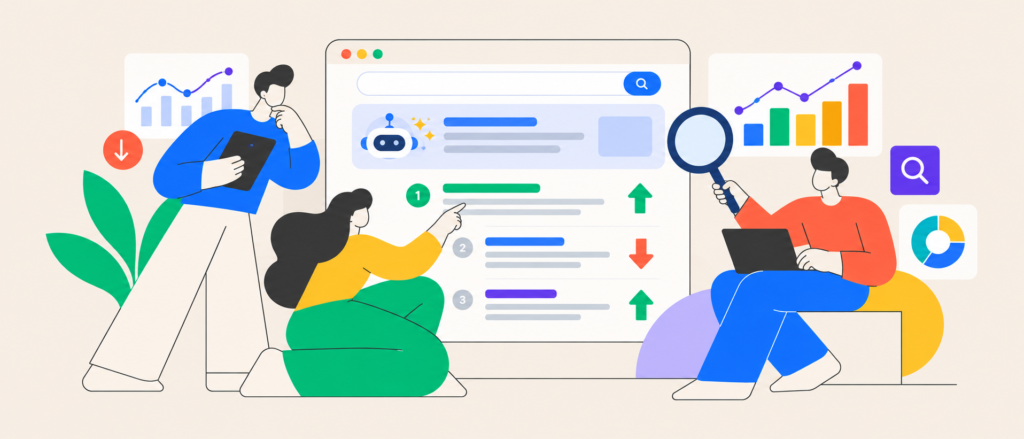
AI search visibility is no longer simply an extension of ranking well on Google. To get your brand mentioned, recommended, or cited in AI-generated answers, you need to make it easier for AI systems to understand who you are, what you are known for, and why your brand and content are credible.
That means building clear entity signals, genuine topical authority, evidence-rich and answer-focused content, and a credible third-party presence across the web. It also means understanding how different AI search experiences (from Google AI Overviews to ChatGPT, Perplexity, and Gemini) discover and evaluate information.
The terminology around this is still evolving. AIO, GEO, and AEO describe overlapping approaches to improving how brands and content appear in AI-generated answers. They are not three completely separate playbooks, and much of the underlying work is an evolution of good SEO and content marketing.
What has changed is the search environment. The overlap between Google’s top-10 organic results and AI citations has dropped from 75% in mid-2025 to 17–38% in early 2026. Ranking first on Google is therefore no longer a reliable guarantee to get AI visibility.
In this guide, we break down what AIO, GEO, and AEO actually mean, what the research says about the signals that influence AI citations, and the practical steps brands can take to improve their visibility across AI search platforms.
|
What AIO, GEO, and AEO Mean (And How They Differ)
The three acronyms describe overlapping approaches to the same problem: getting your brand cited, mentioned, or recommended in AI-generated answers.
Here’s what they mean:
- AEO (Answer Engine Optimisation) is about structuring your content so AI systems can extract it as a direct answer. Think Google AI Overview citations, featured snippets, and voice search responses. The work happens at the content level: how a page is structured, how directly it answers a question, how easily a passage can be pulled and cited without additional context.
- GEO (Generative Engine Optimisation) focuses on being synthesised and cited inside AI-generated responses from ChatGPT, Gemini, Perplexity, and Claude. Unlike AEO, which is largely about on-page structure, GEO is heavily off-site: your brand’s presence across the web, third-party mentions, community discussions, and the consistency of how you are described across external sources.
- AIO (AI Optimisation) is the broadest frame. It includes any ongoing work for making sure AI systems understand who your brand is, what category it belongs to, and why it should be trusted enough to get recommended. Entity clarity, schema markup, and Knowledge Panel accuracy are central here.
In practice, these three overlap significantly. A piece of content built for AEO (structured, answer-first, evidence-rich) will also perform better in GEO. A brand with strong AIO signals (clear entity, consistent description) gets cited more confidently in both. Think of them as layers, not silos.
As Lily Ray, VP of SEO Strategy and AI Research at Amsive, put it: “The overlap with what we have been doing in the SEO space and digital marketing space before AI search existed is very, very strong.”
In other words, many GEO tactics are not entirely new. They are evolutions of the same principles that have long underpinned effective SEO. The key difference lies in where you build those signals and how deliberately you structure information so AI systems can discover, understand, extract, and cite it.
Why AI Search Visibility Matters Even When Traffic Is Small
AI referral traffic currently makes up around 1% of total sessions across most sites (Conductor, 2026, 3.3 billion sessions analysed). That sounds negligible. But the conversion rate changes the calculation entirely.
ChatGPT visitors convert at 14–16%. Perplexity at around 10.5%. Claude at around 16.8%. But Google organic averages just 1.76%. An AI-referred visitor is roughly 8–10 times more likely to convert than a standard organic search visitor.
Beyond direct traffic, AI visibility is increasingly a brand discovery channel. When someone asks ChatGPT which agency to use for content marketing, or asks Perplexity which accounting software suits a small business, the AI’s answer shapes the consideration set before the buyer visits a single website. Not being in that answer means not being considered, regardless of your organic rankings.
How to Improve Your Brand’s AI Search Visibility
1. Entity Clarity: The Foundation Everything Else Builds On
Before an AI system can recommend your brand, it needs to understand what your brand is. This sounds obvious. In practice, most brands have inconsistent, ambiguous signals across the web that make it difficult for AI systems to form a confident view.
Entity clarity means your brand is represented the same way everywhere: the same category language, the same description of what you do, the same positioning across your website, LinkedIn, Crunchbase, press mentions, and directory listings. AI systems build a statistical model of your brand from everything they have seen written about it. Inconsistency produces a fuzzy model. A fuzzy model produces uncertain recommendations, or none at all.
Practical steps:
- Write a single canonical brand description (2–3 sentences: what you do, who you serve, what makes you credible) and use it consistently everywhere your brand appears.
- Implement Organisation schema on your website with sameAs links connecting your domain to LinkedIn, Crunchbase, Wikidata, and other authoritative profiles.
- Create or claim a Wikidata entry if your brand has sufficient notability. This is one of the strongest entity signals available.
- Claim and keep your Google Knowledge Panel accurate. Outdated or missing information here directly affects how confidently Google’s AI systems can describe you.
- Audit how your brand is described on third-party sites. Contradictory descriptions across review platforms, media mentions, and partner pages create the exact inconsistency that weakens AI recommendations.
2. Content Structure, Density and Topical Authority
GEO is 80% strategic and only 20% technical. The strategic work is building genuine topical authority: publishing enough depth in a defined area that AI systems treat your brand as a primary source rather than one of many.
Also, AI systems don’t read your content the way a human does. They retrieve passages. When a user asks ChatGPT a question, the model pulls relevant sections from multiple sources and synthesises them into an answer. If your content is not structured to be extracted as a standalone passage, it will not be cited even if it is the most authoritative piece on the topic.
The average ChatGPT prompt is 23 words long, compared to 3–4 words for a Google search. Content optimised for a 3-word keyword query will not naturally answer a 23-word question. This structural mismatch is one of the primary reasons well-ranked content performs poorly in AI citations.
Practical steps:
- Begin every major section with a 40–60 word standalone answer to the question that section addresses. The answer should make sense without any surrounding context, because AI systems will often pull it without surrounding context.
- Use real user question phrasing as H2 and H3 headings. “How does X work?” and “What is the difference between X and Y?” are more citable than “Overview” or “Background.”
- Add FAQ sections with direct, declarative answers. FAQPage schema makes these easier for AI systems to identify and extract.
- Keep paragraphs short and sections focused. AI retrieval rewards precision over comprehensiveness within a single passage.
- Update content regularly. AI systems prioritise recent information to minimise inaccuracies. Pages updated within the last 3–12 months consistently outperform older content in AI-generated answers.
3. Evidence Density: Statistics, Quotes, and Citations
The Princeton GEO study (Aggarwal et al., KDD 2024) tested nine content modifications across 10,000 queries and measured their impact on AI citation likelihood. The findings are directly actionable:
- Adding statistics to content improved AI citation rates by 41%
- Adding direct quotes from named experts or sources improved rates by 28%
- Citing external sources improved visibility by 115% for lower-ranked content
- Simply adding more words produced no improvement
- Keyword stuffing actively hurt performance
The signal AI systems are looking for is not length or keyword frequency. It is data density and source credibility. A page that makes claims without evidence gives AI systems no reason to prefer it over a competitor’s more substantiated version.
Practical steps:
- Add specific statistics to every major claim. Attribute them to named sources. “Studies show X” is meaningless. “A 2026 HubSpot survey of 1,400 marketers found X” is citable.
- Include direct quotes from named individuals with identified expertise. This is one of the fastest ways to improve citation likelihood on a page that already ranks reasonably well.
- Cite your external sources inline, not just in a reference list at the bottom. The Princeton study found that inline citations significantly outperformed footnote-style attribution for AI visibility.
- Commission or publish original research, surveys, or proprietary data where possible. Original statistics make your content the primary source rather than a secondary one, which is the strongest possible citation signal.
4. Third-Party Presence: The Lever Most Brands Underestimate
This is where AI visibility diverges most sharply from traditional SEO, and where most brands are most exposed. In SEO, you can build a significant presence through your own site. In AI visibility, the signal that matters most is often off-site.
A Semrush study found that ChatGPT regularly cites pages at Google position 21 or lower. AI systems are not simply amplifying organic rankings. They are drawing on third-party sources, community discussions, review platforms, and credible external mentions that may never appear in a standard SEO audit.
Reddit is among the most frequently cited domains by Perplexity. LinkedIn surfaces heavily for B2B queries. Industry publications, YouTube, Quora, and authoritative review platforms all appear regularly in AI-sourced citations. The simple implication is that you need a presence on the sources AI already cites for your category beyond your own site.
Brand co-occurrence also matters significantly. Ahrefs’ analysis of AI Overviews found that the frequency with which your brand name appears alongside your category terms in credible external sources correlates around 0.66 with AI citation likelihood. The more consistently your brand appears in the same sentence as the problem you solve and across sources you do not own, the more confidently AI systems recommend you.
Practical steps:
- Identify which external sources AI systems currently cite when answering questions in your category. Run 5–10 relevant queries across ChatGPT, Perplexity, and Google AI Overviews. Note which domains appear consistently. Those are your target publications.
- Pursue guest articles and editorial placements on those specific publications, not generic high-DA sites. A placement on a site AI already uses for your category creates direct citation value.
- Participate authentically in Reddit communities and industry forums relevant to your category. Detailed, genuinely useful contributions build the kind of organic brand mention that AI systems weight heavily. Low-effort self-promotion gets filtered out, both by community moderators and increasingly by AI systems trained to identify it.
- Build your LinkedIn presence deliberately. For B2B brands, LinkedIn content optimised for answer-format extraction is one of the highest-ROI AI visibility investments available.
- Pursue reviews on G2, Clutch, Trustpilot, or whichever review platform is most relevant to your category. Review platforms are heavily cited by AI systems for recommendation queries (“which is the best X for Y”).
- One warning: mutual promotion listicles, where companies feature each other in “best of” posts, have been flagged by Google as a pattern they are actively monitoring. Earned placements on credible publications outperform coordinated self-promotion in both durability and citation value.
To illustrate what sustained third-party authority building produces, take Justwords’ work with Hero Housing Finance. Over 3 years, the programme combined content, SEO, technical optimisation, and sustained link building. This helped the brand grow organic traffic by 752% and reach more than 60,000 monthly visitors at its peak. The off-site authority built during that programme is now part of the brand’s AI visibility stack, not just its organic rankings.
5. Platform-Specific Considerations
AI visibility is not a single channel. Different platforms cite different sources and behave differently enough to warrant specific attention.
- Google AI Overviews draw heavily from indexed organic results. Strong traditional SEO is your most direct path here. Structured content, E-E-A-T signals, and topical authority all transfer directly. Google’s own guidance says to ignore most AEO/GEO hacks for their platform and focus on SEO fundamentals.
- ChatGPT draws primarily from training data and, for live retrieval, from Bing-indexed content. Building your brand presence over time across credible web sources is what builds the statistical foundation for ChatGPT recommendations. Short-term tactics have limited effect here; consistent, long-term third-party presence is what compounds.
- Perplexity leans heavily on Reddit, community sources, and high-authority publications with live retrieval. If Perplexity is a meaningful platform for your audience, authentic community presence is not optional.
- Gemini behaves similarly to Google AI Overviews in its reliance on indexed content and Google’s quality signals. Strong SEO and E-E-A-T are the primary levers.
Also, ensure that AI crawlers (GPTBot, ClaudeBot, PerplexityBot) are not blocked in your robots.txt. This is the minimum technical requirement and is often overlooked. Beyond that, strong traditional technical SEO (indexation, Core Web Vitals, clean architecture) remains the base, particularly for Google AI Overviews, which correlate heavily with organic rankings.
On llms.txt, the root markdown file some agencies are recommending as a GEO signal: Google has explicitly said it is not required for their systems. Its value on other platforms is mixed and unproven. Do not spend meaningful time or money on it.
6. How to Measure AI Visibility
AI visibility does not yet show up reliably in most analytics tools. Google Search Console’s Generative AI performance report is a useful early indicator for AI Overview appearances. For other platforms, measurement is currently manual.
The practical audit: once a month, run 15 to 20 queries your buyers are likely to ask across ChatGPT, Perplexity, Gemini, and Google AI Overviews. Cover your core category terms, your problem-focused searches (“how do I solve X”), and your competitor comparison queries (“X vs Y”). For each query, note which brands are mentioned, which sources are cited, how your brand is described if it appears, and which competitors appear that you do not.
Track three metrics over time:
- Citation rate: the percentage of relevant queries in which your brand appears
- Share of model: how consistently your brand is included across your category’s full query set
- Sentiment: how AI systems describe your brand when they do mention it
These are imprecise measurements. They are also more honest about your actual visibility in 2026 than a keyword ranking report.
One important caveat: AI citations fluctuate 40–60% month over month as platforms update their retrieval behaviour. Do not overreact to a single month’s results. Look for directional trends over a 3–6-month window.
The Actual Problem With AIO, GEO, and AEO
Before you actually get to work, it is worth being direct about what is happening in this space.
Within months of “GEO” entering the marketing vocabulary, hundreds of agencies had declared themselves GEO specialists. Tools appeared overnight. Playbooks were published with confident authority. Most of them were, as Lily Ray of Amsive put it, “repackaging core SEO approaches using a different name.” The loudest voices declaring the death of SEO often had the least understanding of how modern SEO actually works.
Google itself reinforces that point. In May 2026, Google published its first official AI optimisation guidance and said plainly that many suggested AEO and GEO hacks are not effective or supported by how Google Search works. That includes chunking content into fragments, creating llms.txt files, and pursuing inauthentic mentions. For Google AI Overviews, the path to AI visibility runs directly through good SEO.
But Google is only one part of the AI search landscape. For platforms like ChatGPT, Perplexity, and Gemini, the signals, retrieval systems and sources are different enough that additional targeted work on brand presence and authority across the wider web is required.
The takeaway is simple: the foundation has not changed. The surface area has expanded.
So, Where to Start?
- If you are doing nothing on AI visibility yet, begin with entity clarity. Audit how your brand is described across the web, write a canonical brand description, implement Organisation schema, and claim your Knowledge Panel. This is the foundation every other tactic builds on, and it costs nothing but time.
- If you already have solid SEO foundations, the highest-ROI next step is third-party presence. Identify which sources AI systems cite in your category, and build a sustained editorial and community presence on those specific platforms. This is where the gap between good SEO and genuine AI visibility is largest for most brands.
- If you are already doing both, shift focus to measurement. Run your monthly prompt audit across ChatGPT, Perplexity, Gemini, and Google AI Overviews. Track citation rate and share of model. That data will tell you exactly where to invest next.
Remember, AI search visibility is not a one-time project. The platforms change and the retrieval behaviour shifts. To compound the advantage, you need to treat it as an ongoing programme rather than a checklist. The tactics in this guide are durable because they are built on genuine authority, not tricks. That is also what makes them take time. So, start now.
And if you are not sure where your brand currently stands across AI platforms, or what it would take to make a meaningful difference, that is exactly the conversation we have with new clients at Justwords. We will run the audit, identify the gaps, and tell you honestly what the programme looks like. Start that conversation here or explore how our AI SEO services can help.
FAQs
1. What is the difference between AEO, GEO, and AIO?
AEO focuses on structuring content for direct extraction as answers in AI systems and Google AI Overviews. GEO focuses on earning citations inside AI-generated responses, which depends heavily on off-site brand presence and content authority. AIO is the broader ongoing work of making AI systems understand and trust your brand as an entity. In practice, they overlap significantly and are best treated as complementary layers of the same AI visibility programme rather than separate disciplines.
2. Does good SEO automatically lead to good AI visibility?
For Google AI Overviews, yes, to a significant degree. For ChatGPT, Perplexity, and Gemini, less so. The overlap between Google’s top-10 organic results and AI citations dropped from 75% to 17–38% between mid-2025 and early 2026. Strong SEO is the foundation, but off-site brand presence, evidence density, and answer-first content structure are additional requirements for broader AI visibility.
3. How long does it take to see results from AI visibility work?
Structural content changes (adding statistics, expert quotes, answer-first formatting) can improve citation rates within 6–8 weeks on live-retrieval platforms like Perplexity. Entity clarity work (Wikidata, schema, Knowledge Panel) takes several weeks to propagate. Third-party mention building compounds over 6–12 months. Training-data effects on ChatGPT’s recommendations are the longest-horizon investment.
4. Which AI platform should I prioritise?
Audit which platforms your specific buyers use when asking questions in your category before deciding. Run the queries yourself across ChatGPT, Perplexity, Gemini, Claude and Google AI Overviews and see where your competitors appear. That tells you where the citation gap is largest and where to focus first.
5. Is AI search visibility worth investing in if traffic volumes are still small?
Yes, for two reasons. First, AI-referred visitors convert at 8–10 times the rate of standard organic search visitors. Second, AI recommendations increasingly shape the consideration set before a buyer visits any website. Not being in an AI answer means not being considered, regardless of your rankings.