Google AI Overviews are AI-generated summaries that appear at the top of search results, answer a query directly and link to the pages they drew from. They change SEO because ranking first no longer guarantees visibility. Ahrefs found in March 2026 that only 38% of pages cited in AI Overviews also rank in the top 10 for the same query, down from 76% in July 2025. Rankings still matter, but the measure of success has widened from position 1 to presence (being cited, clicked and remembered).
Google’s own guidance adds a twist. It says there are no additional requirements to appear in AI Overviews and no special optimisations necessary. Yet the data shows citations drifting away from rankings. That means one of the two must be misleading you. But in reality, both are accurate. And the gap between them is where most businesses lose ground.
In this guide, we explain how AI Overviews choose their sources, what that means for rankings and traffic, which queries are most exposed, and 6 practical moves that improve your chances of being cited. It also covers how to measure results when Search Console has no dedicated report.
Key Takeaways
- AI Overviews appear on nearly half of tracked queries, and they cluster around informational searches.
- Only 38% of cited pages rank in the top 10 (Ahrefs, March 2026). Pages ranking lower can win citations by answering the sub-questions behind a query.
- Google confirms that no special markup or file is needed. Indexed, snippet-eligible, genuinely useful pages are the entry ticket.
- Direct answers, full topical coverage and original insight raise your odds of being cited.
- Track conversions, branded search and citations alongside rankings, because clicks alone now understate or overstate performance.
What Google AI Overviews Are and How Often They Appear
AI Overviews are AI-generated answers that appear at the top of Google searches above traditional results. Powered by Google’s Gemini models, they pull information from different websites into one answer and show links to the pages they use. Google brought them to India in August 2024 and expanded them to more languages in October 2024.
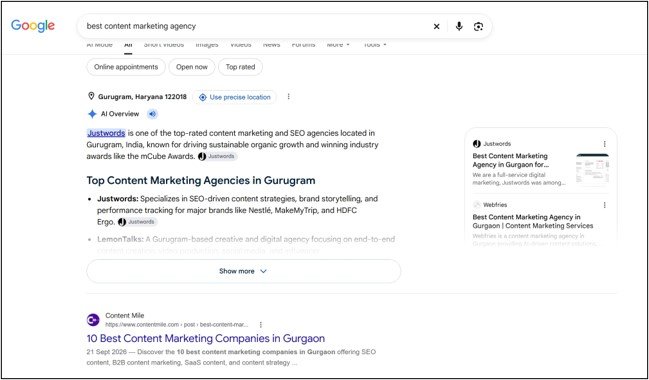
There is no single figure for how often they appear. BrightEdge’s March 2026 data found AI Overviews on nearly half (~48%) of all tracked queries. The appearance rates vary widely depending on query type, intent, industry and device.
Query intent matters more than the headline percentage. As per Semrush’s analysis, commercial queries triggered AI Overviews 18.57% of the time, transactional queries 13.94% and navigational queries 10.33%. Informational searches (the “what is” and “how to” queries) carry the heaviest exposure.
How AI Overviews Change Google Rankings
The old assumption was simple: rank in the top 3 and your page would be the source. Ahrefs’ study of 863,000 keywords and 4 million AI Overview URLs shows that this no longer holds. Of the pages cited, 38% ranked in the top 10, just over 31% ranked between positions 11 and 100, and another 31% ranked beyond the top 100. BrightEdge reported an even lower overlap of around 17%, using a different method. The numbers differ, but they point in the same direction.
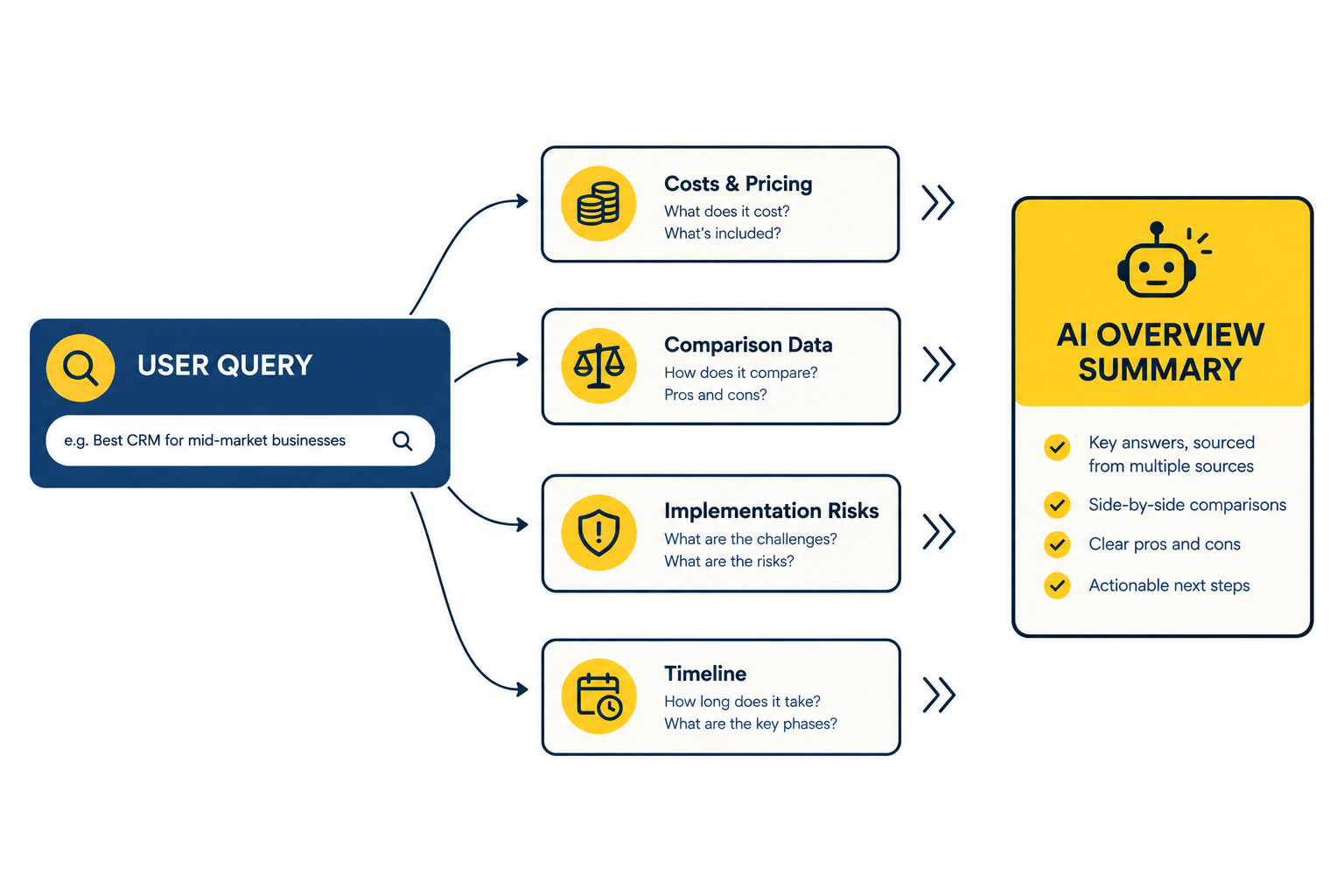
Ahrefs links the shift to query fan-out. When someone searches, Google’s AI runs several related searches in the background and assembles an answer from the combined results. A page that ranks 40th for the headline keyword can still earn a citation if it answers one of those sub-questions better than anyone else. Page-1 rankings still raise your odds. But they have stopped being the only route in.
Google’s documentation explains what the entry ticket is. A page must be indexed and eligible to show a snippet, and there are no additional technical requirements. You don’t need AI-specific schema or new file types. What decides inclusion is whether your page offers the clearest, most credible answer to a piece of the question.
What AI Overviews Do to Traffic (by Query Type)
Pew Research’s US-based study found that users clicked a traditional result in 8% of visits when an AI summary appeared, against 15% when it did not. This suggests AI summaries can reduce clicks to traditional search results. The impact varies by query type, so the mix of searches your business targets matters.
| Query type | AI Overview exposure | What to do |
| Informational (“what is,” “how to”) | Highest | Expect fewer clicks. Aim for citations and brand recall, and give readers a reason to visit: a tool, template or deeper guide. |
| Commercial (“best,” “vs,” “compare”) | Moderate | Win on comparison depth, original data and proof that AI summaries cannot replicate. |
| Transactional (“pricing,” “buy,” “near me”) | Lower | Protect rankings and conversion rate on these pages first. |
| Navigational (brand searches) | Lowest | Keep your brand strong, since these searches carry your highest-intent visitors. |
How to Optimise for Google AI Overviews: 6 Practical Moves
AI search optimisation is traditional SEO with a sharper focus on extractability and topical authority. These six moves cover the work:
- Secure the fundamentals: Pages must be crawlable, indexed and free of nosnippet directives. A page that cannot show a snippet cannot be a supporting link.
- Answer first: Put a direct, complete answer in the first 2-3 sentences under each question-style heading. Elaboration follows. This is what an AI system can lift without guessing.
- Cover the fan-out: Map the sub-questions around each target topic (costs, comparisons, risks, timelines, alternatives) and build a connected cluster. Depth across a topic gives you more chances to be selected.
- Add information gain: A summary can already restate generic advice. Original data, India-specific numbers, expert input and real case results give a source a reason to be cited over the average page.
- Build entity authority: Consistent brand mentions, credible backlinks, named authors and reviews all signal that your brand is a reliable source on its subject.
- Keep facts current: Refresh statistics, dates and prices on your priority pages. Outdated figures weaken trust, and AI systems favour recent, verifiable information.
Use structured data where it accurately describes the visible page. No schema type triggers an AI Overview.
Read more: How to Optimise for AI Search: A Practical AIO, GEO & AEO Guide
How to Measure AI Overview Performance
Google now provides a Search Generative AI performance report in Search Console, which includes data from AI features such as AI Overviews. This gives you a more direct way to understand how your site performs in Google’s AI search experiences.
Along with that, compare impressions and clicks by query type. A rise in impressions with flat or falling clicks on informational queries suggests an AI Overview is absorbing the answer. Track branded search volume to see whether increased visibility in AI results leads to more people searching for your brand. Finally, check your 20 to 30 priority queries manually each month and record whether your brand is cited and which competitors appear alongside you.
What This Means for Your SEO Budget
Be wary of anyone selling a secret AI Overviews tactic. An offer built on special files or markup is a rebranded SEO invoice. The work that earns citations is topical depth, clear answers, original insight and measurement, delivered consistently.
When you evaluate an SEO agency, ask whether it builds around whole topics, how it reports on non-click value, and whether strategy sits with the agency from audit to measurement. Those answers predict results in AI search better than any list of AI buzzwords.
Audit Before You Adjust
AI Overviews have raised the standard in SEO without replacing it. Start with your top 20 commercial and informational queries. Note which show an AI Overview, whether you are cited, and where you rank. The gaps in that sheet become your plan: pages to rewrite, topics to deepen and conversion points to protect.
Every month you wait, competitors are being cited for questions your buyers are asking. If you want a clear view of where your brand stands in AI search, our team can start with an audit through our AI SEO services.
FAQs
1. Can I opt out of Google AI Overviews?
There is no dedicated opt-out. Snippet controls such as nosnippet can limit how Google uses your content, but they also affect regular search snippets, so most businesses should not use them.
2. Do I need llms.txt or special schema for AI Overviews?
No. Google states that no additional files, markup or special optimisations are required. Pages need to be indexed and eligible for a snippet, with structured data used only where it matches visible content.
3. Are Google AI Overviews available in Hindi?
Yes. Google expanded AI Overviews to more than 100 countries in October 2024, with language support that includes Hindi alongside English. Indian searchers can see them in either language.
4. How can I check if my page appears in AI Overviews?
Use the Search Generative AI performance report in Google Search Console to monitor your site’s performance in AI features such as AI Overviews. You can also search your priority queries manually to see whether your page is cited, or use a rank-tracking tool that records AI Overview citations.
5. Should I stop writing informational content?
No. Informational content builds the topical authority and brand recall that earn citations. Prioritise topics tied to the buying journey, and add original insight and a clear next step.
6. Is AI search optimisation different from SEO?
Not really. AI SEO, GEO and AEO are extensions of traditional SEO, with more focus on clear answers, topical coverage, authority and content that AI systems can understand and cite. The fundamentals of good SEO still come first.