
TL;DR
- Most brands waste content by publishing once and moving on. A content flywheel solves this by turning a single hero asset into many smaller pieces that fuel ongoing visibility.
- In 2026, smart teams scale by repurposing content, not producing more.
- One hero asset (webinar, report, podcast) can be turned into 20+ micro-assets across social posts, SEO blogs, email snippets, and sales scripts.
- Core steps: Identify the hero asset → Extract key narratives → Segment into formats → Atomise into micro-assets → Activate across channels → Measure → Refine.
- The flywheel compounds as each piece drives traffic back to the core asset.
- Result: Lower cost, higher consistency, and stronger distribution.
Introduction
This is how most businesses and brands approach content – the content teams spend hours writing, writing, editing content. They hit the publish button on the website, promote it on social media, and move on to the next piece. Then the next. Then the next. Every week brings with it new requirements – new blogs, new social posts, emails and videos, and so on and so forth.
Notice what is happening here – You are creating once, publishing once, and hoping one post on one channel does all the work. Well, it does not. Hence, your team is forced to keep creating constantly just to maintain presence.
What is worse – most of your content gets a few clicks, maybe a share, then disappears into your archive.
There’s a smarter way – it is called the content flywheel.
Let us understand how this process can maximise the output and reach of one content asset, drive back engagement to your brand, and help you step away from a content hamster wheel.
What is a Content Flywheel?
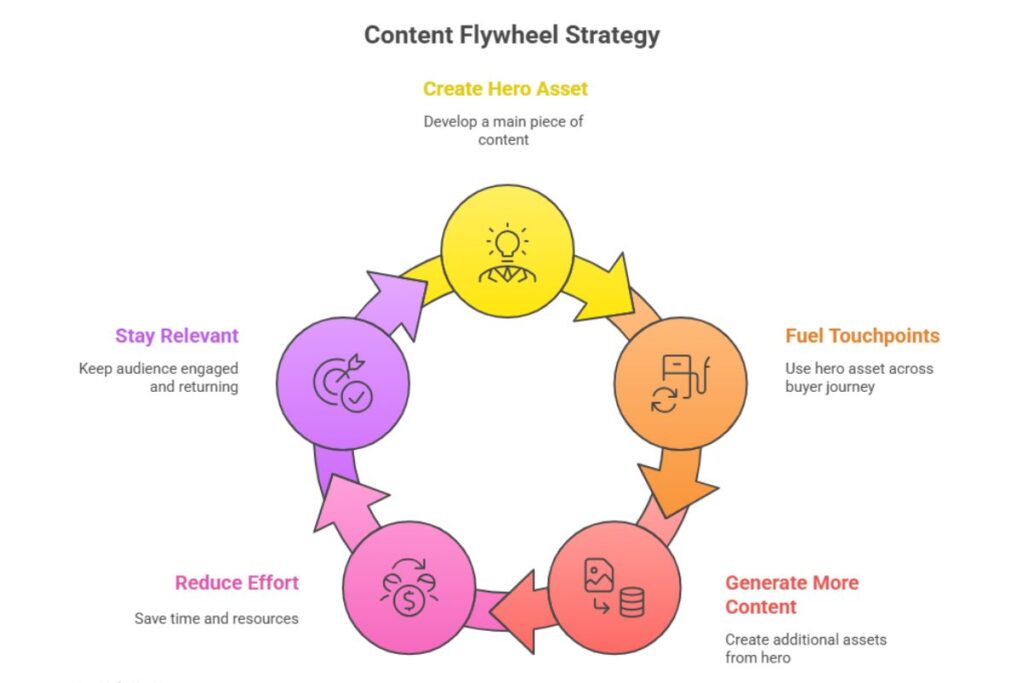
The foundation of the content flywheel strategy is this – build one hero piece of content and then reuse parts of it for creating different content formats for different platforms. In short, you are taking one piece of content and chopping it off into different pieces of content and giving every piece a new life. All those new pieces of content link back to the main content, thereby driving larger engagement to the hero piece.
Unlike traditional strategies, content is not just repeated and reposted on different platforms. Instead, every content piece has its own purpose. And each one keeps the important ideas while adapting to each channel. So, the process is systematic, measurable and sustainable.
For example, a single 60-minute webinar can be repurposed into:
- 5 LinkedIn carousels
- 3 blog posts
- 10 social media snippets for platforms like Instagram and X (Twitter)
- 5 YouTube Shorts and Instagram Reels
- And so on.
Each of these amplify the reach of your webinar and ultimately lead to improved traffic, engagement, leads and ROI.
Why is Repurposing Content through the Content Flywheel Important?
The buying journey followed by your prospects is not linear. They probably discover you on LinkedIn, research you via Google, subscribe on email, watch videos on YouTube, and convert after reading testimonials. Their approach to your brand is fragmented, via multiple channels. Without a content flywheel, every piece that is published lies in isolation.
With a content flywheel, you create one hero asset that becomes XX number of micro-assets, strategically deployed across every touchpoint where your customers actually are. Same core message. Different formats. Consistent presence everywhere.
| Problem with Random Content | How a Content Flywheel Fixes It |
| Every piece lives alone → no momentum | One hero asset fuels 10–20 micro assets |
| Hard to stand out in AI-saturated content feeds | Repurposing forces originality and consistency |
| Users jump across platforms → content gets lost | Flywheel keeps your message aligned everywhere |
| Teams burn time creating from scratch | Repurposing reduces production time 50–70% |
| Hard to measure ROI across scattered assets | Everything traces back to one source of truth |
In our experience, teams that implemented the content flywheel strategy saw 4x higher leads per dollar than those who depended on new content.
According to Semrush’s State of Content Marketing Report, 42% of companies said that systematically repurposed content brought them higher success as compared to single channel content campaigns.
How Can You Build a Content Flywheel: An Example of How 1 Hero Asset Can Become 20+ Micro-Assets
Let us say, you have recorded a 60-Minute Webinar on Content Marketing Strategy for SaaS.
This is how you can break it up into 20-plus Micro-Assets.
A. Video Content (7 assets):
i) Create one long video from the full webinar recording (for YouTube)
ii) Take out 2-6 clips of five 60-90 second highlight clips (which can be repurposed into YouTube Shorts, Instagram Reels, TikTok)
B. Written Content (7 assets):
iii) Create a blog from the full transcript of the original recording (2,500+ words)
iv) Create 3 standalone blog posts from key sections
v) Write 3 LinkedIn articles from different angles
C. Social Media Content (10 assets):
vi) Get 3 LinkedIn carousels (5-10 slides each) from the original webinar
vii) Create 3 quote graphics with speaker insights
viii) Write 3 Twitter/X threads (8-12 tweets each)
ix) Do an Instagram caption series
D. Lead Generation Assets (4 assets):
x) Create a downloadable slide deck (PDF)
xi) Create a Key takeaways checklist
xii) Create a Framework template (based on webinar model)
xiii) Take out one great emailer from the original material
So, here is what we got:
1 Hero Asset = 20-plus micro assets
We are not saying that this is the only way. The break up will completely depend on the kind of Hero Asset you have. But here is a reliable breakdown for different hero assets:
Content Repurposing Potential by Asset Type
| Hero Asset | Micro-Asset Count | Example Breakdown |
| 60-min webinar | 25-30 pieces | 6 video clips + 8 social posts + 3 blogs + 5 graphics + 4 emails + slide deck |
| Research report (20+ pages) | 20-25 pieces | 10 social posts + 5 infographics + 3 blog posts + email series + webinar content |
| Podcast episode (45+ min) | 18-22 pieces | 5 audiograms + 10 social quotes + 2 blog posts + newsletter series + video clips |
| Comprehensive guide (3,000+ words) | 15-20 pieces | 5 blog posts + 10 social snippets + email sequence + downloadable checklist |
| Case study (detailed) | 12-15 pieces | Video testimonial + 5 social posts + 2 blog summaries + one-pager + carousel |
This Works Without Diluting Quality
The key principle here is that each micro asset serves a different audience and a different purpose.
For example
- A long Youtube Video = caters to those who are looking for deeper understanding of what your brand offers
- A 60-second Reel = good for attracting the scroller to your brand
- The LinkedIn carousel = excellent for establishing authority and building trust for your brand
- The email sequence = perfect for nurturing the already engaged audience
- The email sequence = perfect for nurturing the already engaged audience
- The checklist = perfect for attracting the prospects into the funnel
Basic principle of the content flywheel: Same insights. Different formats. Different contexts. Each reaches people who would never consume the original format.
What You Gain: 5 Proven Benefits of Content Repurposing
When you implement a content flywheel, here’s what changes:
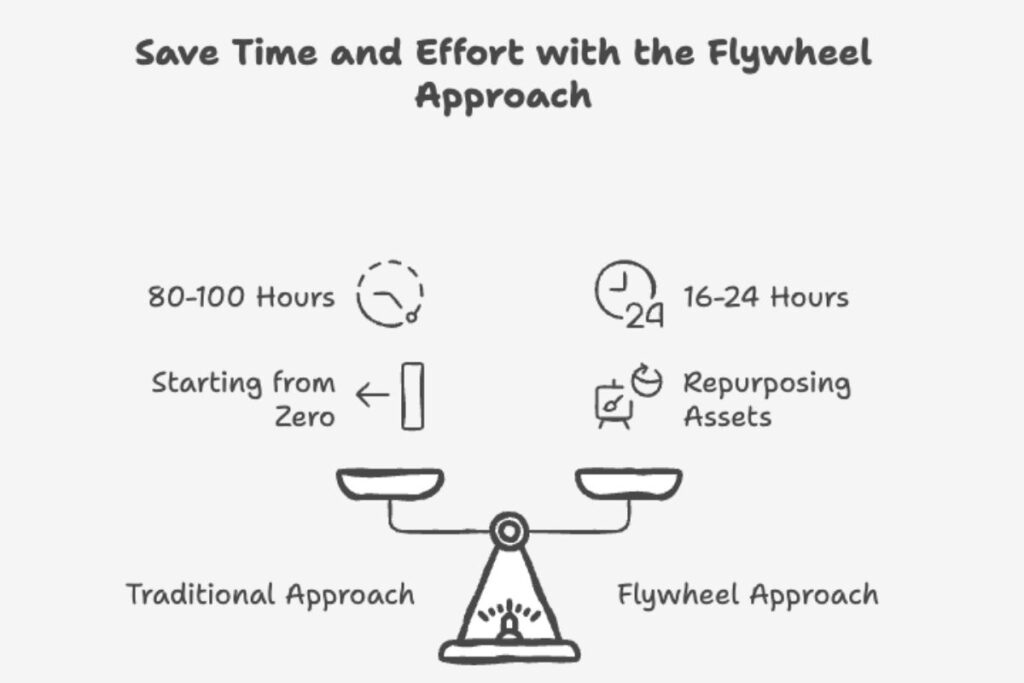
1. Saves time and resources
All you need is one piece of hero content, and you are set. Creating multiple assets from that one piece will save you far more time and resources than creating each one from scratch.
2. Cuts cost per lead
A single hero asset generates leads across multiple funnel touchpoints. Each repurposed micro-asset becomes another opportunity to engage prospects—without additional budget. More touchpoints = more leads at the same cost = better ROI.
3. Maintains quality in a saturated market
Today’s market is flooded with AI-generated content. But only 17% of the top 20 search results on Google are actually AI-generated, as per Originality AI’s report. That’s because users crave unique, well-researched and insightful content.
Repurposing content helps you stand out in a market where everyone else is chasing volume. Each of your micro-assets originates from a single high-quality hero asset, which helps maintain authority across platforms.
4. Maximizes reach
Different people consume content in different ways. Some like social posts or short videos, while others like in-depth reports. Repurposing content helps you reach all audience segments right where they are.
5. Improves engagement at multiple stages
Repurposed micro-assets can target your audience at all stages of the buyer journey. For example, blog posts, social media snippets and infographics can target the awareness stage. On the other hand, in-depth guides or case studies can work for the consideration stage, while product comparisons or demos for the decision stage.
How to repurpose content: Step-by-step framework
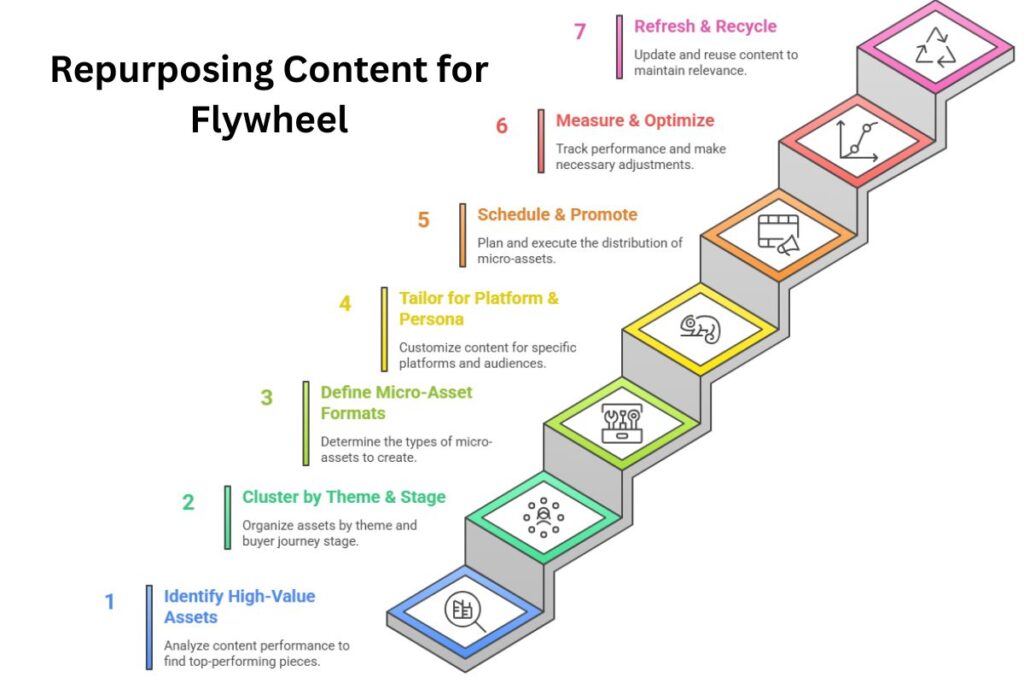
i. Audit and identify high-value assets
Start with what already works. Not every piece of content can be used as the hero asset for your flywheel. Use analytics and identify which content pieces are performing best in terms of metrics like:
- Engagement time (pages, videos, webinars)
- Shares and downloads
- Leads generated
- Organic and social reach
There are also various other micro-engagement signals you can rely on, like how often a quote is clipped, shared, or cited.
You can track these metrics using tools like Google Analytics.
In our experience, only 10–15% of existing content assets are useful for the flywheel. But the good thing is these few pieces can produce 20+ micro-assets each.
ii. Cluster by theme and buyer stage
Once you identify high-value assets, map them to themes and funnel stages: awareness, consideration, decision, retention, and advocacy.
For example, a webinar on “SaaS Growth Strategies” can help create content for different stages:
- Awareness: LinkedIn carousel, short video snippet
- Consideration: Downloadable benchmark table, comparison guides, gated ebooks
- Decision: Personalized client case study, demo video
When clustering content, don’t just repeat across formats. Make sure that your micro-assets reinforce each other instead of competing.
iii. Define micro-asset formats
This is where the flywheel meets platform-specific execution. One hero asset (say, a webinar) could produce:
- 10–15 social posts (LinkedIn, X, Instagram)
- 5–10 short-form videos
- 3–5 blog posts or guides
- 2–3 downloadable assets (PDFs, checklists)
- 2–3 email sequences or nurture campaigns
- 1–2 interactive content like quizzes or surveys
- Event content (webinar highlights, speaker quotes)
The number of assets you need to create for each channel will depend on your audience behaviour. For example, B2B SaaS buyers consume around 60% of content on LinkedIn, 25% through email, and 15% via interactive content. So think of your micro-assets accordingly to maximize ROI.
Also Read: Guide to Use 12 Different Content Marketing Formats in 2023
iv. Tailor for platform & persona
This is the E (Experience) layer of Google’s EEAT. No AI alone can replace nuanced human adaptation. Human touch always matters for both the search engine and your users.
A snippet from your long form hero asset may work on LinkedIn. But to resonate with the typical TikTok audience, it must be rewritten, adjusting tone, pacing, and hook.
Based on our experience, mid-funnel content suffers the most CTR drop if reused as is. But, on adding fresh insights, updated stats, or client examples, our clients saw engagement increase by 40–60%.
v. Schedule, publish, and promote
This is obvious. But many people do it the wrong way.
Your content needs to go out there. But, don’t publish all the micro-assets you created at once. What you should do is create a rolling schedule so that momentum will be maintained. And you can turn each of these assets into amplifiers for your next one.
Also Read: 15 Ways to Promote Your Content After It’s Published
vi. Measure, optimize, iterate
After publishing, track each micro-asset’s performance. See metrics like:
- CTR, engagement, and conversion per asset
- Social shares and content recycling opportunities
vii. Refresh and recycle
Finally, the flywheel’s power lies in longevity. Micro-assets should be refreshed with new stats, updated visuals, or additional commentary every 6–12 months. This extends their life. And the best thing, it saves you from creating new hero content all the time.
Also, maintain a content log linking each micro-asset to its original hero asset. It saves time, ensures consistency, and allows rapid iteration in the AI era.
3 Best Content Types for Repurposing
You can repurpose a lot of things, but not everything. Some will last long, while some others you just have to delete. While there’s no set rule for it, there are a few types that we have found to work the best.
Webinars, panels & workshops
Webinars feel long when you’re running them. But when you repurpose them, you realize they’re basically a content buffet.
1. A single 45-minute webinar can turn into:
- Micro-videos for LinkedIn
- A “top 5 insights” carousel
- A highlight reel
- A blog summarizing the Q&A
- Screenshots for social posts
- An email sequence
And unlike static content, webinars show tone, personality, and real-time problem-solving. These things that work beautifully for creating cool micro-assets.
2. Original research, surveys & proprietary data
Research is the most repurposable type of content in B2B.
Why?
Because people love data more than they love opinions.
Your original research can become:
- Quote graphics
- Trend explainer posts
- Slide decks
- Infographics
- Webinar content
- Email drip campaigns
- PR content
3. Evergreen content
Never forget this. Evergreen content is your staple. Always useful, always relevant, always able to turn into something else. Just make sure the content is still accurate.
These could be your how-to guides, strategy deep dives, step-by-step tutorials, etc.
If you’ve ever published a content piece that still gets organic traffic long after launch, congratulations, that’s your repurposing gold.
The best ways to repurpose content
In the content flywheel framework, repurposing isn’t just copy-pasting. It’s more like remodeling a house: you reuse the structure, but the final look feels fresh.
I will explain how to do it right in 5 ways:
1. Break big ideas into snackable pieces
Long content: Too much for people to process.
Small insights: Scroll-stopping.
Take your hero content and chunk it:
| One insight → one post |
| One chart → one carousel |
| One quote → one graphic |
| One question → one poll |
2. Flip the format
If something was written, make it visual. If something was visual, make it conversational. If something was conversational, make it actionable.
For example:
| Webinar → infographic |
| Podcast → blog post |
| Research → slide deck |
| Blog → script for a short video |
The content is the same. But the experience is different. And you just need to take care of the tone.
3. Update and upgrade (don’t just reuse)
Before repurposing:
- Update stats
- Add current examples
- Fix outdated screenshots
- Refresh CTAs
- Modernize visuals
Small tweaks, but a big credibility boost.
4. Contextualize for the channel
LinkedIn wants a bold hook. Your newsletter wants a story. Your blog wants depth. Your video wants clarity and speed.
So, don’t repurpose like a robot. Think from the user’s perspective and repurpose like someone who actually uses these platforms.
5. Create one asset for each stage of the funnel
This is the part people forget. Repurposing isn’t just about reach. It’s about movement. Here, you’re not just posting more. You’re guiding people further.
Try to turn one hero content piece into content for multiple stages like we discussed earlier.
- TOFU (awareness): short snippets
- MOFU (consideration): explainers and breakdowns
- BOFU (decision): case studies and data-heavy content
How to include repurposing into your content creation process
First of all, you need to stop treating repurposing like an extra task and actually make it part of how you work. Doing repurposing when you have time is like never doing it. It won’t really give you the results you are looking for. And yes, I am saying this from my experience.
If you want it to work, it needs to be baked into your workflow.
Here’s the system we use with clients:
1. Start with a repurposable hero asset and plan before creating
Before creating anything, first ask yourself these questions:
- Is this worth multiplying?
- What’s the hero asset here?
- Which 5–10 angles are naturally inside this?
- Who is the audience, and how does each angle fit a different channel?
- What visual elements do we need to repurpose smoothly?
- What funnel stage will each micro-piece support?
If an idea doesn’t have at least 5 repurposable insights built in, don’t make it a hero asset.
2. Maintain capture hygiene
This is about keeping everything in place before you start repurposing. Call it content hygiene or capture hygiene, but it’s the secret behind every team that effortlessly multiplies content.
It includes:
- Transcripts: These expose quotes, insights, hooks, and moments you missed live.
- Timestamps: Mark down key timestamps during the live call or webinar. Zoom’s auto-highlights make this stupidly easy.
- Raw files: Store your raw video, raw audio, slides, screenshots, chat messages, Q&A, etc. You can use a DAM (digital asset management), Google Drive, Notion, or even a clean folder structure.
- Notes about audience reactions: If someone asks the same question three times, that’s a post. If the chat loses its mind over a framework, that’s a carousel. Capture such audience reactions.
3. Use batching & templates
Batching looks like:
- Clip all videos from one webinar in one session
- Write all LinkedIn posts for one hero asset in one go
- Design all carousels for the month in one week
- Schedule content two weeks ahead
The Creatuuls crew popularized this approach in the marketing community because it works unbelievably well.
Also keep templates for:
- LinkedIn carousels
- Short-form video reels
- Quote graphics
- Tweet screenshots
- Blog expansions
- Email snippets
4. Assign roles
Split the roles instead of expecting one person to do everything. For example:
- Content strategist: define hero asset
- Content creator: produce original hero asset
- Video editor: trims insights
- Social marketer: formats posts
- Designer: visuals
- Growth: distribution and analytics
If you’re a small team or a solo marketer, you can still do this. Just batch the roles instead of stacking them all at once.
5. Distribute over 30–45 days
Try to stay in the feed longer. Because that’s what repurposing is about.
Also Read: A Complete List of Best Content Distribution Platforms
Conclusion
Most great content doesn’t fail because it’s bad. It fails because it’s forgotten.
A content flywheel turns a one-off effort into a recyclable long-term content engine. And that’s how compounding marketing growth happens today. If you still want help with identifying and turning one hidden piece of hero content into a year’s worth of micro-assets, then book a consultation call with us today.
FAQs
1. What exactly is a content flywheel?
A content flywheel is a system where one hero content piece is repurposed into multiple micro-assets that are distributed across platforms. Each asset drives traffic back to the original piece, creating ongoing momentum and long-term ROI.
2. How is the content flywheel strategy different from traditional content repurposing?
Traditional repurposing is about copying the same content into different formats. A content flywheel is more strategic, where each micro-asset has a purpose, platform-specific angle, and funnel fit, all pointing back to the hero asset as the central source of truth.
3. How do you create a content flywheel?
To create a content flywheel, start by developing one high-value hero asset (a report, webinar, industry playbook, or benchmark study). Then break it into multiple derivative formats—blogs, carousels, email snippets, sales enablement pieces, social posts, etc. Finally, distribute these consistently across channels and update the hero asset based on engagement insights.
4. What is an example of a content flywheel?
A simple example of a content flywheel strategy is:
- You run a webinar on SaaS automation trends.
- That becomes a pillar blog, 3 short blogs, 10 LinkedIn posts, 2 email sequences, 5 sales one-pagers, and a gated summary PDF.
- Each piece pushes traffic back to the main asset, increasing sign-ups and lead quality.
- Audience questions from the webinar fuel new content topics, restarting the cycle.
This creates a continuous, momentum-building flow of content from one core idea.
5. What are the three areas of the content flywheel?
Most content flywheel strategies revolve around three core areas:
- Creation – Build one hero asset based on deep research or a strong POV.
- Repurposing – Transform that asset into multiple smaller formats for specific channels and buyer stages.
- Distribution – Publish, promote, and recycle the micro-assets to drive consistent visibility and traffic back to the hero piece.
Together, these three areas ensure your content flywheel keeps spinning with minimal net-new effort.