
TL;DR
- Most content fails without distribution. Over 96% gets zero Google traffic.
- Use the PESO model for content distribution: owned, earned, shared, and paid channels.
- Prioritise owned platforms (blog, email) for long-term ROI.
- Use social media, communities, and SEO to drive visibility.
- Leverage tools like scheduling, CRM, and analytics platforms to improve efficiency.
- Repurpose content and use AI to scale distribution.
- Measure performance and double down on what works.
When you create useful, actionable content, everyone deserves to see it. But creating great content and getting it seen are two entirely different challenges.
Over 96% of content gets zero Google traffic after publication. And in 2026, organic search alone is no longer a reliable source of visibility. Algorithm changes, cookie deprecation, and an unprecedented flood of AI-generated content have made distribution more important, and more complex, than ever.
That is where content distribution platforms play an important role. The right mix of platforms (owned, earned and paid) is what separates content that compounds over time from content that disappears after the first week.
This guide covers what content distribution is, how to choose the right platforms for your goals, the best content distribution sites and tools available in 2026, and how to maximise your outcomes across each channel.
What is Content Distribution?

Content distribution is the process of actively promoting and sharing your content across multiple channels and formats to reach your target audience wherever they are.
It is not enough to publish a post and wait. Without a deliberate distribution strategy, even genuinely valuable content gets lost in the noise.
Content distribution platforms are services or tools that help amplify your content by delivering it to wider audiences, from press release distribution services and blog-publishing sites to paid content discovery networks and automated social media schedulers.
The goal is not to share your content everywhere at once. It is to share it on the right channels, in the right format, to the right audience consistently.
The PESO Model: Four Types of Content Distribution
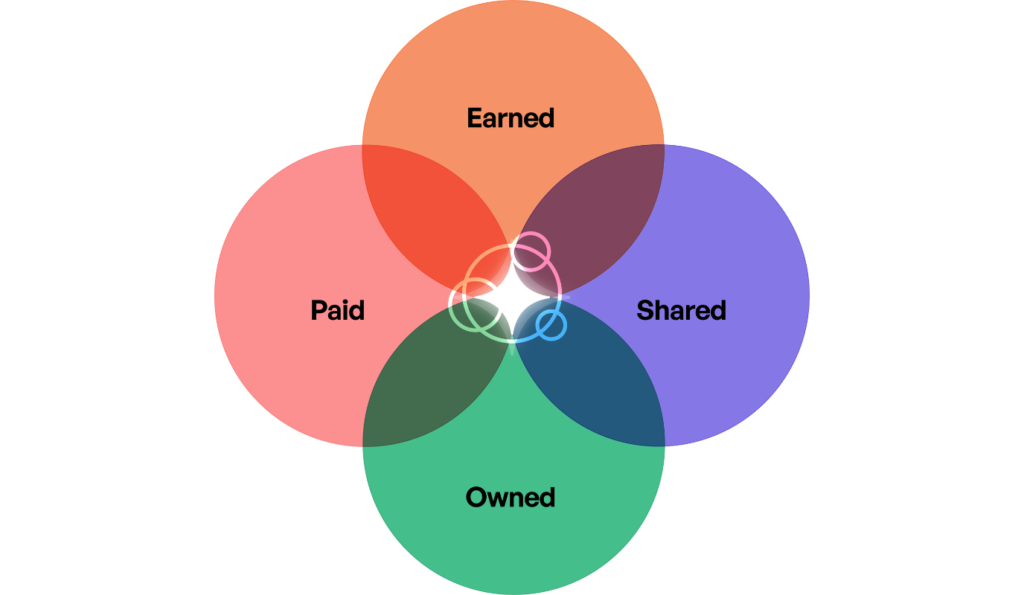
The most widely used framework for content distribution is the PESO Model®, created by Gini Dietrich, which organises distribution channels into four categories:
- Owned – Channels you fully control: your website, blog, email list, and branded social profiles. These are your distribution home base. All other channels should ultimately point traffic back here.
- Earned – Distribution that comes from others: media coverage, backlinks, guest posts, influencer mentions, and organic shares. Earned distribution carries high credibility and powerful SEO signals, but you cannot control or guarantee it.
- Shared – Social media platforms and online communities where your content can be reshared, discussed, and amplified. You do not fully own these spaces (algorithm changes can reduce your reach overnight), but they are essential for visibility and audience building.
- Paid – These are channels where you pay for getting more exposure. Paid advertising, content discovery networks, sponsored placements, and influencer partnerships where you pay for guaranteed reach and targeting. Paid distribution accelerates results when organic traction is slow.
A strong content distribution strategy uses all four in combination. Over-reliance on any single channel, especially one you do not own, is a vulnerability.
From our experience at Justwords, the brands that build the most resilient content programmes invest first in owned channels (email lists, SEO-optimised blogs) and use paid and earned channels to drive initial visibility. That order matters. Building on channels you control means your distribution equity compounds over time, not someone else’s.
How to Choose the Right Content Distribution Platforms
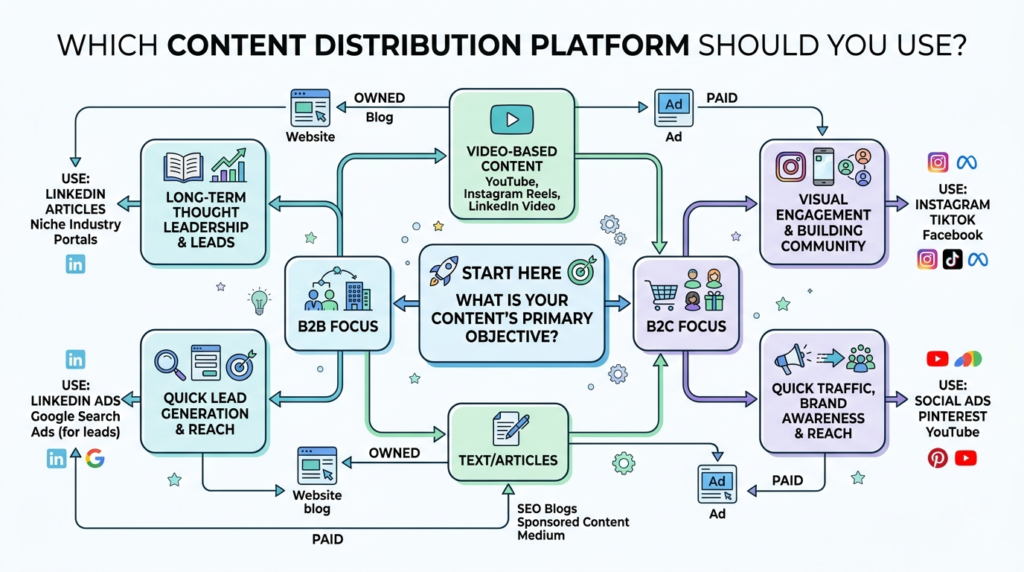
Content marketing platforms offer limitless possibilities for growing your audience and improving your credibility and conversion. However, not all platforms provide the same level of success to everyone. What works brilliantly for a B2B SaaS brand may be entirely wrong for a consumer e-commerce business. Before selecting any platform, evaluate these factors:
- Audience relevance: The only platform worth your time is one where your actual target audience spends time. Know your audience’s demographics, professional context, and content consumption habits before committing to any channel.
- Reach and engagement quality: Larger platforms offer greater reach, but niche platforms with highly engaged communities often deliver better-quality traffic. A smaller, targeted audience that takes action is more valuable than a large, disengaged one every time.
- Content format compatibility: Different platforms are built for different content types – long-form articles, short video, images, audio, interactive tools. Choose platforms where your content format works natively. Forcing a video-heavy strategy onto a text-dominant platform creates friction and underperforms.
- Organic vs. paid reach: Understand upfront whether a platform requires paid investment to reach meaningful audiences, or whether organic distribution is viable. Most major social platforms have reduced organic reach significantly; factor that into your expectations and budget. And, when considering paid promotion, evaluate a platform’s paid advertising options, including targeting capabilities, ad formats, and pricing structures.
- Community engagement features: Platforms with active comments sections, discussion threads, and sharing features generate far more engagement and far more distribution momentum than passive broadcast channels.
- Analytics and measurement: Choose platforms that give you access to meaningful performance data. Without measurement, you cannot improve. The best content distribution tools tie directly to outcomes: traffic, leads and conversions, instead of just impressions.
Also Read : What is Buyer Journey Today and How to Incorporate Content
The Best Content Distribution Platforms in 2026
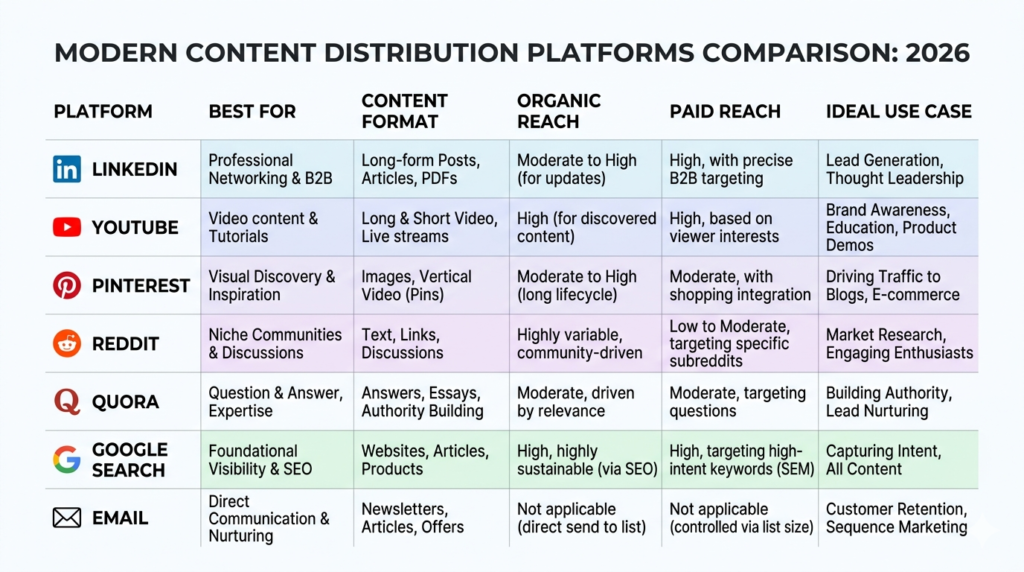
Owned Media Platforms
Owned channels are the foundation of any content distribution strategy. They are underutilised by most marketers, yet they offer the highest long-term ROI because you control them entirely.
- Your website and blog are the anchor of all content distribution. Every other channel should eventually direct traffic here. A well-optimised blog builds compounding organic traffic over time, and your website is the one asset no algorithm change can take from you. Prioritise SEO, site speed, and internal linking to make the most of this channel.
- Email newsletters remain one of the highest-performing content distribution channels available. Your email list is an audience that has explicitly opted in. They want to hear from you. Email consistently outperforms social media for content click-through rates, and unlike social platforms, your list is an asset you own outright.
Tips to use owned channels to the fullest:
- Optimise every piece of content for search before publishing. Owned channels and SEO work together.
- Build a dedicated email list from day one. Grow it actively with every piece of content you produce.
- Use internal links to connect new content to existing high-performing pages, compounding their value over time.
- Make content easy to share directly from your website with visible share buttons.
Also Read : Best Tips & Must Use SEO Practices for Content Writers
Social Media Content Distribution Platforms
Social media remains one of the fastest channels for initial content visibility. But its effectiveness depends heavily on choosing the right platform for your audience and content type.
- LinkedIn: It is the most powerful platform for B2B content distribution in 2026. Long-form articles published on LinkedIn can rank in Google search, and native posts (especially carousels and videos) see strong organic reach relative to other major platforms. LinkedIn data has found that click-through rates are 2x higher when content is shared by employees versus the company itself, which makes employee advocacy a significant distribution lever for brands with active teams.
- Facebook and Instagram (Meta): These remain dominant for B2C content distribution, with Meta’s advanced advertising platform offering some of the most precise targeting options available. The average CPM for Meta ads in 2026 is between $8–$15, and the average CPC is in the range of $0.50–$3, which is competitive for the level of targeting precision on offer.
- YouTube: It is both a social platform and the world’s second-largest search engine. For video content, it offers unmatched organic discoverability. Videos that rank on YouTube also appear in Google search results, making YouTube one of the few social platforms that delivers compounding SEO value.
- Pinterest: It functions more as a search engine than a social network. Pins have a significantly longer shelf life than posts on any other social platform, and well-optimised pins can drive traffic months or years after publication. It is especially valuable for content in lifestyle, design, food, health, and marketing niches.
- X (formerly Twitter): X remains useful for real-time content distribution, particularly in tech, marketing, finance, and media. Its influence has shifted somewhat since 2023, but it still delivers strong referral traffic for the right audiences.
- TikTok and Instagram Reels: These are essential for short-form video distribution, particularly for B2C brands targeting younger demographics. In 2026, short-form video continues to see higher organic reach than almost any other content format on social platforms.
Tips to maximise social media distribution:
- Never use the same post across all platforms. Tailor format, tone, and length to each channel.
- Promote the same piece of content multiple times with different angles (a key stat, a counterintuitive insight, a reader question).
- Use native formats. Content posted natively (not as an external link) consistently outperforms link posts on most platforms.
Also Read : How to Write Great Posts for Social Media
Community and Q&A Content Distribution Platforms
Community platforms offer long-tail, evergreen distribution. Unlike social media posts that disappear in hours, well-written contributions in online communities remain discoverable for months or years.
- Reddit: It is one of the most powerful community platforms for authentic content distribution, if used correctly. Niche subreddits have highly engaged, knowledgeable audiences. Sharing valuable, relevant content in niche subreddits can lead to organic discussions and backlinks. But avoid promotional language because Reddit users favour substance over sales.
- Quora: It is a Q&A platform where detailed, authoritative answers to relevant questions can drive consistent long-term referral traffic. Quora answers usually rank in Google search results, making them a source of compounding organic visibility.
- Medium: It is a high-domain-authority publishing platform ideal for repurposing long-form blog content. Publishing long-form content on LinkedIn and Medium helps establish thought leadership while distributing content directly to your professional network. And articles can rank in Google search too.
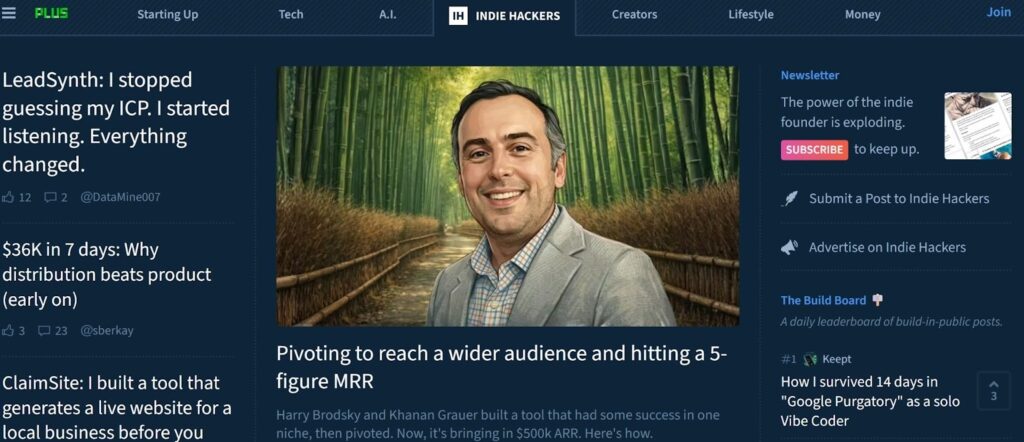
- GrowthHackers, Indie Hackers, and niche Slack and Discord communities: These are increasingly valuable for distribution in specific professional niches, particularly marketing, SaaS, and tech. However, these communities are moderated and sensitive to self-promotion. Low-quality or overly promotional content gets ignored or removed.
Tips for community platforms:
- Build a presence first. Contribute genuinely before sharing links.
- Write standalone, high-value answers rather than brief link posts.
- One great contribution to a community platform can drive traffic for years.
Search and Discovery Platforms
- Google Search (via SEO): Google remains the most valuable long-term content distribution channel for most businesses. Content that ranks earns free, compounding traffic indefinitely. The investment is in quality, depth, and technical SEO, but the returns compound over time in a way no paid channel can match.
- Google News: It is a high-value discovery channel for content-heavy websites and news blogs. Google News pulls in articles that follow strict formatting and quality standards, rewarding publishers with visibility in both Google News and organic search results. Getting indexed in Google News can be a significant traffic driver for the right content strategy.
- YouTube Search: As noted above, YouTube functions as a standalone search engine with over 2 billion logged-in monthly users. Optimising video content for YouTube search (titles, descriptions, tags, transcripts) is a distinct and valuable distribution strategy.
- Voice search and smart speakers: These are growing distribution channels for informational content. Optimising content to answer specific, conversational queries improves visibility in AI-generated answers and voice search results, making it relevant to both AEO and traditional SEO.
Also Read : Top Free SEO Tools to Boost Your Website Ranking
Third-Party and Paid Content Distribution Platforms
- Content discovery networks: Outbrain and Taboola are the most established platforms in this space. They distribute your content as sponsored recommendations on major publisher websites, driving traffic from audiences who are already reading related content. Best suited for top-of-funnel awareness and content amplification with budget to support it.
- PR distribution services: Platforms like NewswireJet, PR Newswire, and similar services distribute press releases and editorial content to journalists, media outlets, and news aggregators. Effective for building brand authority and earning high-authority backlinks.
- Guest posting and featured columns: Writing for reputable third-party publications in your industry is one of the highest-value earned distribution strategies available. It builds authority, earns high-quality backlinks, and puts your content in front of established audiences. In 2026, nearly 60% of marketers plan to partner with more influencers compared to the previous year, and the same relationship-first thinking applies to editorial partnerships.
- Influencer distribution: Working with niche influencers who have highly engaged audiences in your space can deliver targeted distribution that broad advertising cannot. Micro-influencers (5,000–50,000 engaged followers) consistently outperform macro-influencers on a cost-per-engagement basis.
- Other third-party platforms worth considering: Product Hunt (for tech and SaaS launches), Flipboard (news and magazine-style content), Pocket Ads, BuzzFeed, and industry-specific platforms relevant to your niche.
Also Read : The Yay and Nay of Influencer Marketing and Should You Try
Must-Have Content Distribution Tools
Choosing content distribution platforms is only half the equation. Utilising them to the fullest can be daunting. The right content distribution software helps you manage, automate, and measure your distribution efforts at scale.
1. Social Media Management and Scheduling Tools
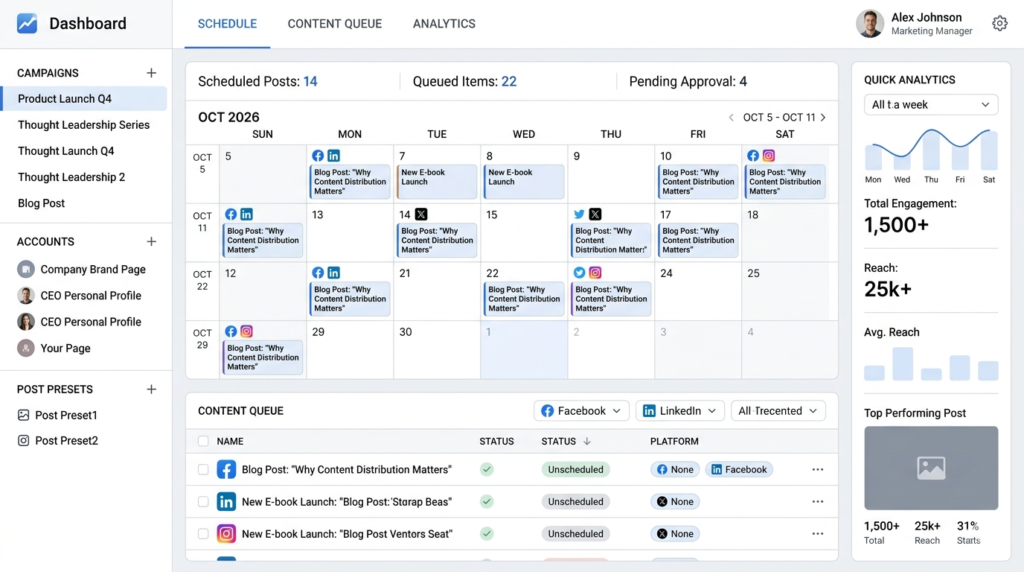
These are the operational backbone of social distribution. From a single dashboard, you can create and schedule posts across multiple platforms to ensure consistent, timely communication with your audience.
Buffer offers a clean, affordable interface for scheduling posts across multiple platforms with built-in analytics, which is ideal for small to mid-sized teams. Hootsuite is more comprehensive, with advanced analytics, content curation, and robust team collaboration features, making it better suited to larger organisations managing multiple brands or channels.
Multi-channel marketing (e.g., email, SMS, and push notifications) can increase engagement by over 250%. And scheduling tools make consistent multi-channel distribution operationally viable.
2. Content Repurposing and AI Distribution Tools
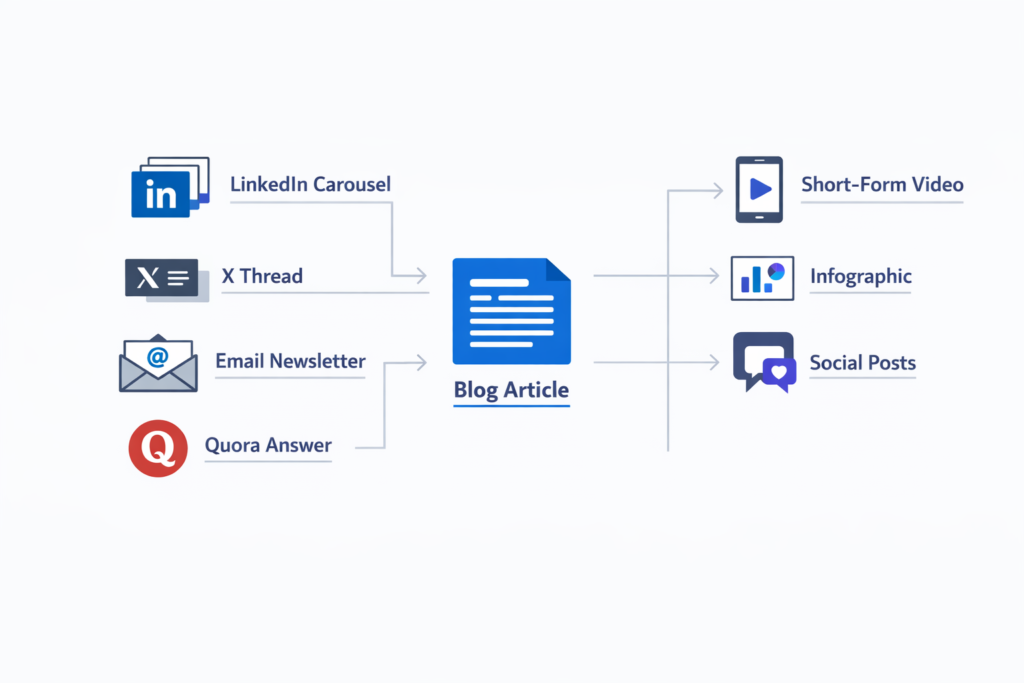
AI-powered content repurposing tools are a genuine 2026 development. Tools like Distribution.ai focus on content repurposing, helping smaller marketing teams increase output while retaining the same quality, voice, and tone. It can create multiple social posts from a single piece of content and support repurposing of blog posts, videos, and podcasts from a single dashboard. Missinglettr automatically builds a year-long social campaign from a single blog post. Tools like these make “create once, distribute everywhere” a practical reality rather than an aspiration.
3. Content Analytics and Performance Tracking Tools
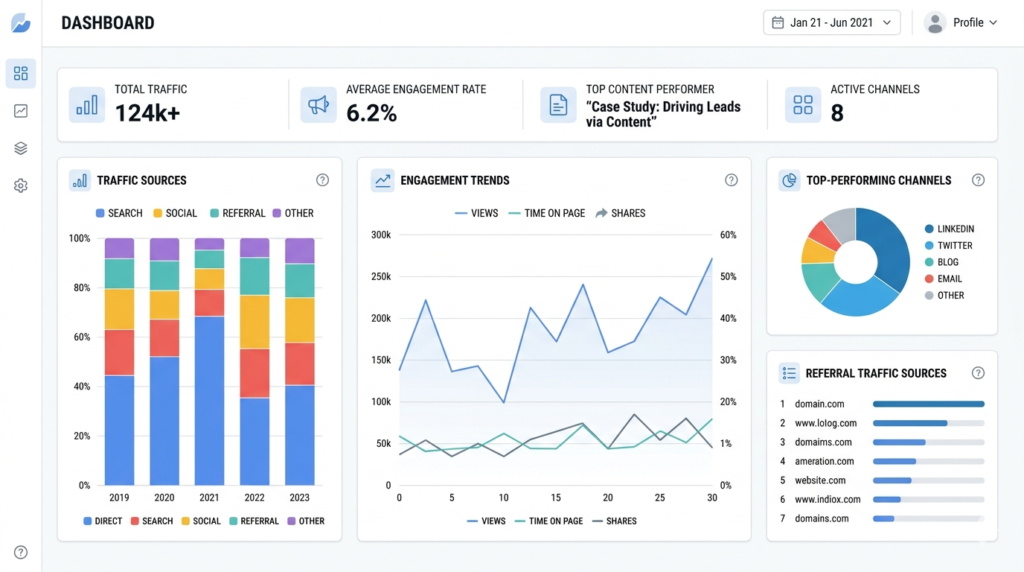
Tools like Google Analytics, Semrush, and BuzzSumo are non-negotiable for measuring which channels are driving real results. BuzzSumo analyses millions of articles across the web to surface what is being shared most actively, making it useful for discovering trending topics and identifying which influencers might amplify your next post.
4. Editorial Calendar and Workflow Tools
These tools help manage multiple projects, organize tasks, and improve team coordination. CoSchedule integrates editorial calendaring with social scheduling and email distribution, connecting your blog, social channels, and email lists so new content is promoted automatically at publication. Planable offers strong team collaboration features with shared calendars, approval chains, and internal comments, reducing the email-chain chaos that plagues most content teams.
5. CRM and Email Marketing Platforms
CRM and email marketing platforms help manage leads and improve engagement through personalised communication.
HubSpot remains the most comprehensive option for full-funnel B2B content distribution, integrating CRM, email, blog, and advertising from a single platform. HubSpot’s Spring 2025 Spotlight delivered more than 200 product upgrades, including AI-powered Breeze Agents that draft content, answer customer inquiries, and trigger nurture sequences.
Mailchimp and ActiveCampaign are strong alternatives for businesses with more focused email distribution needs.
6. Digital Asset Management (DAM) Platforms
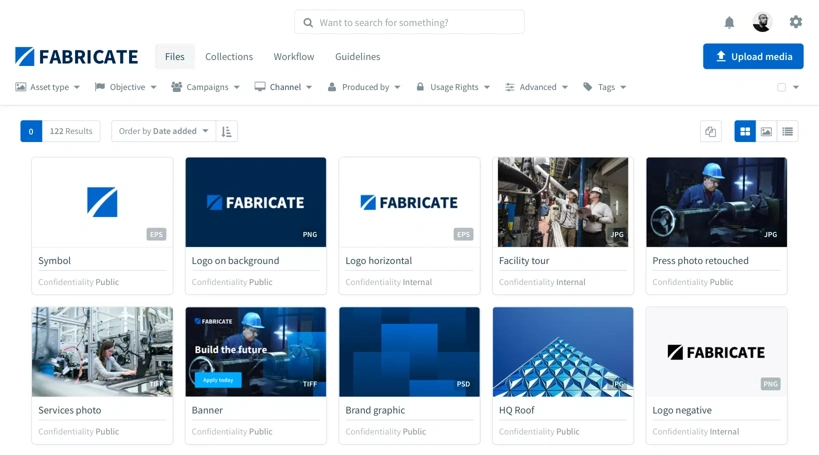
For larger organisations managing content across multiple teams and partners, a DAM platform like Bynder centralises content assets, handles version control, automates sharing, and controls access. This keeps brand consistency intact across every distribution channel.
Also Read : 10 Best AI Tools for SEO in 2026 (Tested & Compared)
How to Maximise Your Outcomes on Content Distribution Platforms
Choosing the right platforms matters. But how you use them determines whether distribution actually drives results.
- Publish SEO-optimised content first: Your owned channel (website/blog) should always be the primary home for your content. Every other platform distributes from there. Getting the SEO fundamentals right (keyword research, strategic placement, meta descriptions, internal linking) means your content continues to earn organic traffic long after the initial promotion push.
- Match content format to platform norms: Dropping a blog post link on TikTok does not work. A LinkedIn carousel adapted from a long-form article does. The best content distribution platforms reward native formats: content that looks and feels like it belongs on that platform. Invest time in adapting, not just reposting.
- Repurpose strategically across formats: One piece of well-researched content can become a LinkedIn carousel, a Twitter thread, a short video, an email, an infographic, and a Quora answer. Each format reaches a different segment of your audience on different channels, extending the reach and lifespan of a single investment.
- Experiment with paid promotion on proven content: Do not use paid distribution to test whether content resonates. Test that organically first. When a piece performs well (high time on page, strong engagement, good organic shares), amplify it with paid. This approach delivers significantly better paid ROI than boosting content at random.
- Use interactive content to drive engagement: Who doesn’t love a good ol’ game of ‘Would You Rather’ or a quiz that tells you which Harry Potter character you are? Polls, quizzes, calculators, and interactive tools generate two-way engagement rather than passive consumption. Interactive content compels action and creates the social sharing moments that amplify organic distribution.
- Measure what matters per channel: Define one success metric per channel (referral traffic from Quora, email click-through rate, LinkedIn post engagement, organic search traffic from blog). Track monthly. Shift effort towards what is working. Consistency on 2 or 3 channels done well is far better than thin presence across 10.
Also Read : 2026 Content Flywheel Strategy: How to Repurpose Content
How AI Is Reshaping Content Distribution in 2026
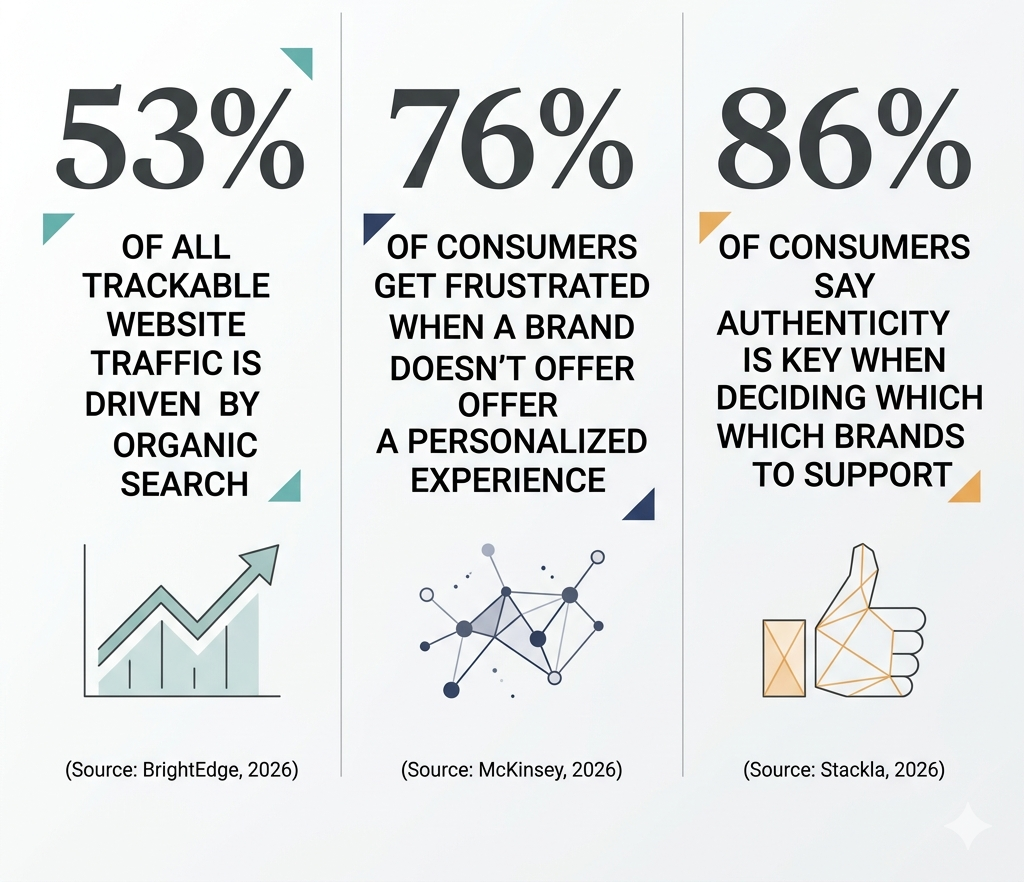
Content distribution in 2026 has a new dimension: AI-generated answers. Google AI Overviews, Bing Copilot, and ChatGPT Search now pull content from across the web to answer user queries directly in the search interface without the user ever clicking through to a website.
This makes distribution strategy and content quality even more interdependent. The content that gets cited in AI-generated answers is content that is authoritative, well-structured, and widely referenced. In other words: content that has been well-distributed and well-linked to.
To be visible in AI-powered search in 2026:
- Prioritise depth and expertise over volume.
- Earn backlinks and citations from authoritative sources.
- Structure content clearly (use headings, lists, direct answers to questions).
- Distribute content to build the referral footprint that signals credibility to AI tools.
Distribution is not just about human readers anymore. It is about building the authority signals that AI tools use to decide what to surface.
Also Read : Google AI Mode Search Explained for Content and SEO Strategy
Conclusion
The secret to effective content marketing strategy is to keep your content alive for the longest time. But that doesn’t mean just sharing your content on distribution platforms is enough.
A sustainable content distribution strategy is built on three things:
- Know your audience deeply – Understand which platforms they use, what content formats they prefer, and what questions they are actively trying to answer.
- Use a deliberate mix of owned, earned, shared and paid channels – Do not rely on any single channel. Build owned distribution assets (email lists, SEO-ranked content) as your foundation, and use other channels to drive traffic toward them.
- Measure, improve and compound – Review performance monthly, double down on what is working, and continuously update your content to keep it fresh and relevant.
Always remember that your objective isn’t to create maximum content, but to create effective and relevant content that stays evergreen over time.
Need help building a content marketing strategy for your business? The Justwords team works with brands to create content that earns visibility. Contact us today to get started.
FAQs
A content distribution platform is a tool or channel used to share content with a target audience across websites, social media platforms, email, and paid networks. It helps businesses distribute content effectively and improve reach.
The four main types are:
A. Owned media (website, blog, email)
B. Earned media (backlinks, PR, influencer mentions)
C. Shared media (social media channels and communities)
D. Paid media (ads, sponsored content, and paid content promotions)
An example of content distribution is publishing a blog post, sharing it on social media platforms like LinkedIn or Instagram, sending it via email, and promoting it through paid ad platforms like Google Ads to reach a wider audience.
Top content distribution platforms include Google (via SEO), LinkedIn, YouTube, Facebook, Instagram, X (Twitter), email marketing tools, and platforms like Reddit, Quora, Outbrain, and Taboola.
Content distribution platforms help distribute your content across multiple channels, ensuring it reaches the right audience through organic, earned, and paid strategies.
Yes, they are essential for improving content marketing results. Without distribution, even high-quality content may not reach its intended audience.
Choose platforms based on your audience, content format (e.g., video content or SEO content), engagement levels, and whether the platform supports your content marketing strategy.
Content creation is the process of producing content, while content distribution is the process of sharing that content across various platforms to maximise visibility and engagement.
Yes, distributing content across platforms can generate backlinks, traffic, and engagement signals that improve SEO performance over time.
Some platforms are free (like organic social media and SEO), while others require investment, such as paid ads, sponsored content, and premium distribution tools