
TL;DR
- Google AI Mode Search uses AI to understand intent and generate structured responses directly in search results.
- It pulls information from multiple indexed sources and supports follow-up questions in the same search flow.
- Rankings still matter, but content can be referenced even without being the top result.
- Clear structure, focused intent, and topical depth increase the chances of being used in AI-generated responses.
- Search strategies now need to consider how content is interpreted, not just how it ranks.
Introduction
Google search is quietly changing, especially when people look for answers that need more than a quick definition. By 2025, AI-generated summaries were appearing in around 15–20% of Google searches, which shows that AI is already playing a role in how information is presented.
This shift is part of how the Google AI Search Engine is evolving behind the scenes. It affects what users see first in search results and how information is organised, even before they decide to click. To understand what is changing and why it matters, read this blog.
What Is Google AI Mode Search?
When you search for something detailed on Google, you often end up opening multiple links to piece together one clear answer. Google AI Mode Search is meant to reduce that effort. It reads information from different web pages and presents a single, organised response directly on the search results page so you can understand the topic faster.
This feature is part of the broader Google AI Search Engine update. It allows you to continue your search in the same flow by asking follow-up questions or going deeper into a specific point. The usual website links are still shown, but they come after the explanation, giving you context first and sources second.
How Does Google AI Mode Work?
When you enter a query in the Google AI Search experience, the system begins by understanding what you are trying to learn. Instead of reading your input as a simple set of words, it focuses on the purpose behind the question. It considers the context of your query, how you have framed it, and whether you are looking for an explanation, a comparison, or a broader understanding of a topic.
Once this intent is clear, Google uses its AI-powered systems to scan relevant web pages, structured data, and reliable sources that are already part of its index. Rather than relying on a single article, the system pulls together information from multiple sources. With the help of generative AI tools, this information is organised into a single response that explains the topic in a clear and easy-to-follow way. The response appears directly within the search results.
What further shapes your experience is how the search continues. Using Google AI Search Mode, you can ask follow-up questions in the same interface instead of starting a new search. The system updates the response based on your next question while keeping the earlier context in mind. This allows you to explore a topic gradually. If you need more detail, you can still open the reference links and read the original content in full.
Key Features of Google AI Mode
Here are the features of Google AI mode:
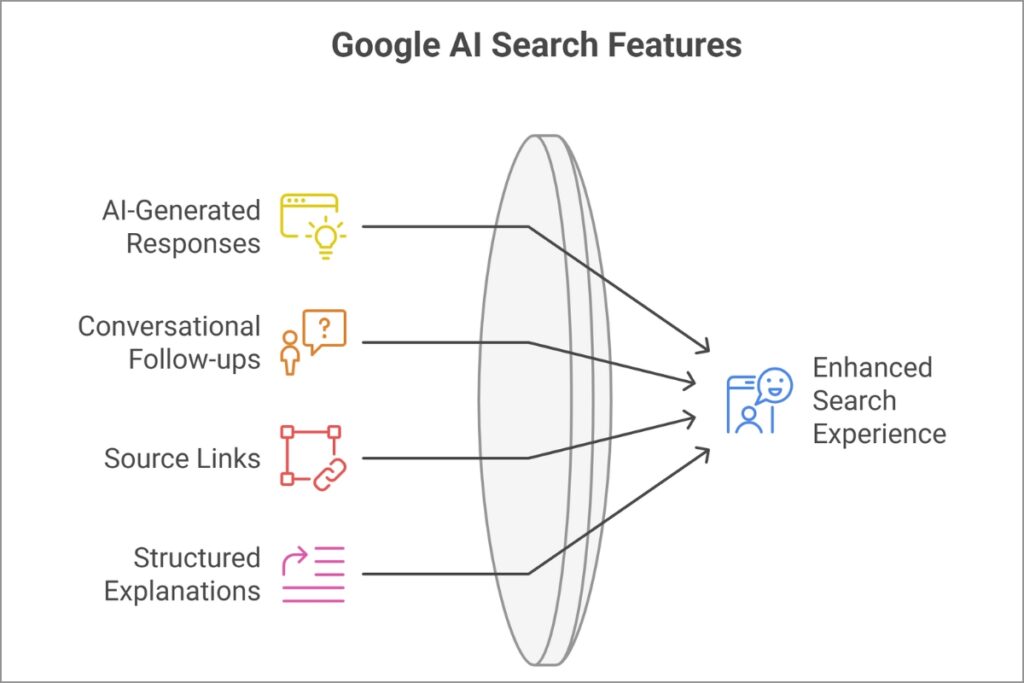
1. AI-generated responses within search results
One of the main features of Google AI Search Mode is that it presents answers directly on the search results page. Instead of opening multiple links to understand a topic, you see a clear explanation upfront. This helps you get the context first and decide whether you want to explore the sources in more detail.
2. Conversational follow-up questions
The Google AI Search experience allows you to continue your search in the same flow. After the initial response, you can ask follow-up questions without starting a new search. The system remembers the earlier context and adjusts the response based on what you ask next, which makes searching feel more natural.
3. Source links for deeper exploration
Even though answers are AI-generated, Google still shows links to original websites. These source links help you verify information and read full articles if you want more depth. This feature keeps the experience transparent and gives you control over how much information you consume.
4. Structured explanations for complex topics
Using generative AI tools, Google organizes information into clear sections and summaries. This makes complex subjects easier to understand, especially when a topic would otherwise require reading multiple long pages and connecting the information yourself.
Is Google AI Mode Replacing Traditional Search?
Google AI Mode is not replacing traditional search, but it is changing how information is surfaced within Google. Search results are no longer only about ranking links on a page. Google now decides which content is useful enough to summarise, reference, and include within AI-generated responses.
Traditional search continues to work well for navigational queries, branded searches, and direct lookups. Pages still rank, links still matter, and traffic still comes through classic results. Google AI Mode becomes more relevant when queries are informational, comparative, or exploratory, which are often the types of searches addressed through blogs, guides, and long-form content.
From a strategy standpoint, AI Mode adds a new layer to how visibility is earned. Content can influence search outcomes even if it does not appear as the top blue link, as long as it is clear, well-structured, and useful enough for Google to reference in its responses.
Google AI Mode vs Traditional Search
| Aspect | Google AI Mode Search | Traditional Google Search |
| How content appears | Google summarises information and references selected sources | Google ranks individual pages in search results |
| What Google prioritises | Clarity, structure, and topical usefulness | Relevance signals, authority, and technical factors |
| Role of content | Content supports AI-generated explanations | Content competes for rankings and clicks |
| Visibility pattern | Pages can be referenced without ranking first | Visibility depends heavily on ranking position |
| User interaction | Search continues through context and follow-up questions | Search progresses through links and new queries |
| Strategic impact | Content must be easy to understand and explain | Content must be optimised to rank and attract clicks |
In practice, both search experiences exist side by side. Traditional search continues to drive direct traffic, while Google AI Mode influences how information is interpreted and presented. Search strategies now need to account for both how content ranks and how it is understood by Google’s AI systems.
Who Benefits Most from Google AI Mode?
The Google AI Search experience tends to benefit certain types of content and websites more than others, especially those that focus on clarity and depth rather than quick clicks.
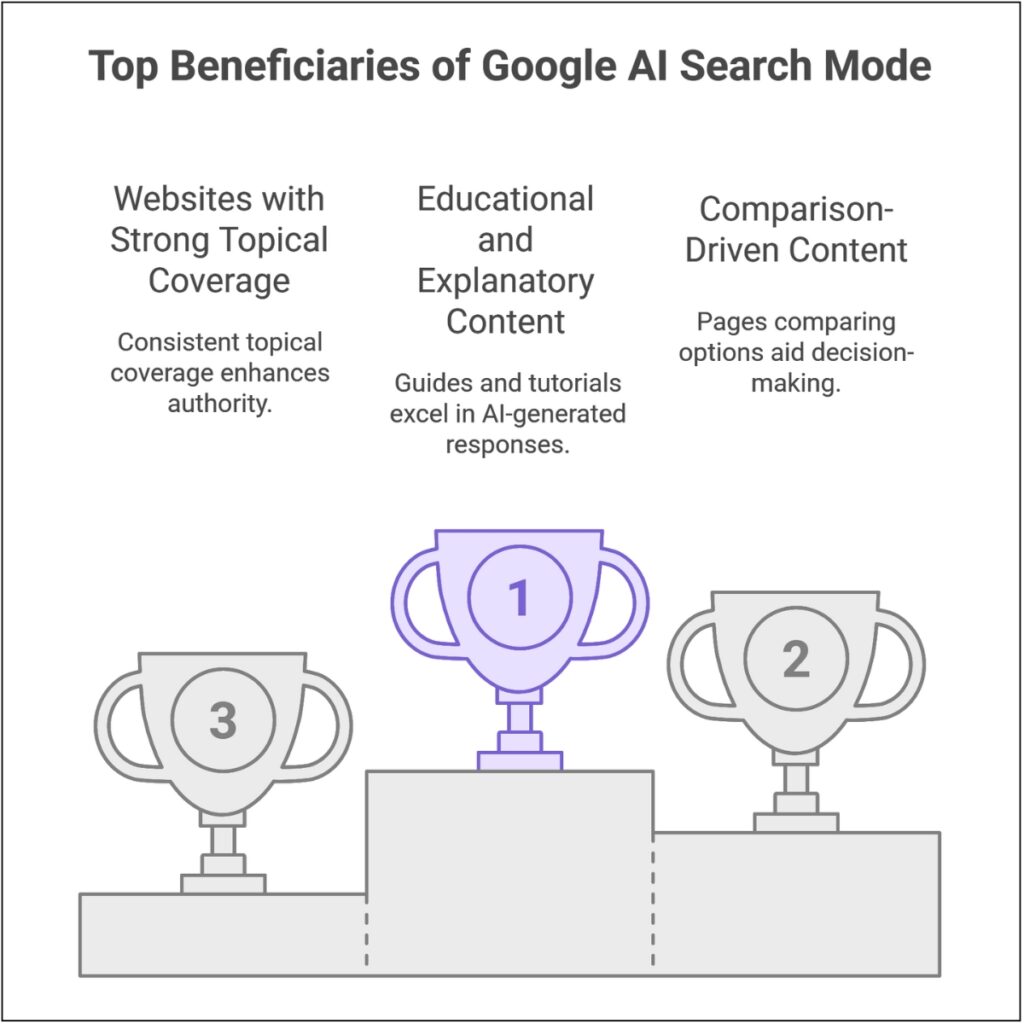
- Educational and explanatory content benefits strongly from Google AI Search Mode. Guides, tutorials, and in-depth articles that break down complex topics are easier for Google to interpret and surface within AI-generated responses.
- Comparison-driven content performs well in the Google AI Search Engine environment. Pages that clearly compare options, processes, or approaches help Google respond to exploratory and decision-stage queries.
- Websites with strong topical coverage see more value from this shift. When related topics are covered consistently across multiple pages, Google is better able to understand context and authority.
- Content aligned closely with search intent benefits more than content written purely for rankings. Clear structure, simple language, and accurate information help Google determine which pages are useful enough to reference.
What This Means for Content Creators and SEO
The introduction of the Google AI Search experience changes how content earns visibility in search. Ranking well is still important, but it is no longer the only factor that determines whether a page influences search results. Google is now evaluating how clearly a page explains a topic and whether its information can be used within AI-generated responses.
This has a direct impact of AI Mode on SEO. Content that is tightly focused, well-structured, and written to answer a specific intent is easier for Google to interpret. Pages that try to cover too many ideas at once or rely heavily on keyword repetition are less effective in this environment.
A strong SEO strategy for AI Mode places more emphasis on clarity and structure.
This includes:
- Writing content that answers one primary question clearly.
- Using descriptive headings that reflect how people actually search.
- Adding context through internal links so related topics are easy to understand as a group.
Internal linking becomes especially important here. When pages are connected thoughtfully, the Google AI Search Engine can better recognise topical depth and relevance across the site. This supports both traditional rankings and visibility within AI-powered search results.
Overall, search performance now depends on how well content explains, not just how well it ranks. SEO and content strategy need to work together to support understanding, accuracy, and intent.
What Does This Mean for the Future of Search?
Search is slowly becoming less about finding pages and more about getting answers. Google is starting to organise information for users instead of asking them to do all the work themselves. This changes what kind of content gets noticed.
Content that explains things clearly, stays focused, and is easy to follow will matter more going forward. Pages that try to cover everything at once or rely on vague language will be harder for Google to use in its responses.
Traditional search is not going away. It will still be useful when someone wants to reach a specific site or look up something quickly. At the same time, searches that involve learning or decision-making will rely more on AI-driven responses. The future of search will reward content that helps people understand, not just find.
Conclusion
Google AI Mode does not replace search, but it changes how content is selected and surfaced. Rankings still matter, but Google is increasingly using content to build responses, not just lists of links. This makes structure, clarity, and intent more important than volume.
Search strategies now need to account for how content is understood and reused by Google, not only how it performs in traditional results.
FAQs
How can you access Google AI Mode? Is Google AI Mode available to everyone?
Google AI Mode is being rolled out gradually. You may see it automatically when you search for certain queries, depending on your location and Google account settings. At the moment, it is not available to everyone and is still expanding through testing phases.
How is Google AI Mode different from ChatGPT or other AI chatbots?
Google AI Mode works inside Google Search and uses live, indexed web content to generate responses. Chatbots like ChatGPT operate separately from search and do not always reflect real-time web updates. AI Mode is built to support search behaviour rather than act as a standalone assistant.
Will Google AI Mode affect SEO and websites?
Yes, it can affect how content is discovered. Search visibility is no longer limited to ranking positions alone. Content that explains topics clearly and is easy to interpret can influence AI-generated responses, even if it is not the top result.
How can you make your content appear in AI Mode?
Focus on clear structure and intent. Content that answers specific questions, uses meaningful headings, and stays accurate is easier for Google to reference. Strong internal linking and topical depth also help Google understand where your content fits.
What’s the difference between AI Mode, AI Overviews, and classic Google Search?
Classic search shows ranked links. AI Overviews provide short summaries at the top of results for some queries. AI Mode offers a more conversational experience where you can ask follow-up questions and explore a topic within the same search view.
Will AI Mode reduce website traffic from search?
Traffic patterns may change, but this does not automatically mean a drop in traffic. Websites that provide useful, in-depth content can still attract clicks through source links and deeper exploration.
How is Google AI Mode different from Gemini (formerly Bard)?
Gemini is Google’s standalone AI system. Google AI Mode uses similar technology but applies it directly within search to organise and present information from the web.
Will traditional SEO strategies still work?
Yes, traditional SEO still matters. Technical optimisation, relevance, and authority remain important. However, they work best when combined with content that is clear, well-structured, and genuinely useful.