
SEO ROI is the profit your organic search programme generates, measured against what you spent to generate it. The formula is (revenue attributable to SEO minus total SEO cost) divided by total SEO cost, multiplied by 100. If SEO brings in ₹12 lakh of gross profit in a year from ₹4 lakh invested, your ROI is 200%.
The formula looks simple but measuring it accurately is much harder. Most businesses know exactly what they spend on SEO, but many can’t say how much revenue organic search actually generated. A customer might discover a business through Google, then contact it by phone or WhatsApp weeks later before they buy a product or service.
AI Overviews add another challenge: rankings can remain stable while clicks decline. That is why SEO measurement needs to go beyond rankings and traffic to track leads, customers and revenue.
This guide shows how to calculate SEO ROI with a worked example, which SEO ROI metrics prove progress at each stage, how to set up SEO conversion tracking so revenue is traceable, and what timeline to expect. It also covers how to read an agency’s report without being impressed by the wrong numbers.
Key Takeaways
- SEO ROI equals (attributable gross profit minus total SEO cost) divided by total SEO cost. Use gross profit, and count every cost.
- Judge SEO on qualified leads and revenue. Rankings and traffic show progress, and they do not show return.
- Tracking form fills, calls and WhatsApp clicks, and connecting them to your CRM, decides whether ROI can be measured at all.
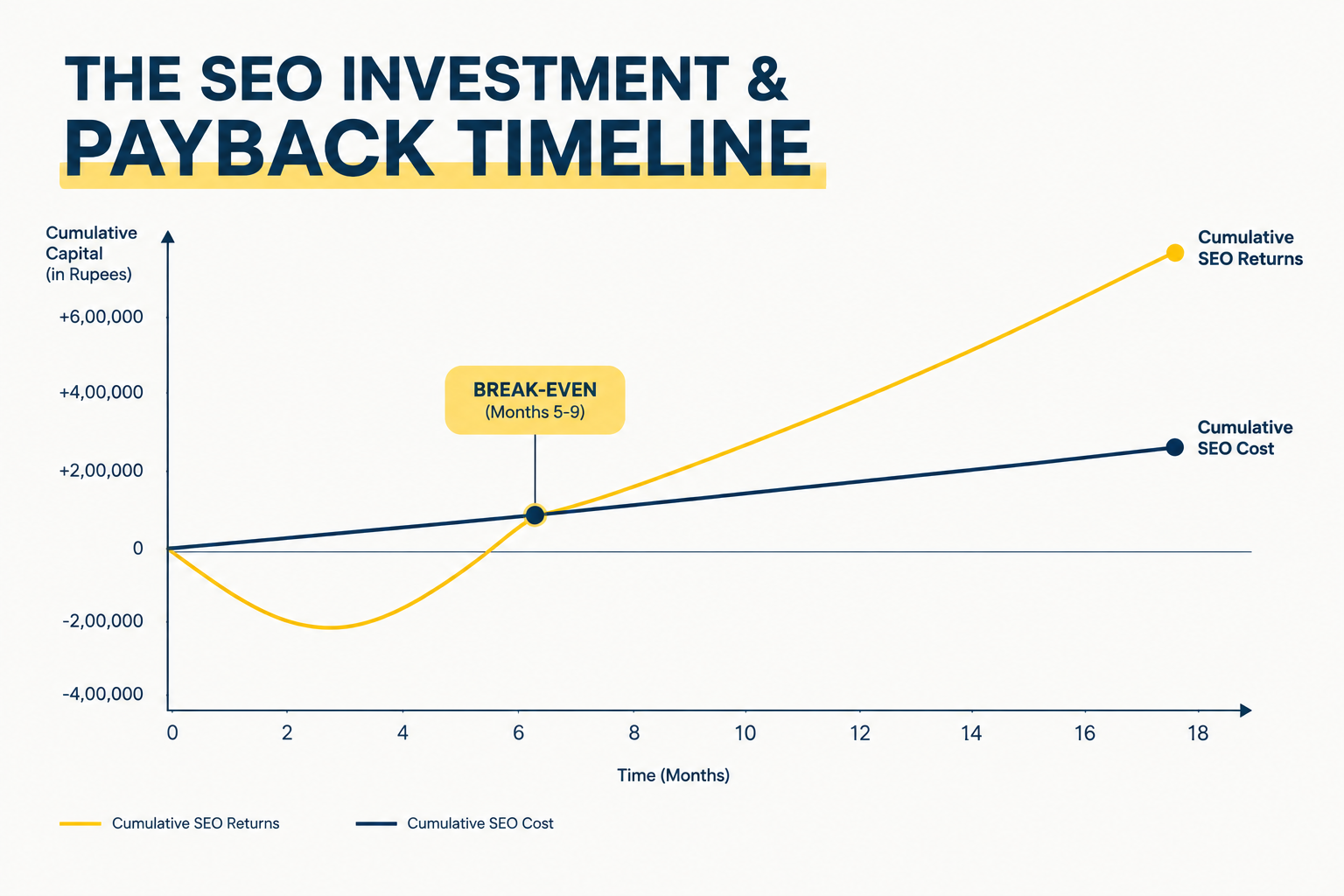
- Expect negative ROI early. Benchmarks put break-even between 5 and 13 months, depending on category, with returns growing after that.
- With AI Overviews cutting click-through rates, conversions and branded demand are more reliable signals than clicks.
How to Calculate SEO ROI: A Worked Example
To calculate the ROI from your SEO investment, start with the total cost. Total SEO cost includes the agency retainer, content production, tools, link acquisition, developer time for technical fixes and any internal hours you can price. Leaving out these expenses makes the ROI look better than it really is.
Next, calculate the return attributable to SEO. Multiply the number of organic customers by the gross profit generated per customer. Gross profit is important because revenue is not the same as profit. For example, a ₹10 lakh sale with a 30% gross margin generates ₹3 lakh in gross profit.
Here is an example for a B2B services firm in Delhi over 12 months:
| Input | Value |
| Monthly SEO investment (retainer, content, tools, developer time) | ₹80,000 |
| Total 12-month cost | ₹9,60,000 |
| Qualified organic leads | 240 |
| Lead-to-customer rate | 10% |
| New customers from organic | 24 |
| First-year gross profit per customer | ₹90,000 |
| Attributable gross profit | (24 × ₹90,000) = ₹21,60,000 |
| SEO ROI | (21,60,000 minus 9,60,000) ÷ 9,60,000 = 125% |
If customers stay for several years, lifetime gross profit gives a fuller picture. Use the same period for cost and return, and state which one you chose.
Which SEO ROI Metrics Actually Matter
Every SEO programme produces three layers of metrics.
- Leading indicators (months 1 to 3) show that work is landing. These include indexed pages, ranking movement on commercial keywords, impressions and referring domains. They prove progress and predict nothing about revenue by themselves.
- Performance metrics (months 3 to 9) show that demand is arriving. Track non-branded organic sessions, organic conversions, conversion rate by landing page and assisted conversions. Separate branded from non-branded traffic, because people who search your brand name already know you.
- Business metrics (month 6 onward) show return: qualified leads, pipeline, closed revenue, cost per acquisition and ROI. These are the numbers a finance head or founder trusts.
Reporting all three is useful. Judging on the first two alone is where businesses go wrong. Watch for the usual vanity metrics like total impressions and average position across all keywords. Each can rise while revenue stays flat.
Also Read: Professional SEO Services: What to Expect in 2026
How to Set Up SEO Conversion Tracking
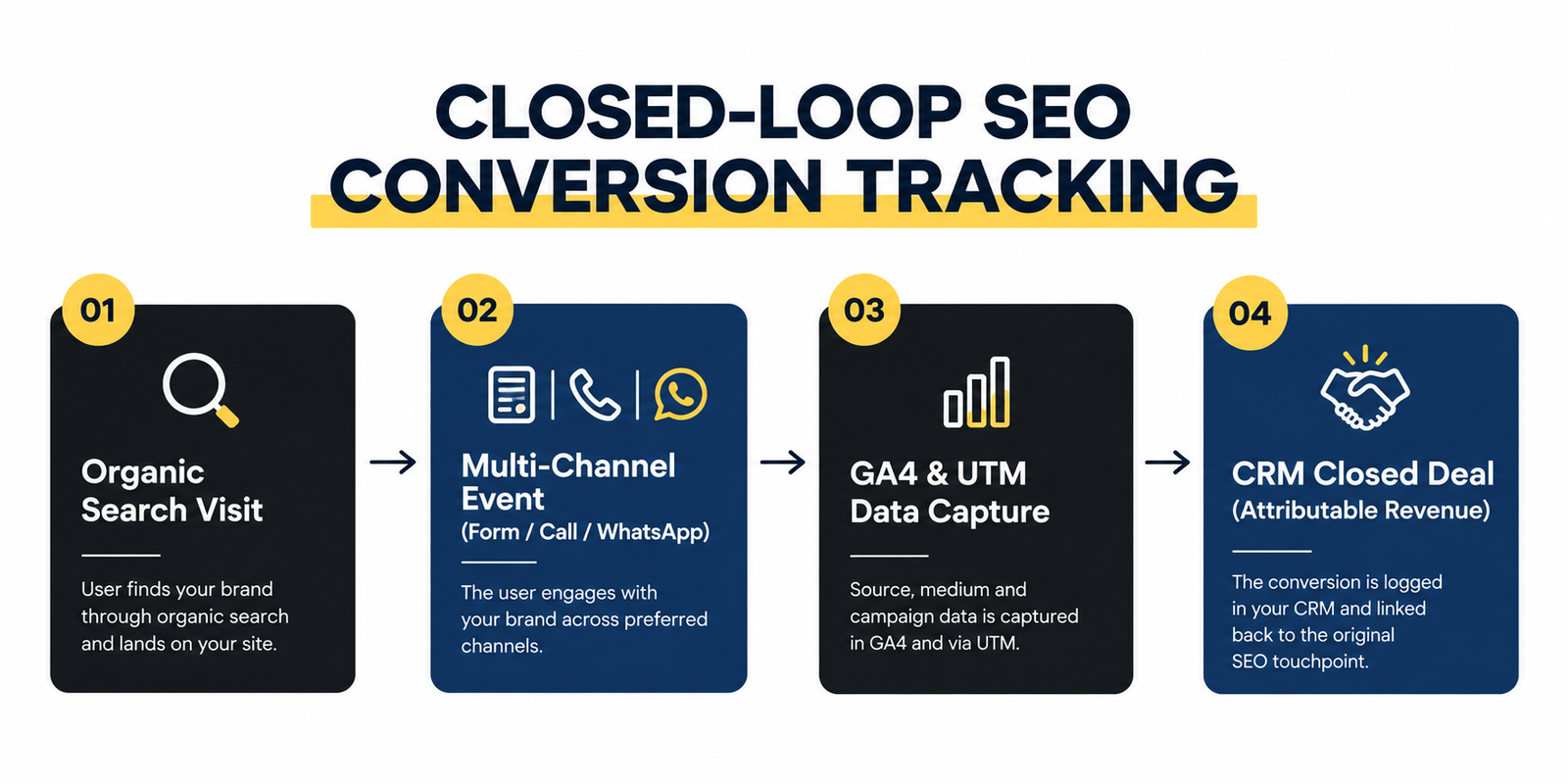
You cannot calculate ROI from data you never captured. For Indian businesses, where calls and WhatsApp carry much of the sales conversation, tracking needs to go beyond form fills.
- Define conversions in GA4 (Google Analytics): Set key events for form submissions, click-to-call, WhatsApp button clicks, chat starts and demo bookings. Assign value where you can.
- Link Search Console to GA4: This connects search queries and landing pages to on-site behaviour.
- Capture source on every lead: Add hidden form fields for source, medium and landing page, and pass them into your CRM, such as Zoho or HubSpot.
- Use call tracking: Dynamic number insertion shows which organic pages generate calls, which matters for clinics, real estate and services.
- Close the loop: Ask sales to mark leads as qualified and closed in the CRM. Without this step, you are measuring enquiries and estimating revenue.
Then check one thing every quarter: what share of last quarter’s leads has a known source? If it is below roughly 80%, treat your ROI figure as an estimate.
How Long SEO ROI Takes
SEO returns start negative. You pay for audits, technical fixes and content before organic traffic compounds, and payback follows.
First Page Sage, a US agency that publishes benchmarks from its own client campaigns, reports a three-year average ROI of 702% for B2B SaaS with a 7-month break-even, 317% for ecommerce with 9 months, and 681% for construction with 5 months. Real estate averages 1,389% with a 10-month break-even. Treat these as directional, since they come from US campaigns and one agency’s client mix.
A realistic pattern for most Indian businesses looks like this: early ranking movement in 2 to 3 months for lower-competition terms, meaningful growth compounding between months 4 and 9, and full velocity in competitive categories at 12 to 18 months.
Model ROI across 12 to 18 months. Reviewing it in 3 months is like judging a factory before its first shipment.
How AI Overviews Change SEO ROI Measurement
Clicks are a weaker signal than they were two years ago. Pew Research found that users clicked a traditional result in 8% of visits when an AI summary appeared, against 15% without one. Ahrefs measured a 58% lower click-through rate for the top-ranking page when an AI Overview was present.
This changes how businesses should measure SEO performance. Traffic can fall while rankings hold, so traffic alone can make a working programme look like a failing one. Focus on conversions and conversion rate, growth in branded search, and whether your pages are cited inside AI answers. Seer Interactive found that brands cited in an AI Overview earned 35% more organic clicks than those that were not. Visibility in these answers can contribute to how users discover and engage with your brand.
Also Read: How to Optimise for AI Search: A Practical AIO, GEO & AEO Guide
Four Mistakes That Distort SEO ROI
- Counting branded traffic as SEO growth: Branded search often reflects PR, referrals and paid campaigns. Report non-branded results separately.
- Excluding costs: Leaving out content production, developer time or tools produces an ROI that collapses under a finance review.
- Trusting last-click only: A buyer may read your guide in week one, return through a direct visit in week five and convert. Last-click credits the wrong channel. Review assisted conversions as well.
- Skipping the CRM link: Enquiries measure interest. Closed deals measure return. Reports that stop at the form fill overstate SEO in some businesses and understate it in others.
What Good ROI Reporting From an SEO Agency Looks Like
A capable SEO agency agrees on the measurement plan in the first month: a baseline, a definition of a conversion, the CRM feedback process and the break-even date you should expect. Monthly reports then follow the three layers above and end with leads and revenue.
That is how Justwords approaches its SEO services, with reporting built around business outcomes. Hero Housing Finance, for example, grew organic traffic by 752% over a 3-year mandate, reaching 60,000+ monthly visitors and 270+ monthly home loan conversions. Their results were tracked through to home loan conversions, so the return could be seen and defended.
Agree on Three Numbers Before You Invest
Before you approve the next SEO budget, agree on three numbers with your provider: how a conversion is defined, what a customer is worth in gross profit, and the month by which you expect break-even. If a provider cannot help you set these in the first month, you will not be able to judge their work in month twelve as well. So here is a question worth answering today: how many of last quarter’s leads can you trace back to organic search?
FAQs
1. What is a good ROI for SEO?
It depends on category and margins. Three-year US averages run from 317% for ecommerce to 1,389% for real estate. Any positive ROI after break-even means the programme is paying for itself.
2. What costs should I include when calculating SEO ROI?
Include the agency retainer, content creation, tools, link acquisition, developer hours and any internal time you can value. Omitting any of these inflates your ROI and weakens the number in front of your finance team.
3. Can I measure SEO ROI without Google Analytics?
Partly. CRM source fields, call tracking and Search Console can show leads, queries and calls by page. GA4 adds session-level behaviour and assisted conversions, so combining all of them gives the most complete view.
4. How often should I report SEO ROI?
Review leading and performance metrics monthly. Review revenue and ROI quarterly, because sales cycles need time to close. A single month of ROI data is rarely reliable, particularly in the first six months.
5. Is SEO still worth it with AI Overviews?
Yes, provided you measure the right things. Clicks are falling on many informational queries, so track conversions, branded search growth and AI citations alongside rankings, and prioritise pages that serve buyers close to a decision.
6. How is SEO ROI different from PPC ROI?
PPC returns start within days and stop when ad spend stops. SEO takes months to break even, then keeps producing traffic without a proportional rise in cost, so measure it over 12 to 18 months.