Most businesses need one SEO agency that covers both traditional search and AI search under a single strategy. An AI SEO agency optimises for visibility inside AI-generated answers (Google AI Overviews, AI Mode, ChatGPT, Perplexity) as well as for rankings. A traditional SEO agency focuses on rankings, traffic and conversions from classic Google search results. The right choice depends on your foundation: fix weak fundamentals first, and add the AI layer once they hold.
The market makes that decision harder than it should be. Within a year, agencies have relabelled themselves as GEO agencies, AEO agencies and AI search marketing agencies, often with the same team and a new price list. On the other hand, Google says no special optimisation is required to appear in AI features. So what separates real AI SEO capability from a rebrand, and what should you pay for?
This guide compares both agency types, shows what data says about AI search, lays out a decision framework by business situation and gives you the questions that expose empty claims.
Key Takeaways
- A traditional SEO agency improves your rankings on Google. An AI SEO agency does that and also works to get your brand named correctly in AI answers.
- AI SEO, GEO and AEO describe overlapping work. All of it rests on traditional SEO fundamentals, extended with entity clarity, answer-first content and third-party authority.
- Google still dominates search in India, and AI referrals remain a small but fast-growing share of traffic. AI search is a layer on top of Google today.
- Traditional SEO agencies often miss AI visibility. AI-only agencies often neglect fundamentals. Both gaps cost you money.
- Weak SEO foundations call for fundamentals first. Strong foundations with falling informational traffic call for an AI layer. Local businesses should start with local SEO.
-
What Is a Traditional SEO Agency, and What Is an AI SEO Agency?
- A traditional SEO agency: SEO stands for search engine optimisation, which means improving your website so it appears higher when people search on Google. A traditional SEO agency does this through four kinds of work. Technical SEO fixes problems that stop Google from reading your site properly. Content work creates pages and blogs that answer what people search for. Link building earns links from other websites, which act as votes of trust. Local SEO helps nearby customers find you on Google Maps. Success is measured in rankings, website visits and enquiries.
- An AI SEO agency: More people now ask an AI tool a question and read the answer it writes, and fewer people click through a list of websites. Google shows AI-written summaries (AI Overviews and AI Mode) at the top of results, and tools such as ChatGPT and Perplexity answer directly. These answers name or link to a few sources, which is called a citation. An AI SEO agency does everything above and also works to make your brand one of those sources in AI answers, and to make sure the answer describes your business accurately.
You will also see terms like GEO (generative engine optimisation) and AEO (answer engine optimisation). Both mean working to appear in AI answers, and agencies use them loosely. Here, “AI SEO” is the umbrella and covers all three.
AI SEO Agency vs Traditional SEO Agency: What Actually Differs
The differences between AI SEO agencies and traditional SEO agencies show up in goals, methods and measurement.
Traditional SEO agency AI SEO agency Goal Rankings, organic traffic, conversions Citations, mentions and accurate brand descriptions in AI answers, plus rankings Core work Technical SEO, content, links, local SEO The same fundamentals, plus entity clean-up, answer-first content, topic clusters, digital PR, video and community presence Metrics Rankings, sessions, leads Prompt-level visibility, mention share, AI referrals, branded search, leads Typical weakness Reports clicks only and adapts slowly Overpromises citations and neglects fundamentals Three terms deserve a plain explanation. Brand or entity clean-up means keeping your company name, description and online profiles consistent everywhere, so that search engines and AI tools recognise one clear business. Topic clusters are groups of connected pages that cover a subject in depth. Mentions on other sites, often called digital PR, means getting credible websites to talk about your brand, since AI tools lean on what independent sources say.
The overlap matters more than the difference. AI Overviews draw on pages that Google has already found (crawled), stored (indexed) and judged useful. Ahrefs found in March 2026 that 38% of cited pages also rank in the top 10, with the rest drawn from a wider pool of relevant pages. This indicates strong SEO raises your odds of a citation.
What the 2026 Data Says About AI Search Traffic
Google handled 98.06% of search referrals in India in August 2026, according to StatCounter. A referral is a visit sent to your website from another platform, so nearly all visits that come from search engines in India come through Google. No alternative search engine has come close in this market.
AI platforms send a small share of traffic. Conductor’s study of 13,770 domains found AI referrals averaging about 1.08% of sessions in late 2025, out of which 87.4% came from ChatGPT. SE Ranking’s June 2026 data across more than 100,000 sites put the share at 0.32%, up from 0.02% in 2024. Adobe reported that AI referrals to US retail sites converted 42% better than other traffic.
Read together, these studies show AI search is small, growing fast and high in intent. It deserves a budget line. However, it does not yet justify abandoning Google rankings.
Where Traditional SEO Agencies Fall Short in AI Search
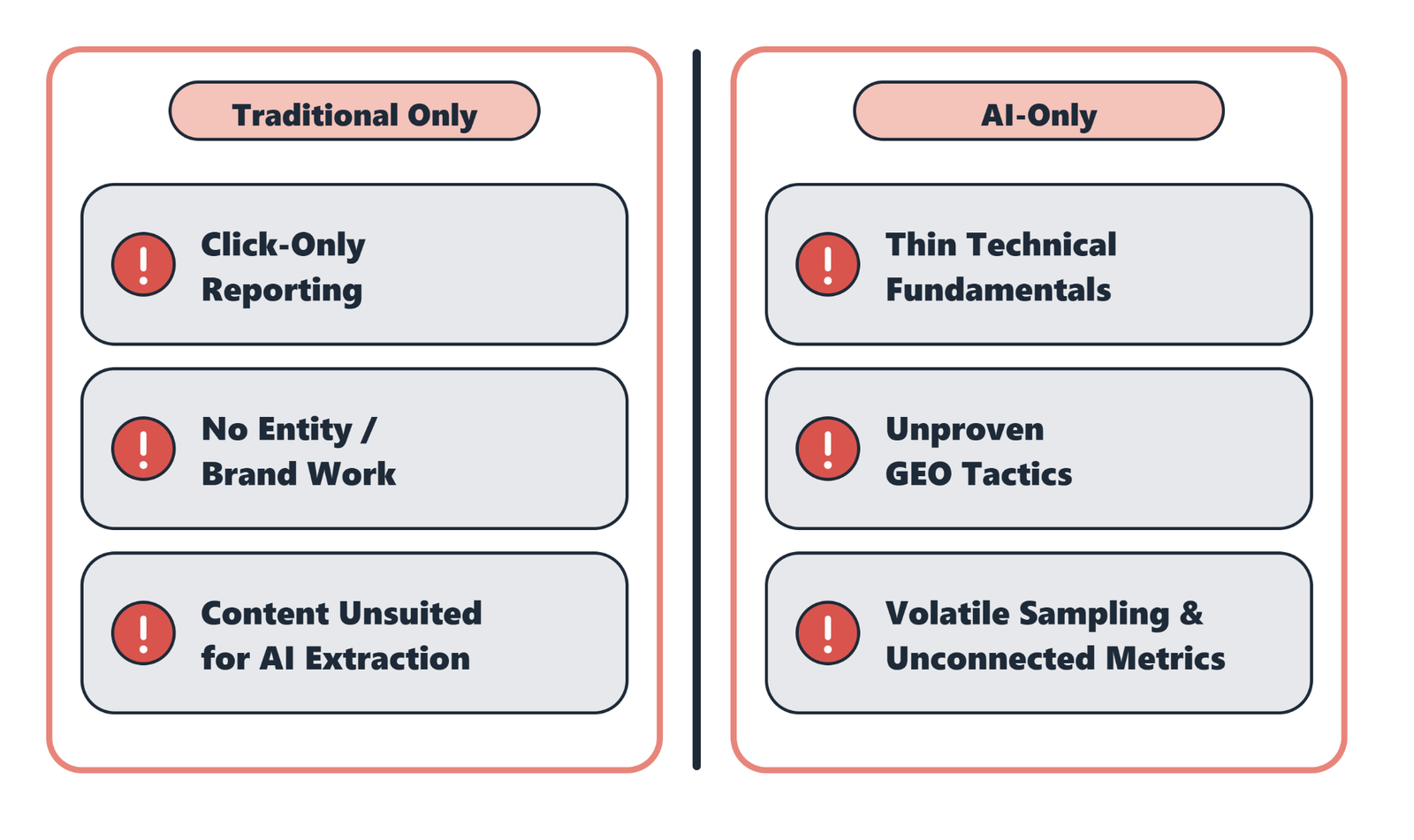
- Alt text: A two-column diagram contrasting the blind spots of traditional SEO agencies against the structural weaknesses of AI-only agencies.
A traditional SEO agency built around keywords and links tends to miss four things:
- Measurement: Reports stop at rankings and clicks. When an AI Overview answers the question, clicks fall while visibility may rise. A click-only report cannot see it.
- Entity and brand work: Branded mentions and consistent brand identity strongly influence AI visibility, yet most traditional retainers include neither.
- Content built for extraction: Pages written to hit a keyword count often lack a clear, direct answer that an AI system can quote.
- Off-site authority: AI systems draw heavily from YouTube, community platforms and independent publications. A link-building programme alone covers part of that ground.
Where AI SEO Agencies Fall Short
Relying only on AI SEO agencies carries its own risks:
- Thin fundamentals: Crawlability, indexation, site speed and internal linking still decide whether a page gets considered. An agency that talks only about prompts may leave these untouched.
- Unproven methods: Google states that no special files, markup or tactics are needed for AI features. ChatGPT and Perplexity have their own algorithms. Claims of secret GEO techniques deserve scepticism.
- Volatile measurement: AI answers change from run to run. A screenshot of one prompt proves little, and sound reporting samples many prompts over time.
- Disconnected metrics: Tracking mentions without connecting them to leads and revenue produces a report that looks busy and shows no return.
How to Decide: Which Agency Does Your Business Need?
Your situation What you need Why Weak rankings, thin content, technical issues Fundamentals first (a site Google can read, useful pages, trusted links), from an agency that writes AI-ready content from day one AI tools cannot cite pages that Google cannot find, store or trust Good rankings, falling informational traffic An AI layer on top of existing SEO Rewriting key pages to answer directly, fixing brand consistency and tracking AI visibility protect you where clicks are shrinking Competitive B2B or enterprise category One integrated agency covering SEO, content, mentions on other sites and measurement Long buying cycles reward consistent authority across channels Local small business Local SEO first: a complete Google Business Profile (your free business listing on Google Maps and local results), reviews and location pages The same signals feed local results and AI answers Existing SEO agency plus a separate GEO vendor Consolidate under one owner Two vendors optimise the same pages in different directions For most businesses, the answer is an integrated, content-led SEO agency with proven AI search capability. A specialist GEO or AEO consultant can add value as a short-term audit for a team with strong in-house SEO, though a permanent second vendor usually creates overlap and conflict in practice.
How to Test an AI SEO Agency Before You Sign
Watch for these red flags in an agency’s pitch:
- Guaranteed citations or rankings: No agency controls AI answers.
- No baseline: A baseline is a starting measurement taken before work begins. Without one, no agency can show improvement later.
- A repackaged SEO plan: The same deliverables under a new name signal a rebrand.
Then ask these questions, and listen for specific answers:
- How will you measure our AI visibility? Look for testing many questions across several AI tools, comparing your mentions with competitors and tracking visits from AI tools in GA4.
- How does AI visibility connect to leads? The answer should reach your CRM, the system where your sales team records enquiries and customers.
- What will you do about our technical and content foundations? A credible plan starts with an SEO audit, which is a full review of your site.
- Who owns strategy? The agency should own it end to end, with your team supplying brand context and approvals.
What an Integrated AI SEO Service Looks Like
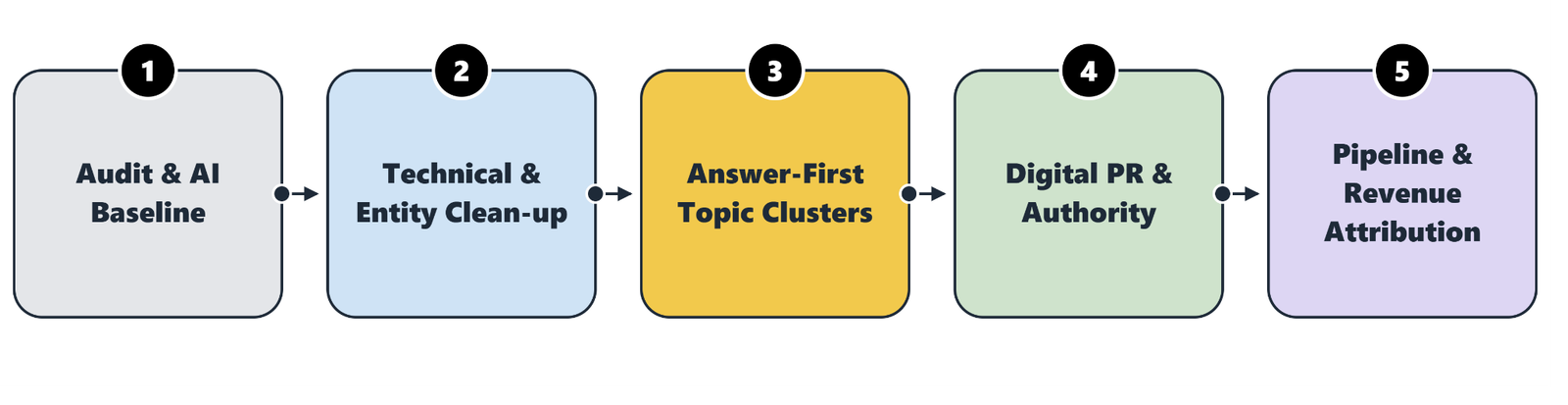
A full-service programme covers an audit with an AI visibility baseline, technical SEO, brand clean-up, topic clusters, answer-first content, mentions on credible sites and reporting tied to leads, all under one owner.Justwords, for example, builds AI SEO services into its SEO and content marketing engine, which runs from audit and strategy through writing, optimisation, distribution, measurement and scale.
Coloplast Store India, an online store for ostomy care products, shows how that plays out. When full SEO and content work began in December 2024, organic traffic was 199, with only 3 keywords in the top 3 positions and no AI Overview appearances. By December 2025, traffic peaked at 16K a month, with 246 keywords ranking, 70 of them in the top three and 13 appearing in AI Overviews. By November 2026, traffic was about 10K, while top-three keywords had risen to 93 and AI Overview appearances to 73.
The content covered patient questions, buyer-focused topics and brand awareness, all reviewed by the client’s clinical team for accuracy. Visibility inside AI answers grew while clicks settled below their peak, which is why AI SEO has to be measured on more than traffic.
What Next: Decide What to Fix First
Where is your visibility weakest today? If rankings and technical health are weak, fix those before paying for AI-specific work. If rankings are solid and informational clicks are falling, add the AI SEO layer. Either way, insist on a baseline, a measurement plan and one team that owns strategy from audit to revenue.
Every quarter spent with a split strategy gives competitors more time to build the authority AI systems learn from. If you would like an honest read on which gap to close first, our team can start with an audit to determine whether you need SEO services or AI SEO services.
FAQs
1. What does an AI SEO agency do?
An AI SEO agency improves your visibility in search results and AI-generated answers through technical SEO, topic-led content, brand clean-up, mentions on credible sites and measurement linked to leads and revenue.
2. Can a traditional SEO agency do AI SEO?
Yes, a traditional SEO agency can do AI SEO if it has added brand clean-up, answer-first content and AI visibility tracking to its process. Ask for a sample report and its baseline method before assuming it has.
3. Is an AI SEO agency worth it for a small business?
Usually not as a separate premium package. Local SEO, a complete Google Business Profile, reviews and clear service pages deliver more and also support AI visibility.
4. How long does AI SEO take to show results?
Early ranking movement usually appears within 60 to 90 days. AI mentions tend to follow over several months as content, brand and authority signals build.
5. Can any AI SEO agency guarantee AI citations?
No. AI answers change across runs and platforms, and no agency controls them. Treat any guarantee as a red flag, and judge agencies on method, measurement and lead outcomes.