
SEO in India costs anywhere from ₹8,000 to ₹5,00,000 per month depending on the scope, agency tier, and competitiveness of your market. For most businesses (mid-sized companies, D2C brands, B2B services firms and growing startups), the realistic range for a full-service SEO retainer from a capable agency sits between ₹50,000 and ₹2,00,000 per month, scaling up from there for enterprise-level work.
The wide range exists because SEO pricing in India is not a standard commodity. What you pay reflects the depth of strategy, the seniority of the team working on your account, the quality of content created, the methodology behind link acquisition, and increasingly, how well an agency handles AI search apart from traditional rankings.
This guide breaks down what SEO actually costs in India in 2026, what drives the price difference between tiers, and how to evaluate whether the number in front of you is reasonable for what your business actually needs.
Key Takeaways
- Full-service SEO retainers in India typically range from ₹50,000 to ₹2,00,000+ per month, scaling higher for enterprise-level programmes.
- Freelancers cost ₹8,000 to ₹25,000 per month and suit a narrow, early-stage scope, not a full-service engagement.
- Your budget depends less on company size and more on your business type, your site’s scale, and how competitive your market is.
- The cheapest SEO in India is never really cheap. Thin content and link spam create penalties that cost more to recover from than a quality retainer would have cost to begin with.
- Price alone is not a reliable quality filter. Use deliverables, methodology and case studies to evaluate proposals.
What SEO Services in India Actually Cost: A Tier-by-Tier Breakdown
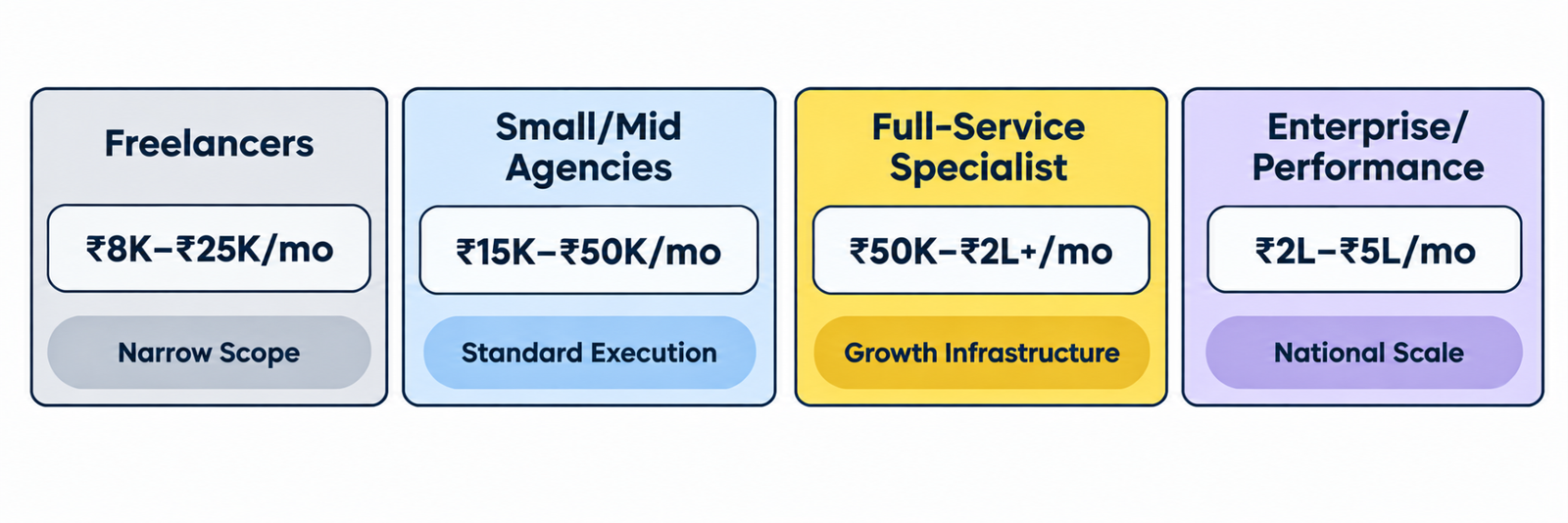
The SEO pricing landscape in India broadly spans four tiers, and the difference between them is not just cost. It is the nature of what is being delivered.
| Who you hire | Typical monthly cost | What you usually get | Best suited for |
| Freelancer | ₹8,000 to ₹25,000 | One or two areas of SEO, such as on-page and keyword research, or content | Early-stage validation, one-off audits |
| Small and mid-tier agency | ₹15,000 to ₹50,000 | Package-led work (fixed keywords, blogs and links); strategic depth varies widely | Local businesses and small sites in low-competition niches |
| Full-service specialist agency | ₹50,000 to ₹2,00,000+ | Content strategy, technical SEO, link building, AI/AEO visibility work and senior oversight working as one system | Mid-sized companies, D2C brands, B2B firms, growing startups |
| Enterprise and large-scale | ₹2,00,000 to ₹5,00,000+ | Dedicated team, advanced technical work, content and link building at volume, authority building across the domain | National ecommerce, enterprise SaaS, finance and BFSI |
Freelancers: ₹8,000 to ₹25,000 per month
A freelance SEO specialist typically covers one or two areas of SEO, such as keyword research and on-page optimisation, or content writing. This suits a narrow, well-defined scope: a startup validating whether organic search works for its category, or a business that needs a one-off technical audit rather than ongoing strategy. It is not a substitute for a full-service engagement, since one person cannot own technical SEO, content, link building and reporting without something getting deprioritised.
Small and mid-tier agencies: ₹15,000 to ₹50,000 per month
This tier covers the majority of agencies operating in India, and the quality range within it is wide. At the lower end, you’ll find templated packages (a fixed number of keywords, blogs and backlinks) with limited strategic depth and often junior execution. At the upper end, some agencies offer genuinely capable mid-market SEO. What to watch for is whether you are buying a package or a strategy. A package tells you what you will receive, a strategy tells you why it will move your organic revenue.
Full-service specialist agencies: ₹50,000 to ₹2,00,000+ per month
This is where integrated SEO engagements live: content strategy, technical SEO, link building, AI-search visibility work, performance reporting and senior oversight working as one system. The higher end applies to competitive categories (finance, real estate, SaaS, ecommerce at scale) that need deeper content investment and stronger link profiles.
At Justwords, our retainers sit across this range, structured in tiers so the scope (pages worked on, keywords tracked, content volume and AI/AEO visibility coverage) scales with what a business actually needs, rather than starting from a fixed, one-size price.
Enterprise and large-scale: ₹2,00,000 to ₹5,00,000+ per month
National ecommerce brands, enterprise SaaS companies, and finance or BFSI players competing for high-volume national keywords operate at this level, with dedicated teams, advanced technical infrastructure, and content and link strategies built across an entire domain ecosystem. Performance-based pricing (a base retainer plus a share of incremental organic revenue) also tends to live at this level, since it requires clean attribution infrastructure to work fairly for both sides.
What Drives the SEO Price Difference
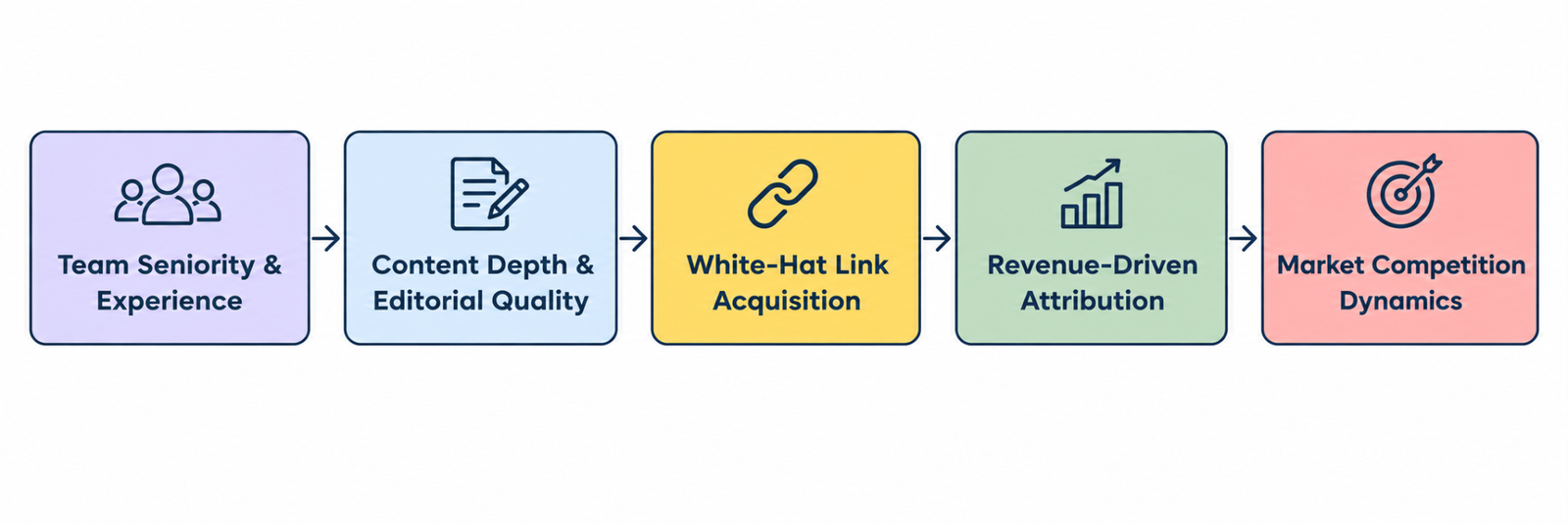
Two agencies quoting ₹25,000 and ₹1,00,000 for what looks like the same scope are not offering the same service at different prices. They are offering different services. Here’s how:
- The seniority of the people on your account: A junior executive running a templated plan is not the same as a senior strategist building a market-specific content architecture. The cost of experienced talent is real, and it directly affects the strategic thinking behind your SEO programme.
- Content quality and volume: SEO in 2026 is inseparable from content. A retainer with a handful of strategically planned, well-researched, editorially reviewed articles a month costs more to deliver than the same number written to a generic template, and that gap compounds over a year. Our own packages, for instance, scale content output by tier rather than cutting corners as volume goes up. Every piece is written to the same editorial standard regardless of how many pieces are in scope.
- Link acquisition methodology: White-hat link building (editorial outreach, digital PR, genuine relationship-based placements) is time-intensive. An agency that promises dozens of backlinks a month at a low price is almost always buying from link farms, and those links don’t build authority; they eventually trigger penalties. Our own link building only considers sites above a minimum authority threshold, and we would rather land fewer, more relevant placements than a large number of generic ones.
- AI search and visibility work: Buyers increasingly get answers through AI tools like ChatGPT and Google’s AI Overviews. Many agencies treat this as a separate add-on and quote extra for it. We build AI visibility work (tracking the questions your buyers ask AI tools, auditing how AI platforms describe your brand and making key pages easy for AI to cite) into every one of our retainers, because it has become a baseline expectation rather than an optional extra.
- Reporting and measurement depth: Reporting on traffic and rankings alone tells you how SEO is performing in search, not what it’s worth to the business. Connecting SEO to leads, opportunities and revenue through analytics and CRM data takes more expertise and ongoing work, and costs more accordingly.
- Industry competition: SEO for a moderately contested B2B category costs less than SEO for a real estate portal competing against decade-old domains. The competitive landscape is a real cost input, and an agency that quotes without understanding your competition is guessing.
In practice, the difference between the two quotes usually looks like this:
| What you are paying for | Around ₹25,000 per month | Around ₹80,000 per month |
| Team on your account | A junior executive running a templated plan | A senior strategist, specialist writer and technical SEO lead |
| Content | 2 to 4 template-based articles | 4 to 6 researched, editorially reviewed articles |
| Link building | Directory, profile and bulk guest post links | A smaller number of highly relevant editorial placements and digital PR |
| Technical SEO | A basic audit, rarely revisited | Ongoing monitoring, with fixes sequenced alongside your developers |
| Reporting | Keyword rankings and traffic | Organic leads, pipeline and revenue tied to analytics and CRM data |
| Strategy | A fixed package | A roadmap that changes as the data does |
SEO Cost by Business Size
Your budget also depends on what you are trying to rank for, how established your competitors are, and how large your site or catalogue is. See this as a rough guide:
| Business profile | Typical monthly investment | What drives it |
| Local or single-location business | Lower end of the full-service range | Fewer pages and keywords to work on, simpler local SEO |
| Growing SME, startup or multi-location business | Mid-range | More pages and keywords, a steady content publishing frequency, broader local presence |
| Established B2B, SaaS or regional ecommerce | Upper-mid range | Deeper content and link building, more competitive keyword sets |
| National or enterprise-scale business | Top of the range and beyond | Large page or catalogue volume, high competition, a dedicated team |
Ecommerce is the exception that scales mostly with catalogue size rather than business type. A 300-product store and a 30,000-product store need very different levels of category page work, filter and faceted-navigation control, and product schema, even when their stated goals look similar.
Not sure which profile fits your business? Talk to our team, and we will scope it against your site and your market.
SEO Pricing Models: Retainer, Project, Hourly or Performance-Based
There are various pricing models in the industry for SEO engagements. The right model depends on whether the work is ongoing, how clearly it can be defined, and how much uncertainty either side is willing to carry.
| Model | How it works | Typical cost in India | Best for | Watch out for |
| Monthly retainer | A fixed monthly fee for an agreed scope | ₹50,000 to ₹2,00,000 for full-service work | Businesses that want sustained organic growth | Vague scope, or fixed quantities that never adapt to what the data shows |
| Project-based | A fixed fee for a defined piece of work, such as an audit or migration | ₹15,000 to ₹2,00,000 depending on scope | A specific problem, a site launch or a migration | No ongoing optimisation, and findings that nobody implements |
| Hourly consulting | You pay for advice or troubleshooting by the hour | ₹1,000 to ₹2,500 an hour for most specialists; more for senior consultants | Teams with in-house people who can execute | Open-ended hours that are hard to forecast |
| Performance-based | Fees tied to rankings, leads or revenue | Usually a base retainer plus an uplift, mostly at enterprise level | Businesses with clean attribution and realistic timelines | Chasing easy keywords, and guarantees no one can honestly make |
| Fixed package | A standard bundle of keywords, blogs and links | ₹15,000 to ₹60,000 | Buyers who want a simple starting scope | Article and link counts standing in for strategy |
One-Time SEO Costs Worth Knowing
SEO costs aren’t always recurring. Some investments are one-time, usually made when an engagement begins or when a website hits a major stage of growth:
| One-time project | What it covers | What moves the price |
| SEO audit (technical, content, or both) | Site architecture, crawlability, Core Web Vitals, keyword and content gaps | Site size and how much existing content needs review |
| Website migration SEO | Pre-migration planning, redirect mapping, post-migration monitoring | Number of URLs, platform change, domain change |
| Local SEO setup | Google Business Profile optimisation, citations, local landing pages | Number of locations and service areas |
Migration is the one businesses most often underestimate. Platform migrations, domain changes and site restructures done without proper SEO oversight are one of the fastest ways to destroy years of accumulated organic authority. A content audit, on the other hand, is worth its cost for businesses that have been publishing for years without a strategic framework, since it shows why existing content isn’t ranking and what to do about it.
How to Set an SEO Budget
A good budget starts with your business economics rather than the agency’s price list. These five questions will get you most of the way there:
| Step | Question to answer | Example |
| 1. Value of a lead | What is a qualified lead or sale worth to you? | A B2B firm with a ₹3,00,000 average deal and a 10% close rate: each qualified lead is worth about ₹30,000 |
| 2. Break-even | How many qualified organic leads does the retainer need to cover itself? | An ₹80,000 retainer needs about 3 qualified leads a month to break even |
| 3. Opportunity | How much organic demand exists, and how strong are the sites already ranking? | Search volume for your commercial keywords, and the domain strength of today’ top results |
| 4. Capacity | What can your own team implement? | If developers and approvers are stretched, budget for the agency to carry more of the work |
| 5. Runway | Can you sustain this for at least 12 months? | A budget that forces you to stop at month 4 is a poor fit, however good the plan |
Run the same numbers for a conservative case too, with a lower close rate and a longer timeline. Spend tends to be heavier in the first few months while technical issues get fixed; traffic and leads typically start compounding from month 4 onward, with competitive categories needing closer to 12 to 18 months to show their full effect. If a budget only works under the most optimistic assumptions, narrow the scope or start with a defined project instead.
The Real Cost of Cheap SEO
The lowest-priced SEO services in India (agencies offering full packages at ₹10,000 to ₹20,000 per month) share a predictable set of characteristics. They often rely on bulk content written around keywords and low-quality backlinks from irrelevant websites and directories. Their reports usually focus on keyword rankings without any connection to leads or actual business results.
The consequence of this is not just zero results. It is negative results. A manual Google penalty for unnatural link patterns can remove a site from search results entirely. Recovery from a penalty typically takes 6 to 18 months of remediation work, including a backlink audit, removing or disavowing harmful links and cleaning up affected content. During this period, the business can also lose valuable organic traffic and revenue. In many cases, the combined cost of recovery and lost revenue is far higher than investing in quality SEO from the start.
There is also the opportunity cost of time. A business that spends 12 months with an ineffective SEO agency and then switches is 12 months behind the competitor that made the right decision at the start. In competitive categories, that gap is meaningful and slow to close.
Therefore, the question worth asking is not “what is the cheapest SEO I can get?” Rather, it’s “what is the cost of not growing organically for the next 12 months?”
How to Evaluate Whether a Quote Is Reasonable
When you receive an SEO proposal, the monthly number is the last thing to evaluate. The first things are:
- What specific deliverables are included, and how are they defined? Instead of simply saying “content”, the agency should specify what it will deliver. For example, “four 1,200-word articles each month, based on agreed keyword topics and editorially reviewed before publishing” gives you a clear understanding of the work included. The more specific the deliverables, the easier it is to judge the value of the service.
- What is the link-building methodology? Ask specifically where backlinks will come from and how the agency qualifies link targets. A good agency should be able to explain its approach clearly. If it cannot tell you how it builds links, be cautious.
- What does reporting cover? Ask to see a sample report from a current client. A good report should show more than impressions, clicks and keyword rankings. It should also help you understand whether SEO is bringing relevant visitors, leads and business opportunities. If the agency does not track these things, it cannot show you the wider business impact of SEO.
- Have they worked with businesses like yours? SEO results vary widely by industry and level of competition. An agency may have good results in an easy-to-rank niche but struggle with competitive commercial keywords. Ask for case studies from businesses similar to yours.
- What is the onboarding process? A credible agency asks about your business goals, sales cycle, existing content and target audience before it proposes anything. An agency that sends a standard package before asking a single question about your business is just selling a product rather than a tailored strategy.
Read more: How to Choose an SEO Agency: Questions Before You Hire
Conclusion
SEO cost in India is not a fixed number. It is a function of what your business genuinely needs, how competitive your category is and the quality of the agency you choose to work with.
The businesses that see the strongest return from SEO investment in India invest according to their goals rather than simply choosing the lowest-priced provider. They invest at a level appropriate to their goals, with an agency that understands their market and measures SEO success by its contribution to leads, sales and revenue.
Organic search compounds. A well-executed SEO programme built over 12 to 18 months creates an asset that continues to generate qualified traffic and leads without proportionally increasing spend. That compounding effect is what makes SEO one of the highest-ROI channels available to Indian businesses and what makes the cost of not investing in it correctly the more expensive choice in the long run.
If you are unsure what your business should spend on SEO, start with the right strategy rather than the lowest price. Justwords can help you assess your current SEO, identify the areas that need investment and build a plan around your business goals. Explore our SEO services or get in touch for a free SEO consultation.
FAQs
1. How much does SEO cost per month in India?
For a full-service SEO retainer from a capable agency, most Indian businesses pay between ₹50,000 and ₹2,00,000+ per month, scaling higher for enterprise-level work. Freelancers charge ₹8,000 to ₹25,000 for a narrower scope. Enterprise mandates with large content volumes and competitive keywords run ₹1,50,000 to ₹5,00,000 per month.
2. Why do SEO prices vary so much in India?
Because SEO is not a standardised service. Pricing reflects the seniority of the team, content quality, link acquisition methodology, whether AI-search visibility work is included or billed separately, and reporting infrastructure. Two agencies quoting different numbers for the same brief are usually offering structurally different services, not different prices for the same thing.
3. Is cheap SEO worth it in India?
Most of the time, it’s not. Agencies charging ₹10,000 to ₹20,000 per month typically deliver thin content and low-quality backlinks that either produce no results or trigger Google penalties. Recovery from a penalty costs more in time and money than a quality retainer would have. The cheapest SEO option almost always has the highest total cost over 12 to 18 months.
4. What affects the cost of SEO in India?
The main factors are industry competition, site size and technical complexity, content volume required, link building scope, and whether you need local, national, or international SEO. A local service business in a low-competition city costs less to rank than an ecommerce brand competing nationally for high-volume transactional keywords.
5. How long does SEO take to show results in India?
Most programmes show early ranking movement within 60 to 90 days for lower-competition terms. Meaningful organic traffic growth typically compounds between months 4 and 9, and full velocity for competitive categories often takes 12 to 18 months. ROI should be modelled across a 12-month horizon, not evaluated at 90 days.
6. Should I hire an SEO agency, a freelancer or an in-house SEO?
It depends on scope. A freelancer suits a narrow, well-defined task. An in-house hire gives you daily availability but one person’s skill set, plus salary, tools and management time. An agency brings a strategist, technical specialist, writers and link builders together, which is often comparable to or lower than the cost of hiring those roles yourself. That’s why you should compare total capability instead of comparing a salary against a retainer.