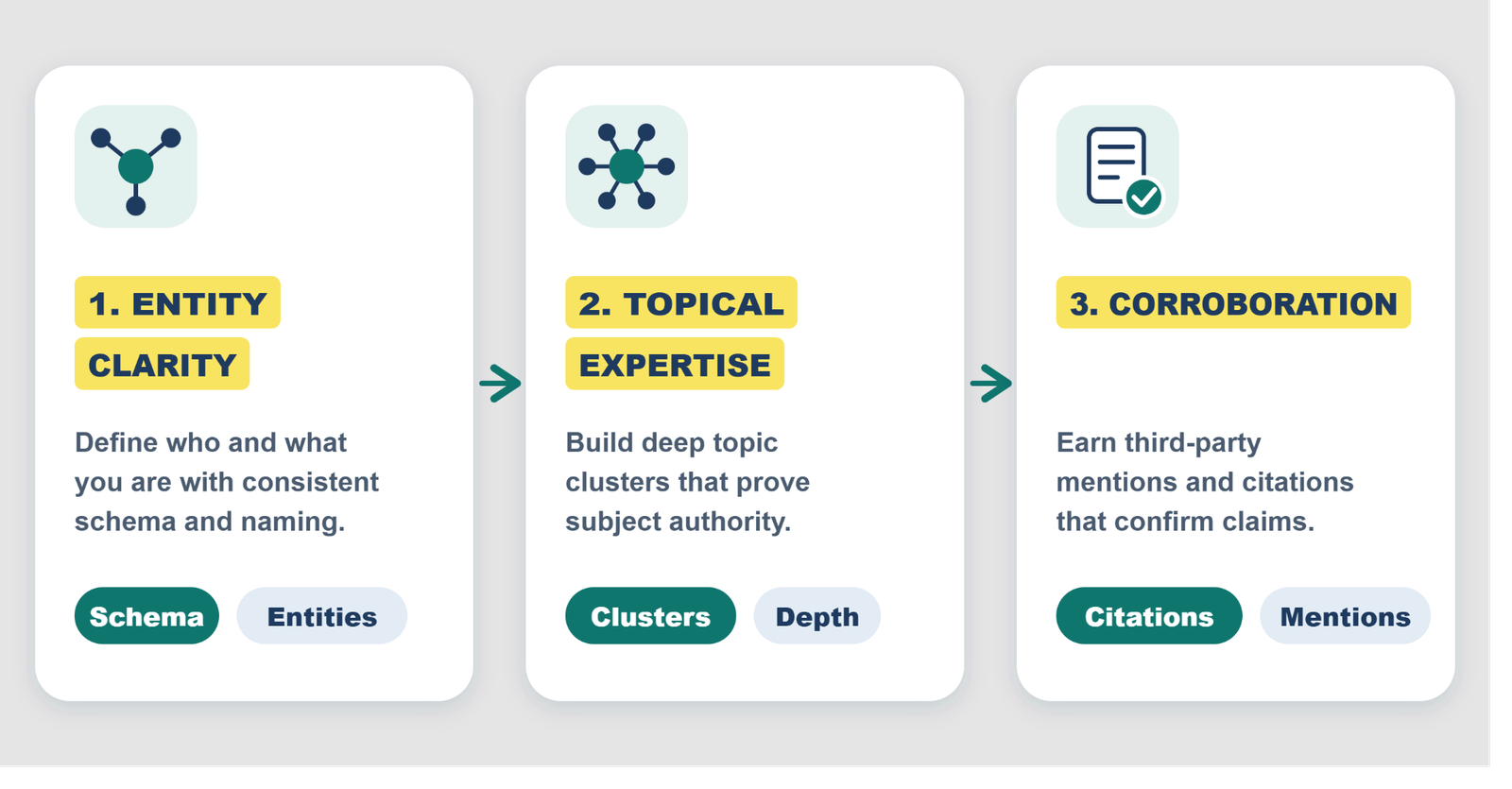
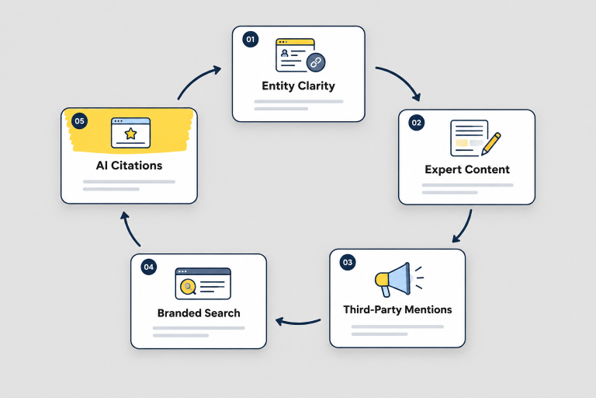
Brand authority for AI search is the degree to which AI systems recognise your brand as a distinct entity, associate it with a specific topic and trust it enough to mention or cite it in generated answers. Three things are crucial to build it: entity clarity (AI knows who you are), expertise (you demonstrably know the subject) and corroboration (credible third parties validate your expertise and reputation).
This guide explains how AI evaluates brands, how entity SEO works, how to build topical authority, where to earn mentions, which website fixes matter and how to measure progress.
Key Takeaways
- AI systems build answers from entities and relationships. Brands that are clearly defined, consistently described and widely corroborated get mentioned more often.
- Branded web mentions, branded anchor text and branded search volume correlate with AI visibility more strongly than backlinks do.
- Entity SEO starts with consistent naming, Organization schema, complete profiles and expert-led pages. Schema clarifies identity.
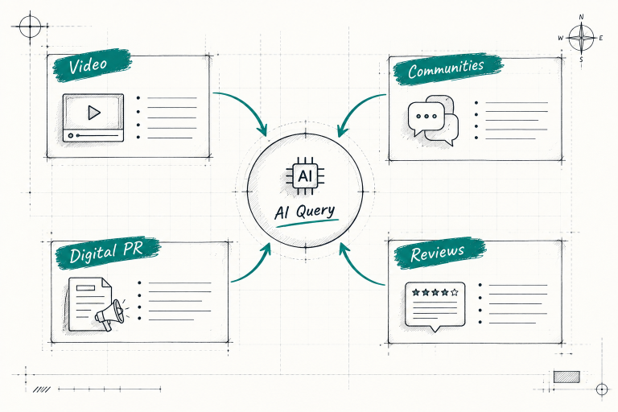
- Topical authority comes from depth on a few subjects, original insight and named experts. Third-party mentions come from digital PR, video, community presence and reviews.
- Measure authority by testing priority prompts across AI tools, tracking branded search and comparing mention share with competitors. Domain authority scores alone miss the picture.
How AI Evaluates Brands in the Age of AI Search
Search engines now understand things as well as words. An entity is a distinct, identifiable thing, such as a company, person, product or place, stored with its attributes and relationships in a knowledge graph. Generative AI answers draw on those relationships. When someone asks for the best email marketing software in India, the system has to decide which brands exist, what each one is known for and who vouches for them.
In practice, AI-driven search leans on off-site signals more than many marketers expect. Ahrefs’ study of 75,000 brands found that branded web mentions (0.664), branded anchor text (0.527) and branded search volume (0.392) all correlated more strongly with Google AI Overview visibility than backlinks (0.218). A follow-up study in December 2025 found that YouTube mentions correlated even more strongly, at about 0.737, across AI Overviews, AI Mode and ChatGPT.
Traditional SEO taught brands to chase keywords and backlinks. In the AI search era, a brand with a strong domain authority score can still be missing from AI answers, and a smaller brand discussed across the web can appear regularly.
Each AI system, however, weighs signals differently. That means no single scoreboard exists. But the direction is clear: brand authority for AI search is built across the web, not just on your website.
That is why building brand authority for AI search requires a different approach. Brands need to establish three things: a clear identity that AI systems can recognise, demonstrable expertise in a specific subject, and corroboration from credible third-party sources.
Read more: How to Optimise for AI Search: A Practical AIO, GEO & AEO Guide
Entity SEO: Make Your Brand Easy for Search Engines to Understand
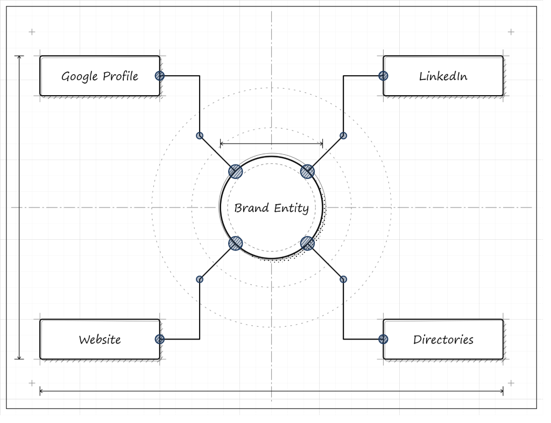
Entity SEO addresses the first pillar by helping search engines understand who you are, what you do and which topics your brand is associated with. Entity-based SEO begins with removing ambiguity. Three steps cover most of the work:
- Standardise your brand identity: Use one company name, one description and one set of founder and address details across your website, Google Business Profile, LinkedIn, directories and press pages. Variations such as “ABC Pvt. Ltd.”, “ABC Private Limited” and “ABC India” force AI systems to guess whether they refer to one entity or three.
- Add Organization schema with sameAs links: Google states that Organization structured data can help it understand your organisation’s details and disambiguate it from others in search results. The markup supports a logo, legal name and several sameAs URLs that link to your official profiles. However, Google lists no required properties and does not guarantee a knowledge panel, so treat schema as supporting evidence. Apply the same thinking to Person markup for your leaders and authors.
- Strengthen entity associations: Publish a detailed About page, leadership profiles with credentials and consistent descriptions of what you do. If your brand meets Wikipedia’s notability standards, accurate Wikipedia and Wikidata entries reinforce identity. If it does not, skip them, since promotional pages get removed.
Topical Authority SEO: Prove Expertise on the Subjects You Want to Own
Topical authority is the depth and breadth of your coverage on a subject. AI systems break a question into related sub-questions, so a brand that answers the whole cluster has more routes to being cited than one that publishes a single page.
Pick 3-5 topics your buyers should associate with you, then build pillar pages and supporting content around each. Back every page with expert signals like named authors with real credentials, original data, first-hand case results and India-specific numbers. These match what Google’s quality guidelines describe as experience, expertise, authoritativeness and trust (E-E-A-T).
| Authority signal | What AI systems can verify | How to build it |
| Entity clarity | Consistent name, description and profiles | Brand standardisation, Organization schema |
| Expertise | Named experts, original data, depth on a topic | Topic clusters, research, expert-led content |
| Corroboration | Mentions on independent sites and platforms | Digital PR, guest articles, awards, reviews |
| Community presence | Real discussion in forums and video | YouTube, Reddit, Quora and LinkedIn participation |
Brand Mentions and AI Search: Earn Corroboration From Trusted Sources
Mentions work because they show that other sources agree with what you say about yourself. They help even when they carry no link.
Where AI Overviews pull from also matters. Ahrefs’ September 2026 analysis of citations across more than 3 million US queries found YouTube at 22.9% of mention share and Reddit at 18.5%, with the top five domains holding 65.9%. Wikipedia sat at 4.0% and LinkedIn at 0.6%.
These are the main routes to earning mentions:
- Original research: Publish a data report with specific findings. Journalists and analysts quote numbers they cannot find elsewhere.
- Expert commentary and guest articles: Place your people in credible industry publications, where each appearance links your brand name to a subject.
- Video: YouTube explainers, interviews and webinars feed the platform AI Overviews cite most often.
- Community participation: Answer questions honestly on Reddit, Quora and LinkedIn, with the brand disclosed and the advice useful.
- Reviews and awards: Customer reviews on Google, G2 or Clutch and industry awards give third-party proof that AI systems can find.
Avoid paid mention schemes and fake reviews. They risk penalties and rarely carry the credibility that earns a citation.
Branded Search and Digital Brand Authority: Build Demand Before the Query
Branded search volume correlated with AI visibility at 0.392 in Ahrefs’ data. People who already know your name are more likely to search for it, which tells search engines that your brand is a real, recognised entity.
Brand awareness work therefore feeds AI visibility: content, PR, social, video and paid media that make buyers remember your company name before they need you.
Track this in Search Console by watching branded query impressions over time. Rising branded demand alongside rising mentions is the clearest sign that digital brand authority is compounding.
Domain Authority, Brand Authority Score and What to Measure
Domain authority, domain rating and any “brand authority score” are third-party estimates built by SEO tools. Google does not use them. Ahrefs found domain rating far less closely related to AI visibility than branded mentions. So, use these scores as rough comparisons and never as the goal.
Build a monthly measurement routine instead:
- Prompt testing: Run 20 to 30 priority queries in ChatGPT, Google AI Overviews, AI Mode, Gemini and Perplexity. Record whether your brand appears, how it is described and which sources are cited.
- Mention share: Compare how often you appear against 3-5 competitors.
- Branded search trend: Track branded impressions and clicks in Search Console.
- AI referral traffic: Check GA4 for visits from AI platforms and measure their conversion rate.
- Description accuracy: Note any wrong facts about your brand and trace them to their source.
Common Mistakes That Stall Brand Authority
- Treating schema as the strategy: Markup describes a brand, but it does not make it credible.
- Ignoring naming consistency: Different company names across profiles weaken entity recognition.
- Chasing links and ignoring conversation: Backlinks still help rankings. Mentions, video and community presence carry more weight in AI visibility.
- Spreading across too many topics: A brand known for everything is known for nothing. Choose a few subjects and own them.
What Next: Audit Your Brand in AI Search This Week
Open Google AI Overviews, AI Mode, ChatGPT and Perplexity. Search your brand name and your five most valuable commercial topics. Note how each tool describes you, which competitors it names and which sources it cites. That gap is your plan.
Every month a competitor is cited for your topic, their authority compounds. If you want a clear view of where your brand stands and what to fix first, our team can run that audit as part of its AI SEO services.
FAQs
1. Is brand authority the same as domain authority?
No. Domain authority is a third-party score estimating link strength, and Google does not use it. Brand authority covers recognition, expertise and independent mentions, which AI systems appear to weigh more heavily.
2. What is entity SEO?
Entity SEO helps search engines identify your brand, people and products as distinct entities and connect them to topics. It relies on consistent naming, Organization schema, complete profiles and corroborating third-party sources.
3. Do brand mentions without links help AI visibility?
Ahrefs found that branded web mentions correlate strongly with AI Overview visibility, linked or not. However, backlinks still support rankings. So, better pursue both.
4. Do I need a Wikipedia page or a knowledge panel?
No. A Wikipedia page requires genuine notability, and Google does not guarantee knowledge panels even with correct schema. Focus on consistent information and credible mentions, and let panels follow.
5. Which platforms matter most for brand mentions in AI search?
YouTube and Reddit lead AI Overview citations, followed by sites such as Wikipedia, LinkedIn and industry publications. Test priority queries in your own category and market.
6. How can I check whether AI tools mention my brand?
Run your priority queries manually in AI Overviews, AI Mode, ChatGPT and Perplexity each month, record the results and check GA4 for AI referral traffic. Several SEO platforms also track AI mentions.