Choosing the right PPC marketing agency can determine whether your advertising budget generates measurable business growth or simply buys more clicks. The best agencies don’t just manage Google Ads campaigns; they optimise every stage of the customer journey, from keyword strategy and conversion tracking to landing page performance and return on ad spend (ROAS). If an agency can’t clearly explain how its work translates into qualified leads, sales, or revenue, it’s unlikely to maximise your ROI.
Yet many businesses discover this only after months of running campaigns.
You hire a PPC marketing agency, approve the monthly ad budget, and wait for the results. At the end of the month, you receive a report filled with impressions, clicks, click-through rate (CTR), and cost per click (CPC). The numbers look encouraging. But when you ask how many qualified leads those campaigns generated, how much revenue they influenced, or whether your advertising spend produced a positive return, the answers become far less clear.
This is a familiar story for businesses across India, from D2C brands in Mumbai to B2B SaaS companies in Bengaluru and financial services firms in Delhi.
That’s why in this article, we explain how to choose a PPC marketing agency that is accountable for ROI. You will learn the questions to ask before hiring, the warning signs to avoid, and the qualities that separate a strategic PPC partner from one that simply manages ad spend.
Key Takeaways
- Choose a PPC marketing agency that measures success by leads, sales, and ROI, not just clicks and impressions.
- Ensure you own your Google Ads account and have full access to campaign data.
- Ask how the agency handles conversion tracking, Quality Score, keyword strategy, and remarketing.
- Look for transparent reporting that connects ad spend to revenue.
- Prioritise agencies that optimise landing pages and the entire conversion funnel.
- Be cautious of unrealistic promises, generic strategies, or agencies that can’t explain how they will improve your business outcomes.
Why Most PPC Campaigns Underperform
Most businesses in India have had at least one bad experience with Google Ads management. The agency ran the campaigns. Money was spent. And at the end of the engagement, nobody could clearly explain what the tens of thousands of rupees had produced.
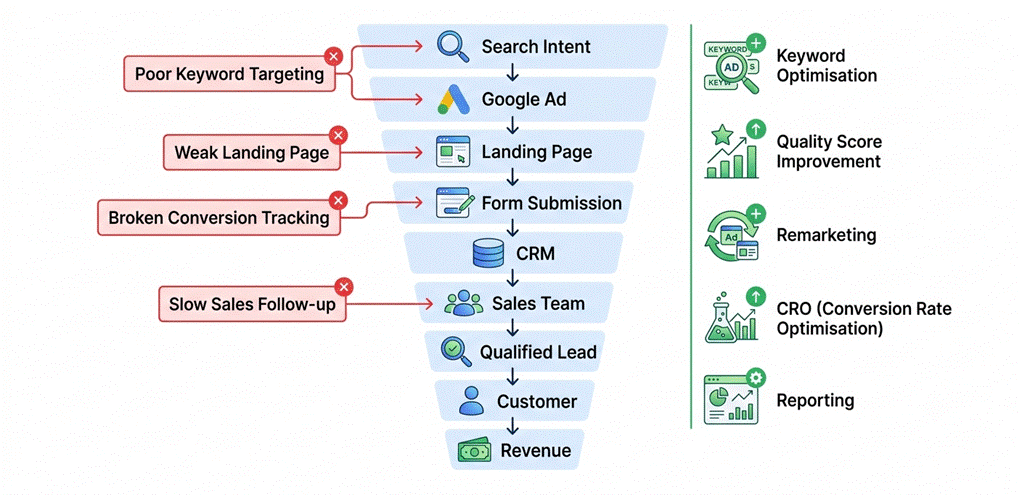
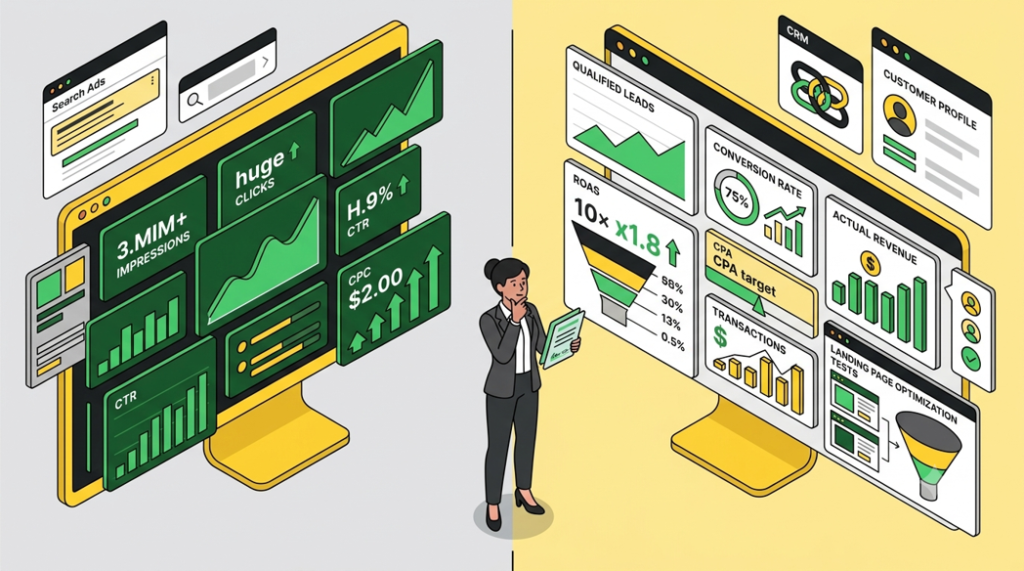
The reason this happens so consistently is that most PPC management companies measure the wrong things. They report on metrics that are easy to pull from a dashboard, like impressions, clicks, average CPC, and stay quiet about the metrics that actually matter to a business, like cost per qualified lead, trial-to-customer conversion rate, and revenue attributed to paid search.
There’s also a structural problem. Many agencies that offer PPC advertising services in India are running the same playbook across every client. Same keyword bidding approach, same campaign structure, same ad copy templates. Yes, it’s efficient for the agency. But it’s expensive for you.
A genuinely good PPC management company doesn’t start with campaigns. It starts with understanding your business: who the customer is, what the sales cycle looks like, what a conversion is actually worth, and what the funnel looks like after the click. Without that foundation, even technically well-executed search advertising campaigns will miss the point.
The Questions That Tell You Whether an Agency Actually Knows PPC
Before you evaluate any Google Ads management agency on their portfolio or their client list, ask them these questions. The answers will tell you everything.
1. How do you approach keyword bidding and match types for a new account?
A competent PPC agency will first talk about intent mapping. It will talk about separating informational, navigational, and transactional keywords, using exact and phrase match to control spend, and building negative keyword lists from day 1 to stop wasting budget on irrelevant traffic. An agency that talks primarily about broad match and automated bidding without explaining the strategy behind it is likely to burn your budget while the machine “learns.”
2. What’s your Quality Score optimisation process?
Quality Score is Google’s rating of the relevance between your keyword, ad, and landing page. It directly affects how much you pay per click and where your ads appear. A good PPC agency tracks Quality Score at the keyword level, identifies underperforming ad groups, and treats landing page optimisation as part of the job. If an agency doesn’t mention Quality Score unprompted, that’s worth noting.
3. How do you set up conversion tracking?
This is the foundational question. If conversion tracking isn’t set up correctly (if it’s tracking page visits instead of actual form submissions, or triggering multiple times per lead), every optimisation decision the agency makes is based on bad data. Ask specifically: what events are you tracking, how are you attributing conversions across devices, and how does this connect to our CRM? Agencies that handle this well will have a clear, specific answer. Agencies that don’t will get vague.
4. What does your remarketing campaign strategy look like?
Search advertising captures people who are actively looking. Remarketing campaigns capture people who visited but didn’t convert. They are the warmest audience in your entire funnel. A serious PPC management company will have a structured remarketing approach: segmented audiences by page visited and time on site, tailored creative for each segment, frequency caps to avoid ad fatigue, and clear exclusions to avoid wasting spend on people who already converted. If remarketing is an afterthought in their proposal, that’s a gap.
5. How do you handle display advertising differently from search?
Display advertising and search advertising serve different purposes. Search captures active intent. Display builds awareness and supports remarketing. An agency that treats them identically with the same bidding logic, creative approach, or success metrics doesn’t understand channel strategy. Good agencies run display advertising and search advertising with separate objectives. They have separate budgets and separate measurement frameworks.
What Good PPC Campaign Optimisation Actually Looks Like
The best PPC marketing agencies in India treat ad spend optimisation as an ongoing process rather than a set-and-review activity.
The first month of a campaign is largely discovery. Keyword bidding data starts to reveal which terms are driving clicks that convert and which are eating budget. Ad copy tests run. Quality Score data accumulates. Conversion tracking confirms whether the right signals are being captured.
By months 2 and 3, a good agency is making structural changes based on evidence, like pausing underperforming keywords, expanding successful keywords into additional match types (such as phrase match or broad match) to reach more relevant searches, restructuring ad groups for better relevance, and refining landing page optimisation based on where visitors are dropping off. CPC optimisation isn’t just about lowering cost per click. It’s about improving the spend-to-outcome ratio for every keyword in the account.
By months 3–6, a well-run lead generation campaign will have a clear picture of cost per qualified lead, which campaigns are producing the best quality traffic, and where the landing page or the offer (not the ad) is the conversion bottleneck.
ROI measurement in PPC is only honest when it connects ad spend to actual business outcomes. An agency that reports monthly without showing you the cost per acquisition trend, the campaign-level conversion rate, and the projected ROAS is giving you a dashboard, not a strategy.
Don’t Hire an Agency That Treats Your Budget Like a Fixed Variable
The agencies that produce the worst outcomes in PPC advertising services are those that treat your monthly budget as a number to spend fully and report on, rather than a resource to deploy intelligently. Underspending some months is not a failure if the alternative is pushing spend into keywords or audiences that aren’t converting. Overspending on what’s working and pulling back on what isn’t is active management. There’s a meaningful difference, and the agency you choose should be able to explain it clearly.
What to Actually Look For When Choosing a PPC Marketing Agency
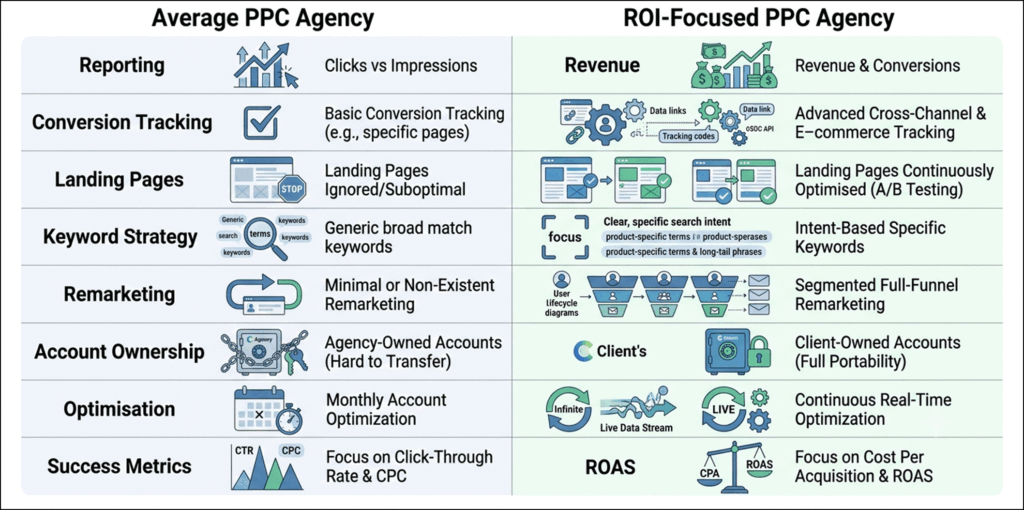
A few practical filters that cut through the noise when choosing a PPC agency are:
- Transparency on account access: Your Google Ads account should be owned by you, not the agency. If an agency runs campaigns in its own MCC (manager account that allows agencies to manage multiple Google Ads accounts from a single dashboard) and you don’t have direct access, then you have no visibility and ultimately no leverage. That’s why this is non-negotiable.
- Industry and funnel familiarity: A PPC management company that has run campaigns for finance brands understands compliance constraints, longer consideration cycles, and the difference between a lead and a qualified lead. An agency that has only done e-commerce PPC will apply the wrong framework to a B2B lead generation campaign. Ask for specific examples from your industry or the closest adjacent one.
- Reporting connected to revenue: Monthly reports should include cost per lead, lead-to-customer conversion rate (where you can provide that data), ROAS by campaign, and a clear CPC optimisation narrative. If the agency’s reporting template doesn’t include these, ask them to add them. If they resist, that’s the answer.
- Landing page involvement: Clicks are only worth something if the landing page converts. An agency that runs search advertising but doesn’t care about what happens after the click is managing only half the job. The best PPC agencies either optimise landing pages themselves or work closely with your web team to close that gap.
- Realistic timelines: Google Ads campaigns typically need 6–8 weeks of data before meaningful optimisation decisions can be made. Any agency promising significant results in the first two weeks is either managing expectations poorly or planning to show you vanity metrics that make the early period look better than it is.
So What Now?
If you are evaluating PPC marketing agencies for the first time or reconsidering your current one, here’s a practical checklist before you commit:
- Confirm that you will own the Google Ads account. No agency ownership, no exceptions.
- Ask for a sample monthly report from a current client. See whether it connects spend to leads to revenue, or just traffic.
- Verify their conversion tracking setup process. If they can’t walk you through it specifically, assume it won’t be done right.
- Ask about their Quality Score monitoring process and how often they review it at the keyword level.
- Understand their remarketing campaigns approach before the account even goes live.
- Get clarity on the CPC optimisation cadence: how often are they in the account, what triggers a change, and how do they document decisions?
- Ask what happens when a campaign isn’t performing. A good agency has a structured diagnostic process. A bad one runs the same campaigns longer and hopes they work somehow.
Also, remember that the right PPC marketing agency for maximum ROI isn’t the one with the most impressive case studies or the lowest management fee. It’s the one that asks the most questions about your business before it talks about campaigns because it understands that ad spend optimisation without business context is just money moving around with no particular destination.
Start with the right questions, and you will find out quickly whether you are talking to an agency that manages budgets or one that drives results.
Frequently Asked Questions (FAQs)
1. How much should I budget for PPC advertising in India?
There’s no universal answer, but a practical starting point is to work backwards from your cost-per-lead target rather than picking a round number. If your average deal value is ₹50,000 and you close one in ten leads, a lead is worth ₹5,000 to you. That tells you what you can afford to spend per conversion and still be profitable. Most Indian businesses running Google Ads seriously (where the goal is lead generation, not just brand visibility) start at somewhere between ₹50,000 and ₹1,50,000 per month to generate enough data for meaningful optimisation. Below that, the account doesn’t accumulate enough conversion signals to improve efficiently.
2. How long does it take to see results from a PPC campaign?
The honest answer is 6–8 weeks before you have enough data to draw conclusions, and 3–6 months before a well-optimised campaign is consistently performing. The first few weeks are discovery – keyword bidding patterns emerge, Quality Score data accumulates, conversion tracking gets validated. Meaningful optimisation starts in month 2. Any agency promising significant results in the first two weeks is either overpromising or showing you vanity metrics. Clicks are not results. Qualified leads that convert to revenue are results.
3. What’s the difference between a PPC management company and running Google Ads yourself?
Running Google Ads yourself is possible. Running it well (with proper campaign structure, negative keyword management, Quality Score optimisation, conversion tracking, audience segmentation, and ongoing CPC optimisation) is a full-time skill set. The cost of doing it badly isn’t just the management fee you saved; it’s the wasted ad spend on irrelevant traffic, the missed conversions from poorly structured campaigns, and the months it takes to recover from a badly set-up account. A good PPC management company pays for itself through better spend efficiency.
4. Should I run search advertising, display advertising, or both?
Start with search. Search advertising targets people actively looking for what you offer. It’s the highest-intent channel in Google Ads and the fastest to show ROI for most businesses. Display advertising is better suited to awareness building and remarketing campaigns targeting people who have already visited your site. Running both from day one without a clear strategy for each often means splitting budget before you have enough data on either. Get search working first, then layer in display and remarketing once you know your conversion numbers.
5. How do I know if my current PPC agency is doing a good job?
Pull your account data and ask three questions. First: is conversion tracking set up correctly, and is it tracking actual business outcomes (form submissions, calls, purchases) and not just page visits? Second: does the monthly report show cost per qualified lead and ROAS, or just impressions and clicks? Third: has the account structure changed at all in the last three months – new negative keywords added, underperforming ad groups paused, landing pages tested? If the answer to all three is no, the account is being managed, not optimised. That tells that the agency is doing only half the job.