
- 57% of companies outsource at least part of their content marketing. And among large enterprises, that figure rises to 75%.
- Building a complete in-house content team in India costs ₹40–80 lakh+ annually in salaries alone, before tools, training, or infrastructure.
- Agencies bring cross-industry pattern recognition that an in-house team, by definition, cannot have.
- In-house teams win on brand depth; agencies win on execution speed, SEO expertise, and scalability.
- For most Indian B2B companies, the answer is not either/or. It is knowing which part of the work belongs where.
The Question Behind the Question
When a business asks, “Should we outsource content marketing or build in-house?” the real question is almost always something deeper than that. More often than not, it comes down to one of these three:
“We are spending money on content and not seeing returns. Is our team the problem?”
“We are growing, and our current setup can’t keep up. What do we do?”
“We have been quoted agency fees that seem high. Can we just hire someone instead?”
Each of these questions deserves a direct answer, not a both-sides-have-merits non-answer. So let us be direct.
What “In-House” Content Marketing Actually Costs in India?
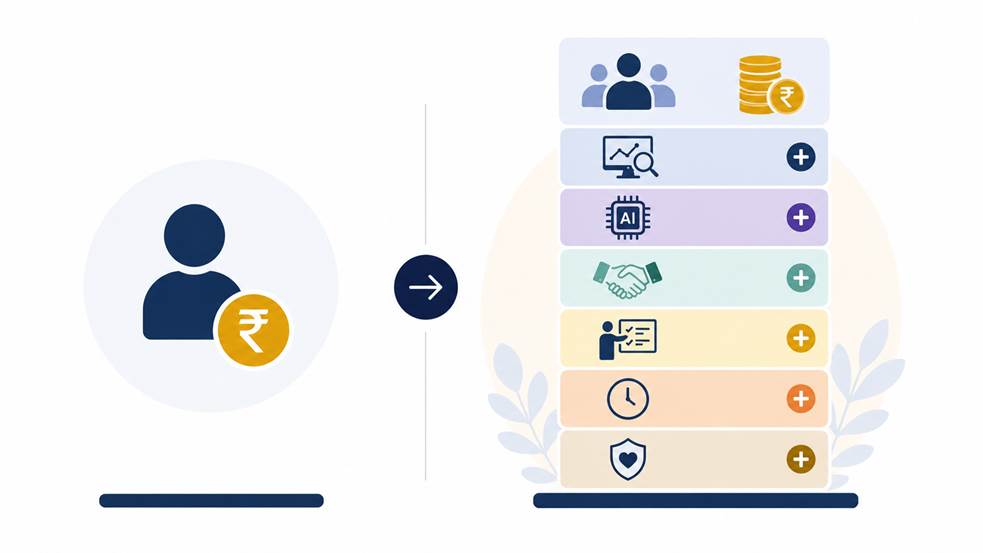
The most common mistake companies make in this decision is comparing content marketing agency fees to a single salary. That is not the right comparison.
A functional in-house content marketing team (one that can actually handle strategy, writing, SEO, and distribution) requires at minimum:
- Content Strategist / Manager: ₹8–12 LPA (Glassdoor, 2026)
- Content Writer(s) — 1–2 people: ₹4–7 LPA each
- SEO Specialist: ₹6–10 LPA
- Social Media / Distribution Manager: ₹5–8 LPA
That is ₹23–45 LPA in salaries for a lean team before you add employer PF contributions (~12%), tools (SEMrush or Ahrefs, SurferSEO, Asana or Trello, AI tools, CMS subscriptions, analytics platforms can run ₹3–6 lakh per year), onboarding time, and the compounding cost of bad hires.
A realistically staffed team covering content creation, SEO, and distribution for a mid-sized B2B company in India runs ₹40–80 lakh annually in fully loaded costs. Often more.
And don’t forget management overhead. A content manager often spends time coordinating writers, SEO, design, approvals, and stakeholders. The hidden cost is usually not software; it’s management bandwidth.
This is not an argument against in-house teams. It is an argument for making the comparison with the full number rather than the headline salary.
| The lesser-considered cost: The average time to hire a good content professional in India’s current market is 6–10 weeks. During that period, your content output is either zero or dependent on whoever can “manage it alongside their existing role,” which typically means it is deprioritised. The opportunity cost of delayed content compounding is real and rarely factored into the hiring decision. |
What a Content Marketing Agency Actually Brings (Beyond Just Writers)
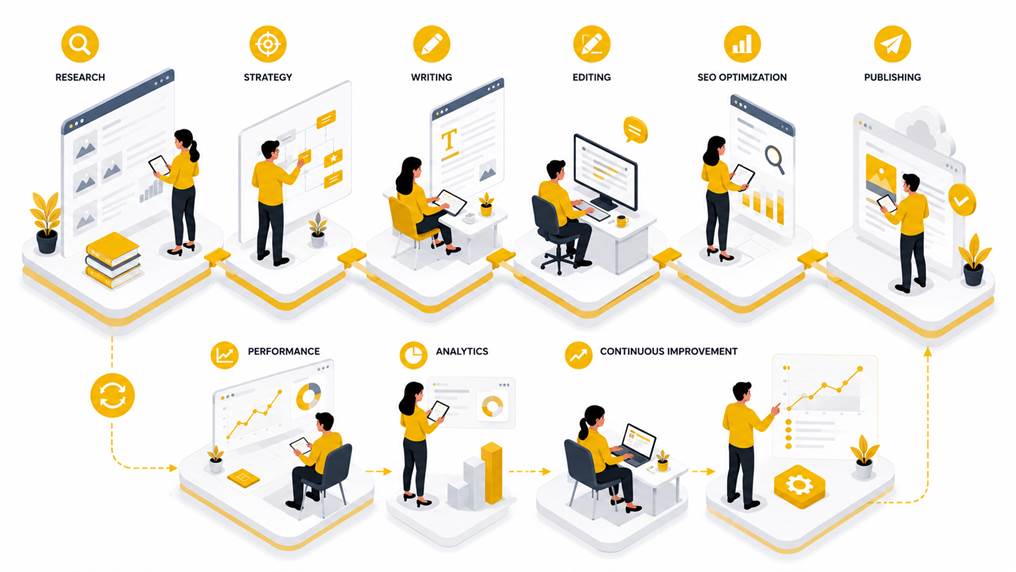
Here is something worth understanding about how a content marketing agency operates at the back end, because it is not obvious from the outside.
When a competent agency picks up a new account, they do not start from a blank page. They bring:
- Cross-industry pattern recognition: An agency that has worked across BFSI, SaaS, real estate, healthcare, and manufacturing has seen what content strategies work (and what fails) across buyer types, funnel stages, and competition levels. An in-house team working in one industry for two years has one data point. An agency working across 20 accounts has twenty, updated in real time.
- A tested content production system: Brief → research → draft → edit → SEO optimisation → publishing – with QC at each stage. Building this system in-house from scratch takes 12–18 months, during which output quality is inconsistent.
- SEO infrastructure that is already built: Keyword research tools, topical authority mapping, internal linking frameworks, technical SEO checks – these are standard operating procedure at a good content marketing agency. Building comparable capability in-house requires both the right people and significant tooling investment.
- Bench depth for scale: When a campaign requires six pieces of content in a week rather than two, an agency can absorb that. An in-house team of three cannot, at least not without burning out.
We have seen this play out consistently across the accounts we manage. A payment technology company that came to us after trying to manage content in-house for 18 months had published 40 articles but ranked for almost none of their target keywords, because no one on their team had built the topical cluster architecture that makes individual articles rank. The content existed. The strategy did not.
Where In-House Teams Can Work Well
An in-house team has one structural advantage that an agency cannot fully replicate: deep, continuous, lived knowledge of the brand.
They sit in product meetings. They hear customer calls. They know the founder’s perspective firsthand. They can sense when a campaign direction feels off-brand before anyone has articulated why.
This matters enormously for:
- Thought leadership content that requires an insider’s perspective (executive bylines, proprietary research, product-led narratives).
- Sensitive categories where brand voice consistency is non-negotiable (regulated industries, premium positioning, founder-led brands).
- Real-time content tied to internal product launches, company announcements, or market moments that require speed and confidentiality.
An in-house team is also better placed to manage relationships with internal stakeholders, like getting sign-off from the legal team, extracting insights from the sales team, and coordinating with product for feature launches.
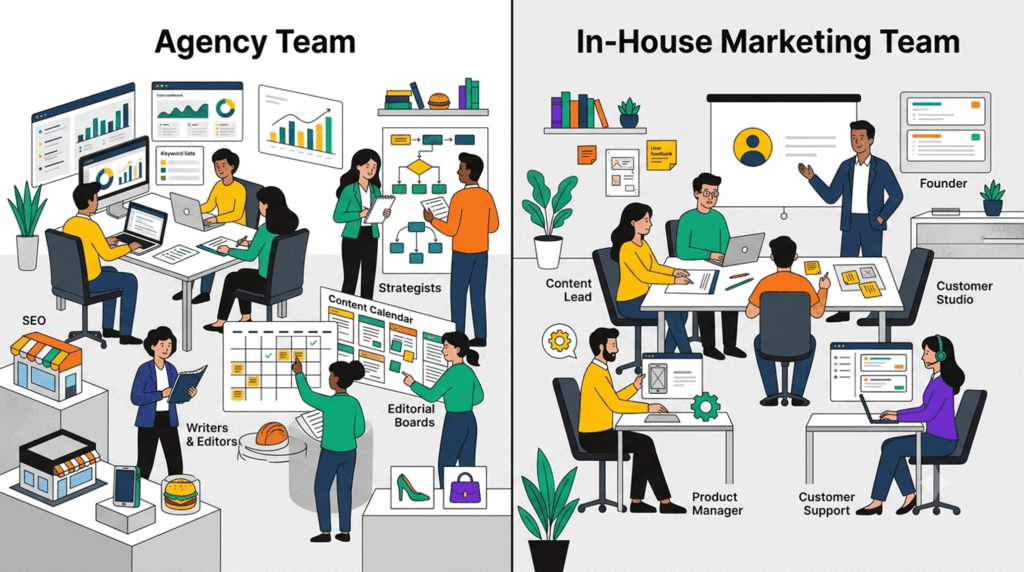
The honest picture: In-house teams are best at knowing the brand. Agencies are best at knowing content.
So, Should You Outsource Content Marketing?
According to Content Marketing Institute, among large B2B companies (over 1,000 employees), organisations outsource 75% of their content marketing activities. But this decreases to 54% among mid-sized firms and 37% among smaller ones.
84% of those who outsource content marketing cite content creation as the activity they get the most help with.
The data reflects a real pattern: most companies that are serious about content growth work with an external agency. Not because they lack internal talent, but because a good content marketing agency does not just produce content. It owns the strategy, the SEO architecture, the content calendar, the measurement framework, and the distribution thinking – end to end. It functions as a marketing partner rather than a vendor you just hand a brief to.
The in-house team’s role in this setup is to provide what only insiders can: brand context, stakeholder access, product knowledge, and real-time business direction. That input makes the agency’s output sharper. The agency’s systems make the in-house team’s instincts actually scalable.
What does not work is treating an agency like a content factory – briefing topics, expecting articles, and measuring nothing. That wastes the most valuable thing a good agency brings, which is the strategic layer that turns content into a compounding growth asset.
The key to making it work: a strong onboarding process, a shared content strategy document, and a single point of contact on both sides who is empowered to make decisions. That’s how brands get the most from an agency partnership.
The Signal That You Need a Content Marketing Agency (Not Just More Headcount)

There are specific situations where the answer to “should we outsource?” is clearly yes:
- Your content exists but does not rank: Content without SEO strategy is a not a marketing strategy. If you have been publishing for 12+ months and organic traffic has not moved meaningfully, the problem is almost certainly structural (keyword mapping, topical authority, internal linking, or technical SEO) rather than writing quality. This requires SEO expertise that most in-house content teams, particularly in India, do not have embedded. A content marketing agency brings it all in one integrated system.
- You need to scale faster than hiring allows: The average content hiring cycle in India takes 6–10 weeks per role. If your business is growing and your content output needs to double in the next quarter, an agency can absorb that demand immediately.
- You are entering a new market or category: When a brand is expanding into a new vertical, say, a B2B SaaS company entering the healthcare or BFSI sector, an agency with existing knowledge of that category’s content landscape, compliance requirements, and buyer language is significantly more efficient than building that knowledge from scratch in-house.
- Your team is producing content but cannot measure what works: If your content programme has no clear KPI framework (traffic targets, keyword ranking movement, lead attribution), you do not have a content strategy. You have a content habit. An agency can bring the measurement discipline that’s lacking.
Final Thoughts
The agency vs. in-house debate misses the bigger question: what does your content programme actually need to work? And does your current setup actually deliver it?
A content marketing agency is just one way to access the right skills, systems, and consistency needed to make content marketing work without the cost and complexity of building an entire team in-house.
A content marketing agency worth working with does not just write articles. It builds the strategy that determines what gets written, the SEO architecture that determines what ranks, the measurement framework that determines what gets improved, and the distribution thinking that determines who actually sees it. That is a complete marketing function.
The companies that treat content as a growth lever rather than a task consistently outperform those distributing it across whoever has bandwidth. Building that capability in-house is possible but slow, expensive, and fragile to attrition. Partnering with a good content marketing agency that owns it end-to-end is, for most Indian companies, the faster and more reliable path to results that actually compound.
FAQs
1. What is the main advantage of outsourcing content marketing?
Access to an integrated team of strategists, writers, and SEO specialists immediately, without the 6–10 week hiring cycle, tooling costs, or management overhead of building in-house.
2. Is it cheaper to outsource content marketing or hire in-house in India?
A fully loaded in-house team covering content, SEO, and distribution typically costs ₹40–80 LPA in India. Agency retainers for comparable output are generally significantly lower, with no recruitment, onboarding, or attrition risk.
3. When should a company build an in-house content team?
When the business has sufficient scale, budget, and time to hire, onboard, and retain a full team across strategy, writing, SEO, and distribution. For most growth-stage Indian companies, this is slower and more expensive than partnering with an agency that already has all of these capabilities integrated.
4. What content marketing activities should be kept in-house?
Brand context, product knowledge, stakeholder relationships, and real-time business direction. A good agency builds strategy and executes it, but that strategy is sharper when the in-house team provides deep organisational context throughout the engagement.
5. How do I maintain brand voice when working with a content agency?
Through a comprehensive brand brief, an onboarding process that includes interviews with key stakeholders, and a feedback loop during the first 4–8 weeks of engagement. A good agency will actively build your brand voice into their brief and editorial system. But it should not live only in your head.
6. What does a content marketing agency do that a freelancer doesn’t?
An agency brings integrated capability (strategy, SEO, writing, editing, and distribution) with QC systems and account management. A freelancer delivers a single skill set. For content programmes with SEO at their core, a freelancer alone is almost never sufficient.
7. How long before outsourced content marketing shows results?
Organic SEO results typically compound between months 4–9. Content quality and output volume improvements are visible from month 1. Brands that have been publishing without a strategy often see significant ranking improvements within 3–6 months of applying proper topical architecture.
8. Can a small business outsource content marketing?
Yes, small businesses can outsource content marketing. It is often more efficient than hiring, since they can access a full team without the overhead. The key is choosing an agency with experience in their category and a retainer model that matches their current volume needs with room to scale.