
- India’s internet growth is being driven by Tier-2 and Tier-3 cities.
- Most Indian users prefer consuming content in their native language rather than English.
- Regional-language content generates 1.5–2x higher engagement than English content.
- Voice search is making vernacular SEO a major growth opportunity.
- Translation isn’t enough. Localisation and transcreation drive better results and conversions.
English Was Never India’s Internet
For years, Indian brands have built their digital strategies around a simple assumption: if the content is in English, the audience will come.
But here is a number that should change how you think about your content strategy: only 43% of urban internet users prefer accessing the internet in English, according to a study by Internet and Mobile Association of India (IAMAI)–Kantar.
Read that again. Even in cities. Even among India’s most digitally active population.
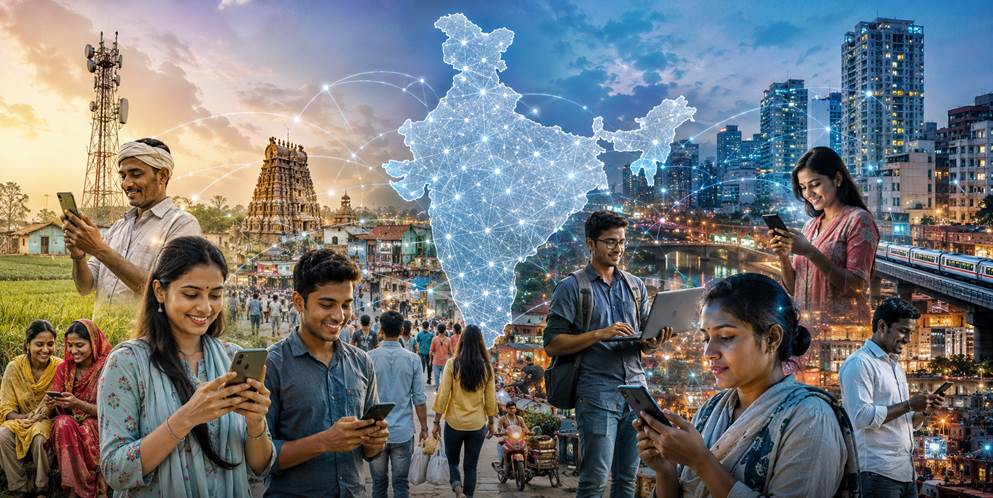
Now factor in that rural India, with 488 million users, accounts for 55% of India’s entire internet population, growing at double the rate of urban areas.
These are not niche users. They are the majority. And they are arriving with a clear preference: content in their own language.
The premise that English is the default language of the Indian internet was always a metro-centric assumption. It is now demonstrably, statistically wrong.
What “Regional Content” Actually Means (And What It Doesn’t)
Before the stats, a definition worth getting right (because this is where most brands make their first mistake).
Regional language content is not your English blog run through Google Translate and published in Hindi. That is a different thing, and a significantly worse one.
The distinction:
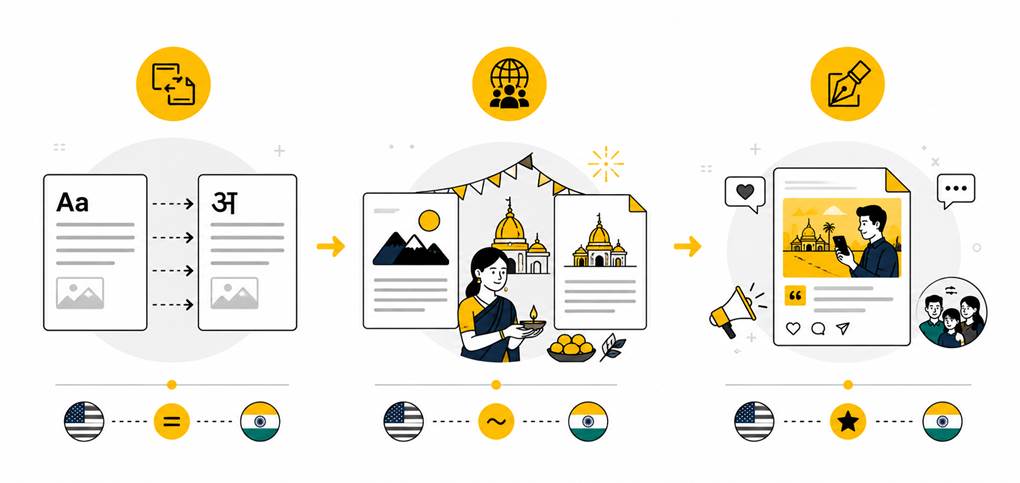
- Translation converts words from one language to another. It is linguistic.
- Localisation adapts meaning, tone, and context. It is cultural.
- Transcreation recreates the intent, emotion, and resonance of content from scratch in a new language. It is strategic.
A banking brand writing about fixed deposit returns in Hindi cannot just swap out the English words. The idiom, the trust signals, the examples used, the cultural references – all of these need to be rebuilt for the reader. A campaign that works beautifully in Mumbai may land completely flat in Patna if it uses the wrong register, references the wrong festivals, or assumes a financial literacy baseline that doesn’t exist in that market.
Language in non-metro India is not just a communication preference. It is a trust signal. When a brand speaks your language (actually your language, not a translated version of someone else’s), it signals that it knows you, understands you, and is here for you.
6 Stats That Explain Why Tier-2 and Tier-3 India Is Now the Growth Market
Stat 1: 98% of Indian internet users consume content in Indic languages
The IAMAI–Kantar 2024 report says 870 million users (98% of internet users) accessed the internet in Indic languages. Even 57% of urban internet users prefer regional language content for at least some of their consumption. If your content strategy is English-only, you have a major structural gap.
Stat 2: Rural India now accounts for 55% of India’s internet users
India has approximately 886 million internet users, and 488 million of them live in rural areas. In other words, the majority of India’s internet audience is now outside major metropolitan centres. For brands chasing growth, this is where the audience increasingly lives and they prefer vernacular language.
Stat 3: 68% of Indian internet users prefer content in their native language
This figure, from a 2024 IAMAI–Nielsen study, has increased year-on-year for the past five years. The direction is clear, and it is not reversing. Preference for native-language content correlates strongly with higher-consideration decisions like healthcare, finance, education, and real estate. These are exactly the categories where brands most need trust.
Stat 4: Regional content gets 1.5–2x more engagement
Regional language content, particularly video and voice formats, consistently outperforms English-equivalent content by 50–100% on engagement metrics.
Lower competition. Higher resonance. Better ROI.
Stat 5: 88% of Indian internet users trust a brand more when it communicates in their local language
Trust is what determines purchase intent, loyalty, and word-of-mouth. A 2024 research study published on International Journal of Research Publication and Reviews (IJRPR) found that among users who trust vernacular content, 61.54% expressed higher purchase intent after seeing vernacular advertising. This is the clearest possible argument for regional content as a conversion tool, not just a reach tool.
Stat 6: 70% of users during Amazon’s 2025 Great Indian Festival sale came from Tier-2 and Tier-3 cities
Amazon reported that 70% of customer visits during Great Indian Festival 2025 came from Tier-2 and Tier-3 cities, while approximately 70% of new Prime members also originated from these markets. At the same time, the company reported a 52% year-over-year increase in Hindi-language interactions with Alexa and has begun testing Alexa+ in Hindi for India’s 600+ million Hindi speakers.
The Voice Search Dimension
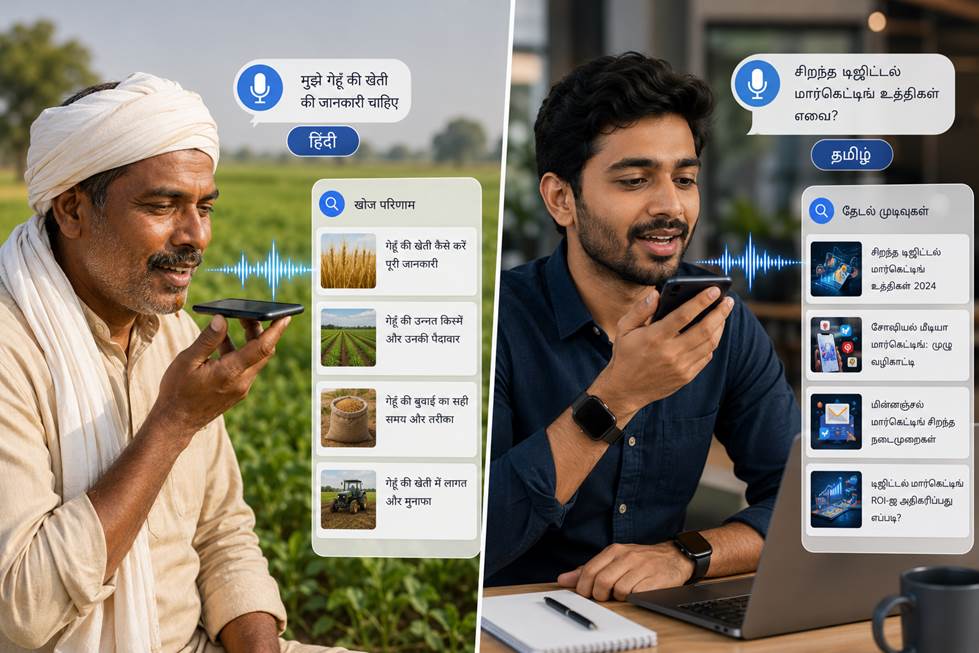
Typing in a regional script on a QWERTY smartphone is genuinely difficult. Speaking is effortless in any language.
This friction asymmetry is the single most powerful driver of voice adoption in India. And it is almost entirely a regional language phenomenon.
Voice search queries in India have grown at 270%, according to a joint analysis by the Mobile Marketing Association and digital agency Isobar in their report titled “The Voice Playbook” for India. Hindi has become the second most-used language on Google Assistant globally, trailing only English.
At the Google for India 2024 event, Google announced the expansion of Gemini Live to Hindi, with eight additional Indian languages including Bengali, Tamil, Telugu, Marathi, Kannada, Gujarati, Malayalam, and Punjabi to follow. It explicitly targets users who prefer to communicate in their native language, noting that over 70% of Indian internet users prefer native-language communication.
What does this mean for content strategy?
A user in Lucknow searching for a pump for their farm does not type “best agricultural water pump features.” They press the microphone and ask: “khet ke liye sabse accha pump kaun sa hai?” A first-time home buyer in Coimbatore does not search for “affordable 2BHK apartments in Tamil Nadu.” They speak a question they would ask a trusted friend in Tamil – in their own phrasing, with local context.
Voice search is fundamentally regional search. And vernacular SEO (optimising for how people actually speak their queries in regional languages) is one of the most under-contested spaces in Indian digital marketing right now.
The SEO implication is significant: question-based headings, FAQ sections, and long-tail conversational phrases in regional languages are among the fastest ways to capture AI Overviews and voice search real estate that your English-first competitors haven’t even considered targeting.
What Bharat Sounds Like: The Hinglish Reality
One nuance that pure “regional language” framing misses: much of Tier-2 and Tier-3 India does not communicate in pristine Hindi or formal Tamil. It communicates in Hinglish – the fluid, code-switched hybrid of Hindi and English that has become the natural register for hundreds of millions of Indians, particularly on social media and messaging apps.
Hinglish is not a corruption of either language. It is its own dialect, with its own logic, cadence, and cultural markers. Brands that try to write formal Hindi copy for a Hinglish-speaking audience sound stiff. Brands that write colloquial Hinglish, where appropriate, sound like they belong.
This also matters for SEO. Google increasingly indexes Hinglish queries as distinct from both Hindi and English searches. Content that mirrors how your audience actually searches, including transliterations and hybrid phrases, will outperform formally correct content that nobody actually uses to search.
Building a Multilingual Content Strategy: What Actually Works
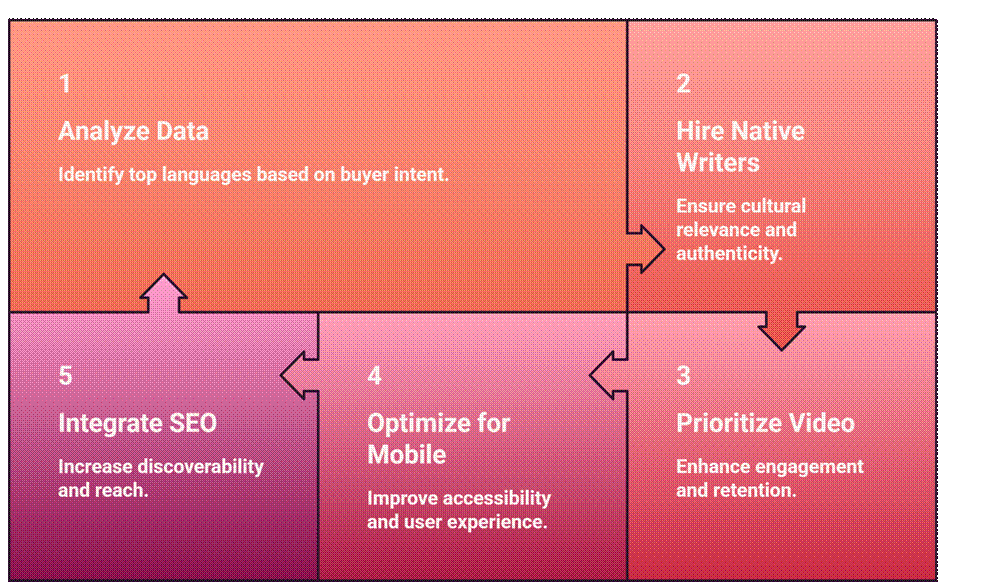
The instinct to “just add Hindi” is understandable but insufficient. Here’s a practical framework that scales:
- Start with data: Look at your sales enquiries, CRM data, and Google Analytics geography reports. Where are your actual leads coming from? Often, businesses discover significant Tier-2 and Tier-3 buyer intent they have been largely ignoring. Prioritise the top two or three languages your buyers actually use (typically Hindi, English, and Tamil, Marathi or Bengali) rather than trying to cover all 22 official languages at once.
- Hire native writers, not translators: The output quality difference between a content piece transcreated by a native-language writer who understands the cultural context and a translated piece (whether by a translator or an AI tool) is immediately apparent to the reader. Regional content done cheaply is often worse than no regional content; it signals inauthenticity rather than inclusion.
- Prioritise video over long-form text: Video in regional languages dramatically outperforms text in engagement and retention, especially on YouTube and Instagram Reels. Short-form video scripts in regional languages, narrated by native speakers, are often the highest-ROI regional content investment for brands entering these markets. YouTube India reported in 2024 that over 60% of its watch time now comes from regional language videos.
- Optimise for mobile-first: Tier-2 and Tier-3 users almost exclusively access content on mobile devices, often mid-range or budget smartphones. Regional language pages need to be fast-loading, image-light, and readable on smaller screens. A heavy English website with a Hindi translation layer that loads slowly on a ₹10,000 phone defeats the purpose entirely.
- Don’t localise content in isolation: Regional SEO, with keywords, meta descriptions, and schema markup in the target language, is what makes regional content discoverable. Content without distribution strategy serves no one. A strong multilingual content strategy integrates content production with regional SEO so that the right person finds the right content at the right moment.
| Pro Tip: When planning your regional content calendar, map it to regional festivals rather than a pan-India marketing calendar. Chhath Puja content for Bihar audiences, Pongal content for Tamil Nadu, Onam content for Kerala. These cultural touchpoints signal authenticity in a way that generic festive content never will. Brands that acknowledge your festival (“not the festival”) earn disproportionate trust. |
Conclusion
The Indian internet is a diverse market. It has 22 official languages, hundreds of dialects, and a billion people who search, consume, and buy in the language they feel most at home in, which, for the majority, is not English.
The brands that will own the next decade of India’s digital growth are those who understand Bharat on Bharat’s own terms: its languages, its idioms, its festivals, its concerns, and the specific kind of trust that only comes from speaking directly to someone in their own voice.
Regional language content is not a supplementary strategy. For most Indian B2B and B2C brands, it is where the next phase of growth actually lives.
If you want your content to connect with more people, in more places, take a look at our content marketing services and let’s make it happen.
FAQs
1. Why is regional language content important in India?
Because 98% of India’s 886 million internet users consume content in Indic languages, and Tier-2/Tier-3 cities, where regional language preference is strongest, now drive the majority of internet growth.
2. Which regional languages should brands focus on first?
Start with Hindi and either Tamil, Marathi or Bengali based on your sales geography. These four languages cover the largest digitally active non-English user bases. Validate against your own CRM and analytics data before committing.
3. Do Tier-2 and Tier-3 users prefer vernacular content?
Yes, Tier-2 and Tier-3 users significantly prefer vernacular content. 68% of Indian internet users prefer native-language content overall. In Tier-2 and Tier-3 markets, this preference is even stronger, particularly for high-consideration categories like finance, healthcare, and education.
4. How does regional content impact SEO?
Regional language pages can rank for entirely uncontested keyword clusters in Hindi, Tamil, Telugu, and other languages. These are queries that English content cannot touch. Voice search in regional languages adds a further dimension of SEO opportunity, especially for conversational, long-tail queries.
5. Is translating English content enough?
No. Translation converts words; it does not adapt meaning, cultural context, or emotional resonance. Effective regional content requires transcreation (rebuilding the content’s intent and tone for the target language audience, not just converting its vocabulary).
6. Does regional content improve conversions?
The data suggests yes. 88% of Indian users trust brands more when they communicate in the local language. Lower competition and higher cultural relevance also reduce cost-per-acquisition on regional language ad campaigns.
7. How does voice search affect regional content strategy?
Voice search is almost entirely a regional language phenomenon in India, driven by the difficulty of typing in regional scripts on QWERTY keyboards. Content optimised for conversational, question-based regional language queries (including FAQ sections and schema markup) captures voice and AI search real estate that English-first content misses entirely.
8. Is regional content marketing cost-effective?
Generally yes. Regional language ad campaigns on Google and Meta see lower CPCs and CPAs due to lower competition. The Tier-2 and Tier-3 market represents 700+ million users that most brands are largely ignoring, making it one of the least contested growth opportunities in Indian digital marketing.