For nearly two decades, the most important question in digital marketing was whether people could find you on Google. Rankings, traffic, click-through rates, page-one visibility – the entire machinery of content and SEO was built around answering that question.
That question has been replaced by a harder one.
Does AI trust you enough to recommend you?
Right now, your potential customers are asking ChatGPT, Perplexity, and Google’s AI Overviews which brand to trust in your category. They are getting a direct answer in seconds, often without visiting a single website. The search box has become the answer box. No scrolling through 10 blue links, no comparing options, no clicking through to read. Just a recommendation by AI.
Your brand is either in that answer or it is not. And that determination has already been made, based on everything the AI has gathered about your brand across the internet: your content, reviews, third-party mentions, and message consistency. By the time a buyer types their question, AI has already made up its mind.
This is not a gradual transition. Consumer behaviour has shifted permanently toward what is faster and easier. It is very difficult to go backwards from convenience.
To understand why AI visibility matters and how to build it, let’s step back and look at how the definition of brand visibility has changed with every major shift in digital behaviour.
Key Takeaways
- The search box has become the answer box. AI tools are now making brand recommendations before a buyer ever visits your website.
AEO (Answer Engine Optimisation) is becoming increasingly important.
The metric that is replacing page 1 rankings is share of model: how often does AI recommend your brand when a buyer asks for a solution in your category?
Coherence beats volume. A brand mentioned consistently and clearly across fewer sources outperforms one that appears everywhere in inconsistent, fuzzy ways.
Every Era Has One Central Question. This Era’s Is Different.
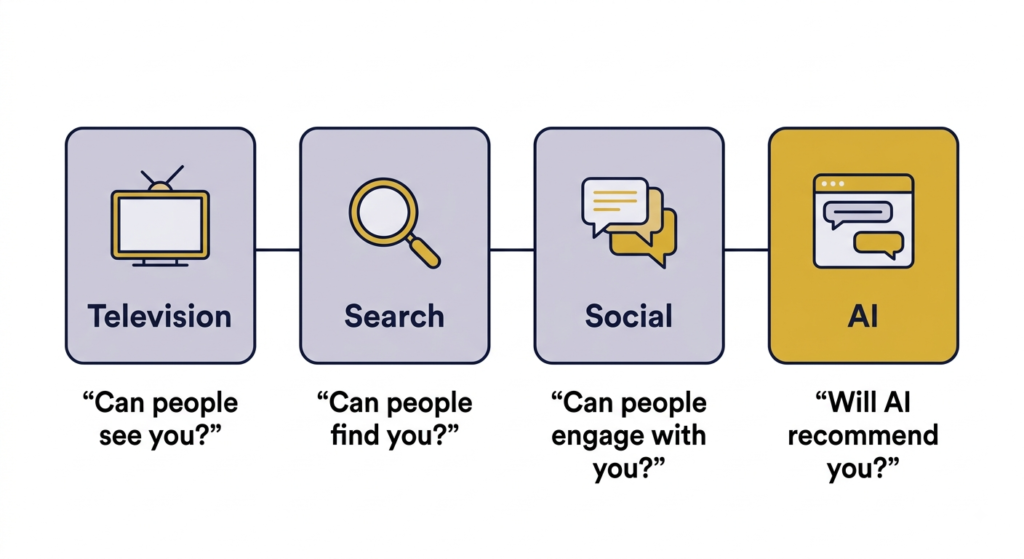
Every phase of marketing has been defined by a single question that determined who won and who did not.
The television era asked: can people see you? The search era asked: can people find you? The social era asked: can people engage with you? The AI era asks: does the machine trust you enough to recommend you?
That last question is different in a way that changes everything about how brand visibility works.
In every previous era, the consumer made the final call about which brand to consider. They saw the ad and chose to look it up. They saw the search result and chose to click. The brand’s job was to be visible and compelling enough to earn that choice.
In this era, that choice is increasingly being made by a machine before the consumer even gets involved. AI systems have already decided which brands belong in the conversation and which do not. The buyer is handed a shortlist of one.
This is why AEO (Answer Engine Optimisation) is not just another channel to optimise for. It is a structural shift in how brand discovery happens. The businesses that understand this and build for it now will have an advantage that compounds over the next 3–5 years. The ones that wait for it to become obvious will find they are recovering ground rather than gaining it.
What AI Actually Looks for (And Why Most Brand Content Fails the Test)
AI engines do not work like traditional search crawlers. They are not looking for keyword density or backlink counts. They are looking for structured, authoritative content that can be synthesised into a direct, confident answer.
The practical test is simple: if a machine cannot summarise a piece of your content in three bullet points and cite it with confidence, it will not use that content. It will use a competitor’s instead.
This is where most brand content fails. Not because it is badly written, but because it is not built to be understood and repeated by an AI system. It is vague where it should be specific. It hedges where it should be definitive. It covers too many things instead of owning one area clearly.
The other failure mode is inconsistency. Many brands appear across hundreds of pages, blog posts, press mentions, and directories, but the way they are described varies significantly across each one. Different positioning, different category language, different claims. To a human reading any one of those pages, it might look fine. To an AI trying to build a coherent understanding of the brand, it is noise.
This is where the principle that matters most for AEO comes in: coherence over volume.
A brand mentioned 50 times, consistently, in the same category, with the same clarity about what it does and who it serves, gives AI far more to work with than a brand mentioned 500 times in inconsistent, fuzzy ways. The machine needs to be able to form a confident view of your brand. If your own content cannot give it that, your competitors’ content will define you instead.
The Metric Replacing Page 1 Rankings
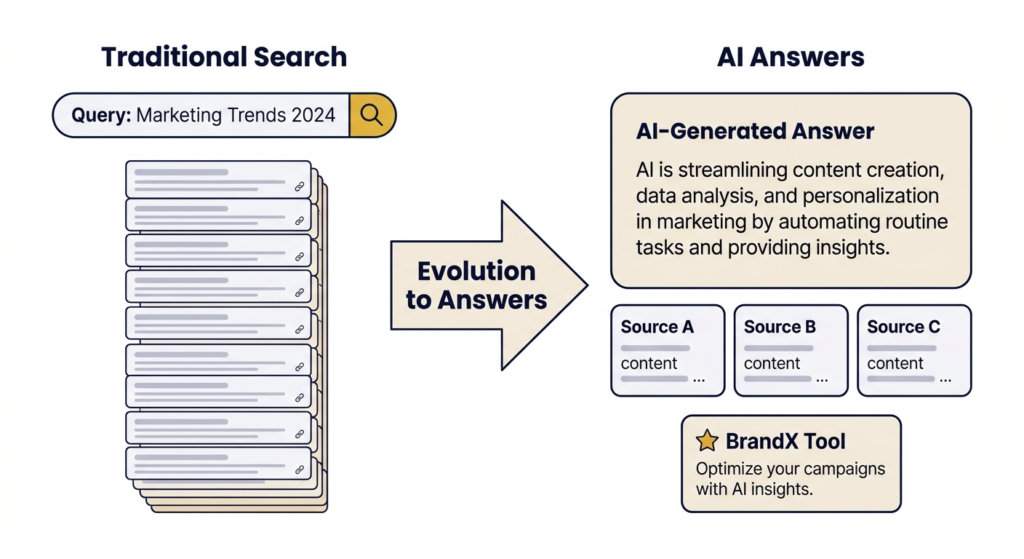
When an AI tool answers a question, it typically draws on 3 or 4 primary sources. Being one of those cited sources is the new position zero. In many cases, it is more valuable than a page 1 ranking, because the user is already getting a synthesised recommendation where the AI is implicitly endorsing your brand.
The measure that matters is share of model: how often does AI recommend your brand when a buyer asks for a solution in your category?
Most businesses cannot fully measure this yet. The tools are still catching up. But the way to track it manually is straightforward: run the queries your buyers are asking across ChatGPT, Perplexity, and Google’s AI Mode. Note which brands appear consistently. Note whether yours is among them. Do this across your core category terms, your competitor comparison queries, and your problem-focused searches.
What you find will tell you more about your actual brand visibility in 2026 than your Google Analytics dashboard.
What AI Visibility Actually Looks Like (Before and After)
This is where the conversation usually stays abstract. So here is a concrete example of what the difference looks like.
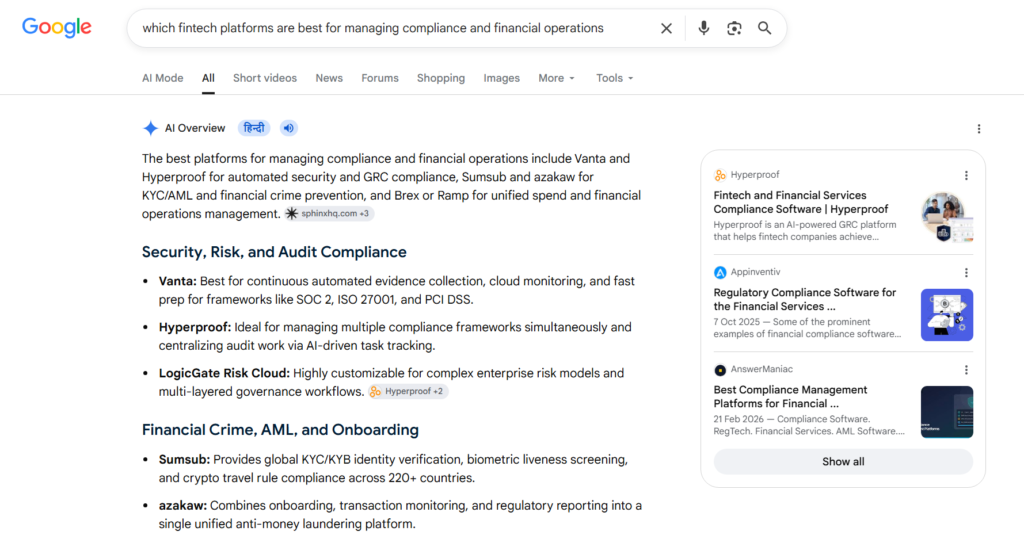
A B2B fintech brand ranks on page 1 for several competitive terms. Their blog is active, their domain authority is reasonable, and their SEO is not broken. But when a potential client asks ChatGPT “which fintech platforms are best for managing compliance and financial operations?”, the brand does not appear. A competitor with a fraction of the traffic does, because that competitor has published a handful of deeply structured articles on compliance challenges, been cited in two trade publications, and used consistent category language across every touchpoint. The AI has enough coherent signal to recommend it with confidence. The first brand, despite more content and more traffic, has given AI nothing solid to hold onto.
This is the gap AEO closes. And it is widening every month as AI search usage grows.
How to Build AEO Visibility: The Framework That Actually Works
AEO is not a separate content programme. It is what happens when your content strategy is executed with enough depth, consistency, and structure that AI systems can understand and cite it confidently. At Justwords, we have distilled this into five principles that run through every content engagement we take on.
1. Own a topic, do not just cover it.
A single comprehensive piece of content that genuinely answers a question is worth more for AI visibility than ten surface-level articles on adjacent topics.
The goal is topical authority: publishing enough depth in a defined area that AI systems recognise your brand as a credible, primary source.
Shiprocket’s blog grew traffic 40% year-on-year partly because we built tightly clustered, intent-mapped content around ecommerce and logistics, not a scattered mix of trending topics.
2. Make your brand easy for a machine to understand.
The way you describe your brand, your category, and your core service should be consistent across your website, blog, social profiles, PR mentions, and directory listings. Inconsistency is noise. A brand described differently in fifteen places gives AI nothing solid to synthesise.
This is one of the first things we audit when a new client comes on board: not just what they are publishing, but whether the signals across the web tell a coherent story.
3. Structure content to answer and engage, not just inform.
Content that directly answers a specific question, with a clear opening answer, defined terms, and logical section structure, is far more likely to be cited. The blog format that buries the answer in paragraph five is the wrong format for AEO. Answer first, and then use context, evidence and useful detail to keep the reader engaged.
4. Build third-party credibility deliberately.
AI systems weight external mentions heavily. Guest articles on respected industry publications, trade media coverage, client case studies in third-party formats, and consistent review profiles all contribute to the trust signal that makes AI comfortable recommending a brand.
This is why guest posting and editorial outreach are not optional extras in an AEO-aware content programme; they are how you build the external proof that internal content alone cannot provide.
5. Measure share of model, not just rankings.
Run the queries your buyers are asking across ChatGPT, Perplexity, and Google AI Overviews. Note which brands appear. Note whether yours is among them. Do this monthly across your core category terms, your problem-focused searches, and your competitor comparison queries. It is not a perfect measurement, but it is more honest about your actual AI visibility in 2026 than a Google Analytics traffic report.
The Honest Caveat
Nobody has fully cracked the AEO formula yet. The field is still developing, the AI systems update frequently, and a significant amount of what is currently sold as “AEO services” is older SEO thinking with new vocabulary. Be sceptical of anyone promising guaranteed AI visibility or a fixed formula that works across all platforms.
What is certain is the behavioural shift: buyers have moved from searching to asking, and the answer is replacing the list. That makes depth, consistency, authority and clarity increasingly important.
Brands that are building those signals are accumulating an advantage that will be difficult for late movers to close. And that work doesn’t require abandoning SEO or starting from scratch. It means making the content, authority and brand signals you are already building clearer, more consistent and more useful to both search engines and AI systems.
That is the approach we take at Justwords. We help B2B, B2C, and growth-stage businesses build content and SEO programmes that improve organic visibility and strengthen their authority and brand clarity across the evolving search landscape. If you want to understand where your brand currently stands in AI search and what you can do to improve its visibility, explore our AI SEO services or speak with our team.
FAQs
What is AEO and how is it different from SEO?
SEO (Search Engine Optimisation) focuses on ranking in traditional search results, where users click through to a website. AEO (Answer Engine Optimisation) focuses on being the source that AI systems cite when generating a direct answer to a user’s query. The user may never visit your website at all. The goal shifts from earning a click to earning a citation.
How do I know if my brand is visible in AI search results?
Run the queries your buyers are most likely to ask across ChatGPT, Perplexity, and Google AI Overviews / AI Mode. Note which brands are recommended, which sources are cited, and whether your brand appears. Do this across category queries, problem-focused searches, and competitor comparison questions. It is not a precise measurement yet, but it gives you a realistic view of your current AI visibility.
Does good SEO automatically lead to good AEO visibility?
Not automatically. SEO and AEO share some foundations, particularly the importance of high-quality, authoritative content, but AEO requires additional elements like structured answers, consistent brand language across all touchpoints, and credible third-party mentions. A brand with strong SEO rankings but inconsistent messaging across the web may still perform poorly in AI-generated answers.
How long does it take to build AEO visibility?
There is no fixed timeline. AEO visibility is built through consistent, high-quality content production over months, not weeks. Brands that already have strong topical authority and consistent external mentions will see results sooner. Those starting from scratch should think in terms of 6–12 months of disciplined execution before meaningful visibility builds.
Should we prioritise AEO or traditional SEO in 2026?
You don’t need to choose between AEO and traditional SEO. You need a content strategy that supports both. Traditional organic search still drives significant traffic and should not be abandoned. But content written purely for keyword rankings, without the structure and depth that AI systems reward, is increasingly leaving AEO visibility on the table. The two are increasingly complementary: strong SEO creates the foundation, while AEO extends that visibility into AI-generated answers.