
A B2B SEO agency is a specialist that builds search and content strategies for companies selling to other businesses. It accounts for long sales cycles, multi-stakeholder buying committees, low-volume high-intent keywords, and success metrics tied to qualified pipeline rather than traffic volume.
B2B SEO is fundamentally different from general SEO, and applying the wrong framework to it produces an expensive failure pattern. Traffic rises, keyword rankings improve, the agency presents confident monthly reports, and six months in, someone from the sales team asks why leads have not followed.
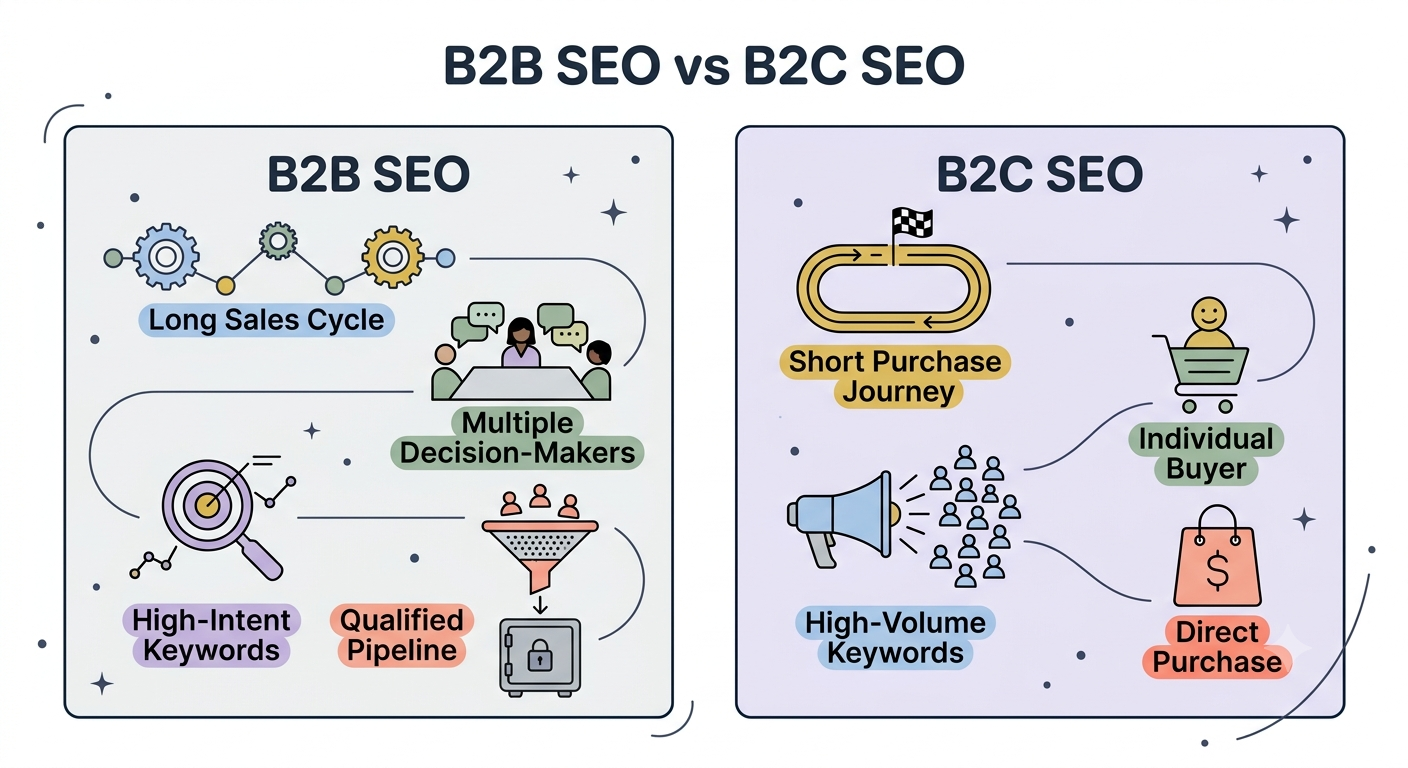
The solution to this is very structural. A generalist SEO agency optimises for the signals it knows how to move. Those signals, like session volume, keyword positions, and domain authority, are legitimate inputs in B2C SEO, where purchase decisions happen in hours and the buyer is usually one person. In B2B, they are insufficient measures of a strategy that needs to perform across a buying committee of 6 to 10 stakeholders, over a sales cycle averaging 84 days, and across content formats that range from awareness-stage editorial to technical documentation to ROI case studies.
The CFO evaluating your SaaS product searches for different things than the IT lead. The IT lead searches for different things than the department head who first identified the problem. An SEO strategy that does not account for this committee structure produces content that reaches one persona and misses the rest, which means the conversion does not happen even when the traffic arrives.
That is the gap a specialist B2B SEO agency is built to close.
Let’s understand how.
|
The Long Sales Cycle Problem (And Why It Defeats Generic SEO)
The average B2B sales cycle is 84 days. During that period, a buyer might interact with your content 8 to 12 times across different formats and channels before they are ready to speak to sales. Each of those interactions is an SEO opportunity, and each one requires a different type of content targeting a different stage of consideration.
Generic SEO agencies tend to solve for discovery: awareness-stage content, broad informational keywords, blog posts that bring people to the top of the funnel. This is necessary but nowhere close to sufficient for B2B.
What they leave unbuilt is equally important. Comparison content for buyers evaluating vendors (e.g., “HubSpot vs Salesforce for mid-market India”), technical documentation that satisfies the IT evaluator’s search queries, ROI calculators and case studies that speak to the CFO’s approval criteria, pricing transparency content that pre-empts the procurement team’s objections. These are mid- and bottom-of-funnel assets. They do not generate impressive traffic numbers. But they generate qualified pipeline. A B2B SEO agency understands the difference and builds for both.
B2B SaaS companies face this challenge in a particularly acute form. A SaaS buyer is not making a one-time purchase. They are committing to a recurring contract with switching costs. Their diligence is proportionally higher. They will compare you to every credible competitor. They will look for you in third-party review platforms, industry publications, and peer communities. They will run a free trial if one is available and evaluate technical performance before the commercial conversation begins.
The SEO content strategy for a SaaS company must support all of these evaluation stages. That means problem-aware content at the top of the funnel, solution-comparison content in the middle, and trust-building assets like verified case studies and technical documentation at the bottom. Most agencies build the first layer and consider the job done.
Keyword Research for B2B: Volume Is the Wrong Metric
This is where generalist SEO agencies create their most persistent problems for B2B clients. They optimise for search volume because that is the metric they know how to improve, and it is the metric clients most easily understand in a monthly report.
But B2B keyword research should optimise for commercial intent and conversion proximity rather than volume alone. Long-tail keywords account for 70% of B2B organic search traffic, and the queries that drive qualified leads are usually the phrases that a volume-first approach would deprioritise or ignore entirely.
Queries like “Best CRM software for 50-person sales team India” get fewer searches per month than “CRM software.” But it converts at a significantly higher rate because the buyer who searched it has already defined their need, their company size, and their geography. They are closer to a decision. That is the keyword worth ranking for.
This distinction changes the entire content architecture. Instead of broad category pages chasing high-volume terms, a B2B SEO strategy builds out hyper-specific content clusters: industry-vertical landing pages, use-case-specific feature pages, city or region-specific service pages for companies targeting enterprise accounts in particular markets, and integration pages that capture buyers mid-evaluation (e.g., “Salesforce integration with Zoho Books”).
B2B SaaS companies that segment their content and pages by industry vertical see an average 28.7% higher organic traffic than those with generic positioning. The specificity is the conversion mechanism.
Multi-Stakeholder Content: The Invisible B2B SEO Challenge
Consider a standard B2B SaaS purchase in India. The initiator might be a department head who identified the problem. The technical evaluator is from IT. The commercial approval sits with the CFO. The actual users who will be onboarded are a team of 20. Each of these people will run independent search queries during the evaluation, and each of them will look for different signals.
The department head searches for business outcomes like “reduce HR admin time by 40%.” The IT evaluator searches for compliance and technical architecture like “SOC2 compliant HRMS India” or “HRMS with Active Directory integration.” The CFO searches for ROI validation like “HRMS cost savings mid-market companies India.”
If your SEO content only addresses one of these perspectives, you will show up for that stakeholder’s queries and disappear from everyone else’s. A specialist B2B SEO agency maps this committee structure before building the content plan. It identifies who researches what, at which stage, and builds the content infrastructure that captures each stakeholder’s attention at the right moment in their individual research path.
This is what separates a B2B content strategy from a generic content calendar.
The Thought Leadership Dimension That Generalists Miss
95% of B2B decision-makers say strong thought leadership makes them more receptive to sales and marketing outreach. 79% say they are more likely to advocate for proposals from companies that consistently produce high-quality thought leadership.
These numbers come from the Edelman-LinkedIn B2B Thought Leadership Impact Report 2025, and they reflect a dynamic that plays out in B2B organic search in a very specific way. B2B buyers, particularly at the senior level, search for expert perspectives as part of their due diligence. They are not only evaluating your product. They are evaluating whether your company is credible enough to trust with a decision that has real career consequences for them.
An SEO strategy that only chases product and solution keywords misses this layer entirely. The content that builds this credibility takes different forms: original research, analyst-style commentary on industry trends, detailed technical guides authored by named experts, and opinion content that takes a clear, substantiated position on contested questions in the industry.
This content does not always generate direct leads. It generates the kind of trust that makes the lead conversion easier when it does come. A generalist agency will rarely invest in it because the traffic numbers are modest. A specialist B2B SEO agency understands that the buyer who read three of your thought leadership pieces before requesting a demo is already half-sold before the sales team picks up the phone.
SaaS SEO: A Distinct Discipline Within B2B
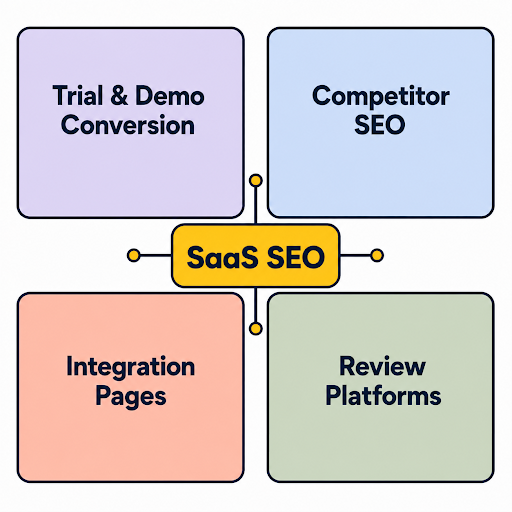
SaaS companies have additional SEO requirements that sit outside standard B2B strategy and are rarely understood by agencies without direct SaaS experience.
- Trial and demo conversion optimisation: In SaaS, an organic visitor converting to a free trial or demo request is often the primary SEO conversion goal, not a direct sale. The content architecture must guide visitors from informational queries through consideration content and into a trial flow, with each stage reducing friction for the next. This requires understanding product-led growth mechanics and conversion rate optimisation (CRO) across a long journey.
- Competitor SEO: SaaS buyers compare products as a matter of course. They will search “X vs Y,” “best alternative to X,” and “X pricing.” These are some of the highest-conversion query types in SaaS SEO. An agency without SaaS experience often avoids competitor content out of caution or ignorance, giving this traffic entirely to competitors who have no such hesitation.
- Integration and use-case pages: For SaaS companies with an extensive integration ecosystem, integration pages that target queries like “Slack integration for project management” or “Zapier alternative for India teams” are a scalable, high-intent traffic source that most generalist agencies have never built.
- Review platform optimisation: G2, Capterra, Trustpilot, and Software Suggest collectively influence a significant portion of B2B SaaS purchase decisions. A complete SaaS SEO strategy includes not just on-site content but a deliberate approach to review platform presence, because these platforms rank alongside your website for branded and category searches.
What to Expect From a Specialist B2B SEO Agency
A B2B SEO agency worth working with approaches the engagement as a strategic growth partner. That distinction shapes everything from how the first conversation goes to how success is defined 12 months later.
They will ask about your sales cycle length, typical deal size, buying committee structure, and existing content before they mention keyword targets. For them, strategy always comes before execution. They will map content to pipeline stages rather than search volume tiers, insist on measuring qualified leads and revenue attribution rather than organic sessions, and be candid about timeline.
B2B SEO typically shows meaningful pipeline impact between months 6–12. Any agency promising significant lead generation in 90 days without credible precedent in your category is adjusting its claims to match your expectations, not your market’s reality.
The agencies that consistently deliver B2B results share a few characteristics. They have demonstrated experience in your vertical or in adjacent B2B categories with comparable complexity. They can show case studies with qualified lead and revenue impact. They have genuine content capability across different formats like thought leadership, technical documentation, commercial comparison content, and conversion-focused copy. And they treat your sales cycle as the governing constraint on everything they build, because that is what it is.
This is the standard we hold at Justwords across every B2B and SaaS engagement. Every strategy begins with business understanding. Only then do we move to keyword research or a content calendar. Content is mapped to buying committee stages. And measurement is tied to qualified traffic, lead contribution, and organic revenue wherever possible.
The proof is in how those engagements have performed. Logistics SaaS platform Shiprocket scaled to a consistent 120-piece monthly content pipeline over four years and grew blog traffic 40% year-on-year through search intent planning and deliberately built topical authority. These outcomes do not happen with a generic SEO framework applied to a B2B problem. They happen when content strategy is treated as an organic growth engine, and when the agency running it understands that qualified pipeline is the only metric that actually matters to a B2B business.
Conclusion
B2B SEO is not a more complex version of B2C SEO. It is a different discipline with different success metrics, different content requirements, and a fundamentally different understanding of what a conversion actually means for a business with a 90-day sales cycle and a 10-person buying committee.
A generalist agency will spend 9 to 12 months teaching you this through poor lead quality, traffic that does not convert, and a growing gap between monthly reports and sales team reality.
The right B2B SEO agency starts with your buyer, your sales cycle, and your revenue goals and then builds the content infrastructure that earns authority at every stage of the purchase journey. It does not sell blogs. It builds organic growth systems that compound over time and produce qualified demand.
If that is the outcome your business needs, it’s worth having a conversation about an SEO audit and strategy.
FAQs
1. What is a B2B SEO agency?
A B2B SEO agency specialises in search engine optimisation for companies that sell to other businesses. This includes strategy, content, and technical SEO built specifically for long sales cycles, multi-stakeholder buying processes, and lower-volume, higher-intent keyword targets.
2. How is B2B SEO different from B2C SEO?
B2B SEO targets longer sales cycles (average 84 days versus 9 for B2C), buying committees of 6 to 10 stakeholders rather than individual buyers, and lower-volume keywords with higher commercial intent. Success is measured in qualified pipeline and leads, not just traffic volume or session counts.
3. Why does a B2B company need a specialist SEO agency?
Because the content strategy, keyword architecture, conversion goals, and measurement frameworks for B2B are structurally different from B2C. A generalist agency applies the wrong framework, optimises for the wrong metrics, and produces traffic that does not convert to the qualified pipeline B2B companies need.
4. What is SaaS SEO and why does it require specialist expertise?
SaaS SEO addresses the unique requirements of software-as-a-service companies: trial and demo conversion optimisation, competitor comparison content, integration page strategy, and review platform presence. These requirements sit outside standard B2B SEO strategy and are rarely understood by agencies without direct SaaS experience.
5. What kind of content does B2B SEO require?
B2B SEO requires a full-funnel content architecture including awareness content for problem-aware buyers, solution-comparison and use-case content for evaluating buyers, and trust-building assets including case studies, ROI documentation, and technical specifications for buyers in vendor evaluation. Thought leadership content also plays a specific role in building the credibility that senior B2B decision-makers require before engaging with sales.
6. How do I choose the right B2B SEO agency in India?
Look for demonstrated experience in your industry vertical or in comparable B2B categories. Ask for case studies that show pipeline or revenue impact, and not only traffic growth. Evaluate their content capability across formats, not just blog writing. And assess whether they ask about your buyer, your sales cycle, and your deal structure before they ask about your keywords. The quality of those early questions reveals whether they understand B2B.