
For most Indian businesses, a content marketing agency is the better choice. It gives you a complete team, a strategy built around search and buyer intent, and room to scale up or down, usually for less than the base salaries of an equivalent in-house team. An in-house team wins in narrower cases like large enterprises with deep proprietary expertise, high daily publishing volume and the budget to staff every function.
The comparison most businesses make is salary against retainer, and it misses the bigger gap. The real difference sits in coverage and continuity. One hire cannot be content strategist, SEO specialist, writer, editor, designer and analyst at the same time. And when that person resigns, the knowledge just leaves with them.
This article compares the two models on cost, capability, control and risk, using Indian salary data and published research on content teams. It also sets out the model that works best for most growth-stage businesses, so you can decide with numbers in front of you.
Key Takeaways
- A lean in-house team of one content lead and two writers costs roughly ₹1.1 lakh to ₹1.6 lakh per month in base salary alone, before benefits, tools, hiring and management time are added.
- Content marketing agencies bring a full team of specialists, which a team of three can’t match at the same budget.
- In-house teams are stronger on brand proximity and speed of access to experts. Agencies are stronger on strategy depth, SEO integration, scale and measurement.
- The model that works for most Indian businesses is agency-led strategy and execution, with one internal person who provides brand context, product knowledge and approvals.
- Decide on ownership first. Whoever owns strategy, SEO and measurement determines the results.
What an In-House Content Marketing Team Really Costs in India
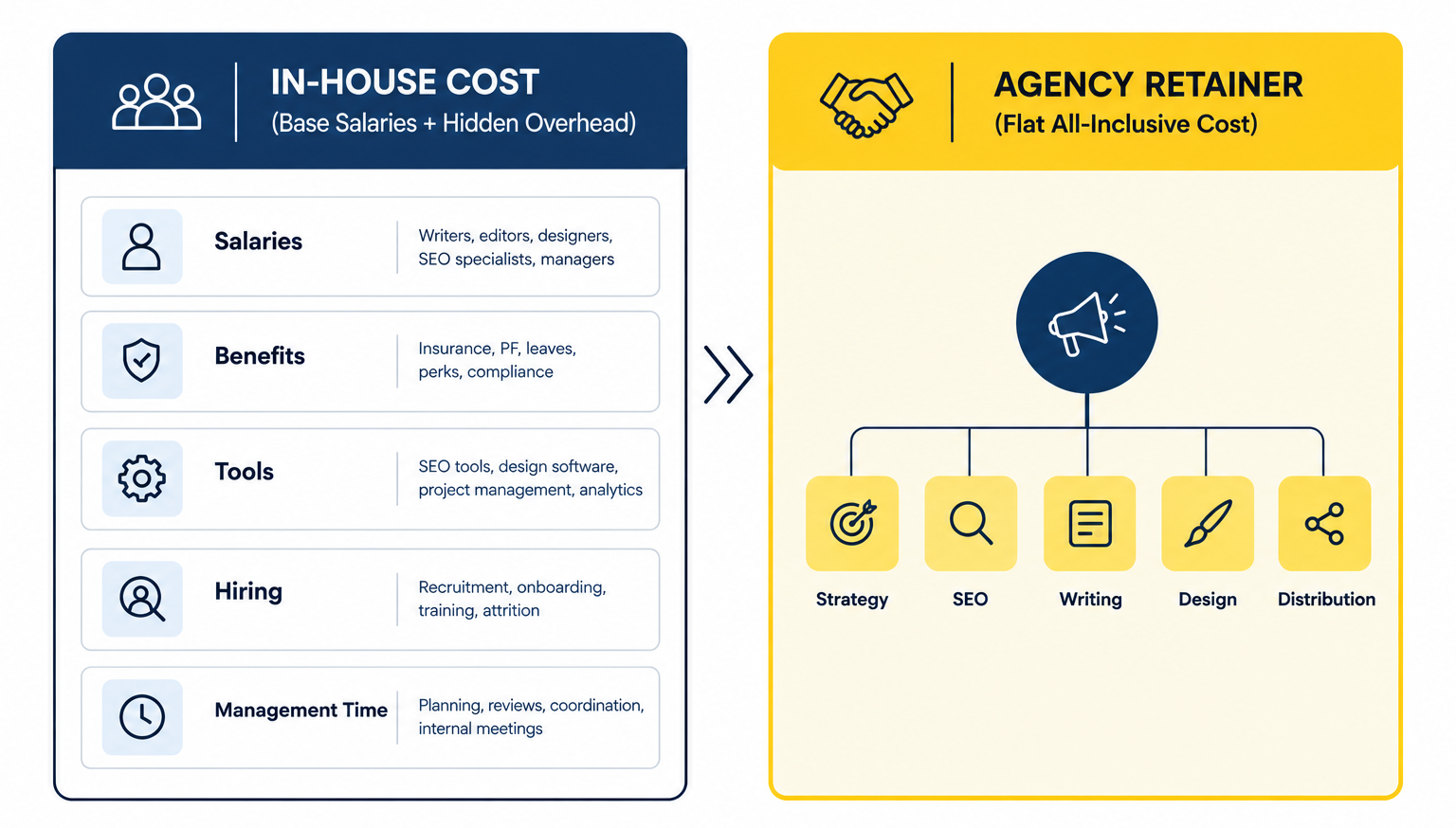
Salary is the visible cost. Based on Glassdoor and PayScale India data, a lean team looks like this.
| Role | Median base salary (annual) |
| Content lead (strategist to manager level) | ₹6,50,000 to ₹12,55,000 |
| Content writer (two needed) | ₹3,40,000 each |
| Team total (base salary only) | ₹13,30,000 to ₹19,35,000 |
That works out to roughly ₹1.1 lakh to ₹1.6 lakh a month, and it covers only three people. A designer, SEO specialist and editor are not in the table, and each adds their own salary.
Apart from that, there are several costs that sit outside it. Benefits and bonuses add to every salary. Recruitment takes weeks, and a new hire takes months to understand your product and audience. Tools for SEO, analytics and workflow are billed separately. Management time, which is the most overlooked cost, falls on a marketing head who is already stretched.
A lean team also concentrates risk. Content Marketing Institute research on B2B marketers found that 54% of dedicated content teams have only 2 to 5 people. When one of those people leaves, a third or half of your capability leaves too.
What a Content Marketing Agency Brings
An agency retainer for an SME in India typically falls between ₹50,000 and ₹1,50,000 a month. What that buys is breadth.
- A full team on day one: Strategy, SEO, writing, editing, design, distribution and reporting sit under one engagement. You don’t wait three months to hire a specialist.
- Strategy built from search data: A good agency starts with an audit of your keywords, competitors and buyer questions, then builds a content roadmap around them. Content and SEO run as one system with one budget.
- Elastic capacity: Output can rise for a product launch or fall in a slow quarter without hiring or layoffs.
- Experience across sectors: A team that has worked on fintech, healthcare and ecommerce programmes brings patterns that a single in-house hire hasn’t seen.
- Measurement discipline: Reporting is tied to traffic, leads and revenue, and an outside team has no reason to flatter the numbers.
Where an In-House Team Wins
An in-house team has some advantages in a few specific situations:
- Brand proximity: Writers who sit beside product managers and founders absorb the voice, jargon and the unwritten rules of the business.
- Speed: A question to an engineer or a founder gets answered in hours.
- Responsiveness: Real-time commentary on regulatory changes or market news is easier from the inside.
These advantages depend on access being actually used. Founders, product heads or engineers often have less bandwidth to sit with the content team for every blog. Sitting close to expertise has no value if the experts never write, review or record anything.
Content Marketing Agency vs In-House: Decision Framework
| Your situation | Better fit | Why |
| Startup or SME, no content lead, goal is organic growth | Agency | You need strategy, SEO and execution together, and a full team costs less than hiring one. |
| Growth-stage business with one marketer handling content | Agency with an internal brand owner | The marketer provides brand context and approvals. The agency owns strategy, creation and distribution. |
| Enterprise with deep proprietary expertise and daily publishing | In-house core team, agency for specialist work | Volume and speed justify permanent staff, while SEO and strategy gaps still need specialists. |
| Regulated sector such as BFSI or healthcare | Agency with a defined approval process | Compliance review stays internal, and the agency runs the content programme around it. |
The Content Marketing Model That Works for Most Indian Businesses
The strongest setup is agency-led, with a single internal owner. The agency owns the strategy, SEO, content, distribution and measurement end to end. Your internal person gives brand context, access to product and subject experts and stakeholder approvals, usually a few hours a week.
This split places each responsibility where it is done best. Your team knows your business, and the agency knows how to turn that knowledge into organic growth. It also protects you from the single-hire risk, since the programme does not depend on one person staying.
What This Looks Like in Practice
Scale is where the difference between the two models shows most clearly. Justwords took Tally Solutions from 20 to 25 content pieces a month to 300+ pieces a month, and it supported Shiprocket at 120 pieces a month, with 40% year-on-year blog traffic growth. Shiprocket’s audience ranged from Tier-2 sellers to D2C brands, which required strategy for several distinct buyer groups at once. An in-house team of three would struggle to keep that pace and that range, however talented its members.
Both projects sat within wider content marketing services that tied output to organic growth and measurement, which is where the value comes from. Volume without strategy produces content nobody reads.
Decide Who Owns Strategy, Then Choose
Before comparing quotes and salaries, ask who in your business can own content strategy, SEO and measurement for the next 18 months. If you have that person, a funded team around them and the patience to wait through the hiring period, building in-house can work. If you do not, each month spent searching delays the organic growth your competitors are already collecting.
If you would rather skip the hiring cycle, speak to a content marketing and SEO agency that takes ownership of the whole programme, and let your team focus on what only they can provide.
FAQs
1. Is a content marketing agency cheaper than an in-house team in India?
Usually, yes. A lean in-house team of three costs ₹1.1 lakh to ₹1.6 lakh monthly in base salary alone, while SME agency retainers typically run ₹50,000 to ₹1,50,000 and cover a wider team.
2. When should a company build an in-house content team?
Build in-house when you publish at high daily volume, hold deep proprietary expertise, and can fund a full team including strategy, SEO and design. Smaller operations rarely justify the cost and hiring time.
3. Can I use an agency and an in-house team together?
Yes, it often works well. Let the agency own strategy, SEO, content and measurement, while your internal person provides brand context, subject-expert access and approvals. This keeps responsibilities clear and avoids duplication.
4. How many people are in a typical in-house content team?
Most B2B organisations with a dedicated content team have 2-5 people. Most teams therefore cover several specialisms with very few people.
5. Will an agency understand my brand and industry?
A good content marketing agency begins with an audit, stakeholder interviews and a review of your existing content before it writes anything. Assigning one internal owner for briefs and approvals speeds up how quickly the team learns your voice.
6. How do I move from in-house content to an agency?
Start with an audit of existing content and documented brand guidelines. Keep one internal owner for approvals, brief the agency on priority topics, and run both teams briefly side by side before the handover.