
It is probably a bit too early to make any definitive statements, but from what we are seeing so far, Google’s November 2026 core update looks like a big one. It started rolling out on November 10, and it is not done yet. It is the third broad core update of the year, after March and May, and Google says it could take up to two weeks. So we still have some time before things settle down.
But there is already plenty of movement.
What makes this update particularly interesting is the kind of websites that seem to be losing visibility on Google Search. Some early Search Console data shared by SEO practitioners points to sites that have been publishing AI-generated content at scale, with very little human involvement. Google is calling it a regular core update, and that is all it has officially said.
But there is more to this story than just another core update.
This update did not arrive alone. It followed the longest spam update of 2026, a rewrite of Google’s AI content guidance and a noticeable rise in manual actions. We are also hearing from our own industry sources that several large, well-known websites in healthcare, infrastructure and finance have had pages de-indexed in recent weeks. These developments together point to a direction that is becoming increasingly difficult to ignore.
So, what exactly is happening? Is this another update that will shuffle rankings for a few weeks, or are we beginning to see the consequences of publishing thousands of AI-written pages without anyone really taking responsibility for them?
Let’s look at what we know so far, what the SEO community is seeing and what we think website owners should be paying attention to.
Key Takeaways
|
What Google released, and what the early data shows
Google began the rollout on November 10 at 10:06 a.m. PT. It applies globally, covers all languages and may take up to two weeks, which points to completion around November 24. Google describes it as a regular update designed to surface relevant, satisfying content from all types of sites. At the time of writing this article, no completion notice had been posted.
What early Search Console data is telling us
While the rollout is underway, Search Console is currently a more reliable window into performance than any rank tracker. Glenn Gabe of G-Squared Interactive has suggested treating it as the source of truth because third-party visibility tools are returning noisy data. By November 17, he had seen clear surges and drops in Search Console, with November 13 looking like the day the update landed. He also flagged two domains that had scaled heavily on AI-generated content and were already falling hard.
There are sites gaining visibility, too. That’s important because a core update re-scores everyone; it doesn’t simply penalise a predetermined group of websites. Some pages lose ground while others move up because Google considers them more useful for a particular search.
Looking at the winners, therefore, can tell us as much about the update as looking at the losers.
Also, there are two things to keep in mind before drawing conclusions:
- First, Google confirmed a logging error that undercounted impressions in the Search Console generative AI report from November 9 to 11. So a dip there may reflect missing data rather than an actual visibility loss.
- Secondly, if the rollout runs its full two weeks, the comparison week Google recommends will include Thanksgiving, Black Friday and Cyber Monday, which distorts any before-and-after view for retailers globally.
How 2026 got here: spam updates, a core update and a rewritten rulebook
The March core update ran from March 27 to April 8 and the May core update from May 21 to June 2. Spam updates followed in March, June, August and September. The September one ran from September 24 to October 8, a stretch of 13 days and 16 hours, which made it the longest spam update of the year.
Google named no specific policy, and reports of manual actions rose around its completion.
The November update therefore came almost six months after the May update began. But there was plenty happening in that gap. Google was changing its Search Central documentation, clarifying what it considers useful content and making its expectations around AI-generated material considerably more explicit.
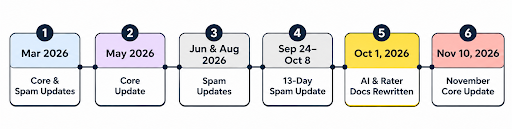
Google published the warning six weeks before the update
On October 1, Google added a line to its generative AI guidance saying it is “critical to manually fact-check and review all AI-generated content” before publishing, with the review extending to titles, alt text and other metadata.
The same day, its helpful content guidance was updated to define main content and explain four attributes that quality raters assess:
- Effort
- Originality
- Talent or skill
- Accuracy
The guidance also makes it clear that accuracy matters even more for health, finance and other YMYL (Your Money or Your Life) topics.
There was another interesting change. Google also began describing AI-generated headshots, invented names and false credentials as deception. Google’s rater guidelines already treat content mass-produced without editing or curation as low-effort content.
Three days later, SEO analyst Lily Ray wrote that “all signs point to a major Google update on the horizon,” naming scaled AI content, fake authors and tactics built to game AI answers as the likely targets. The core update arrived about five weeks after her post.
Gary Illyes of Google has also said that scaled content is becoming a bigger problem than link spam.
Google does not need to ban AI-generated content blanketly (here is what Google actually thinks of AI content). It has already defined what good content should demonstrate, that is, effort, originality, skill and accuracy. An unreviewed AI publishing pipeline fails to meet those standards because it is designed to produce material quickly, not necessarily to establish whether that material adds anything useful.
This is why the description of the November update as a “regular update” should not reassure websites that have been publishing AI content at scale without proper editorial oversight. Google does not need to announce a specific target for its systems to reassess that content.
What AI slop looks like, and why it survives until it does not
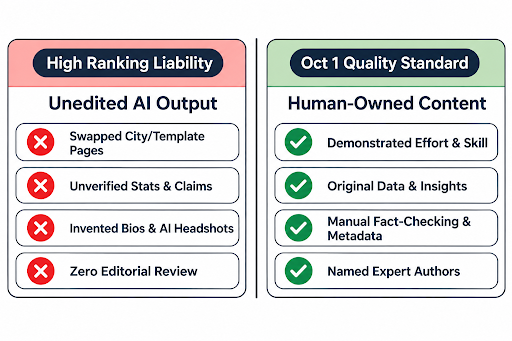
What actually counts as AI slop?
AI slop is content produced in volume with no named expert, no original information and no fact-check. Three hundred location pages with only the city name swapped is slop. So is an “ultimate guide” that rearranges what the top three results already say, and so is any article carrying a statistic nobody verified.
Why does this content still rank?
The problem is that this kind of content can still get visibility, at least initially. Enforcement is slow and uneven, which can make a scaled-content strategy look successful long before its weaknesses show up.
Reddit offers an interesting example of how this can play out. Its CEO said machine-translated content was being ranked lower. Glenn Gabe subsequently connected the decline of Reddit’s AI-translated pages with the May core update and June spam update. However, he later reported seeing those translations gain visibility again during the September spam update.
For anyone watching these developments, the obvious question is: if the pages can lose visibility and then regain it, does that mean the strategy still works?
Not necessarily. Ranking fluctuations do not establish that Google has approved of the underlying content. They show that Google’s systems are continually reassessing pages, and that visibility can change as those systems evolve.
The problem with temporary ranking gains
Lily Ray’s case studies offer another reason to be cautious. She has documented websites that used AI to scale content, experienced initial growth and then suffered substantial declines within the following year.
This is the part that many businesses underestimate. A strategy can appear successful for months before its weaknesses become visible in organic search. By then, the website may have hundreds or thousands of pages built around the same flawed approach.
Our concern is that every quarter a scaled-content website survives encourages another brand to try the same thing. The initial traffic looks like validation, the publishing costs look attractive and nobody wants to question a strategy that appears to be delivering. But only until the ranking losses arrive.
Penalties, manual actions and the return to human writers
Algorithmic hits versus manual actions
Algorithmic hits and manual actions are different problems. A spam or core update sends no notice and has no reconsideration process. A manual action appears in Search Console and can be appealed once the issue is fixed.
SEO experts reported more manual actions for thin, scaled and pure-spam content around the September update, which suggests Google is using human review alongside SpamBrain, its automated spam detection system.
The de-indexing we are hearing about is more prominent in healthcare, infrastructure and finance. That is consistent with how Google weighs these topics. A wrong dosage, a wrong interest rate or an invented regulation harms a reader, and Google holds YMYL pages to the highest accuracy bar it has. We would expect these sectors to be treated the hardest.
Why brands are bringing human writers back
Meanwhile, the reverse migration has begun.
The Washington Times reported in March that e-commerce and fintech companies had quietly rehired content writers they had earlier replaced with AI. We are seeing that increase even further now.
Brands that shifted towards AI-first content strategies to reduce the cost of producing content are now spending more to get it fixed by humans. But the problem is most of these brands are paying twice – once to produce the content at machine speed, and again to rebuild it properly.
“When an AI-first content programme stalls, the first request is rarely for more new articles. Brands want to know which pages deserve to exist, who can stand behind them, and what has to be rebuilt with real expertise. Cleaning up costs far more than getting it right the first time.”
|
Where we think this goes next
Looking at Google’s documentation changes and the updates that followed, we see a few likely developments:
- More enforcement, announced in documentation first: Google clarified that its spam policies apply to AI Overviews and AI Mode on May 15, and the May core update followed six days later. The October 1 rewrite was followed by the November update. We expect Google’s help pages to keep signalling the next move. So, read them.
- Recovery will be slow: Sites that fixed problems this year have reported recoveries taking months, and some improvements only register at a later core update. Anyone hoping for a quick reversal in December should plan for a longer timeline.
- YMYL will be hit hardest: Unreviewed AI content in finance, healthcare and legal categories carries the highest ranking risk and the highest business risk at the same time.
- AI search will inherit the damage: AI answers can be grounded in Google’s index. So, a drop in Google rankings can carry into AI search visibility. A brand that scales slop loses twice.
- “AI-assisted, human-owned” content workflow becomes the minimum: Named authors with verifiable credentials, original input and an accountable editor are becoming the entry ticket. Byline pages with invented people are now a documented liability.
What to do in the next 14 days
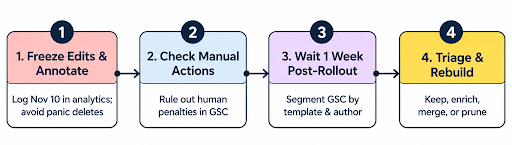
While the rollout is live, the priority should be to understand what is happening on your website before making major changes. Here is how we would approach the next few weeks:
- Freeze large edits: Rewriting or mass-deleting during a live rollout makes diagnosis impossible. Doing so makes it difficult to establish whether a ranking change came from Google’s update or from your own interventions. Add an annotation in your analytics for November 10 and keep a record of what moved.
- Check Manual Actions first: Open the Manual Actions report in Google Search Console. It takes two minutes and tells you whether Google has identified a specific policy violation through human review or whether you are dealing with a ranking change that needs further investigation.
- Wait for completion plus one week: Wait for Google’s completion announcement and allow a full week after that before comparing performance. Use the week before November 10 as your baseline, while accounting for seasonal changes in search demand.
- Segment Search Console data by group: Break results down by page template, publish date, author and production method. The pattern is usually in the groups, and a sitewide line hides it.
- Triage every affected page: Keep what is useful, rewrite what has promise by adding original input, merge near-duplicates, and remove pages that exist only to catch search variations. A structured content audit makes this triage faster. Do this after the rollout, and avoid wholesale deletion.
- Extend fact-checking to metadata: Google’s guidance now covers titles, alt text and schema. So a process built only for body copy leaves a gap. If schema is part of your workflow, review your structured data markup too.
- Fix authorship: Delete invented bios and AI-generated headshots. Replace them with real people, real roles and credentials a reader can check, which is the practical side of experience and expertise in Google’s E-E-A-T guidelines.
- Prefer Search Console over trackers: Third-party tools are currently noisy, so base decisions on first-party data.
What a human-owned content process looks like
To put into perspective, let us explain the process we follow at Justwords. Content starts with a deep understanding of the brand, the products or services, the industry and broader content strategy. A draft only comes later. The editor assigned to each account writes a detailed brief and brand guidelines before anyone starts writing content. A writer and an editor are paired on the account and stay connected to the client, and subject matter experts are interviewed before drafting begins on website and authority content. Technology helps us work faster at every stage, and a human who understands the bigger picture signs off on every piece.
Two tools help us enforce the standard. Our Content Gap Analysis Tool reviews what already ranks, what the client has already published, the questions people ask in People Also Ask and forums, and the intent behind the search, so that each brief includes what the top results are missing. Our Content Quality Checker then scores every draft against E-E-A-T, SEO and AEO criteria, including first-hand experience, factual accuracy and original points of view, and returns specific improvement flags in place of a general “looks good”.
“A fact-check pass means tracing every statistic to its original source, confirming the source says what the draft claims and removing anything we cannot verify. Originality is a separate check. After reading the top results, the content must still contain something the others don’t, such as expert input or real data.”
|
For Tally Solutions, we increased content production from 20–25 to 300+ content pieces a month across India, the UAE and Saudi Arabia. Writers were matched to each market’s regulatory requirements, while the editorial team monitored changes to keep compliance content accurate and current. High volume and high standards can coexist when people own the work.
The test to run before the next update
Open your 10 highest-traffic pages and your 10 most recently published ones. For each, ask who wrote it, what it contains that the top three results do not, and who verified the facts. Any page where the you can’t answer one of those questions is your weakness. You have little evidence to defend that page’s value or accuracy to Google.
Core updates now arrive roughly every few months, and Google is documenting its expectations ahead of each one. Decide this week which pages you would defend to a sceptical editor, and rebuild the rest.
If you would rather have an outside team run that audit and rebuild what fails it, talk to us.
FAQs
When did the Google November 2026 core update start and how long will it take to roll out?
Google began rolling out the November 2026 core update on November 10, 2026, at 10:06 a.m. PT. It is global, applies to all languages, and is the third broad core update of 2026. Google says it may take up to two weeks, pointing to completion around November 24. Some past core updates have overrun, so wait for the confirmation on the Google Search Status Dashboard.
Does Google penalise AI-generated content?
Google does not penalise content for being AI-generated. It acts against scaled, low-effort content, whatever produced it. Its guidance now explicitly calls manual fact-checking of AI output critical before publishing.
What is the difference between a core update and a spam update?
A core update re-evaluates overall content quality and relevance across sites. A spam update improves automated detection of spam policy violations such as scaled content abuse. Both can affect rankings, and neither sends a notification.
How do I know if my site was hit by the core update?
Wait until the rollout is complete and another full week has passed before drawing conclusions. Then compare your Search Console performance with the week before the update began. Check the Manual Actions report first, followed by performance breakdowns for individual page types, authors and publication dates.
How long does it take to recover from a core update?
Recovery can take weeks to months. Algorithmic drops have no reconsideration request. So, improvement depends on fixing content quality and waiting for Google to reassess, sometimes until a later core update.
Should I delete my AI-written pages?
Avoid mass deletion in a panic. Review pages after the rollout, then keep useful ones, rewrite promising ones with original input and expert review, merge duplicates, and remove pages that serve no reader.