An AI SEO audit checks whether AI search engines like ChatGPT can access, understand, trust, and cite your website, on top of the usual technical and on-page SEO checks. The checklist below covers seven areas: crawler access, technical health, content, structured data and entities, off-site signals, an AI visibility baseline, and measurement. Work through them in that order, fix what blocks you first, and repeat the audit every quarter.
Most sites fail this audit for reasons a standard SEO audit never checks. A page can rank on page 1, pass Core Web Vitals and still be missing from AI answers because a firewall turns away AI crawlers, the key text loads only after JavaScript runs, or the wider web describes your competitors more consistently than it describes you. Those gaps cost you the answer buyers read before they decide whether to click anything.
This guide walks through each area in the order you should fix it, shows how to separate a real gap from a harmless warning, and flags the mistakes that waste a quarter. It works for a 10-page local site and a 10,000-page enterprise one; only the scale changes.
Key Takeaways
- An AI SEO audit extends a normal SEO audit with checks on AI crawler access, entity clarity, citable content and brand mentions beyond your own site.
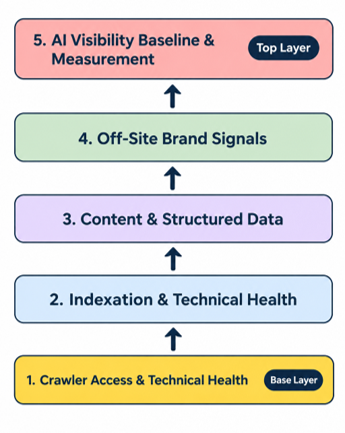
- Fix these in order: access, technical health, content, structured data, off-site signals. Polishing the upper layers on a broken base wastes effort.
- Benchmark AI visibility before you change anything, using 30-50 real buyer questions and running them several times across platforms.
- Clicks alone no longer show whether AI visibility is improving. Track citations, mentions and assisted leads as well.
- Audit quarterly. Platforms, competitors and your own site keep moving.
What an AI SEO Audit Covers That a Traditional SEO Audit Misses
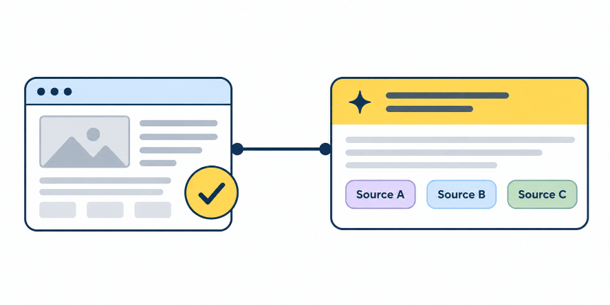
A traditional SEO audit asks whether Google can crawl, index and rank your pages. An AI search optimisation audit asks that and one more question: when someone puts a buying question to an AI tool, can it read your site, trust it and name you in the answer? The foundation is shared (our guide to an SEO audit covers the basics), but the checks widen.
| Area | Traditional SEO audit | What an AI SEO audit adds |
| Crawling | Googlebot access, robots.txt, sitemap | AI crawler access, firewall rules, server-rendered key text |
| Content | Keywords, intent, on-page tags | Direct answers, citable facts, coverage of buyer questions |
| Authority | Backlinks | Brand mentions, reviews, consistent entity facts across the web |
| Success metric | Rankings and clicks | Appearance rate, citation share, assisted leads |
The urgency is real. Ahrefs found that the top-ranking page earns 58% fewer clicks where an AI Overview appears, and YouGov’s India report classed 89% of surveyed online searchers in India as AI searchers. Ranking first still matters, but being named in the AI answer now matters alongside it.
Crawler access shows the gap most clearly. An analysis of 15.5 million sites found that about 1 in 10 block at least one AI crawler, and nearly 3 in 10 of the top 1,000 sites do. In our experience, many of those blocks are inherited from CDN (Content Delivery Network) or security settings instead of being chosen by the marketing team, which is why the first check in the audit so often finds something.
Before You Start: Set Up the Audit
You need Google Search Console, GA4, a site crawler such as Screaming Frog or Sitebulb, access to server logs or your CDN dashboard, and a spreadsheet. The spreadsheet is your audit template. It should have one row per issue, with columns for area, evidence, impact, effort, owner and status. Nothing fancier is needed.
Do an audit by page template instead of going page by page – homepage, service or product pages, category pages, blog posts and location pages. A problem on a template affects every page built from it, so one fix clears hundreds of rows.
The AI SEO Audit Checklist
1. Crawler Access: Can AI Systems Reach Your Pages?
AI answers cannot cite pages that their crawlers could not fetch. Access gaps are the cheapest to fix and the costliest to ignore. And they hide well because the site looks perfect in a browser.
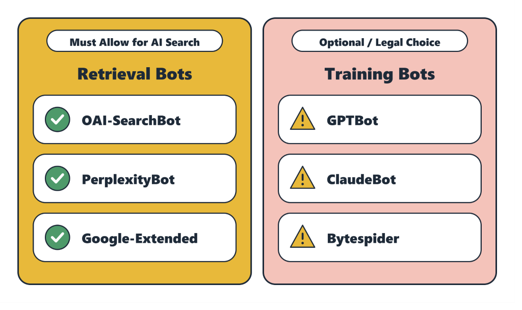
- Robots.txt: Review the rules for AI user agents. Training crawlers (such as GPTBot and ClaudeBot) and search or retrieval crawlers (such as OAI-SearchBot and PerplexityBot) do different jobs. So decide on each one deliberately.
- Firewall and CDN rules: Many security and CDN services now block AI bots by default or offer one-click blocking. Check whether yours does.
- Server logs: Look for 403 and 429 responses to AI user agents. A blocked bot leaves evidence here and nowhere else.
- Rendering: Disable JavaScript and reload your key pages. If prices, service descriptions or answers vanish, many AI crawlers will not see them either.
- Walls and pop-ups: Check for login walls, heavy cookie banners and interstitials that hide text.
Fix: Allow the retrieval bots you want to appear in, server-render key content, and record the decision on training crawlers with your legal and brand teams.
2. Indexation and Technical Health
AI answers lean heavily on pages that search engines have already crawled and indexed. So, a page missing from that index rarely gets cited. This is also where standard audit tools earn their keep.
- Indexing report: In Google Search Console, review pages marked “Crawled, currently not indexed”, duplicates, and canonical conflicts. Commercial pages sitting in these buckets are your first fix.
- Sitemap: Only indexable, canonical, 200-status URLs belong in it.
- Status codes: Remove redirect chains, soft 404s and broken internal links.
- Speed and mobile: Check the Core Web Vitals report and fix slow templates.
- Architecture and internal links: Important pages should sit within three clicks of the homepage, with descriptive anchor text and no orphan pages.
Fix: Start with pages that earn revenue. One blocked service page deserves more urgency than a thousand low-priority warnings.
3. Content: Are Your Pages Worth Citing?
AI tools like ChatGPT and Google AI Overviews quote pages that answer a question clearly and add something new. Generic content that repeats what ten other sites say gives them no reason to pick yours.
- Question coverage: List 30 to 50 questions your buyers ask, from early research to final comparison, and map each to a page. Unmapped questions are your biggest gaps.
- Answer structure: Check for a direct answer near the top, question-led subheadings and tables for comparisons.
- Evidence and expertise: Look for original data, case studies, named expert authors and visible update dates.
- Overlap and thin pages: Merge or remove pages competing for the same topic (see keyword cannibalisation) and pages that say very little. Our content audit guide shows the process.
- Freshness: Prices, specifications and dates must be current, because outdated facts keep circulating in AI answers long after you correct them.
- On-page basics: Titles, meta descriptions, headings and URLs still shape selection and clicks. The on-page SEO checklist covers them.
Fix: Rewrite your top commercial pages first. One strong answer page is better five thin ones.
4. Structured Data and Entity Clarity
AI systems work with entities: companies, products, people and places. Your job is to remove any doubt about which entity you are and what it does.
- Schema coverage: Look for Organization, WebSite, Product or Service, Article, LocalBusiness, and Review schema markup wherever it matches visible content. Our guide on schema markup covers the implementation.
- Validation: Test with Google’s Rich Results Test and the Schema Markup Validator, and watch for plugin defaults that contradict what the page says.
- Brand facts: Name, address, phone, description, founders and social profiles should match across your site, Google Business Profile (GBP), LinkedIn and online directories.
- About and author pages: State plainly who you are, what you do and who you serve. Vague pages produce entities that are hard to place.
Fix: Implement connected schema instead of isolated snippets, and correct every inconsistent profile.
Alt text: Entity connection blueprint showing how structured data links Organization, Person, Product and profile data to establish brand clarity for AI engines.
5. Off-Site Signals: What Does the Web Say About You?
AI answers rarely rely on your website alone. When someone asks for a recommendation, reviews, news coverage, forums, YouTube and “best of” lists feed the answer. And you can’t control any of them directly.
- Brand search: Search your brand and category on Google, YouTube, Reddit and review platforms. Note what appears, how accurate it is and which competitors are there beside you.
- Reviews and listings: Check the volume, recency and accuracy of reviews and listings. For local businesses, run a full local SEO audit covering GBP completeness, categories, photos, reviews and citations.
- Third-party mentions: List the publications and comparison pages that name your competitors but not you.
- Links: Review backlink quality. A handful of relevant mentions is worth more than hundreds of directory links.
Fix: Build a target list of the 10 third-party sources most likely to shape answers in your category, then plan citable contributions. That could include original research, expert commentary and case studies.
6. Your AI Visibility Baseline
This step turns the audit from opinion into evidence. Without a baseline, you cannot tell whether any fix worked.
- Build a prompt set: Write 30 to 50 questions in your buyers’ own words – category questions, comparisons, problem-led questions and brand questions. Add Hindi or regional-language versions if your audience uses them.
- Run across platforms: Test each prompt on Google AI Overviews and AI Mode, ChatGPT, Gemini and Perplexity. Answers shift from run to run, so repeat each prompt several times.
- Record what matters: See whether your brand is mentioned, which URL is cited, how accurately you are described, which competitors appear and which third-party sources feed the answer to AI.
- Calculate two numbers: Appearance rate (the share of runs that mention you) and citation share (your citations as a share of all citations in the set).
Fix: For every prompt where you are absent, trace the cause back to areas 1–5 of this checklist. A spreadsheet is enough to start, and AI tools for SEO can automate the runs later.
7. Measurement and Lead Attribution
AI visibility earns budget only when it connects to leads.
- GA4 segments: Create a referral segment for sources such as chatgpt.com and perplexity.ai. Some AI visits arrive as direct traffic, so treat the segment as a floor.
- Search Console trends: Track impressions on question-style queries and the branded search trend, which is a useful signal of growing awareness.
- Lead forms and sales calls: Add a “How did you hear about us?” field and ask sales teams to log AI mentions.
- Reporting: Put citations, mentions and leads next to clicks. Our guide to SEO ROI measurement shows how.
How to Turn Findings Into a Fix List
A finished AI SEO audit usually produces hundreds of rows. Triage them into three tiers.
| Tier | What goes here | Timeline |
| Blockers | Crawler blocks, noindex and canonical errors, broken key templates | Few days |
| Quick wins | Schema fixes, profile consistency, meta tags, internal links, outdated facts on top pages | 2 to 4 weeks |
| Compounding work | New and rewritten content, digital PR, review generation, topic clusters | 3 to 12 months |
Blockers come first and compounding work comes last, because compounding work pays back for years but only when the first two tiers are clean. Give every row an owner and a date. An audit without owners stays a document.
What Fixing These Gaps Looks Like in Practice
Justwords has worked on sites at very different stages. Autoxperia, a new automotive platform, went from 41 ranking keywords on 1 June 2026 to 4,491 by 6 September, with AI Overview presence on 554 keywords. Coloplast Store India, a healthcare ecommerce site where every article is clinically reviewed, grew keywords in Google’s top three from 3 to 93 and AI Overview presence from none to 73 between December 2024 and October 2026. Both programmes began with a measured baseline, which is why the later gains can be trusted.
7 AI SEO Audit Mistakes That Waste a Quarter
- Trusting the tool score too much: Crawlers flag hundreds of warnings, and most do nothing for visibility. A 95 out of 100 health score says little about whether anyone gets cited.
- Allowing or blocking every AI bot without a decision: Choose per crawler, based on what it does and what your content is worth to you.
- Treating schema as the strategy: Schema clarifies what a page is about. Content, mentions, and reputation earn the citation.
- Judging AI visibility from one run: One answer on one day proves nothing. Repeat prompts across platforms and track rates.
- Auditing only your own domain: Half the signals AI tools use are on other sites.
- Delivering a report without owners: A 90-page audit with no priorities or deadlines gets filed and forgotten.
- Auditing once: Run the full audit quarterly and the prompt test monthly.
Where to Start This Week
Begin with the two checks that cost nothing: crawler access and a 30-question prompt test. Together they take an afternoon. And they tell you whether your gap is access, content or reputation. This is what decides where the next quarter goes. If either check shows problems, fix those before spending a rupee on new content.
The timing helps too. SE Ranking’s study of more than 100,000 websites found AI referrals at 0.32% of total traffic in 2026, up from 0.24% in 2025 and 0.02% in 2024, a 16-fold rise in under two years. The slice is still small, which makes now the right time to build your baseline and close access gaps while most competitors are still guessing.
A small site with a few hundred pages can run the full checklist in-house. Ecommerce catalogues, multi-location businesses, JavaScript-heavy builds, and regulated categories such as healthcare and finance usually need someone who reads server logs and schema fluently, because a missed blocker means a quarter of invisible work.
The brands named in AI answers get chosen long before a buyer clicks anything. If you would rather have specialists run this audit, Justwords’ AI SEO audit and GEO services give you a prioritised fix list, a measured AI visibility baseline and a roadmap your team can act on.
FAQs
1. What is an AI SEO audit?
An AI SEO audit reviews whether AI search engines can access, understand and cite your website. It extends a traditional SEO audit with checks on AI crawler access, structured data, brand consistency, off-site mentions and AI answer visibility.
2 How long does an AI SEO audit take?
A small site takes 1-2 weeks, a mid-size business site 3-4 weeks, and a large ecommerce or enterprise site longer. The prompt testing and off-site review take more time than most teams expect.
3. Can I run an AI SEO audit for free?
Yes. Google Search Console, GA4, a free crawler (Screaming Frog’s free version covers 500 URLs), and manual prompt testing are enough for a first pass. Paid tools mainly save time on larger sites and repeat tracking.
4. How often should I audit my website for AI search?
Run a full AI SEO audit every quarter and a lighter prompt test every month. Run an extra audit after a redesign, migration or sudden drop in impressions, since each of these can introduce new access or indexing problems.
5. What should an AI SEO audit report include?
A useful report lists findings with evidence, an impact and effort rating for each, an AI visibility baseline and prioritised fixes with owners and deadlines. It should also set a date for re-testing.