No. SEO will not be dead in 2027. Google is processing more searches than before, and AI search still draws on pages that search engines find and trust. What is dying is a narrow version of SEO – publishing keyword-stuffed pages, chasing informational rankings and judging success by clicks alone. The version of SEO that survives builds visibility, authority and conversions across traditional Google results and AI answers.
The evidence supports both camps, which is why the debate never settles. Alphabet reported on 28 October 2026 that Google’s year-over-year query growth was the highest in five years. Yet SparkToro and Similarweb found that 68% of US Google searches ended without a click in early 2026, up from 60% in 2024. Searches are growing, and the share of searches that send a visitor to a website is shrinking. That gap is the real business problem.
In this article, we separate the myth from evidence, explain what is changing between AI search and traditional search, set out what to expect from SEO in 2027 and give you a plan to act on now.
Key Takeaways
- Google query volume is at a five-year growth high, so search is expanding and still the main route to buyers in India.
- Clicks are shrinking on informational queries, and publishers have taken the heaviest losses. Businesses with commercial and local intent are less exposed.
- Rankings remain the entry ticket to AI answers. Pages must be found, indexed and trusted before they can be cited.
- Plan for conversational queries, AI visibility tracking, brand authority and revenue-based reporting in 2027.
- Judge SEO on leads and revenue, and treat clicks as one signal among several others.
Why People Keep Asking Whether SEO Is Dead
The question returns with every major shift: social media, voice search, featured snippets and now AI. This time the worry has data behind it.
Google’s AI Overviews and AI Mode answer questions at the top of the page. SparkToro’s study of Similarweb clickstream data shows the zero-click rate rising between 2024 and 2026. The Reuters Institute and Chartbeat found that Google search referrals to publishers fell 33% globally in the year to November 2025, and Chartbeat data reported by Axios showed small publishers losing 60% of search referrals in two years.
Gartner added fuel in 2024 by predicting that traditional search engine volume would fall 25% by 2026. But as of Alphabet’s third-quarter 2026 results, Google’s own search query growth has gone the other way.
What the Evidence Shows: Myth vs Reality
| Claim | What the evidence shows |
| People are abandoning Google | Alphabet reported the fastest year-over-year query growth in five years in Q3 2026, and said AI features are driving usage. |
| AI has killed organic clicks | Zero-click share is rising, yet US organic search traffic fell only 2.5% year over year in Graphite data reported by Search Engine Land. Losses concentrate in publishers and informational queries. |
| AI search is replacing SEO | AI platforms send a low single-digit share of visits. SE Ranking measured 0.32% of traffic in 2026, and Conductor found about 1.08% in a different sample, both growing from a small base. |
| Rankings no longer matter | Google says a page must be indexed and eligible to show a snippet to appear in AI features. Pages that search engines cannot find rarely get cited. |
The broader pattern is consistent. Search is growing, AI answers are absorbing some clicks, and the damage depends on the kind of query you depend on.
AI Search vs Traditional Search: What Is Actually Changing
The biggest change is not that people have stopped searching. It is that search engines and AI platforms are changing how people ask questions, discover brands and decide which information to trust. Four developments explain this shift:
- Queries are getting longer and richer: On Alphabet’s Q3 2026 earnings call, management said queries in AI Mode run about three times longer than traditional searches, and 1 in 5 AI Mode searches globally use voice, images or documents. People now ask full questions and expect full answers.
- Answers arrive before clicks: A buyer comparing options may read an AI summary, see three brands named and visit only one website, or none. Your brand can win or lose a customer before they even visit your page.
- Visibility spreads across platforms: Google AI Overviews, AI Mode, ChatGPT, Perplexity, YouTube and community sites all shape shortlists. Search no longer ends at ten blue links on Google search.
- Ads are moving in: Google said it is scaling ads within AI Overviews and AI Mode to more users, queries and countries. Paid and organic visibility will increasingly share the same screen, which makes joint planning between SEO and PPC teams more important.
What Is Dying in SEO
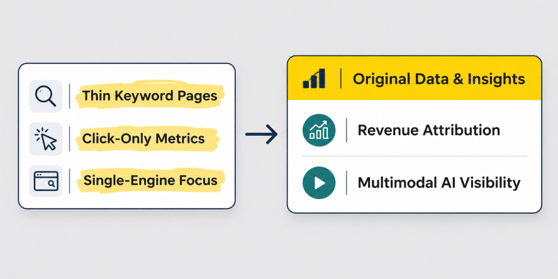
The shift towards AI-powered search does not mean every established SEO practice has become obsolete. However, it does expose tactics that were built primarily to attract search traffic rather than help people make decisions. These are the areas businesses need to rethink:
- Thin keyword pages: Generic explainers that restate what an AI summary already says give a reader no reason to click. Content needs original information, examples or expert perspectives to justify its place in search results.
- Click-only reporting: A report that stops at sessions cannot see brand visibility inside AI answers. Businesses need to know whether they are being mentioned, cited and considered, even when users do not visit their websites.
- Informational traffic as the main goal: This is where AI Overviews and zero-click behaviour bite hardest, and publishers have felt it most.
- Link-only authority: Links still help, yet mentions, reviews and consistent brand signals carry more weight than they used to.
- Google-only thinking: Optimising only for Google leaves you exposed as users spread across several platforms like ChatGPT, Perplexity and YouTube.
What Still Works: SEO Is Still Working Where It Counts
Not every part of SEO is equally affected by AI search. Several established practices remain essential, while others are becoming more valuable because they help businesses attract qualified visitors and build trust. Here is where SEO investment still makes commercial sense:
- Technical SEO: Crawlable, indexable, fast pages with clear structure remain the foundation for rankings and AI citations. AI search does not remove the need for search engines to discover and understand your content.
- Commercial and local intent: Not all searches are equally vulnerable to zero-click behaviour. In Semrush’s analysis, commercial queries triggered AI Overviews 18.57% of the time and transactional queries 13.94%, far below informational searches (57.1%). A buyer who is ready to book, enquire or purchase something still clicks. For service businesses, local SEO, a complete Google Business Profile and reviews remain among the strongest levers.
- Original insight: AI systems can summarise widely available information, but proprietary data, expert commentary and real case results give both readers and AI systems a reason to use your page.
- Brand authority: Consistent company information and credible mentions across the web help search engines and AI tools recognise and trust you.
- Conversion-ready pages: Fewer visits make each visit more valuable. So, pages need clear offers, proof and easy next steps.
SEO Trends 2027: What to Plan For
The following trends reflect changes already visible in search behaviour, Google’s product development and the way AI platforms surface information. Use them as planning assumptions for 2027.
- Conversational and multimodal queries grow: People are increasingly asking complete questions instead of entering short keyword combinations. So, write for full questions, and support image and video formats where buyers use them.
- AI visibility becomes a standard metric: Expect reporting on how often your brand is mentioned and cited, next to rankings.
- Brand signals carry more weight: Entity consistency, reviews and third-party mentions will matter alongside links.
- Fewer, stronger pages win: Publishing more content will not automatically produce more visibility. Consolidate overlapping content and invest in pages that add original evidence.
- Measurement moves to revenue: Traffic and rankings will remain useful diagnostic metrics. But boards will ask what organic search contributes to pipeline. SEO reporting will need stronger connections to qualified enquiries, opportunities and revenue.
- Paid and organic blend: With ads entering AI answers, SEO services and paid media need one shared plan.
A 90-Day Plan for Businesses
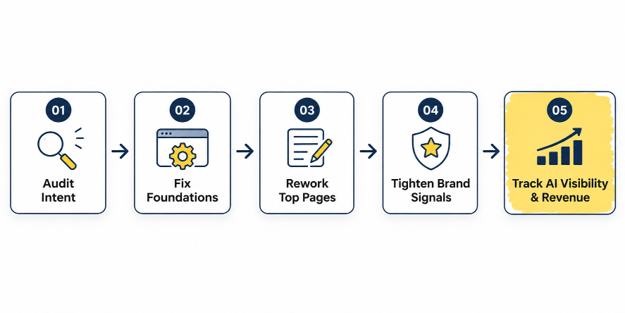
Understanding the changes is one thing. But acting on them requires a structured approach that does not involve rebuilding your entire SEO strategy overnight. The following 90-day plan gives businesses a practical starting point:
- Audit what changed: In Google Search Console, compare impressions and clicks by query type. Falling clicks with steady impressions point to AI answers absorbing demand.
- Fix foundations: Resolve crawl and indexation issues, thin pages and slow templates.
- Rework your top pages: Pick the 10-20 pages that drive leads. Lead with direct answers, add sourced statistics and expert input, and strengthen CTAs. Try to make these pages more useful to both buyers and search systems.
- Tighten brand signals: Align company details across your website and external profiles, and build a stronger reputation through reviews and mentions.
- Track AI visibility and leads together: Create a list of 20–30 priority questions that potential buyers might ask. Test them monthly across Google AI Overviews, AI Mode, ChatGPT and Perplexity. Record whether your brand appears, whether your website is cited and which competitors are recommended. Compare these findings with enquiries and conversions in your CRM.
What This Looks Like in Practice
Coloplast Store India, an online store for ostomy care products, tracked this pattern closely. When Justwords began full SEO and content work in December 2024, organic traffic was 199, with just 3 keywords in the top three positions and no AI Overview appearances. By December 2025, traffic peaked at 16K a month, with 70 top-three keywords and 13 AI Overview appearances. By November 2026, top-three keywords had risen to 93 and AI Overview appearances to 73, while traffic settled at about 10K.
Rankings kept improving and AI visibility grew sharply, even though clicks fell back from their peak. A report built only on traffic would have called that a failure. A report built on visibility and conversions shows a stronger position.
Stop Asking Whether SEO Is Dead
The useful question is which parts of your SEO still earn revenue, and which parts only earn clicks that AI answers are about to absorb. Check your top 20 queries and pages this month. Keep investing where leads come from, rework where visibility is slipping and stop paying for traffic that never converted.
Every quarter you delay gives competitors more time to become the brand AI tools name for your category. If you want a clear view of where your organic visibility stands going into 2027, our team can start with an audit through our SEO services and AI SEO services.
FAQs
1. Is SEO dead in 2027?
No. Google’s query growth is at a five-year high, and AI answers draw on pages that search engines find and trust. The tactics are changing toward visibility, authority and conversions.
2. Will AI replace SEO?
AI changes where and how people see results, and it still relies on indexed, trusted content. Most businesses will need SEO plus AI visibility work. Today, AI platforms send a small share of visits.
3. Is SEO still worth it for small businesses in 2027?
Yes, particularly local and service businesses. Commercial and local searches trigger AI Overviews less often than informational ones, and buyers ready to act still click. Keep your Google Business Profile and reviews strong.
4. What are the biggest SEO trends for 2027?
Expect more conversational and multimodal queries, AI visibility reporting, stronger brand signals, fewer and better pages, revenue-based measurement and ads appearing inside AI answers.
5. How is AI search different from traditional search?
Traditional search lists pages to choose from. AI search assembles an answer from several sources and names a few. Queries are longer, and buyers often decide whom to trust before clicking.
6. Should I stop writing blogs because of AI Overviews?
No. Stop writing generic explainers. Publish content with original data, expert input and clear next steps, aimed at questions tied to buying decisions, since that content earns citations and leads.