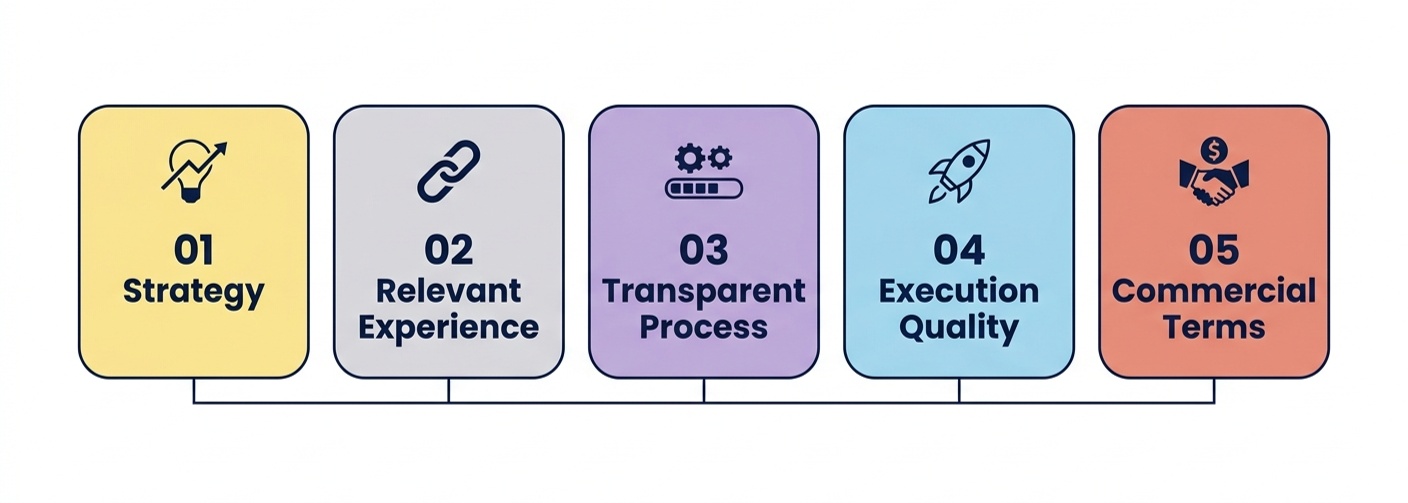
To choose the right digital marketing agency in India, evaluate 5 things in this order: strategic capability (do they build a plan before producing anything?), relevant experience (have they delivered in your category or a comparable one?), transparency of process (do you know exactly what they will do and how they will report it?), quality of execution (writers, SEO depth, distribution), and commercial terms (contract flexibility, pricing clarity, no hidden costs).
Everything else, including the awards, the client logos on the homepage, the pitch deck, is secondary to these five.
Key Takeaways● The right digital marketing agency for your business is not the biggest, cheapest, or most awarded. It is the one that understands your category, can prove results in it, and is structured to deliver what your business actually needs. ● Most Indian businesses choose agencies based on pricing and presentation decks. The ones that get lasting results choose based on process, proof, and strategic fit. ● Red flags are as important as green ones. Guaranteed rankings, vague reporting, and long lock-in contracts are signals worth taking seriously. ● Month-to-month contracts exist. If an agency insists on a 12-month lock-in before proving anything, ask why. |
Why Most Businesses Get This Decision Wrong
The digital marketing agency market in India has grown significantly over the past decade. There are thousands of agencies across Gurgaon, Mumbai, Bangalore, and every major city, ranging from boutique specialists to large full-service firms. The volume of choice makes the decision harder, not easier, and most businesses default to the wrong selection criteria.
The most common mistake is choosing based on price. In the Indian market, pricing for digital marketing services varies enormously, from ₹15,000/month freelancer-style arrangements to ₹3 lakh/month enterprise engagements. Price tells you about an agency’s cost structure and positioning, not about whether they will deliver results for your business. An agency charging ₹25,000/month that understands your category and executes consistently will outperform a ₹1.5 lakh/month agency producing generic content with no real SEO integration.
The second most common mistake is choosing based on the client logo list. A roster of well-known brands is a credibility signal, but it tells you nothing about whether the agency can do what your business specifically needs. An agency that has managed social media for a consumer FMCG brand may have no idea how to build organic search visibility on Google for a B2B SaaS company.
The framework below is designed to help you cut through both of these shortcuts and make a decision based on what actually predicts results.
Step 1: Define What You Actually Need Before Approaching Anyone
Before evaluating a single agency, get specific about what you are trying to achieve and how you will measure it.
Just thinking “We want more digital presence” is not enough to choose a digital marketing agency. Instead, think of a specific, measurable goal like “We want to grow organic search traffic from 8,000 to 25,000 monthly visitors within 12 months, with a focus on bottom-of-funnel keywords that convert to demo requests”. The more specific your goal, the easier it becomes to assess whether an agency is equipped to deliver it.
Also decide which services you need. Digital marketing is a broad category covering SEO, content marketing, paid media, social media, email, web development, and more. Most agencies offer all of these, but only a few are genuinely excellent across all of them. Knowing whether you need an SEO-first content programme, a paid media specialist, or a full-service integrated partner will help you shortlist the right type of agency rather than a generalist that does everything adequately and nothing well.
Step 2: Evaluate Strategic Capability First
The most important indicator of agency quality is not what they produce. It is how they decide what to produce.
An agency with genuine strategic capability will not begin talking about content volumes, posting frequencies, or deliverables until they understand your audience, your competitive landscape, your current organic performance, and your funnel.
Strategy always comes before execution. If an agency jumps straight to say, “we will publish 8 blogs a month and manage your social media,” without first auditing what exists, they are not selling you a growth programme. They are just scaling production.
Ask directly: what does your strategy process look like before you begin execution? A strong answer involves audience research, competitive content audits, keyword and topic mapping, funnel alignment, and a documented content plan. A weak answer involves a generic onboarding call and a content calendar template.
In 16 years of working with businesses across finance, SaaS, ecommerce, healthcare, and manufacturing, the pattern at Justwords is consistent: the engagements that deliver compounding results are always the ones where strategy is built carefully before we move to creating content. The ones that underperform are always cases where execution started before the strategy was clear.
Step 3: Ask for Proof in Your Category (or Close to It)
Case studies are the most useful due diligence tool available to you, but only if you interrogate them properly.
Do not just look at the numbers. Ask what the starting conditions were, what specific actions the agency took, and over what time period the results were achieved. A 500% traffic increase sounds impressive until you learn it went from 200 to 1,200 visitors a month. So, context matters.
Look for enough proof in a category that is comparable to yours. If you have a fintech brand, then an agency that has worked on organic search for a housing finance brand will understand financial services content, regulatory sensitivity, and competitive keyword environments. That experience transfers. On the other hand, an agency whose entire portfolio is in lifestyle and consumer brands may not have the domain depth to produce content that earns trust in a B2B or regulated category.
For reference, Justwords’ work with Hero Housing Finance grew organic traffic by 752% over 3 years, reaching 60,000+ monthly visitors and 270+ home loan conversions per month at peak. For Amity University Online, organic users grew 46.6% and search impressions grew 87.3% in 4 months. For Shiprocket, blog traffic grew 40% year-on-year over a four-year engagement. These are not isolated wins in a single category; they span NBFC, education, and B2B SaaS, which tells you how we approach organic search growth with a repeatable process.
Step 4: The Questions to Ask Any Agency Before Signing
Most agency pitches are designed to impress. But interrogating further reveals where they might fall short. These questions will help you bypass the presentation and get to what matters:
On strategy:
- What does your onboarding and strategy process look like before execution begins?
- How do you decide what content or campaigns to prioritise?
- How do you handle it when a strategy is not working?
On execution quality:
- Who will actually be working on our account, and what is their background in our industry?
- How do you vet the writers or specialists assigned to client accounts?
- What does a typical content brief or guideline look like?
On SEO specifically:
- Do you handle on-page SEO, off-page SEO (link building), and technical SEO, or only some of these?
- How do you approach keyword research at a programme level, not just per article?
On reporting:
- What metrics do you report on, and how often?
- Can you show us an example of a client performance report?
- How do you report on things that are not working?
On commercial terms:
- What does your contract structure look like?
- Is there a minimum commitment period?
- What happens if we want to scale up or down?
Pay close attention to how agencies answer the last set of questions. Agencies that default to 6 or 12-month lock-in contracts before proving value are structuring the relationship to protect themselves, not to earn your continued business. Month-to-month arrangements exist and are a sign of an agency confident enough in its results to not require contractual lock-in.
Step 5: The Digital Marketing Agency Checklist for Indian Businesses
Use this as a structured evaluation tool when comparing agencies:
Strategic capability
- Do they audit before they execute?
- Is there a documented strategy delivered before content or campaigns begin?
- Do they map content or campaigns to specific funnel stages and audience segments?
Relevant experience
- Do they have case studies in your category or a comparable one?
- Can they show organic traffic, lead, or revenue outcomes, not just vanity metrics?
- Have they worked with businesses at your scale?
Execution quality
- Are writers domain-matched to your industry or generalists?
- Is SEO built into content production or treated as an afterthought?
- Do they have a clear, documented production workflow?
Reporting and transparency
- Do they report on business outcomes or just activity metrics?
- Is reporting proactive or only on request?
- Do they flag and address underperforming work?
Commercial terms
- Month-to-month or locked-in contract?
- Are pricing and scope clearly defined upfront?
- Is there a clear escalation process if deliverables are missed?
Red Flags to Watch for in the Indian Digital Marketing Agency Market
The Indian digital marketing agency market has no shortage of agencies that oversell and underdeliver. These are the signals worth taking seriously:
- Guaranteed rankings: No credible agency guarantees specific keyword rankings. Search algorithms change, competitive landscapes shift, and any agency promising page 1 results within a fixed timeframe is either misleading you or planning to use tactics that will eventually harm your site.
- Vague or vanity-metric reporting: If an agency’s monthly report leads with impressions, follower counts, and “content published,” ask what those numbers mean for your business. Impressions and follower growth are not outcomes. Organic traffic, keyword ranking improvements for commercially relevant terms, and lead contribution from organic channels are outcomes.
- AI-generated content at scale: A significant number of Indian agencies have shifted to AI-generated content to reduce costs and increase margins. The output is fast and cheap, but it is also detectable, generic, and increasingly penalised by search algorithms. Ask directly whether the content you receive is human-written. Ask to see a sample before you sign.
- No discovery or strategy phase: If an agency is ready to begin execution within days of your first conversation, without conducting an audit or building a strategy, they are not building a programme for your specific business. They are plugging you into a template.
- Long lock-in contracts upfront: A 12-month minimum commitment from an agency that has not yet demonstrated results is a commercial structure designed to protect the agency. Confidence in results produces flexible contracts, not restrictive ones.
Also Read: How to Choose an SEO Agency: Questions Before You Hire
What Pricing for Digital Marketing Agencies Looks Like in India
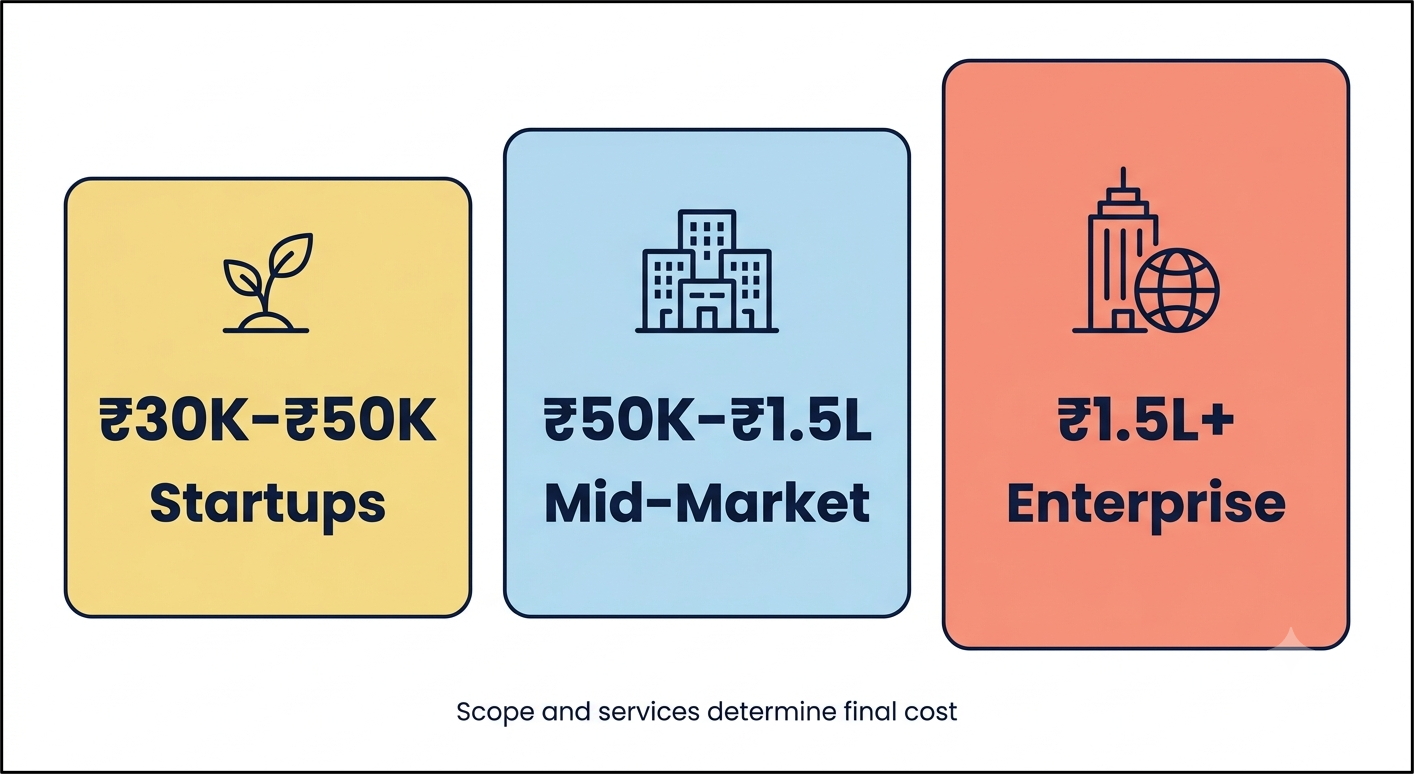
Pricing for digital marketing agencies in India varies significantly based on services, scope, and agency quality.
As a rough guide, digital marketing programmes for startups typically start from ₹30,000 to ₹50,000 per month. Mid-market businesses running integrated content and SEO programmes generally invest between ₹50,000 and ₹1,50,000 per month. Enterprise engagements with high-volume content, full SEO (on-page, off-page, and technical oversight), paid media, and social media management can go above ₹1,50,000 per month.
Price alone tells you very little. What matters is what is included, who is actually doing the work, and whether the agency can demonstrate that comparable investment has delivered results for comparable businesses.
Why the Right Agency Feels Like a Long-Term Growth Partner
The distinction between a vendor and a growth partner is a real operational difference that determines how much value an agency creates over time.
A vendor delivers what is in the scope document. A growth partner tells you when the scope document needs to change because the data suggests a better path. A vendor reports what happened last month. A growth partner uses last month’s data to recommend what should happen next month and why.
That is what Justwords delivered for its clients. And it is exactly what clients appreciate the most about us. For example, Prashant Chopra at Hero FinCorp put it directly: “They have built a deep understanding of our brand and value proposition. Their digital marketing work for us has been effective, and they actually deliver on the talk.” Prashant Ramakrishnan at TVS Motor Company described the relationship even more simply: “They can be treated as an extended team.”
That is the relationship worth looking for. Not the agency with the best pitch deck, but the one that earns the right to be described as part of your team.
If you are in the process of evaluating agencies and want an honest conversation about what your business needs and who is the right fit, speak with our team. We have been helping businesses across India choose the right digital marketing strategy since 2010.
FAQs
1. How do I evaluate a digital marketing agency in India if I have never hired one before?
Start with your goal, not a list of agencies. Define what you want to achieve, what success looks like numerically, and over what timeframe. Then shortlist agencies with demonstrable experience in your category, ask for case studies with specific results, and run them through the questions listed in this article. Never sign based on a pitch alone.
2. What are the biggest red flags when choosing a digital marketing agency in India?
Guaranteed rankings, AI-generated content presented as human-written, vague reporting focused on vanity metrics, no strategy or audit phase before execution, and long mandatory lock-in contracts before any results are demonstrated.
3. How long should I commit to a digital marketing agency before expecting results?
For content marketing and SEO, meaningful organic growth typically begins to appear between 3 and 6 months. Paid media can show results faster. Expect a 30-day strategy and onboarding phase, measurable early signals by 60 to 90 days, and compounding results from 6 months onward. Any agency promising significant results before 90 days in SEO or content is overpromising.
4. What should a digital marketing agency’s onboarding process look like?
A well-structured onboarding process includes a discovery session to understand your business, audience, and goals; a content or channel audit to assess what exists and what is working; a competitive landscape review; and a documented strategy delivered before execution begins.