Many businesses looking for professional SEO services are still asking the same questions they did five years ago.
“Can you get us to #1 on Google?”
“How many keywords can we rank for?”
“How much more organic traffic will we get?”
Those still matter. But in 2026, professional SEO services should do much more than improve rankings. They should help your business appear in Google Search, AI Overviews, and AI-powered answer engines like ChatGPT and Perplexity.
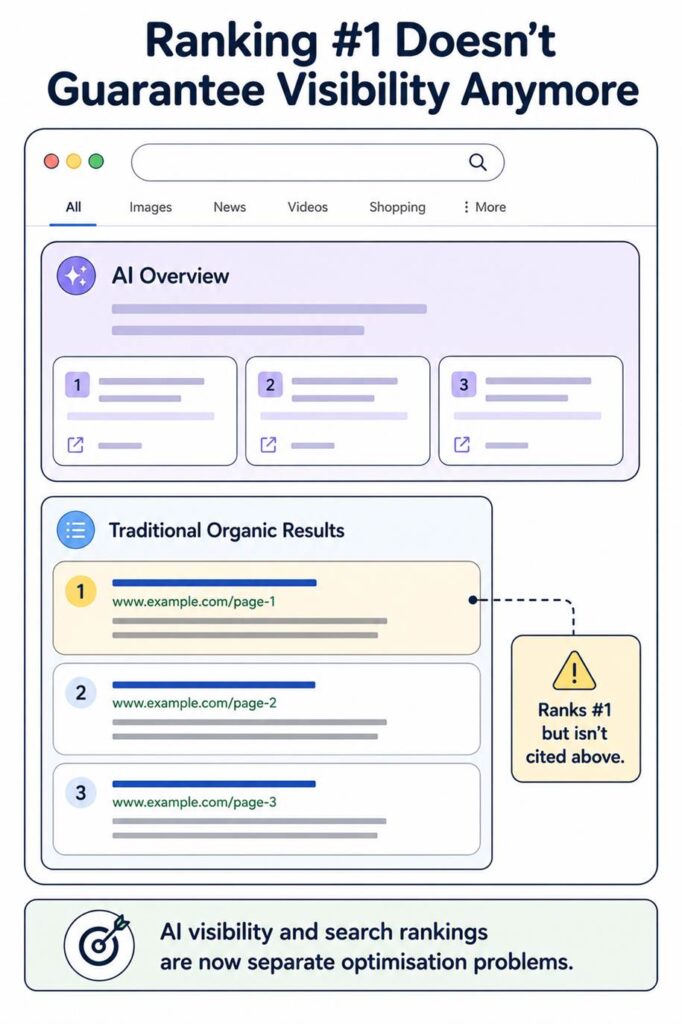
The reason is simple. Today, your website can rank #1 on Google for its most important keyword and still not appear in the AI-generated answers that many people read first. A few years ago, this was not possible. Now, it happens often. And it shows a growing gap in how SEO is measured and delivered.
This is not a reason to abandon SEO. It is a reason to understand exactly what professional SEO services should deliver now, and what to look for when you are evaluating who to work with.
Key takeaways
- Professional SEO now includes AI optimisation alongside technical SEO, content, and link building.
- Ranking #1 is no longer enough to be visible in AI-generated search results.
- AI Overviews, GEO, and AEO are now core parts of modern SEO.
- E-E-A-T and brand authority directly influence AI visibility.
- SEO reporting should measure AI visibility, conversions, and business impact, not just rankings.
What SEO Services Must Cover in 2026: The Expanded Scope
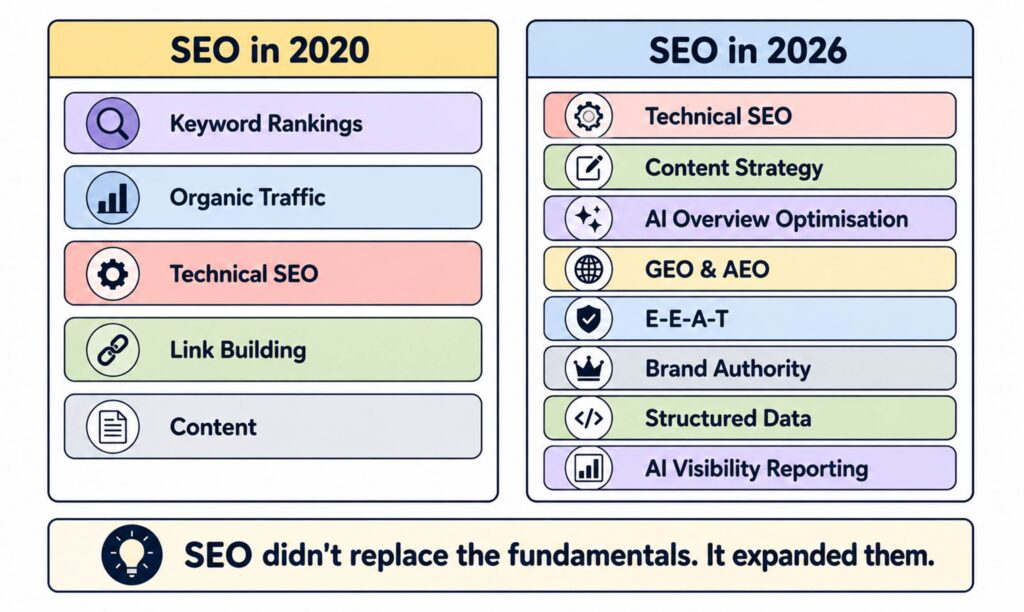
1. Traditional SEO: Still the Foundation
Technical SEO, on-page optimisation, keyword strategy, link building, Core Web Vitals, etc., haven’t become irrelevant. They remain the non-negotiable foundation.
Google still crawls, indexes, and ranks web pages. The fundamentals still matter: make important content crawlable, keep pages indexable, use internal links, provide high-quality media, make structured data match visible content, and create helpful, reliable, people-first content.
What has changed is that traditional SEO is now necessary but not sufficient. An SEO company that delivers only this in 2026 is providing a partial service. It’s like servicing your car’s engine while ignoring the fact that the road has fundamentally changed.
2. AI Overview Optimisation: The New “Position 1”
As of early 2026, AI Overviews reach over 2 billion monthly users, with informational searches triggering AI Overviews at rates as high as 80–88% depending on the industry. For Indian businesses competing in any information-heavy category like finance, healthcare, real estate, SaaS, and education, a significant share of searches that should be finding you are now being answered by AI before your result even appears.
Seer Interactive data shows that brands cited in an AI Overview see a +35% CTR compared to those not cited. For many query types, being cited in the AI answer is the primary visibility outcome worth optimising for.
Getting cited requires a specific set of content signals that differ from traditional ranking factors:
- Structured schema markup: FAQPage, Article, HowTo, and Credibility markup improve machine readability and make content extractable for AI-generated answers.
- Direct answer blocks: Content that opens a section with a clean, concise answer to the likely query, before expanding into depth, is significantly more likely to be pulled into an AI Overview.
- Original, verifiable data: Pages containing more verifiable facts are cited in AI Overviews at a higher rate than pages with fewer facts. AI systems favour traceable, source-attributed information over unsupported claims.
- Summary sections and clean heading structure: These are the elements most likely to be quoted in AI Overviews.
A professional SEO service in 2026 should be building all of this into content architecture systematically.
3. E-E-A-T as a Fundamental Requirement
Google’s E-E-A-T signals (Experience, Expertise, Authoritativeness, Trustworthiness) have always been quality guidelines. In 2026, they function as measurable technical signals that AI systems cross-verify across the web.
AI systems cross-verify your brand’s signals across the entire web, not just your website. The consistency of your messaging across your website, social profiles, Google Business Profile, and third-party reviews is now an active ranking input. Also matters is whether your business has original, proprietary content, research, case studies, or data that only you can produce.
Brands with weak off-site presence are being hit harder by Google updates than ever before. Building brand authority has now become an SEO function apart from being a PR function.
What this means practically is:
- Named authors with verifiable credentials
- Consistent brand entity signals across platforms
- Original data in content
- Third-party citations from authoritative sources
An SEO agency that is not actively working on your brand’s cross-web presence alongside your on-site content is leaving a significant signal gap.
4. Zero-Click Strategy: Measuring the Right Thing
Even with the increase in zero-click queries, anticipating follow-up search intent is key to content strategy in 2026. When a user searches for something basic and the AI Overview provides an answer, some people will be satisfied, and some won’t. For those who aren’t, building content clusters that map to the full line of inquiry (not just a single search) is what captures the next click.
This reframes how content strategy should work. The goal is not to rank for one query in isolation. It is to own the full topical cluster around your category so that wherever a buyer is in their search journey, your brand is the consistent, trusted source they keep finding.
Only a small minority of marketers currently track AI visibility metrics. That means most businesses are entirely blind to the fastest-growing search surface. A professional SEO service should now include AI Overview impression share and share of voice in People Also Ask as standard reporting metrics, alongside traditional traffic and conversion data.
5. GEO and AEO: Optimising for AI Engines Directly
Generative Engine Optimisation (GEO) and Answer Engine Optimisation (AEO) are the disciplines of making your content citable by AI-powered systems like Google AI Overviews, ChatGPT, Perplexity, and others.
AI systems do not read your rankings to decide what to cite. They build recommendations from training data, third-party mentions, and brand signals across the web. This means the work of appearing in AI-generated answers happens outside your website as much as inside it. It can be through editorial mentions in industry publications, consistent presence on authoritative third-party platforms, and content that directly answers the questions AI systems are trained to synthesise.
Marketers are now actively implementing GEO strategies. And this is moving fast. For Indian businesses, where most competitors have yet to build any of this infrastructure, the early-mover advantage is significant and compounding.
What This Means for Indian Brands Specifically
Many Indian business websites block AI crawlers, have zero schema markup, and have no brand presence on AI-indexed third-party platforms. The competitive gap between those who have built the AI visibility layer and those who have not is widening every month.
This is both the challenge and the opportunity. Indian businesses have entered the year with a significant AI visibility deficit relative to global competitors. But the domestic competitive landscape means that closing that gap in the next 6 months or so delivers compounding returns, because most local competitors have not started.
The search landscape also has specific dynamics that affect strategy. AI Overviews appear particularly frequently in search queries that already have a high rate of zero-click searches. In high-intent categories like BFSI, healthcare, and real estate, where Indian B2B and B2C brands compete hardest, the AI Overview presence is already substantial and growing.
Voice search remains a distinct factor in India. As discussed in the regional SEO strategy, the majority of voice queries arrive in Hindi and other regional languages, and voice search results are almost entirely drawn from schema-structured content and AI Overview citations. Brands not optimising for this layer are invisible to an enormous segment of mobile-first Indian searchers.
What Good SEO Reporting Looks Like Now
If your current SEO reporting covers only keyword rankings and monthly traffic, you are looking at a rearview mirror in a car that has turned.
A professional SEO service in 2026 should report on:
- Organic traffic and trend: This should include device and geography breakdown.
- Conversions from organic: Leads, form fills, calls, attributed revenue.
- AI Overview impression share: How often your content appears in AI-generated answers.
- People Also Ask presence: This is one of the SERP features that’s still driving clicks.
- Brand entity signals: Branded search volume, third-party citation growth, Google Business Profile engagement.
- Content coverage gaps: Which queries in your topical cluster you are not yet answering.
Rankings are an input signal, not an outcome. The outcome is visibility, leads, and revenue through every platform where your buyers search.
Conclusion
SEO in 2026 is more valuable and more complex than it has ever been. The brands that invest in it correctly through topical authority building, AI citability, structured content, and cross-web brand signals are compounding a visibility advantage that becomes increasingly difficult for competitors to close.
The brands that are still measuring it with old metrics are optimising for a search result that no longer represents the majority of how their buyers find information.
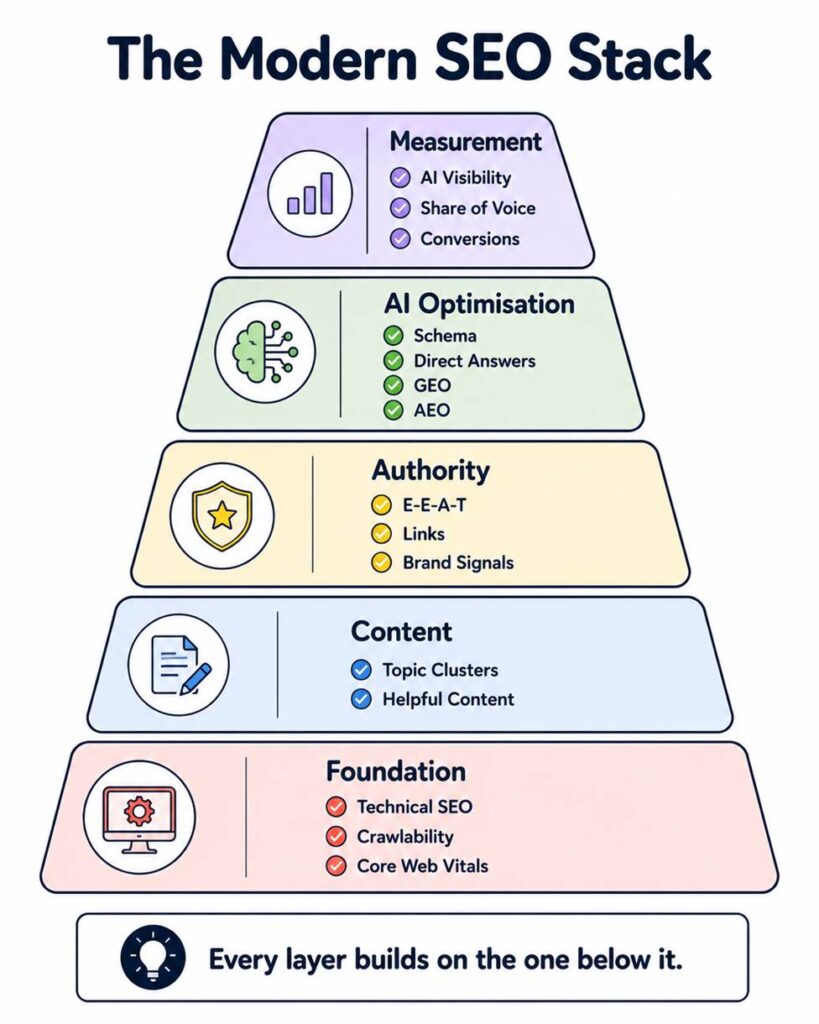
Professional SEO services in 2026 should span technical SEO, content strategy, AI Overview optimisation, GEO and AEO, E-E-A-T signal building, and measurement frameworks that capture the full visibility picture today.
If your current SEO partner is not speaking to all of these dimensions, that is worth a conversation with us.
FAQs
1. What do professional SEO services include in 2026?
Technical SEO, content strategy, AI Overview optimisation, structured schema markup, E-E-A-T signal building, link acquisition, and GEO/AEO. Plus reporting that covers AI visibility and conversions, not just keyword rankings.
2. How has SEO changed in 2026?
AI Overviews and AI Mode are now Google’s default search experience, with a zero-click rate of roughly 93% in AI Mode. SEO now requires optimising for AI-generated answers and brand citation across multiple platforms, and not just ranking on the traditional results page.
3. What is AI Overview optimisation?
The practice of structuring content so that Google’s AI-generated summaries mention you and cite your brand as a source. It requires a clean heading structure, FAQPage schema, direct answer blocks, and original verifiable data, all of which increase the likelihood of your content appearing in AI Overview responses.
4. Does traditional SEO still matter in 2026?
Yes, it remains the non-negotiable foundation. Technical SEO, content quality, and link building still determine how search engines understand and trust your site. But traditional SEO alone is now insufficient; AI visibility optimisation is the layer that determines whether you appear in the answers buyers actually read.
5. What is GEO in SEO?
Generative Engine Optimisation (GEO) is the practice of making your content citable by AI-powered answer engines, including Google AI Overviews, ChatGPT, and Perplexity. It involves structured content, original data, third-party editorial mentions, and consistent brand entity signals across the web.
6. What should SEO reporting cover in 2026?
Organic traffic and trend, conversions from organic, AI Overview impression share, People Also Ask presence, brand entity signal growth, and content coverage gaps. Rankings alone are insufficient as a primary success metric.
7. How long does SEO take to show results in 2026?
Early signals such as technical fixes, structured data implementation, and first content improvements are visible within 60–90 days. Meaningful organic traffic and AI visibility growth typically compound between months 4–9, depending on domain authority, competition, and content volume.