
If you are looking for content marketing examples to inspire your next campaign, you have come to the right place.
And if you have been led to believe that content marketing is just “writing blogs,” stick around, because the examples in this post will change how you think about the entire thing.
Content marketing is the strategic use of content like blogs, videos, podcasts, newsletters, communities, tools, etc. to attract, engage, and convert a clearly defined audience. The goal is to make your audience’s lives better, smarter, or easier, and in doing so, earn their attention, their trust, and eventually their business.
The brands in this post have done exactly that. Some are global names with massive budgets. Some are digital-native businesses that grew almost entirely through content. A few are B2B content marketing examples that prove this isn’t just a B2C game. And we have included some Indian content marketing examples because the strategy works just as powerfully at home.
What they all have in common: they stopped talking about themselves and started solving problems for the people they wanted to reach.
Key Takeaways
- The best content marketing examples share one thing: they put the audience’s needs before the brand’s need to sell.
- Great content marketing doesn’t look like advertising. It looks like education, entertainment, or a community people want to belong to.
- The tactics evolve (UGC, personalised data stories, short-form video, community-led growth), but the underlying principle remains: earn trust first.
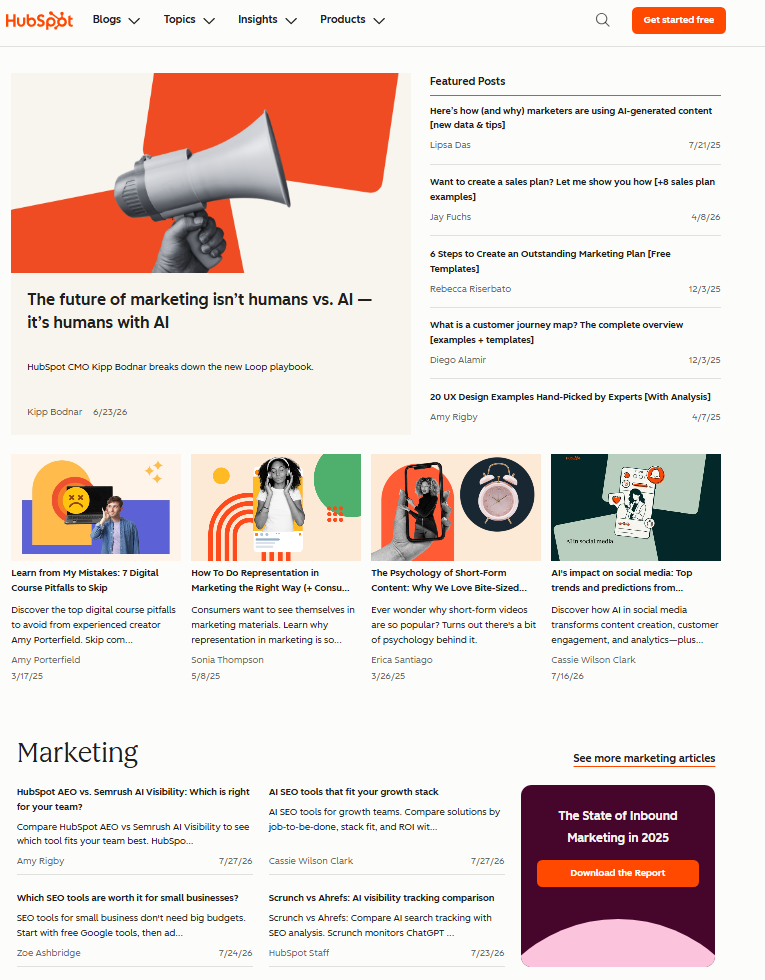
1. HubSpot: The Education-First B2B Content Marketing Playbook
What they did: HubSpot built one of the most comprehensive content marketing ecosystems in the B2B world and used it to grow from a startup to a company worth over $30 billion.
The strategy was simple in concept but relentless in execution: teach marketers and salespeople everything they need to know, for free. Blog posts, in-depth guides, free templates, research reports, certifications through HubSpot Academy, and a free CRM that lets people experience the product before they ever pay for it.
Their blog alone attracts millions of visitors every month. Their free tools like website grader, email signature generator, and blog idea generator function as lead magnets that bring in a constant stream of qualified prospects. Their State of Marketing report, published annually, has become one of the most-cited data sources in the industry, which means HubSpot gets mentioned every time someone uses the data.
Why it works: HubSpot didn’t just create content. They created a content ecosystem where every piece of content connects to the next. A reader finds a blog post through Google, subscribes to their newsletter, downloads a template, gets certified through the Academy, and eventually becomes a CRM customer. Each piece of content supports the others, turning the whole thing into a self-reinforcing flywheel.
The results: HubSpot’s content-driven inbound approach is one of the most studied content marketing strategy examples in B2B history. Their blog consistently ranks for thousands of high-intent marketing and sales keywords, and their free tools drive millions of qualified leads annually.
Your takeaway: Teaching your audience is the fastest way to earn trust in B2B. Stop gatekeeping knowledge. Build content that genuinely helps your buyers do their jobs better, and they will come to you when they are ready to buy.
2. Spotify Wrapped: When Personalised Data Becomes Viral Content
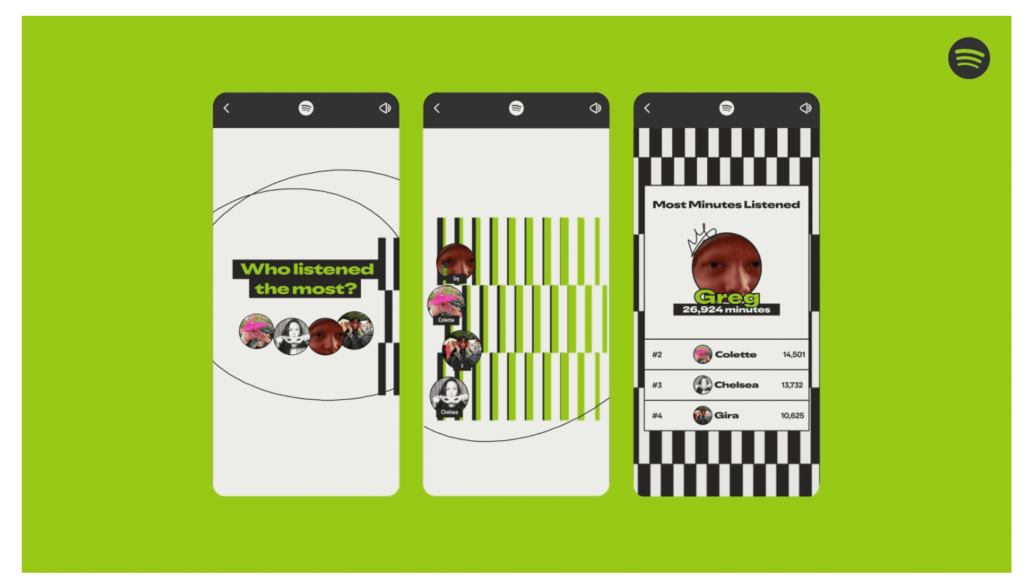
What they did: Every year since 2016, Spotify has turned its users’’ listening data into a personalised, beautifully designed retrospective called Spotify Wrapped. It tells you your top artists, songs, genres, and listening patterns. This is packaged as a shareable story designed for social media.
The genius of Wrapped is in the mechanics. Users get something that feels uniquely theirs, just like a mirror held up to their own identity and taste. And because it’s designed for sharing, millions of people voluntarily broadcast Spotify’s content to their own audiences. In 2025, Spotify saw over 200 million engaged users within the first 24 hours of Wrapped’s release. The 2024 iteration saw 245 million users engaging with it in the first 7 days across 184 markets and 53 languages.
The 2025 edition added “Listening Age,” a feature that calculated how young or old your music taste skewed and generated massive social conversation. There were about 116,000 mentions of “Listening Age” in the week following Wrapped’s 2025 launch, generating 5% of overall campaign engagement.
Why it works: Wrapped sits at the intersection of identity, self-expression, and belonging. Users recognise themselves in the data, then want to share that self-portrait with the world. It’s not advertising. It’s a cultural moment that users look forward to every year. Late November became known as “Wrapped Day” before the official release, meaning Spotify gets a pre-launch awareness surge for free.
There’s a lesson here too about what not to do: the 2024 edition leaned into AI-generated features and received significant backlash for feeling impersonal. Spotify course-corrected in 2025, returning to the human-centric, playful storytelling that made Wrapped beloved. Even the best campaigns have to keep evolving and staying true to what your audience loves about you.
Your takeaway: You almost certainly have data about your customers that could become meaningful content for them. Their usage patterns, results, milestones, and more. These can all be turned into personalised stories. Think about what data you have access to that, if shared with your customer, would make them say “wow, that’s exactly me.” That’s your Wrapped.
3. Duolingo: Building a Brand Personality That People Actually Like
What they did: Duolingo turned a language learning app into one of the most entertaining brand personalities on the internet and used content marketing to grow with a fraction of the ad spend their competitors would have needed.
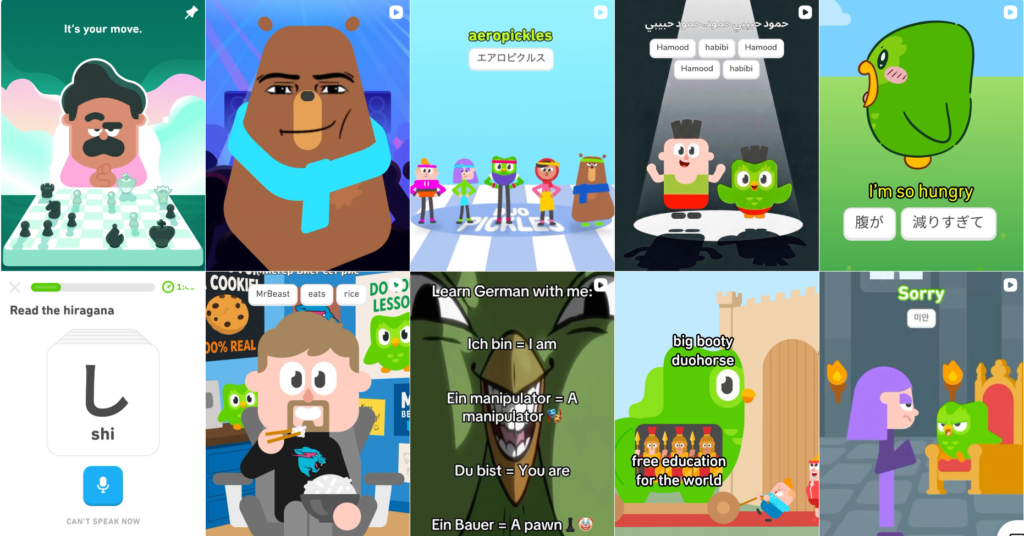
The strategy centres on Duo the Owl, their mascot, who became a social media phenomenon through absurd, self-aware, “unhinged” humour on TikTok, Instagram, and YouTube. Duo memes about reminding users to do their lessons. Duo shows up at pop culture moments. Duo interacts with users in comments in genuinely funny ways. The brand doesn’t advertise; it entertains. Duolingo’s marketing spend was roughly 12.1% of revenue in 2024 (a fraction of what comparable subscription companies spend) while their growth compounded through earned media and organic sharing.
By 2025, the brand reported a 41% increase in revenue and a 40% increase in daily active users. These numbers are directly attributed to their content-first approach. A 2025 shareholder letter even formally attributed slower growth to the fact that they had “posted less unhinged content,” which tells you everything about how central content was to their growth engine.
Why it works: Duolingo understood their audience (primarily Gen Z and millennials) and built a content personality that genuinely resonated with them. The content doesn’t feel like marketing. It feels like entertainment you share because it made you laugh.
Your takeaway: You don’t need to go “unhinged” to take something from Duolingo’s playbook. But you do need a consistent brand voice and point of view. What would your brand sound like if it had a personality? What would it say? How would it make people feel? A clear brand personality makes your content instantly recognisable and far more shareable.
4. Zomato: Indian Content Marketing Done Right
What they did: Zomato is one of the best digital marketing content examples to come out of India, and it’s one we particularly admire. What Zomato built isn’t just a food delivery app. It’s a brand that people genuinely enjoy engaging with online.
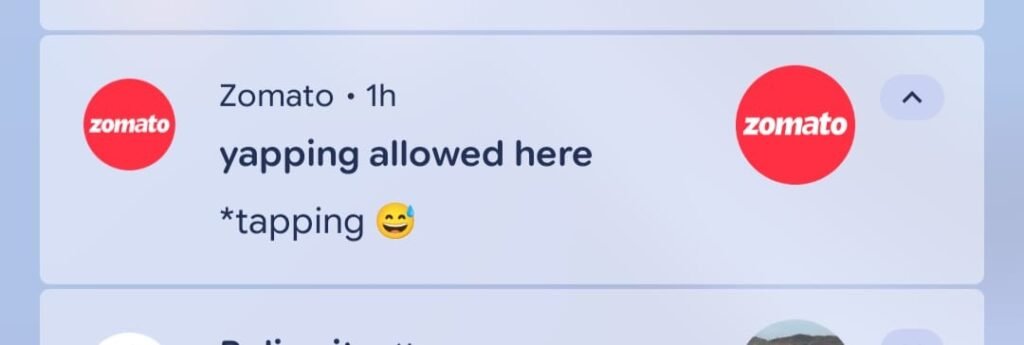
Their content strategy is witty, culturally sharp, and relentlessly native to the platforms they use. Push notifications that double as comedic one-liners. Social media posts that tap into Indian cultural moments and festivals with a self-aware tone. The #ZomatoMemes campaign, which invited users to create and share memes about food and delivery experiences, generated 120 million impressions, 2 million shares, and 300,000 user-generated posts in a single month.
From an SEO perspective, their content strategy is equally sharp. Zomato ranks in the top 3 positions for over 3,500 food and delivery-related keywords, and organic traffic accounts for 48% of total sessions (up from 40% in 2023). They have built out extensive location-specific and cuisine-specific content that captures searchers at every stage of the decision journey.
Zomato crossed 80 million monthly app users in 2025, with FY 2024–25 consolidated revenue reaching ₹20,243 crore, which was a 67% year-on-year growth.
Why it works: Zomato treats its social media as a creative property. Their tone is consistent, their cultural awareness is sharp, and they understand that in India, content has to work in multiple languages, across different regional sensibilities, and across both metro and Tier 2 cities. Localisation is a core part of their content strategy.
Your takeaway: You can’t copy Zomato’s tone as is, but you can learn from their approach. Know your audience deeply, understand their cultural context, and build a social media presence that feels like a person rather than a press release. Meme marketing, done well and authentically, is one of the most cost-effective forms of content distribution available.
5. GoPro: The Gold Standard of UGC Content Marketing
What they did: GoPro built one of the most brilliant user-generated content marketing strategies in history, and the product itself is what made it possible. Their cameras are designed for capturing extreme, visually stunning moments. So they did the logical thing: they made it incredibly easy and rewarding for users to share those moments publicly.
The GoPro Awards programme incentivises users to submit their best photos and videos. Their Million Dollar Challenge lets users submit footage for a chance to have their clip featured in GoPro’s annual highlight reel and win an equal share of $1 million. The result is a continuous, self-renewing library of stunning content, created by their own customers, that GoPro can use across every channel.
Why it works: GoPro essentially outsourced its content creation to the people best placed to create it – their customers. And those customers had a compelling reason to participate. The content is authentic, visually powerful, and exactly what prospective buyers need to see to understand what the product can do. It’s sales content that doesn’t look like sales content.
Your takeaway: UGC is one of the most powerful content marketing tools available, and you don’t need a million-dollar prize fund to run it. Think about what your customers are already saying or sharing about your product or service. Can you create a structure that captures and amplifies it? What would incentivise your customers to generate and share content? Even a simple “tag us” prompt, followed by actively re-sharing the best responses, is a start.
Also read: 7 Instagram Marketing Strategies for Business Growth in 2026
6. American Express Open Forum: The B2B Content Marketing Classic
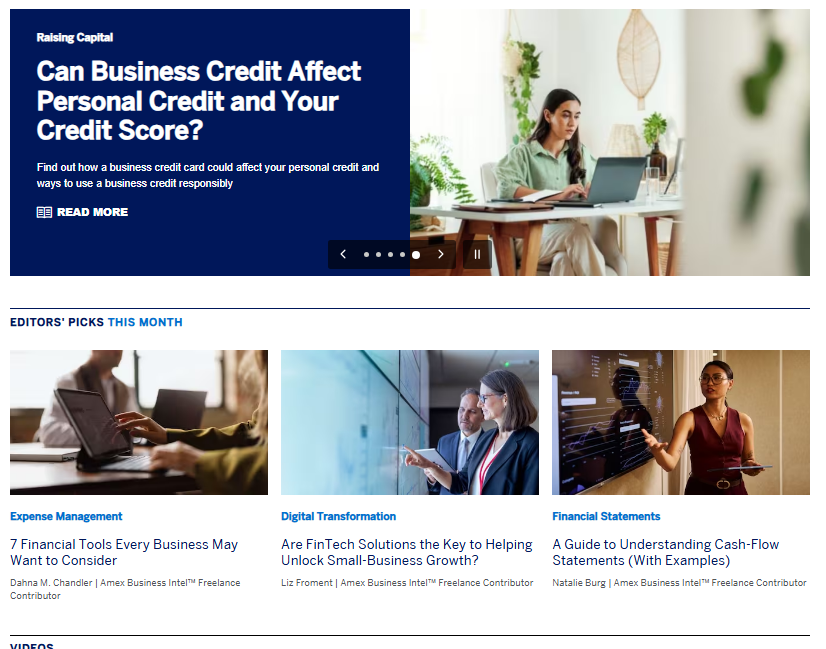
What they did: Since 2007, American Express has run what is arguably one of the most successful B2B content marketing examples in history. Open Forum (now known as AMEX Trends & Insights) was built on a simple premise: if AMEX’s customers are small business owners, why not create the most useful content destination for small business owners on the internet?
Instead of selling credit card features, they created a platform packed with business advice, strategies, success stories, and practical guidance. They featured real small business owners as subjects instead of brand spokespeople.
A cafe run by civic leaders. A men’s apparel brand with a bulldog mascot. Stories that other business owners could see themselves in.
They then opened the platform to a community dimension, where business owners could share advice, post questions, and rate each other’s responses. The content became interactive and community-driven.
Why it works: AMEX understood that their customers’ success was AMEX’s success. By creating genuinely useful content for their audience, they built the kind of trust and loyalty that no amount of traditional advertising could buy. And it worked: Open Forum became the number one source of new AMEX cardholders for years. Not through hard selling, but through serving.
Your takeaway: Step into your customer’s shoes. What problems are they trying to solve that have nothing directly to do with your product, but that your product category touches? Becoming a resource for those problems builds credibility that converts.
7. Heineken Go Places: When Employer Branding Becomes Content Marketing
What they did: In 2016, Heineken launched Go Places, a content marketing campaign designed not for customers, but for prospective employees. The campaign used a beautifully produced manifesto video accompanied by 12 quirky interview questions to give candidates a vivid sense of what Heineken’s culture felt and looked like.
It was designed to be shared on social platforms, making it easy for candidates to self-select and determine whether they were a good fit before even applying. The second version, launched in 2019, featured real employee stories at its centre, making transparency and authenticity the core content values.
Why it works: Employer branding and content marketing rarely get paired together, but Go Places showed that the same principles apply. Know your audience (in this case, job seekers), understand what they want to know, and tell real stories that help them make a decision.
The results: During the first month after launch, Heineken saw 300% more job applications than the prior year, a 54% increase in LinkedIn followers, and a 350% increase in visits to their global careers page. Average time spent on the Go Places website hit 5.24 minutes, which is exceptional for a recruitment site.
Your takeaway: Your employees are some of your best content creators and brand advocates. Don’t limit your content marketing thinking to prospects and customers. Your talent brand is also a marketing asset, and authentic employee stories are content that builds trust with multiple audiences simultaneously.

8. Cadbury x Age UK: Content Marketing With a Social Purpose
What they did: Cadbury’s collaboration with Age UK stands as one of the most emotionally powerful content marketing campaign examples in recent memory. Prompted by Age UK data showing that 1.4 million senior citizens in the UK experience chronic loneliness, Cadbury stripped the branding from their Dairy Milk packaging. They replaced it with nothing but blank purple and donated 30 pence from every bar sold to Age UK.
The “Donate Your Words” campaign wasn’t just a donation mechanic. It was a content-driven awareness campaign. TV presenter Sue Perkins committed to 30 hours of absolute isolation to help people emotionally understand what loneliness feels like. The resulting content (emotionally raw and genuinely difficult to watch) became the centrepiece of the campaign.
The results: Cadbury’s buzz scores climbed 2.3 points nationally in the first two weeks. Among people aged 65 and over, brand awareness improved by 11%.
Why it works: The campaign worked because it was built on a genuine social insight rather than a vague gesture toward “doing good.” The blank packaging created a physical, visible symbol of the campaign. The content told a human story with real stakes. And the donation mechanism meant every purchase was an action, not just a sentiment.
Your takeaway: Combining CSR with content marketing can build something valuable that pure performance marketing can’t: emotional connection. But it has to be genuine, specific, and rooted in real impact. Vague “we care” messaging doesn’t work. A specific cause, a clear action, and authentic storytelling do.
9. Rolex and rolex.org: Storytelling as Long-Term Brand Authority
What they did: In 2018, Rolex launched rolex.org, a separate website dedicated entirely to content: the story of founder Hans Wilsdorf, the brand’s philanthropic work, and its vision of perpetual excellence. No products for sale. No prices. Just storytelling, beautifully produced and photographed.
The site was designed to complement Rolex’s commercial site rather than compete with it. Its purpose was to deepen the brand’s identity as a legacy institution. The word “perpetual” runs through the site’s language like a thread. That’s subtle but deliberate.
The results: In just a few months after launch, rolex.org generated over 200,000 backlinks. That’s a remarkable signal of how compelling the content was to readers and publishers alike.
Why it works: Rolex understood that their brand isn’t just about watches. It’s about achievement, endurance, and legacy. The content site is an expression of that brand identity. It builds authority and emotional depth without ever trying to close a sale.
Your takeaway: Creative and emotional storytelling can establish you as an authority in your field. Think about the values and stories at the heart of your brand that go beyond your product. What does your brand actually stand for? Build content around that story.
10. Notion: Community + Templates as a Content Marketing Engine
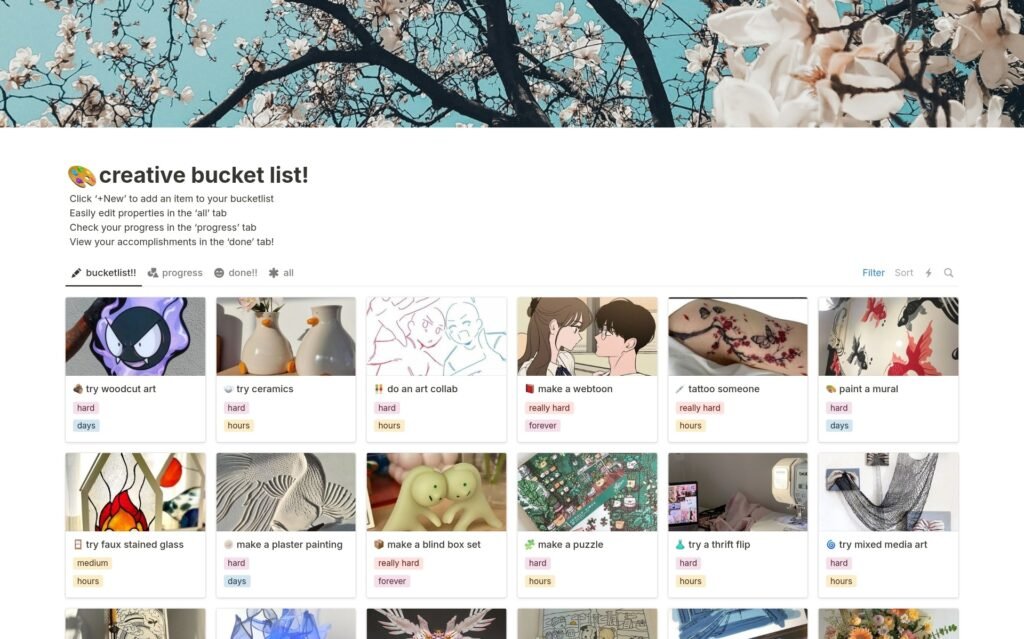
What they did: Notion built their content strategy around making their product’s power visible through the people who use it. Their template library, which lets users share workflow templates with the community, is both a content asset and a product education tool. Their YouTube channel offers detailed tutorials on building workflows. Their community forums are a constant source of real-world use cases and user innovation.
The result is a brand that feels like a community platform rather than a software product. New users don’t just download Notion and figure it out alone. They discover a universe of content created by other users that helps them understand what’s possible and how to get there.
Why it works: Notion turned its users into its content team. The template library grows organically as power users share their best workflows. Every tutorial video answers a real question real users are asking. And the community makes people feel like they belong to something, not just that they use a tool.
Your takeaway: If you have a product with a learning curve, think about what content would make that curve less steep and more exciting. Tutorials, templates, community forums, and peer-to-peer knowledge sharing are all forms of content marketing. And the best part is that much of it can be created by your users, not just your team.
What All These Content Marketing Examples Have in Common
You have read ten very different stories – a food delivery app in India, a language learning owl, a luxury watch brand, a credit card company. The budgets, audiences, and content formats couldn’t be more different.
But if you look closely, every one of these great content marketing examples shares the same foundation:
- They started with the audience, not the product: AMEX didn’t lead with credit card features. HubSpot didn’t lead with their CRM. Cadbury didn’t lead with chocolate. Each brand led with something their audience cared about, needed, or wanted and let the product earn its place in that story.
- They built systems: The best examples here are repeatable content engines, whether it’s HubSpot’s blog, Spotify’s annual Wrapped, GoPro’s Awards programme, or Zomato’s social media machine. Content marketing works through consistency and compounding, not single bursts.
- They gave before they asked: Free knowledge, free tools, free entertainment, free community, free inspiration. Every brand here led with generosity and converted attention into loyalty over time.
- They used content to build something beyond sales: Trust, community, authority, and identity are things no ad can build in a single impression. Content builds them slowly, steadily, and durably.
What’s Your Content Marketing Story?
Every brand mentioned in this blog post started somewhere. AMEX launched Open Forum in 2007 with a simple idea. GoPro started by asking their users to share their footage. Duolingo began posting jokes on TikTok.
The best content marketing doesn’t require a massive budget or a 50-person team. It requires clarity on who you are talking to, a genuine desire to help them, and the discipline to show up consistently.
If you want to build a content strategy that compounds over time (one that creates authority, drives organic traffic, and generates leads while you sleep), that’s exactly what we do at Justwords.
We have been building content-driven growth engines for brands since 2010. If you want to see how we have done it for companies like Hero FinCorp, Nestle, ICICI Lombard, Birla Opus, and Amity University, see our case studies.
FAQs
1. What makes a good content marketing example?
A great content marketing example solves a real problem for a specific audience, avoids leading with a sales message, and delivers consistent value over time. The best examples are built on a clear strategy (not one-off creative ideas), and they create a content system that compounds in value the longer it runs.
2. Can content marketing work for B2B businesses?
Absolutely. Some of the best B2B content marketing examples like HubSpot, AMEX Open Forum, and Notion show that education-first content is especially powerful in long sales cycles where trust is the main differentiator. B2B buyers do extensive research before purchasing; content that helps them do that research builds credibility that converts.
3. How do I create a content marketing strategy with a small budget?
Start with what you know. Your team’s expertise is your biggest content asset. Write about what you know better than anyone else in your market. Build one strong piece of content per week rather than five mediocre ones. Lean into UGC, where your customers can create content for you. Focus on evergreen formats (guides, tutorials, how-tos) that continue generating traffic long after publication.