
There’s a question that comes up in almost every content strategy conversation: “We have budget for content. Should we focus on blogs, whitepapers, or case studies?”
The honest answer? It depends on where your buyers are in their journey. But most B2B companies in India are making this decision based on gut feel rather than well defined strategy.
Consider this: over 80% of B2B buyers consume at least five pieces of content before contacting a vendor, and 67% of that research happens before they ever speak to your sales team. If you are only producing one content format, you are invisible for most of that journey.
This article breaks down what each format actually does, who it reaches, and where it fits in the B2B lead generation picture, specifically in the Indian market.
TL;DR
- Blogs do not directly generate leads. They generate traffic and awareness. Leads come from what you attach to them.
- Whitepapers capture volume leads at the research stage. Expect email registrations, but not many sales enquiries.
- Case studies convert high-intent buyers. They are the closest content format to a sales conversation.
- The most effective B2B content strategy in India uses all three as a connected funnel.
Blog vs. Whitepaper vs. Case Study: What Each Format Is (And What It Is Not)
Before getting into lead generation performance, it helps to define the three formats accurately because they are often misunderstood, especially in how they are expected to perform.
Blogs: The Awareness Engine
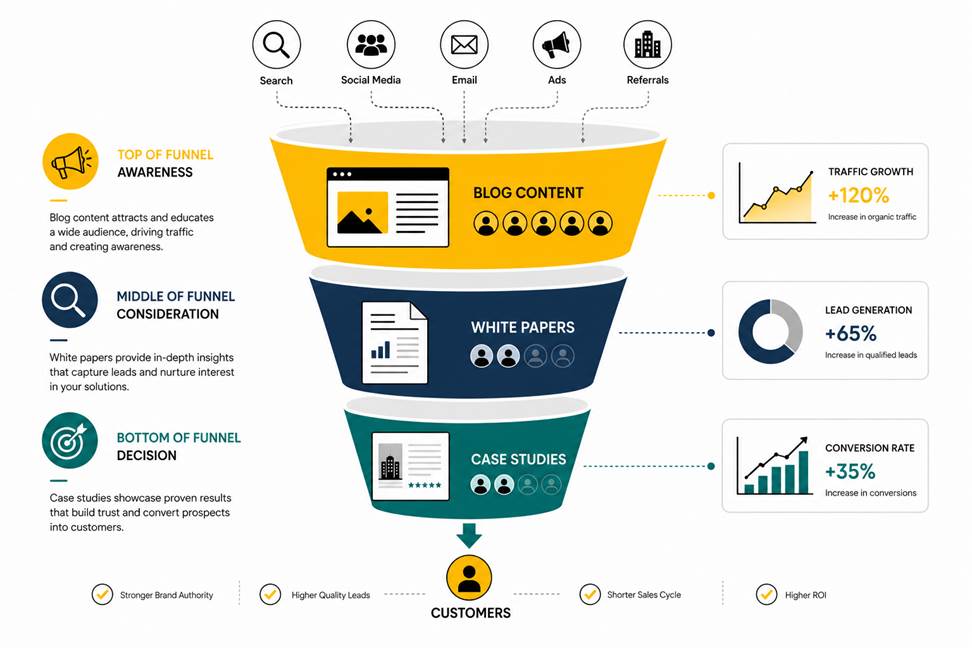
A blog is a regularly updated, search-optimised article on your website. Its primary job is discoverability: helping potential buyers find you when they are searching for answers. Blogs are top-of-funnel (TOFU) assets. They educate, attract, and build authority.
What they are not: direct lead generators. A blog does not close a deal. The lead comes from the CTA, the content offer, or the email capture that sits within or below it. Expecting a blog to independently produce leads without this infrastructure is like expecting a signboard to deliver customers without a shop behind it.
Whitepapers: The Research-Stage Converter
A whitepaper is a long-form, deeply researched document (typically 8 to 20 pages) that takes a complex problem and analyses it thoroughly. It signals expertise. In the B2B context, it is a middle-of-funnel (MOFU) asset: the reader is no longer just browsing; they are actively researching solutions.
Whitepapers are gated, usually behind an email or a short form, which is precisely how they generate leads. But the leads they generate are email registrations rather than purchase intentions. The prospect is saying ‘I am interested in this topic’ rather than ‘I am ready to buy.’
Case Studies: The Decision-Stage Closer
A case study is a narrative account of how a real client achieved a specific result with your product or service. It is bottom-of-funnel (BOFU) content built for prospects who are already evaluating vendors and need proof.
This is the most under-invested format in Indian B2B content marketing, and arguably the one with the highest conversion potential. A well-crafted case study answers the one question every B2B buyer is privately asking: “Has this worked for someone like me?”
The Lead Generation Reality: What the Numbers Say
Let us put actual data against each format rather than relying on assumptions.
Blogs: High Reach, Indirect Lead Conversion
B2B companies with consistent blogging generate 67% more monthly leads than those that do not. But notice the word ‘consistent.’ One blog a month does not bring the results. It is the compounding effect of a sustained blog content strategy (paired with strong SEO) that generates organic traffic and, over time, qualified pipeline.
In 2024, the website, blog, and SEO were the top ROI-generating channels for B2B brands globally, ranking above paid social and paid search. In the Indian context, where cost-per-click on Google Ads continues to rise across competitive B2B categories, organic blog-led SEO has become even more economically attractive.
| Did You Know? 96% of content on the web still struggles to attract meaningful search traffic, despite publishing blogs. The differentiator is almost always SEO strategy, not writing quality alone. |
Whitepapers: Strong Lead Volume, Lower Lead Quality
Gated content like whitepapers, eBooks, and research reports is the classic ‘email capture’ mechanism in B2B. Landing pages for gated content typically convert at 10–25%, making them genuinely effective lead magnets when the offer is compelling and the traffic is targeted.
However, here is the nuance most content teams miss: 66% of prospects who download gated content will not be ready to purchase for more than a year. The whitepaper captures the lead. Whether that lead becomes a customer depends almost entirely on the nurturing sequence that follows.
For Indian B2B companies, particularly in SaaS, BFSI, consulting, and IT services, whitepapers are highly effective at building a database of informed prospects. The challenge is the follow-through. Most companies invest in creating the whitepaper and almost nothing in what happens after the download.
| Pro Tip: For Indian B2B companies, consider a localised whitepaper on a problem specific to the Indian market, such as regulatory challenges, infrastructure constraints, or sector-specific data, rather than adapted versions of global research. Original India-specific data is rare and commands far higher download rates. |
Case Studies: Smaller Audience, Far Higher Conversion
Case studies rank among the most effective content types among B2B marketers globally.
In Redpoint Insights’ 2025 B2B Buyer research, when buyers were asked what content builds trust most, case studies ranked fifth, behind original research, expert opinions, peer insights, and customer testimonials. But they were the only format on the list that simultaneously demonstrates all four. A good case study is the testimonial, the peer insight, and the proof of expertise, all in one.
The Edelman 2025 Trust Barometer found that for more than 50% of buyers, trust carries equal weight to cost and quality in making a purchase decision. Case studies are the most efficient trust-building asset in your content arsenal. Yet they remain chronically under-used, particularly by Indian B2B companies who cite difficulty in getting client approvals for publication.
Which Content Format Generates More Leads in India?
The direct answer: none of them, in isolation.
The more useful framing: each format dominates a different stage, and trying to use one format to do another’s job is one of the most common (and expensive) mistakes in B2B content marketing.
B2B buyers consume an average of 4.5 pieces of content before contacting a supplier and up to 8+ before making a final purchase decision.
That buying journey is not linear, and it is not served by a single format. Here is how it actually plays out for a typical Indian B2B buyer in, say, the IT services or SaaS space:
- Stage 1 — Discovery: A CFO’s team searches “content marketing ROI for BFSI brands India.” They land on a blog post. Justwords has one. A competitor doesn’t. First impression made.
- Stage 2 — Research: The same team now wants a comprehensive view. They download a whitepaper: “The State of B2B Content Marketing in India 2026.” They hand their email address over willingly.
- Stage 3 — Evaluation: Three weeks later, the team is shortlisting agencies. They read case studies, specifically looking for work in BFSI. A detailed case study with real traffic growth figures closes the loop.
Every format played a role. Remove any one of them and the buyer simply moves to a competitor who has all three.
A Lesser-Known Insight: The ‘Trust Gradient’ in Indian B2B
Here is something that rarely comes up in global content marketing discussions but is critically relevant in the Indian B2B context: Indian buyers, particularly at the mid-market and enterprise level, apply a significantly higher trust threshold before engaging a new vendor.
This is partly structural: procurement committees are larger, approval cycles are longer, and the decision-making culture in India tends to be more consensus-driven than in Western markets. The implication for content strategy is significant.
Blogs build familiarity. Whitepapers build credibility. Case studies build trust. In markets where trust is the dominant purchase variable, under-investing in case studies is a direct miss on conversion.
Consider this: a 2025 LinkedIn B2B Influence Report found that 94% of marketers agree trust is the most important element in building a successful B2B brand. Yet most Indian B2B companies allocate the bulk of their content budget to blogs – the format that builds familiarity, not trust.
The implication: If your content strategy is 80% blogs and 20% ‘everything else,’ you are likely winning the awareness game but losing at conversion, especially in a market where the final purchase decision is driven by proof rather than information.

How to Build an Effective Content Format Strategy for Indian B2B
The practical framework is simpler and goes like this:
- Publish blogs consistently (minimum 2–4 per month) to build topical authority, drive organic traffic, and establish your brand’s voice in your category. Pair each blog with a content offer relevant to the topic (a template, checklist, or gated guide). This is what converts blog traffic into contacts. Think of a strong SEO and content marketing strategy as the long-term foundation here.
- Develop one or two high-quality whitepapers per year on topics where your target audience faces complex decisions. For Indian B2B, sector-specific research (BFSI, healthcare, manufacturing, SaaS) almost always outperforms generic global content. Gate these carefully, promote via LinkedIn and email, and have a lead nurturing sequence in place before launch.
- Build your case study bank aggressively. 3–5 strong, specific and results-driven case studies, ideally covering different industries and use cases, will do more conversion work than a year’s worth of blogs. This is where most Indian B2B companies underinvest significantly.
- Let them work together. Link from your blog to relevant case studies. Use whitepaper downloads to introduce prospects to your case studies via email. Build the funnel instead of individual pieces.
| Pro Tip: When asking clients for case study approvals, offer three options: a full public case study with their name; an anonymised version (‘a leading BFSI company in India’); or a confidential internal use document for sales conversations only. Most clients will agree to at least one of the three. The barrier is usually how the request is made, not the client’s willingness. |
For Startups Specifically: Where to Begin?
This is one of the most common questions we get from early-stage or mid-stage Indian B2B companies: do we start with blogs or case studies?
The sequencing that actually works (and this is based on what we see consistently across the accounts we manage) is:
- First 3 months: Blogs. Build your domain authority, establish your topic expertise, and get indexed for relevant keywords. This is non-negotiable for long-term organic growth.
- Months 3–6: First case study. Even one strong case study from your earliest client (with real metrics, real challenges, and a genuine outcome) is worth more in a sales conversation than ten blog posts.
- Month 6 onwards: Your first gated asset, even a simple checklist or framework, gives you lead capture infrastructure on your now-growing blog traffic.
The mistake startups make is waiting until they have ‘enough’ case studies before investing in blogs, or waiting until they ‘establish the blog’ before creating any BOFU content. The formats are not sequential. They are parallel, with priority shifting over time.
Quick Reference: Blog vs. Whitepaper vs. Case Study at a Glance
| Blog | Whitepaper | Case Study | |
| Primary goal | Drive organic traffic | Capture qualified email leads | Convert ready-to-buy prospects |
| Funnel stage | Top (TOFU) | Middle (MOFU) | Bottom (BOFU) |
| Reader mindset | Exploring, learning | Researching solutions | Evaluating vendors |
| Lead type | Potential audience | Volume leads (email/download) | Quality leads (sales-ready) |
| Content depth | 800–2,000 words | 3,000–8,000 words / detailed | 500–2,000 words / narrative |
| Gate it? | No; keep open for SEO | Yes; email gate for lead capture | Partially; summary free, full gated |
| Typical conversion | Builds traffic; blog CTA ~1–3% | Landing page download: 10–25% | Warm prospect conversion: 30–50% |
| Production effort | Low–medium | High | Medium–high |
| Best for India B2B | Awareness, long-term SEO | Enterprise, SaaS, BFSI decision stages | Services, IT, consulting, agency |
The Bottom Line
Blogs, whitepapers, and case studies do not compete with each other. They serve different buyers at different stages of the same journey. And they work best when designed to hand off to each other, not operate in silos.
For Indian B2B brands, the most common gap is in the middle and bottom of the funnel – the assets that capture and convert the traffic that blogs work hard to attract.
Investing in one format at the expense of others is a bit like building an excellent front door on a house with no rooms inside. The traffic arrives. The conversion doesn’t.
At Justwords, we build content strategies that span the full funnel, from the blog posts that bring your first visitor in to the case studies that bring them across the line. If your current B2B content marketing feels like it is generating traffic but not enquiries or enquiries but not the right ones, it is usually a format imbalance problem.
FAQs
1. Which content format generates the most leads in India?
No single format wins across the entire funnel. Blogs generate the most traffic; whitepapers capture the most email leads; case studies convert the highest-quality, most sales-ready prospects. The most effective B2B content marketing strategies in India use all three in a connected funnel.
2. Are blogs useful for lead generation?
Yes, but indirectly. Blogs generate organic traffic through SEO. Leads come from the CTAs (calls-to-action), gated offers, or contact forms embedded within or linked from the blog. A blog without a lead capture mechanism is purely a brand awareness tool.
3. Why do case studies generate high-quality leads?
Case studies generate high-quality leads because the reader is already a high-intent buyer evaluating vendors rather than someone just casually browsing. Case studies provide proof over promise: real results for real clients in recognisable situations. They answer the one question every serious B2B buyer asks: ‘Has this actually worked for someone like me?’
4. Do whitepapers work for Indian B2B companies?
Yes, whitepapers do work for Indian B2B companies, particularly for enterprises, SaaS companies, and BFSI brands where buyers spend significant time in the research phase. India-specific whitepapers addressing local regulatory, market, or operational challenges outperform globally adapted content significantly.
5. How many blogs are needed before seeing leads?
There is no universal threshold, but most B2B blogs begin to generate meaningful organic traffic between months 4 and 9, assuming consistent publishing (2–4 posts per month), solid SEO optimisation, and internal linking. Leads follow traffic, but the gap depends on what lead capture infrastructure is in place on the site.
6. Should startups focus on blogs or case studies first?
Both, but staggered. Start with blogs in the first 3 months to build domain authority and organic visibility. Develop your first case study by month 3–6, even with one client. The two formats serve different buyer stages and are not in competition.
7. What is the best B2B content marketing format?
The best format is the one that matches your buyer’s current stage. For awareness: blogs. For research-phase lead capture: whitepapers. For vendor evaluation and conversion: case studies.
8. Can one content format work across the funnel?
No format is truly full-funnel on its own. Blog posts can be written for different intent stages (awareness vs. comparison), but they do not replace the trust-building function of case studies or the in-depth education of whitepapers. A single-format strategy is almost always a funnel with gaps.