
Content marketing, done correctly, is without a doubt one of the most effective marketing strategies out there. It builds brand authority and drives compounding organic growth over a long period of time like no other channel. Done incorrectly, it produces a content library nobody reads, rankings that never materialise, and a team that eventually concludes “content marketing doesn’t work for us.”
It does work. But the mistakes that prevent it from working are consistent and mostly avoidable.
The most common content marketing mistakes are not about writing quality or publishing frequency. They are strategic errors made before content is written: targeting the wrong audience, ignoring the full funnel, publishing without distribution, and scaling quantity without building quality.
At Justwords, we audit content strategies regularly for new clients who are frustrated that their content is not converting, and for existing ones who want to understand why growth has stalled. The same mistakes appear again and again.
Below, we list the 10 most costly content marketing mistakes we have seen businesses make, and exactly how to fix them.
TL;DR
- Content marketing works. But the mistakes that prevent it from working are surprisingly consistent.
- Most businesses struggle because they target the wrong audience, neglect distribution, publish inconsistently, or optimise for the wrong metrics.
- Content that ranks and converts is built around audience needs, search intent, evergreen topics, and clear conversion paths.
- AI should accelerate expertise, not replace it.
Fixing these strategic mistakes is often enough to turn content from a cost centre into a growth channel.
10 Common Content Marketing Mistakes to Avoid in Your Content Strategy (And How to Fix Them)
1. Not Putting Your Audience First
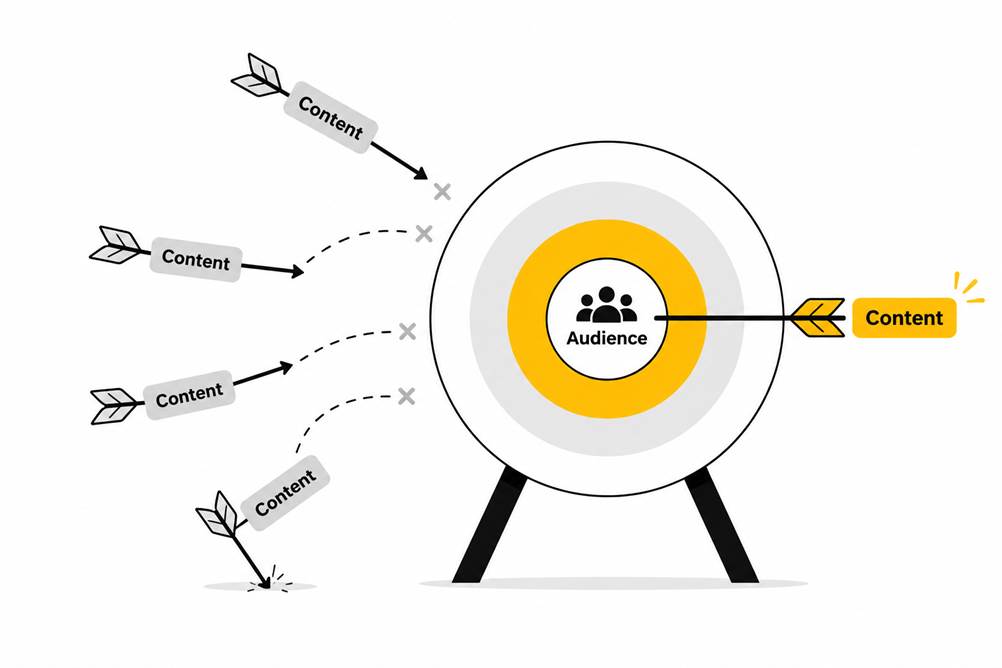
This is the most fundamental content marketing mistake, and it is shockingly common, even among teams that think they know their audience.
There is a difference between having a general idea of who your audience is and genuinely understanding the specific problems they face, the language they use to describe those problems, and the type of content they actually find useful. Most content teams fall into the first category. They take their cues from competitor blogs, trending topics, and keyword volumes, and end up writting content that is technically on-topic but does not resonate.
The result: As per a McKinsey study, 76% of people say they get frustrated when brands send content, emails, or offers that are not relevant to their lives, largely due to a lack of personalisation. That is more than three-quarters of your audience disengaging before you have had a real chance to earn their attention.
How to fix it: Use first-principles thinking about your audience. Start with human motivations rather than marketing assumptions and understand why people buy before deciding how to market.
Talk to your sales team, because they hear real objections and questions every day. Talk directly to customers. Use audience research tools to understand what your target readers actually engage with. Build detailed audience personas that go beyond demographic data to include psychographics like what frustrates them, what they aspire to, and what they are responsible for at work.
The best brief for a content piece is a real question from a real customer, not a keyword from a competitor’s ranking page.
2. No Distribution Strategy
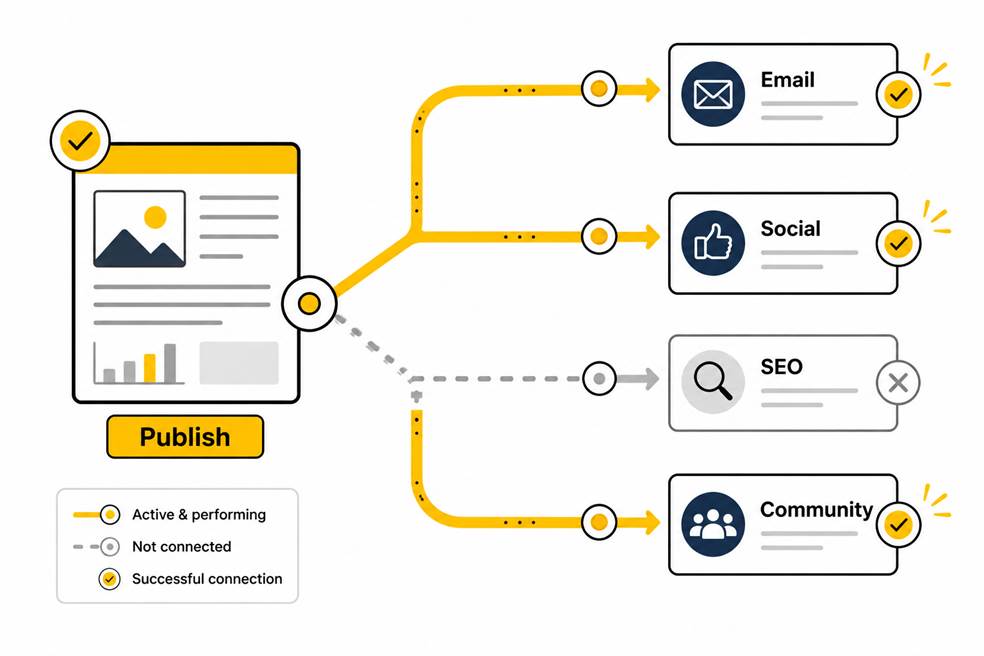
Many content teams operate on a “publish and pray” model. The article goes live, gets shared once on social media, and is then left to find its own audience. In reality, it rarely does.
Promoted content gets 10 to 20 times more initial traction, which signals quality to search engines like Google and accelerates your rankings. Content that gets no initial engagement sends the opposite signal. And most content published without active distribution gets no engagement at all.
This is a compounding problem. Weak initial signals lead to weak rankings. Weak rankings lead to low organic traffic. Low organic traffic means the content never builds the authority needed to rank better. Content teams then conclude the topic or format “doesn’t work” and move on, when the real issue was purely distribution.
How to fix it: Treat distribution as a mandatory step from the start in every content workflow. For every piece published, have a distribution checklist: which social channels, which email segments, which online communities, which internal teams should share it, whether it should be pitched as a guest post or repurposed for another platform. Spend as much time promoting content as creating it. A 50/50 split is a useful rule of thumb.
Also build a follow-up system. Prospects rarely convert on first contact. Marketing automation tools like ActiveCampaign, LeadSquared, or HubSpot can nurture leads across multiple touchpoints after they first engage with your content. The customer journey from first-time reader to paying client typically involves multiple exposures. So, content that is never followed up on leaves conversions on the table.
3. Using Only One Content Format
Sticking to text-only blog posts is one of the fastest ways to limit your content’s reach. Not because blogging does not work (it absolutely does) but because different audience segments consume content in fundamentally different ways, and a single format will always exclude large portions of your potential audience.
91% of businesses now use video as a marketing tool, and 90% say it delivers good ROI. 88% of people have been convinced to buy a product after watching a brand’s video. Short-form video in particular (Reels, YouTube Shorts, LinkedIn video) has become the primary discovery format for most audiences, reaching people who would never find a blog post through Google search.
Podcasts, infographics, newsletters, case studies, and interactive tools are some of the other formats to consider. Each format serves a different purpose and reaches a different segment.
How to fix it: Start with your core content piece, usually a well-researched blog post or video, and build a repurposing system around it. A 1,500-word blog post can become a short-form video, a LinkedIn carousel, a newsletter section, a set of social posts, and an infographic. This multiplies the reach of every piece of content you produce without multiplying the effort proportionally. Match format choices to where your audience actually spends time, not to what is easiest to produce.
4. Neglecting Evergreen Content in Favour of Trending Topics
Chasing trends feels productive. A trending topic gives you an obvious angle, a ready-made audience, and the possibility of a short-term traffic spike. But trend-driven content has a predictably short shelf life. And a content library built primarily on trending topics generates traffic that peaks and declines rather than compounds.
Google’s Quality Rater Guidelines explicitly assess whether content provides lasting value or was created primarily to attract clicks from trending topics. Trend-chasing articles tend to generate high bounce rates because they attract low-intent visitors, which reinforces a negative engagement signal in Google’s ranking algorithm.
Evergreen content, built around questions and problems that remain relevant over time, is what creates compounding organic traffic. A well-researched guide published today can still be driving leads three years from now with occasional updates. A post about a trend from six months ago is invisible.
How to fix it: Identify the 10 to 15 core questions your target audience asks most frequently. These become your evergreen content priorities. Use Google Trends to validate longevity: does search interest in this topic remain stable over 12 to 24 months, or does it spike and collapse? Stable interest means evergreen potential. Spiky interest is just trend content.
Balance is appropriate. Trend content serves a purpose for short-term visibility and social sharing. But the backbone of your content strategy should be evergreen content pieces that build authority over time and keep generating traffic without constant refreshing.

5. Publishing AI-Generated Content Without Human Editorial Oversight
This is the most significant content marketing mistake of the last two years, and one that is actively destroying the search visibility of businesses that make it.
AI content tools have genuinely made content production faster and more accessible. The mistake is treating AI output as final output and publishing at high volume without adding original insight, real experience, or genuine expertise. Google has been unambiguous about this.
| Starting around June 2025, Google began issuing manual actions for “scaled content abuse,” specifically targeting websites that excessively used AI-generated content without adding value. Niche information sites with 500+ AI pages published in 2025 saw 60 to 80% traffic loss. Affiliate review sites with AI-generated product comparisons saw 40 to 70% traffic loss. That meant these sites effectively disappeared from search results. |
Google does not penalise AI content per se. It penalises thin content that fails to serve user intent, regardless of how it was produced. AI just happens to be the most efficient way to produce that kind of content at scale. The March 2026 core update continued this enforcement trajectory.
How to fix it: Use AI as a production accelerator, not a replacement for expertise. AI is genuinely useful for research, outlining, drafting, repurposing, and generating variations. Human editors must then enrich the draft with original data, first-hand experience, specific examples, and the kind of genuine insight that AI cannot produce. Add real author bylines with credentials. Cite original sources. Include proprietary data or client results where relevant. These are the EEAT signals (Experience, Expertise, Authoritativeness, Trustworthiness) that Google’s quality raters specifically look for.
The formula that works in 2026: AI efficiency + human depth + genuine expertise = content that ranks and converts.
6. No Clear CTA
Educational content with no clear next step is one of the most common and most frustrating content marketing failures. You attract a reader, hold their attention, genuinely help them, and then let them leave without direction on what to do next.
Educational content with no clear CTA (call-to-action) leaves engaged readers with nowhere to go. Depending on where they are in the buying journey, that next step could be subscribing to a newsletter, downloading a relevant guide, booking a consultation, or reading a related case study. The key is that there is always a relevant, frictionless next step.
How to fix it: Every piece of content needs a CTA. But the CTA must be contextually relevant to both the content and the reader’s likely stage in the buying journey. A top-of-funnel (TOFU) blog post about “what are marketing automation tools” should not CTA directly to “book a demo call.” It might offer a related guide or checklist. A bottom-of-funnel (BOFU) piece comparing marketing automation tool options absolutely should CTA to a demo or free trial.
Audit your existing content. If any article ends without a clear next step, fix it immediately. This is one of the highest-leverage conversion improvements you can make with minimal effort.
7. Targeting Keywords Without Understanding Search Intent
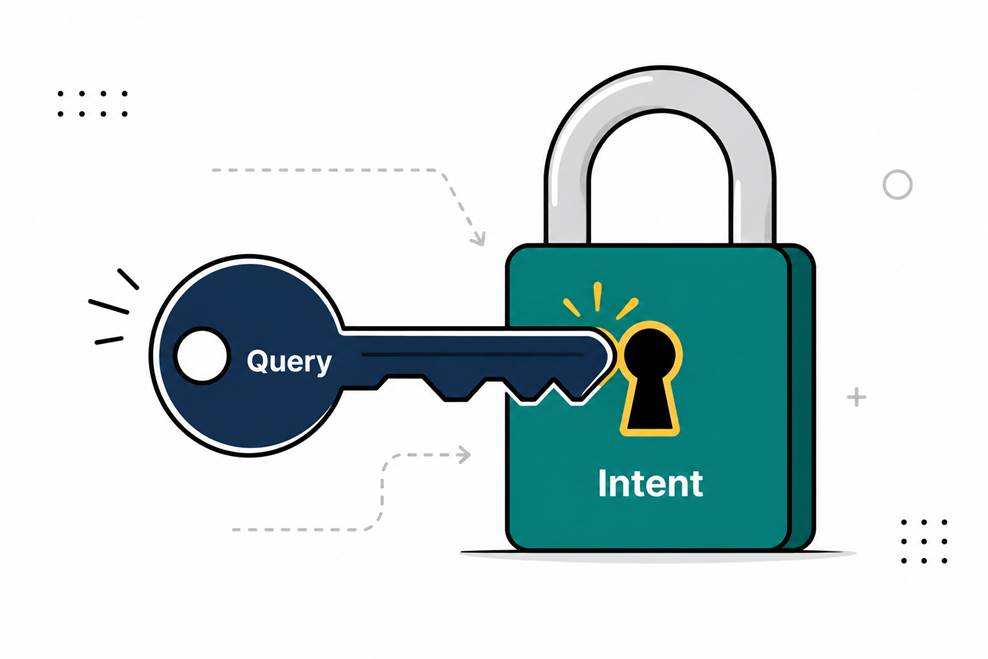
Many content teams research keywords diligently and still produce content that ranks for nothing useful for the business. The reason is almost always a mismatch between the keyword and the content’s actual approach, which results from a failure to understand search intent.
Search intent is what someone actually wants when they type a query. “Account based marketing strategy” might be typed by someone wanting a conceptual explanation, a step-by-step guide, a template, or a comparison of approaches. Getting the keyword right but misreading the intent produces content that users bounce from immediately, which tells Google the content failed to satisfy the query.
Targeting keywords without understanding what searchers want leads to high traffic and zero conversions. The fix is to analyse what is currently ranking and match your content’s format and depth to the intent those pages reflect.
In 2026, this matters even more because of AI search. Google’s AI Overviews and tools like ChatGPT pull answers that best match searcher intent rather than keyword presence. Content that clearly and directly answers a specific question in the right format and at the right depth has a significantly higher chance of being cited in AI-generated responses.
How to fix it: Before writing, search the target keyword and analyse the top five results. What format are they (listicle, guide, comparison, tool)? How long are they? What angle do they take? What questions do they answer? This tells you what format and depth Google considers appropriate for that intent and eventually what you need to match or exceed to rank.
8. Measuring Vanity Metrics Instead of Business Impact
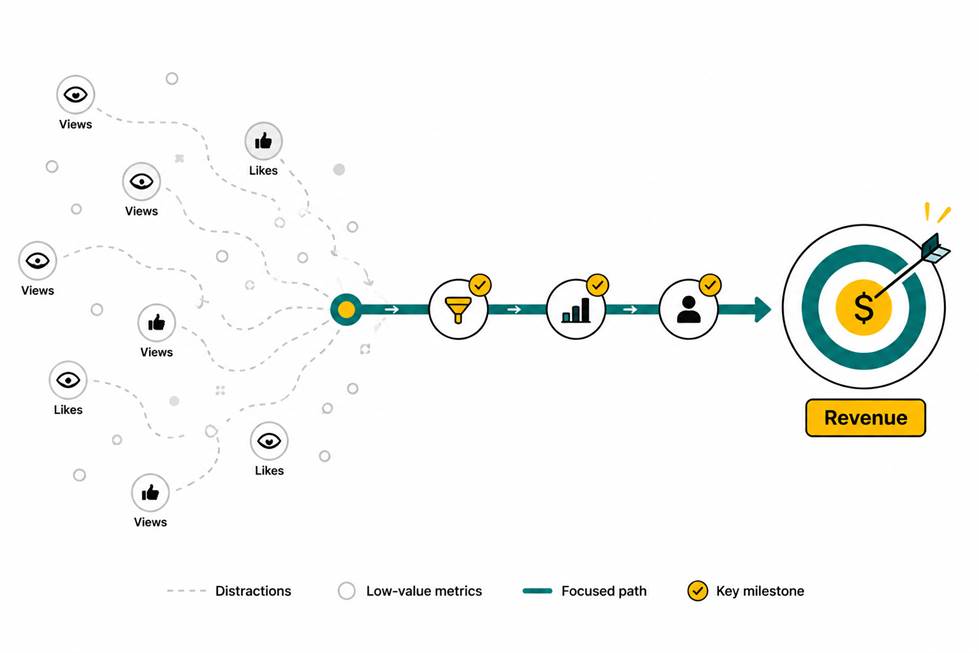
Increasing page views, social media followers, and impressions feel like progress. They are easy to track, easy to report, and easy to improve with clickbait. They are also largely disconnected from whether your content marketing is actually growing your business.
Most content fails because brands measure these vanity metrics over business impact. A piece of content with 500 page views that generates 20 qualified leads is worth more than a piece with 10,000 page views that generates none. If your content team is optimising for the former metric, they are optimising for the wrong thing.
How to fix it: Define business-impact metrics before you publish. The metrics that matter include organic traffic from qualified keywords, conversion rate on content pages, leads generated by content, revenue influenced by content (tracked through UTM parameters and CRM attribution), and customer acquisition cost from organic channels. These take more work to track but they tell you whether content is actually doing its job.
9. Inconsistent Publishing
Publishing ten blog posts in January and nothing for the next three months is not a content strategy. It is a content event. And it almost always produces disappointing results, which then gets attributed to “content marketing not working.”
77% of creative teams struggle to produce content fast enough to meet demand, leading to rushed content and poor quality, or inconsistency that makes it harder to gain traction. The algorithm rewards consistent publishing signals. Your audience builds a readership habit around consistent content. Backlinks and shares accumulate steadily with consistent output. All of these benefits evaporate when output stops.
How to fix it: Publish at a frequency you can genuinely sustain. Two quality posts per month maintained consistently will outperform ten posts one month and none for the next four. Build a content calendar three months in advance. If you have limited internal capacity, batch-produce content during quieter periods. If the team cannot maintain the calendar, this is a signal to bring in external support rather than continue the burst-and-silence cycle.
10. Trying to Do Everything Yourself
One of the biggest mistakes you can make as a content marketer is to try and do everything yourself. This is as true in 2026 as it was in 2010. Content marketing requires a genuine range of skills: strategic thinking, keyword research, writing, SEO, design, video production, distribution, analytics. No single person does all of these well, and expecting them to usually results in mediocre output across the board.
71% of businesses have a monthly content marketing budget under $1,000. And many of these are the same businesses wondering why their content does not perform. Under-resourcing content marketing and then expecting professional results is one of the most common and most frustrating patterns we see.
How to fix it: Identify your actual strengths and outsource the rest. If you are a strong writer, focus there and bring in an SEO specialist. If your strength is strategy and distribution, find a writer whose style matches your brand voice. If you have neither the time nor the skills across the board, a content marketing agency can handle the full workflow, and the ROI from a well-executed content strategy almost always justifies the investment in 6–12 months.
At Justwords, the clients who see the strongest results are those who treat content marketing as an investment with a defined budget and clear KPIs, not as a side task that gets attention when everything else is done.
Final Thoughts
If you do a Google search for your targeted keywords today, don’t be surprised to find over a million results. That is the kind of intense competition that you will have to deal with in content marketing today. That’s why it’s super important to use the right strategy and avoid the common mistakes discussed in this article.
And if you are making any of these mistakes, the Justwords team can audit your content strategy and identify exactly where the gaps are. Get in touch.
FAQs
1. Why does content marketing fail for most businesses?
The most common reasons are lack of audience understanding, no distribution strategy, inconsistent publishing, and measuring the wrong metrics. Most businesses that say “content marketing doesn’t work” have actually implemented it incorrectly. They either stopped too early, targeted the wrong audience, or produced content without a strategy behind it.
2. Is AI content safe to publish for SEO in 2026?
AI-assisted content is safe and can rank well. According to Originality, approximately 17% of top 20 Google search results contain AI-generated content as of late 2025. What Google penalises is scaled content abuse: mass-publishing thin, low-value AI content without original insight or human editorial oversight. The distinction is quality and intent rather than the use of AI itself.
3. How long should I wait to see results from content marketing?
Typically 3–6 months before meaningful organic traction, and 6–12 months before content becomes a reliable, consistent source of leads. Businesses that quit before this window closes almost always conclude it “did not work,” when in fact they stopped before results would have materialised.
4. What is the most important content marketing metric?
For most businesses, it is organic leads generated through content because it connects content activity directly to business outcomes. Traffic and rankings are useful leading indicators, but they are not the end goal.
5. What is the biggest content marketing mistake in 2026 specifically?
Publishing AI-generated content at scale without human editorial oversight. This was not a significant risk a couple of years ago. It is now one of the fastest ways to lose search visibility, following multiple Google spam updates in 2025 and 2026 that specifically targeted scaled content abuse.