
Content marketing in India costs anywhere from ₹30,000 to over ₹2,00,000 per month for a full-service engagement, depending on the scope, the agency and what you are actually buying. That figure covers strategy, content creation, SEO, distribution, link building and performance measurement – the full system that turns content into qualified traffic and leads. A few blog posts from a competent agency can cost between ₹8,000 and ₹25,000. A per-word rate from a good agency starts at around ₹1 to ₹3 per word and can go significantly higher for specialist topics.
That range is wide, and it is wide for a reason. What looks like the same deliverable on a quote sheet can be fundamentally different depending on who is doing it and what strategy sits behind it.
This article breaks down what content marketing actually costs in India, why prices vary so sharply, what you should expect at different budget levels, and how to figure out whether what you are spending is returning anything at all.
Quick Overview
- Content marketing retainers in India range from ₹30,000/month (startups) to ₹2,00,000+/month (enterprise).
- Per-article pricing for SEO-optimised content is around ₹1 to ₹3 per word from a professional agency.
- Content marketing pricing varies by scope, agency tier, industry complexity, content volume, how much strategy is involved and whether SEO is included. Content marketing is a growth strategy and should not be confused with a writing service.
- The cheapest option is never the most cost-effective one when ROI over 12 to 24 months is measured.
- Month-on-month contracts with no lock-in are a signal of a content marketing agency confident in its results.
Why Content Marketing Pricing in India Varies So Much
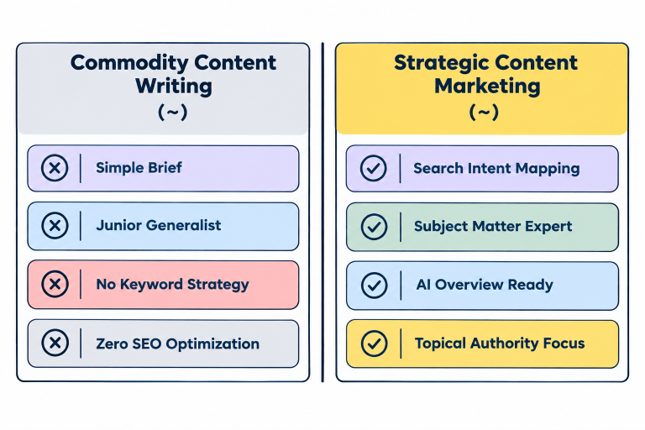
The Indian market confuses content marketing with content writing. They are not the same thing. Content writing is a deliverable. Content marketing is a growth strategy that uses content as its primary lever. And pricing it correctly requires understanding what you are actually buying at each budget level.
Most pricing confusion in the Indian content marketing space comes from one fundamental problem: buyers compare prices without comparing what is being bought.
A ₹1,000 blog article and a ₹5,000 blog article are not the same thing. One is written by a generalist working from a simple brief. The other is researched by a strategist who understands search intent, built around a keyword opportunity that exists, written by subject matter experts, edited for topical authority and optimised to earn AI Overviews citations. The visible output (a 1,500-word article) looks identical. But the business outcome is much different.
The same logic applies to monthly retainers. A ₹15,000/month retainer typically buys a junior executive handling 12 to 15 accounts, automated reporting and content that no one is accountable for in terms of traffic or leads. A ₹75,000/month retainer buys a dedicated strategy lead, content rooted in keyword research, on-page SEO, link building and monthly performance reviews against business goals.
Understanding this gap is the starting point for any serious content marketing budget conversation.
Content Marketing Pricing Models in India
Indian content marketing agencies typically structure their pricing in three ways.
1. Monthly Retainer
This is the most common model for ongoing content programmes. The client pays a fixed fee each month for an agreed scope. For example, a certain number of articles, SEO activities, social posts, distribution and reporting. Retainers reward consistency, which is what SEO and content-led growth require.
Retainer ranges in India (2026):
| Business Stage | Monthly Retainer Range | What It Typically Covers |
| Startup/Early Stage | ₹30,000-₹60,000 | Content strategy, keyword research, SEO-optimised content, basic on-page optimisation, monthly reporting |
| SME/Growth Stage | ₹60,000-₹1,50,000 | Full strategy ownership, content production, SEO (technical + on-page), link building, social content, distribution, performance reporting |
| Enterprise/Scale | ₹1,50,000 and above | Integrated content and SEO strategy, high-volume content, multi-channel execution, authority building, dedicated team, full measurement tied to leads and revenue |
The scope document matters more than the headline number. A ₹40,000 retainer that defines the strategy, content calendar, distribution plan, and reporting framework is a real content marketing programme. A ₹40,000 retainer described vaguely as content and SEO activities is just a production contract with no accountability for outcomes.
2. Project-Based Pricing
This is used for one-time engagements. A content audit, a website copy overhaul, a content strategy document or a campaign. Project fees are scoped upfront and don’t require ongoing commitment.
Typical project ranges:
- Content strategy and audit: ₹30,000 to ₹75,000
- Website content (10–15 pages): ₹40,000 to ₹1,20,000
- One-time campaign content: ₹30,000 to ₹1,00,000
Project-based work makes sense when you have a defined task with a clear endpoint. It is not the right model for building organic traffic over time, which requires compounding effort.
3. Per-Article/Per-Word Pricing
Per-piece pricing is common for businesses that manage content strategy in-house and need production support. It is also how many agencies price standalone blog writing.
Per-article rates in India (2026):
| Content Type | Price Range |
| Basic SEO blog (800–1,200 words) | ₹1,000–₹5,000 |
| Mid-tier SEO article (1,500–2,000 words) | ₹2,000–₹8,000 |
| Long-form/thought leadership (2,500–4,000 words) | ₹5,000–₹12,000 |
| Long-form YMYL/specialist content (finance, legal, medical) | ₹8,000–₹15,000 |
Per-word rates from professional agencies and senior freelancers are roughly ₹1 to ₹5 per word for standard content. YMYL and highly technical content go higher.
Anything below ₹1,000 for an SEO-optimised article in 2026 almost certainly means AI-generated or lightly edited commodity content. That is not inherently wrong for every use case, but it is not content marketing; it is content production. The difference matters.
What Drives Content Marketing Cost in India
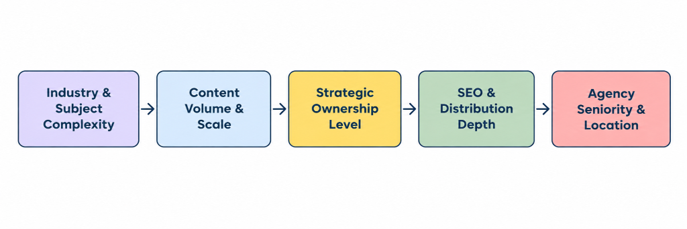
The price of content marketing depends on more than just the number of words. The type of content, how difficult it is to produce and how much you need all affect the cost. Common determining factors are:
- Industry and content complexity: Finance, healthcare, legal and B2B technology content require verified data, subject-matter expertise and careful fact-checking. These cost more than lifestyle or general interest content, and rightly so. A poorly written fintech article carries regulatory and reputational risk. A well-written one earns backlinks, drives qualified traffic and positions the brand as an authority.
- Content volume: Higher volume typically brings unit economics down, but only when quality is maintained. Scaling from 4 articles to 15 articles per month requires systems, not just capacity.
- Whether strategy is included: The biggest cost variable in any content marketing engagement is whether you are paying for a strategist who decides what to create and why, or just for someone to execute a brief you give them. Execution alone is cheap. Strategy is where the ROI lives.
- SEO depth: An article written for a human reader and an article optimised for search intent, structured for AI search, interlinked with the right cluster, and built around a keyword gap in your domain is what brings results. The SEO layer adds cost and adds the majority of the organic return.
- Agency tier and team structure: Metro agencies in Delhi, Gurugram, Mumbai and Bangalore command a premium over smaller city agencies. More importantly, agencies with senior strategists, dedicated editors and in-house SEO teams charge more than those routing everything through junior executives. The premium is almost always worth evaluating on output quality.
What You Should Expect at Each Budget Level
₹30,000 – ₹50,000/month
An entry-level content marketing programme for early-stage businesses establishing an organic presence. At this budget, a good agency will own the content strategy (keyword research, topic selection, content priorities) and execute against it with SEO-optimised content and basic on-page work. What this tier does not typically cover is active link building, distribution, or deep technical SEO. Think of it as building the content foundation that a fuller programme can eventually scale.
₹50,000 – ₹1,00,000/month
This is where content marketing starts functioning as an integrated growth programme. The agency should own the full strategy (content, SEO, and how the two connect) and execute across content creation, on-page optimisation, basic link building and social distribution. Monthly reporting should be tied to organic traffic and keyword visibility, not just deliverable counts. At minimum, expect a quarterly strategy review where the data drives decisions about what to build next. This tier suits SMEs who are serious about organic growth and want an agency accountable for measurable outcomes.
₹1,00,000 – ₹2,00,000+/month
A full-service content marketing investment that covers the entire system: strategy, content creation, SEO (technical and on-page), active link building and authority building, multi-channel distribution, social content, and measurement tied to leads and revenue contribution. At this level, the agency should function as an extension of your marketing team. It should own the execution as well as make the strategic decisions that determine what needs to be done, why, and in what order. Enterprise brands and growth-stage companies competing for high-intent audiences in competitive categories typically require this level of integration to build meaningful organic visibility.
The ROI Conversation: Is Content Marketing Worth the Cost?
The data is not subtle. Content marketing generates 3 times as many leads as traditional outbound marketing at 62% lower cost, a benchmark that has held across HubSpot, Demand Metric, and CMI research through 2025 and 2026. Companies with active blogs generate 67% more leads per month than those without. Organic search still drives over 53% of all trackable website traffic.
What makes content marketing financially distinct from paid media is compounding. A well-ranked blog article generates more traffic in months 7 to 12 than it did in months 1 to 6 at near-zero additional cost. A paid ad stops delivering the moment the budget is paused. But content keeps working.
Justwords has seen this play out consistently across clients. Hero Housing Finance grew from zero to 60,000+ monthly visitors and 270+ home loan conversions per month across a 3-year content and SEO mandate. This is a result that compounding organic investment produces, not a paid campaign.
What to Watch Out for When Evaluating Content Marketing Costs
A few pricing signals that should prompt scrutiny:
- Very low per-article rates: Below ₹3,000 to ₹4,000 for SEO content means the economics of producing quality work do not add up. Someone is cutting corners, maybe on research, on editing, on strategy, or on all three.
- No strategy in the retainer scope: If an agency quote lists deliverables (articles, social posts) but does not mention keyword research, content strategy, or performance benchmarks, you are buying output with no accountability for outcomes.
- Guaranteed rankings with short timelines: Legitimate SEO and content marketing agencies do not guarantee first-page rankings in 30 to 60 days. The ones who do are either targeting near-zero-traffic keywords or misrepresenting how organic growth works.
- All-in-one pricing with no transparency: If an agency bundles ad spend into a content marketing retainer without separating the two, or quotes a monthly number without specifying scope, ask for a line-item breakdown before signing anything.
- Lock-in contracts as the only option: A confident agency with a strong track record does not need to lock clients in for 12 months upfront. Month-on-month flexibility is a sign of an agency willing to be held accountable for results each month.
The Budget Question Is Really a Strategy Question
Most businesses that struggle with content marketing spend did not pick the wrong price point. They picked the wrong frame. They priced content marketing like a production service, measured it like a campaign, and expected results in a timeframe that organic growth simply does not work in.
The businesses that get content marketing right treat the budget as an investment in a system. One that takes 6-12 months to build momentum and then compounds well beyond what paid media can sustain at equivalent spend.
If you are at the stage of figuring out what your content marketing budget should be and what it should actually cover, Justwords has been doing this across 400+ clients for 16 years. With us, the conversation starts with your business goals. You can check out our content marketing services or reach out directly to start that conversation.
FAQs: Content Marketing Cost in India
1. What is the average content marketing cost in India for a small business?
Small businesses in India typically spend between ₹30,000 and ₹60,000 per month on content marketing. This covers a basic programme of 4-8 SEO-optimised articles per month, keyword targeting and light on-page SEO. The exact cost depends on the industry, content volume and whether link building is included.
2. What is the per-word rate for content writing in India?
Professional content writing in India is priced at roughly ₹1 to ₹5 per word, depending on the writer’s experience, the content type, and the industry. Specialist and YMYL content commands rates at the higher end of this range. Rates below ₹1 per word are associated with entry-level or AI-assisted output.
3. What is the difference between a content marketing retainer and project-based pricing?
A retainer covers ongoing monthly work (articles, SEO, strategy, reporting) at a fixed monthly fee. Project-based pricing covers a one-time, defined scope such as a website copy overhaul or a content strategy document. Retainers are better suited to organic growth programmes. Project pricing makes sense for discrete, time-bound tasks.
4. Is content marketing cheaper than paid advertising in India?
Over the long term, content marketing is significantly more cost-efficient than paid advertising. Organic leads cost roughly ₹1,500 to ₹2,500 per lead on average, compared to ₹5,000 to ₹15,000 for PPC-driven leads in competitive categories. The difference is that content marketing takes longer to build but continues delivering returns after the investment is made. Paid media stops when the budget stops.
5. What should a content marketing retainer in India include?
A properly structured content marketing retainer covers strategy ownership, not just content production. That means it should include a content and SEO strategy built around your business goals, a keyword-driven content plan, SEO-optimised content creation, on-page optimisation, distribution and link building (at mid-to-upper tiers), and performance reporting tied to organic traffic, rankings, and lead metrics with a strategy review at least quarterly. If a retainer quote lists deliverables but no strategy framework, no distribution plan, and no performance benchmarks, that is not content marketing.