An SEO (Search Engine Optimisation) agency improves your website’s visibility when people search for what you offer on Google and other search engines, all without paying for ads. When someone in India searches on Google for things like “HR consultants in Bangalore” or “best CRM software,” an SEO agency works to make sure your website appears near the top of those results.
They do this by fixing technical problems on your site (page speed, broken links), optimising your content to match what people are actually searching for, building credibility through links from other reputable websites, and creating content that answers the questions your customers are asking. Each month, they audit, fix, create, and build, which translates into improved search rankings, more organic traffic to your site, and measurable business outcomes like leads or sales over a 3–6 month timeline.
The specific roles, deliverables, and process vary by agency, but the underlying job is the same: make your website the most credible, relevant answer to the searches your customers are already running.
Key Takeaways
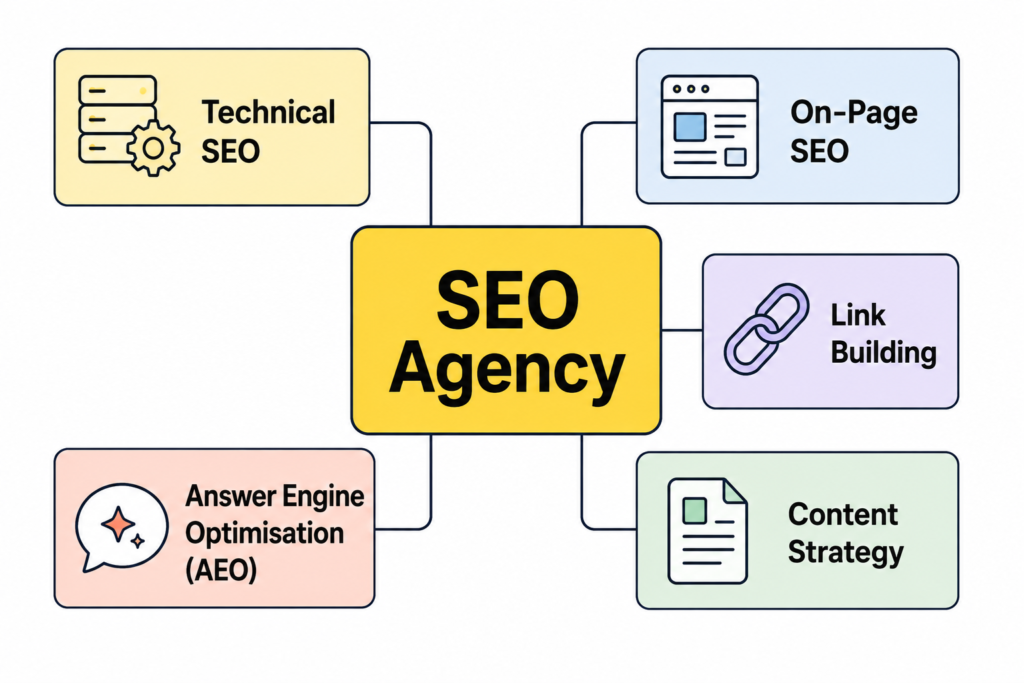
- An SEO agency works across five disciplines: technical SEO, on-page optimisation, link building, content strategy, and Answer Engine Optimisation (AEO) for AI search platforms.
- Monthly deliverables should show what was done, what changed in rankings and traffic, and what’s planned next.
- The SEO audit process is where every engagement should start. It sets the strategy and prioritises the work.
- In 2026, AEO (optimising for AI citations in ChatGPT, Google AI Overviews) is as important as traditional search ranking. A good SEO agency handles both.
The Five Things an SEO Agency Is Actually Responsible For
An SEO agency works across five distinct disciplines simultaneously. A well-structured agency has specialists (or at minimum clear ownership) across each of these areas.
1. Technical SEO
Technical SEO is the starting point for everything else. Before content or link building can perform, Google needs to be able to crawl the site, index it correctly, and understand its structure. The SEO audit process covers site architecture, page speed, mobile usability, crawl errors, duplicate content, canonicalisation, Core Web Vitals, and structured data markup.
Technical SEO deliverables from a thorough audit are usually a prioritised list of fixes. Some of these are simple enough for a content editor, while others require a developer. A site with unresolved technical issues will underperform regardless of how strong the content or backlink profile is.
2. On-Page SEO
On-page SEO is about making each page as relevant and clear as possible for the search queries it should rank for. This starts with the keyword research workflow (mapping search terms to pages based on intent, volume, and competitive difficulty) and flows into optimising title tags, meta descriptions, heading structure, body content, and internal links.
On-page work also includes identifying keyword cannibalisation, where two pages compete for the same term and split authority instead of consolidating it.
On-page vs off-page SEO tasks are often lumped together in agency reporting, but they are distinct: on-page controls what’s on your site, off-page controls how the rest of the web perceives it.
3. Off-Page SEO and Link Building
This is about how a site builds authority in Google’s eyes. The quality and topical relevance of sites linking to yours is one of the strongest signals Google uses to rank pages.
Off-page SEO tasks include identifying link targets in your industry, running editorial outreach, producing content worth citing, and building a backlink profile that signals genuine expertise. This work is slow and relationship-dependent. An agency promising fast, cheap links is almost always describing a process that creates short-term gains and long-term penalties.
4. Content Strategy
Content strategy is what connects search demand to your website’s pages. A good SEO agency should be able to identify which questions your target audience is searching, which pages are missing from your site, and which existing pages need to be expanded, consolidated, or rewritten.
Content strategy in SEO isn’t about publishing more frequently. It’s about publishing the right content for the right intent, structured in a way Google can understand and users will actually read.
5. Answer Engine Optimisation (AEO)
In 2026, this has become a critical distinction from traditional SEO. AI Overviews are now showing up on 37.8% of commercial searches, often before the traditional blue links. An SEO agency that doesn’t optimise for AI answer engines is leaving visibility on the table.
AEO is about structuring content so ChatGPT, Google AI Overviews, Perplexity and similar platforms can extract, understand, and cite your pages as authoritative answers. This means different formatting (bullet points, clear definitions, FAQ sections, structured data) and a focus on being the source AI systems quote.
A good SEO agency in 2026 runs both SEO and AEO in parallel, since a solid ranking still feeds into whether AI systems can find and trust your content.
How the SEO Agency Process Works, Month by Month
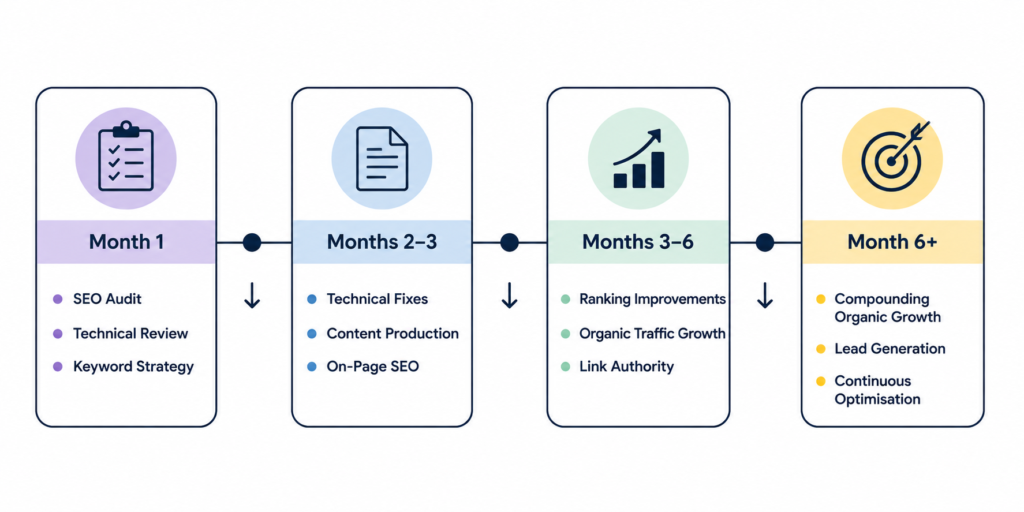
Let’s understand what a well-run SEO process actually looks like across the first six months:
- Month 1 (audit and strategy): The SEO audit process takes priority before anything else is touched. This covers technical health, keyword research, competitive gap analysis, content inventory, and on-page opportunity mapping. The deliverable at the end of the first month isn’t rankings improvement; it’s a prioritised roadmap that tells you exactly what needs to be done, in what order, and why. Agencies that skip the audit and move straight to execution are optimising without knowing what they are optimising for.
- Months 2 & 3 (implementation and early content): Technical SEO deliverables from the audit are put into action, typically through a structured brief passed to the client’s development team or handled directly by the agency. On-page optimisation begins on priority pages. The keyword research workflow produces a content schedule. Link building outreach starts, though editorial placements take weeks to materialise. Search results don’t move much yet, which is expected and normal.
- Months 3–6 (early ranking signals): Lower-competition keywords begin moving. Organic traffic to optimised pages starts climbing. Links placed in month 2 begin passing equity. Content published earlier gets indexed and starts finding its position in search results. This is also the adjustment phase, where the agency should be reading the data, identifying which keyword clusters are gaining traction, and reallocating effort accordingly.
- Month 6 onwards (compounding returns): The pages, links, and technical improvements from the first six months begin producing returns that grow without proportional additional investment. This is the nature of SEO that makes the patience worthwhile. It also explains why clients who disengage at month 3, frustrated by the lack of early movement, often hand over the benefit of their own investment to the next vendor who inherits a partially-warmed account.
What SEO Agency Monthly Deliverables Should Actually Look Like
SEO agency monthly deliverables are where the most frustration tends to accumulate. Too many agencies send traffic graphs and ranking tables without explaining what drove the changes or what the plan is to continue them.
A monthly deliverable worth its fee answers three things: what was done, what changed, and what’s next.
What was done should be specific: a log of technical fixes implemented with the corresponding URLs, on-page changes made and where, content published with the target keyword, and links secured with the linking domain and traffic estimate.
What changed should connect activity to outcomes. Keyword rankings for tracked terms, organic traffic by page and segment, and where the data is available, lead or conversion volume from organic. SEO reporting frequency should be monthly at minimum, with a quarterly review that steps back from month-on-month fluctuation to assess overall trajectory.
What’s next should explain the upcoming month’s priorities and the reasoning behind them. An agency that only reports on what happened last month without a forward plan is reactive. SEO strategy requires looking ahead, which includes identifying seasonal opportunities, content gaps opening up in the competitive landscape, and technical improvements still in the implementation queue.
Red Flags to Watch Out for When Choosing an SEO Agency
Watch for these in agency proposals and monthly reports:
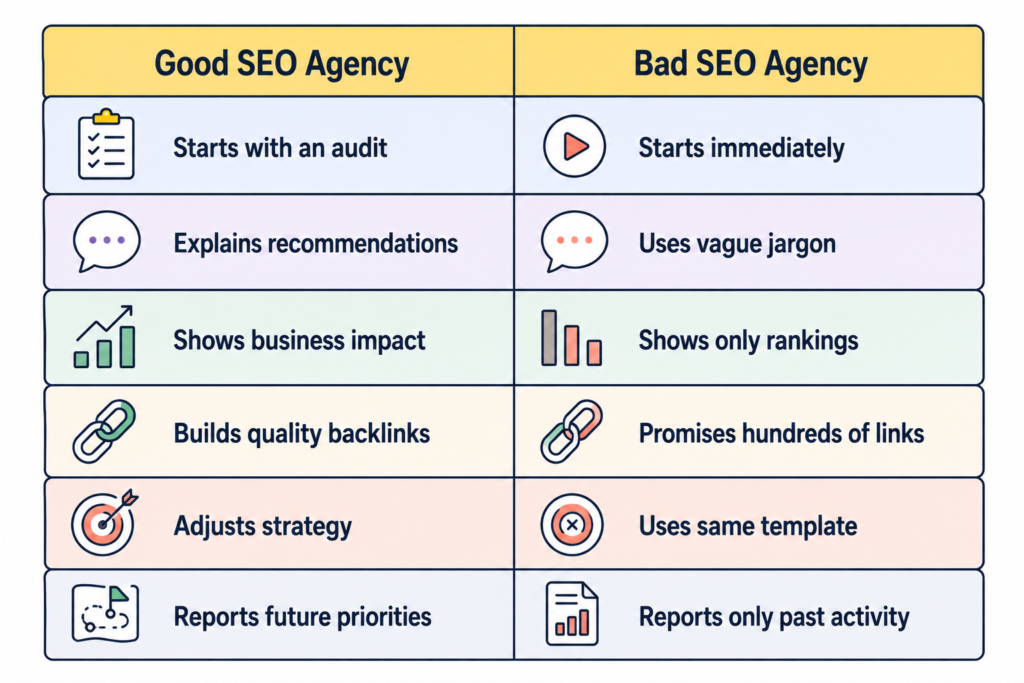
- They can’t explain why: If an agency recommends work but can’t articulate why it matters for your specific business (how a piece of content connects to your sales cycle, why a particular technical fix will move your key keywords, which audience segment a content update targets), they are running a generic playbook, not a strategy tailored for you.
- The report is all output, no outcome: A monthly report that shows “published 8 blog posts, built 3 links, fixed 12 technical issues” without connecting it to rankings, traffic, or business goals is a task list. You are paying to see activity, not results.
- They are not monitoring what isn’t working: A good agency will tell you when a strategy isn’t delivering. It will give you a keyword cluster that won’t move despite multiple attempts, a content angle that generates traffic but no conversions, a link-building approach that’s yielding low-authority placements. An agency that only reports wins is avoiding the conversation about recalibration.
- They are resistant to questions about approach: If you ask how they selected a keyword to target or why they chose a particular link outreach strategy, a good agency explains their logic. If you get defensive answers, that’s a sign they haven’t adapted the approach to your business.
The Bottom Line
SEO is not a magic switch. It’s a system. One that takes time to build, requires consistent input across multiple disciplines, and rewards patience with results that compound rather than expire the moment you stop paying.
What an SEO agency does, at its best, is run that system intelligently on your behalf. They keep your site technically healthy so Google can find and trust it. They make sure your pages speak the language your customers are using when they search. They build credibility through associations with reputable websites in your industry. They produce content that answers real questions at every stage of your buyer’s journey. And increasingly today, they make sure your brand shows up not just in traditional search results but in the AI-generated answers that are reshaping how people find information online.
If you are evaluating an SEO agency for the first time, the most important question to ask isn’t “how many keywords will you rank me for?” It’s “how will you show me that your work is moving my business forward?” The agency that answers that clearly, specifically, and without defensive jargon is the one worth talking to further.
At Justwords, we have been doing SEO for 16 years across Indian businesses, from D2C brands scaling on search to enterprise companies competing on high-intent keywords.
If you want to have a conversation about whether SEO makes sense for your business right now (and which agency might be the right fit), let’s talk. Explore our SEO services or book a call with our team to understand your situation, your goals, and what a 90-day roadmap would actually look like.
Also Read: SEO Agency vs Freelancer: Hire the Right SEO Agency
Frequently Asked Questions (FAQs)
1. How long before an SEO agency produces results?
Meaningful movement in rankings typically begins around months 3–4 for lower-competition terms, and months 5–6 for more competitive keywords. The timeline depends on your domain’s existing authority, the competitiveness of your industry, the volume of technical issues needing resolution, and how quickly content gets published and indexed. Agencies that promise visible results within the first month are either targeting very low-competition keywords or overstating what early-stage work can produce.
2. What should be in an SEO agency’s monthly report?
At minimum, an SEO agency’s monthly report should include keyword ranking changes for tracked terms, organic traffic trends by page, a specific log of work completed (with URLs), and a summary of what’s planned next month and why. The report should connect activity to outcomes. Quarterly reports should zoom out to show trajectory, competitive shifts, and strategic adjustments.
3. What’s the difference between on-page and off-page SEO?
On-page SEO covers everything on your own website (content, headings, internal links, page speed, technical structure, keyword targeting). Off-page SEO refers to everything external to your site that influences how Google perceives your authority (primarily backlinks from other websites, but also brand mentions, digital PR, and community presence). A technically excellent site with no backlinks will struggle to rank for competitive terms. A well-linked site with poor on-page structure will lose rankings to better-optimised competitors.
4. Does an SEO agency also handle content creation?
It depends on the agency, but most full-service SEO agencies include content strategy in their scope and either produce content directly or brief it for client-side teams. At minimum, your agency should be telling you what content is needed, which keywords each piece should target, how it should be structured, and what the intent behind each search term is. Content production without SEO direction tends to publish well-written pages that rank for nothing.
5. What’s the difference between SEO and AEO? Does my agency need to do both?
SEO optimises for ranking in traditional Google search results. The goal is top positions and clicks. AEO (Answer Engine Optimisation) optimises for being cited in AI-generated answers from ChatGPT, Perplexity, Google AI Overviews, and similar platforms. A good agency in 2026 optimises for both simultaneously, since the foundations are similar even though the execution differs.
6. How often should content be updated to stay relevant to both SEO and AEO?
For content to perform well in AI search platforms, freshness is critical. Leading brands update key content quarterly, particularly pages about industry trends, product recommendations, or technical processes that can become outdated. For traditional SEO, annual updates on evergreen content usually suffice unless algorithm changes or competitive shifts demand faster action. The middle ground: create a quarterly content refresh calendar that prioritises high-traffic pages and pages you want cited in AI Overviews, leaving less-critical pages on an annual update cycle.