SEO is the practice of earning visibility and clicks from search engine results by ranking well. GEO, or generative engine optimisation, is the practice of earning citations, mentions and accurate descriptions inside AI-generated answers, such as Google AI Overviews, AI Mode and ChatGPT. The two work together best. GEO depends on SEO foundations, which means the right strategy for most businesses is SEO first, with GEO added on top and weighted by how your buyers search.
The SEO vs GEO debate usually arrives as a replacement story, and that framing causes expensive mistakes. The two strategies optimise for different selection mechanisms. A page can rank on page 1 and never be quoted by an AI tool, while another page gets cited and ranks nowhere. Choose wrongly, and you pay for visibility you cannot measure or for rankings that no longer reach the buyer.
This article covers what each discipline is, where they differ, what each delivers, whether GEO replaces SEO and how to choose a strategy that fits your business. It ends with a practical sequence you can start this quarter.
Key Takeaways
- SEO earns rankings and clicks. GEO earns citations and mentions in AI answers. Both depend on useful, well-structured, trusted content.
- Research behind GEO found that adding statistics, quotations and named sources raised visibility in AI answers, while keyword stuffing did not.
- Google still handles nearly all search in India, and AI referrals remain a small share of traffic, so GEO is a layer on top of SEO today.
- Small local businesses should lean on SEO and a light GEO approach. B2B and research-heavy categories should run both from the start.
- Measure both against leads and revenue. Rankings, mention share and AI referrals only matter when they connect to pipeline.
What Are SEO and GEO?
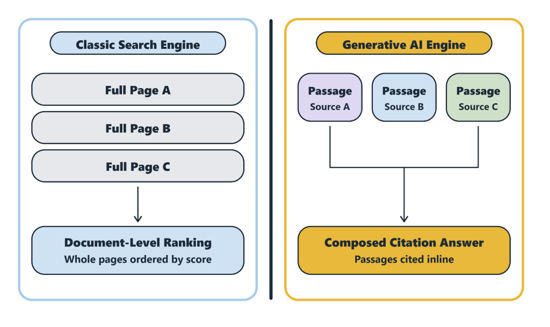
Search engine optimisation (SEO) focuses on ranking pages in classic search results. Success looks like higher positions, more organic sessions and more leads from Google.
Generative engine optimisation (GEO) focuses on being retrieved, quoted and recommended when a generative AI system like ChatGPT or Google AI Overviews composes an answer. The term comes from a 2024 paper presented at KDD, a major data science conference, by researchers from Princeton, Georgia Tech, the Allen Institute for AI and IIT Delhi.
You will also see AEO (answer engine optimisation). It targets direct-answer formats such as Google AI Overviews and voice responses. In practice, AEO and GEO overlap heavily, and many practitioners treat AEO as one part of GEO.
SEO vs GEO: Key Differences
| SEO | GEO | |
| Unit of success | A page ranking for a query | A brand or passage cited or recommended in an answer |
| How content is selected | Ranking algorithm orders pages | AI retrieves passages from several sources and composes one answer |
| Content that works | Pages matched to search intent, with strong links and authority | Direct answers, specific facts, named sources and clear entities |
| Authority signals | Backlinks, relevance, experience and trust | Mentions across the web, consistent brand identity, consensus across sources |
| User behaviour | Click through to a site | Read the answer, and click less often |
| Measurement | Rankings, sessions, conversions | Prompt-level visibility, mention share, AI referrals, branded search |
The first two rows explain most of the confusion. Search engines rank documents, and generative engines assemble answers. There is also no single AI scoreboard that exists. One analysis of matched prompts found that Google AI Mode and AI Overviews share only about 11% of their cited URLs. Your visibility differs by the generative AI engine, and you must test each one.
Benefits of SEO and Benefits of GEO
What SEO delivers:
- Demand at scale: Google handles around 98% of search referrals in India in 2026.
- Compounding returns: Content and authority keep producing traffic without a matching rise in cost.
- Mature measurement: Search Console, GA4 and your CRM tie rankings to leads and revenue.
What GEO delivers:
- Presence while buyers research: People now form shortlists inside AI answers, often before they visit a website.
- Brand authority: Being cited repeatedly across engines signals that independent sources trust you.
Does GEO Replace SEO?
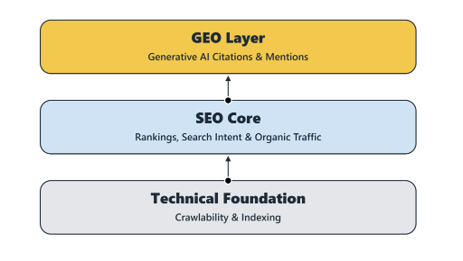
GEO isn’t replacing SEO today, and the reasons are practical.
First, generative engines draw on pages they can find. Google states that for AI features, a page must be indexed and eligible to show a snippet, with no further requirements. Pages that search engines cannot crawl or trust rarely get quoted.
Second, traffic still flows through Google. AI platforms send a small share of visits today (0.3-1.1%). However, the share is growing fast from a low base.
Third, GEO tactics improve good content and cannot rescue weak content. Treat GEO as a layer on top of strong SEO, and expect that layer to grow in importance.
SEO vs GEO: How to Choose the Right Strategy for Your Business
| Business type | Lead with | How much GEO to add |
| Local small business | Local SEO, Google Business Profile, reviews | Light: consistent business details, clear FAQs and service pages |
| Ecommerce or D2C | Category and product page SEO | Moderate: comparison content, review signals, product detail depth, video |
| B2B, SaaS and professional services | SEO and content together | High from day 1: buyers research in AI tools, so original data and expert content matter |
| Publisher or information-led site | SEO plus brand building | High: informational queries show AI Overviews most often, so diversify and build direct audience |
| New website | SEO foundations | Build answer-first structure from the start |
A rule of thumb: the longer and more research-heavy your buying cycle, the earlier GEO should enter the plan. A plumber needs a strong Google Business Profile. A software vendor selling to enterprise buyers needs to be the brand AI tools name when a CTO asks for options.
A Practical SEO and GEO Strategy: What to Do First
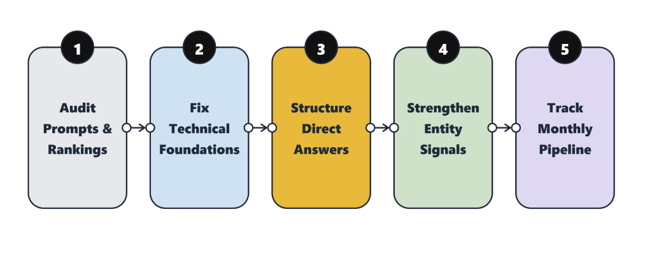
- Audit both channels: Review rankings, indexation and conversions in Google Search Console. Then test 20 to 30 priority prompts across AI Overviews, AI Mode, ChatGPT and Perplexity, and record whether your brand appears and how it is described.
- Fix the foundations: Resolve crawl issues, thin pages, weak internal linking and slow templates. Nothing else works without this.
- Rework priority pages: Lead each section with a direct answer. Add specific statistics with named sources, expert quotations and clear definitions. Add FAQ sections that mirror real questions.
- Strengthen entity and authority signals: Keep company details consistent across your site, Google Business Profile and directories. Add Organization schema, collect reviews and earn mentions through original research and expert commentary.
- Measure monthly: Track SEO through rankings, sessions and leads. Track GEO through citation and mention share, AI referrals in GA4 and branded search growth. Tie both to pipeline.
Mistakes to Avoid in an SEO and GEO Strategy
- Cutting SEO to fund GEO: The foundations that earn citations are SEO assets.
- Buying tools before fixing content: A tracking dashboard does not make a page worth quoting.
- Gaming the answer: Keyword stuffing and thin pages added for AI perform poorly for GEO, and they weaken trust with readers.
- Judging by one prompt: AI answers vary between different runs and engines. Sample widely and over time.
- Optimising for one engine: ChatGPT leads today, and its share is falling. Build content that works across engines.
How SEO and GEO Work Together in Practice
Strong SEO and GEO results come from content that serves both. Coloplast Store India, an online store for ostomy care products, shows what that looks like in the numbers. When Justwords began full SEO and content work in December 2024, organic traffic was 199, with three keywords in the top three positions and no AI Overview appearances. By December 2025, traffic peaked at 16K a month, with 70 keywords in the top three and 13 appearing in AI Overviews. By November 2026, top-three keywords had risen to 93 and AI Overview appearances to 73, while traffic settled at about 10K.
The SEO measures (rankings) and the GEO measures (AI Overview appearances) rose together, even though clicks fell back from their peak. That is why both need tracking side by side. It is also why content, SEO and GEO sit best inside one programme under a single owner, because splitting them across vendors tends to produce duplicate effort and conflicting edits to the same pages.
Choose Based on Where Your Buyers Decide
Ask where your buyers form their shortlist. If they search Google and click through, invest in SEO first and build GEO into your content standards. If they ask AI tools for recommendations before they contact anyone, GEO moves up the list, but it still rests on SEO.
Every quarter you delay a baseline, competitors become the default names in the answers your buyers read. If you want a clear view of both channels and a sequenced plan, our team can start with an audit through our SEO services and GEO services.
FAQs
1. Do I need GEO if I already do SEO?
Yes, GEO is needed as an extension of your SEO. The same pages you have created need clearer answers, specific facts and consistent brand signals. Most of the work builds on existing content, so a separate programme is rarely needed.
2. Is GEO worth it for a small business?
A light version is definitely worth it for small businesses if budget allows. Keep your Google Business Profile complete, collect reviews, publish clear service pages and answer common questions directly. Skip premium GEO packages until your SEO foundations are strong.
3. How do I measure GEO results?
Test a fixed set of priority prompts monthly across AI Overviews, AI Mode, ChatGPT and Perplexity. Record mentions and descriptions, compare against competitors, check AI referrals in GA4 and watch branded search in Search Console.
4. Does ranking on Google help me get cited by AI tools?
Generally, ranking on Google does help get cited by AI tools, because many AI tools retrieve pages from search indexes and prefer trusted sources. AI engines differ, though, and a page can be cited without ranking highly, so test each AI tool separately.
5. What content changes improve GEO?
Direct answers, specific statistics, expert quotations and citations to credible sources improve GEO. Keyword stuffing does not. Make claims specific, sourced and easy to extract.
6. How is GEO different from AEO?
AEO targets direct-answer formats such as AI Overviews and voice results. GEO targets citation and recommendation inside generative AI answers. The work overlaps heavily, and AEO is treated as part of GEO.