To measure AI search visibility, track how often your brand is mentioned and cited in AI answers for a fixed set of buyer questions, how accurately it is described, what traffic and demand follow, and how all of that compares with competitors over time. Five numbers that carry most of the weight include appearance rate, citation share, AI share of voice, AI referral traffic and AI-assisted conversions. Rankings and sessions alone cannot show any of them.
The difficulty is that AI answers are not stable results. The same question can return different brands on different runs. Many answers produce no click at all, and much of the influence shows up later as a branded search or a direct visit. Teams that report from one screenshot or a single vendor score end up with numbers that look precise but don’t mean much.
This guide covers the AI search visibility metrics worth tracking and how to calculate each one, the data sources and tools that produce them, and how to build a report a founder or CMO can act on. It picks up where the baseline step of our AI SEO audit checklist ends.
Why Traditional SEO Metrics Miss AI Search Performance
A keyword ranking is a position. An AI answer is closer to a probability: the same prompt can name different brands from one run to the next. SparkToro’s research found that asking AI tools for brand recommendations repeatedly returned the same list less than once in a hundred tries. A brand that appears in 40% of runs and a brand that appears in 5% can both look present in a single screenshot, which is why rates tell more than snapshots.
Clicks mislead from the other side. SE Ranking’s study of more than 100,000 websites put AI referrals at 0.32% of total traffic in 2026, a 16-fold rise since 2024 but still a sliver. Judge AI visibility by referral traffic alone and you will conclude that nothing is happening, long after buyers have shortlisted your competitors inside an answer.
| Traditional metric | AI search equivalent |
| Keyword ranking | Appearance rate across a fixed prompt set |
| Backlinks and authority | Citation share and source mix |
| Organic sessions | AI referral sessions plus branded search growth |
| Search impressions | Impressions in AI Overviews and AI Mode |
| Organic conversions | AI-assisted conversions, including self-reported |
The AI Search Visibility Metrics Worth Tracking
9 metrics to track AI search visibility can be put into three layers. Start with the first layer and add the others as your reporting matures.
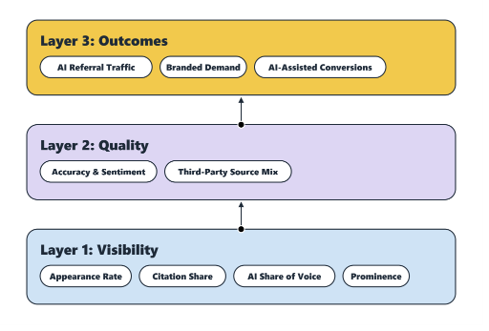
Layer 1: Visibility Metrics
- Appearance rate: Runs in which your brand is mentioned, divided by total runs. Report it by platform and by funnel stage, because a brand can dominate comparison questions and vanish from category ones.
- Citation share: Your cited URLs as a share of all cited URLs across the prompt set. This is the core of AI citation tracking, and it also shows which of your pages the engines trust.
- AI share of voice: Your mentions divided by the mentions of you and your named competitors. It answers the question leadership actually asks: how are we doing against them?
- Prominence: Whether you are named first, recommended, or buried in a list. Frequency matters more than position, so use prominence as a tiebreaker.
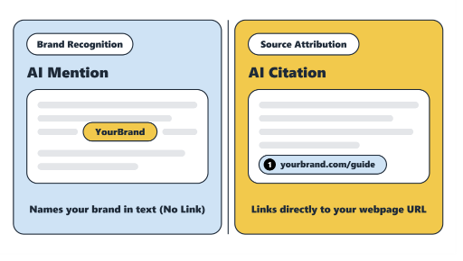
A mention names your brand. A citation links to your page as a source. You can have one without the other, so track both.
Layer 2: Quality Metrics
- Accuracy and sentiment: Check whether the answer gets your pricing, features, locations, and positioning right, and whether the tone is favourable. Wrong facts in AI answers can be fixed, but only if someone is looking for them.
- Source mix: Which sites feed the answers about your category (review platforms, forums, news, or your own pages). It shows where off-site effort will pay back.
Layer 3: Outcome Metrics
- AI referral traffic: Sessions from sources such as chatgpt.com, perplexity.ai, and Gemini. This covers your ChatGPT referral traffic and its equivalents. Treat it as a floor, because some AI visits arrive as direct traffic.
- Branded demand: The trend in branded searches and direct visits. Many buyers meet your name in an AI answer and then search for you.
- AI-assisted conversions: Leads and revenue from AI referral sessions, plus self-reported attribution through a “How did you hear about us?” field and sales call notes.
Build a Prompt Set That Makes the Numbers Meaningful
Every metric above depends on the prompts. Use 30 to 50 questions in your buyers’ own words, split across four types: category questions (such as “best CRM for small manufacturers in India”), comparison questions, problem-led questions, and brand questions. Add Hindi, Hinglish, or regional-language versions if your audience searches that way.
Run each prompt several times per platform, and lock a core set for trend tracking. Add new prompts at each quarterly review instead of swapping old ones out, because a changing set makes every trend line meaningless.
Data Sources and Tools: What Each Can and Cannot Tell You
| Source | What it shows | Limits |
| Dedicated AI visibility tools (Semrush AI Visibility Toolkit, Ahrefs Brand Radar, Peec AI, Profound, Otterly) | Automated prompt runs, mentions, citation share, competitor share of voice | Answers are sampled and simulated; engine coverage and prompt caps vary |
| Google Search Console | Impressions from AI Overviews and AI Mode in a dedicated report, plus branded query trends | The AI report shows impressions only, with no clicks or queries |
| GA4 | AI referral sessions, engagement, and conversions by landing page | Misses AI visits that arrive as direct traffic |
| Server logs or CDN dashboards | AI crawler and fetch activity | Shows access, not visibility |
| CRM and lead forms | Self-reported AI attribution and deal value | Depends on sales discipline |
Entry plans for dedicated tools run from roughly $30 to $200 a month in late 2026, with enterprise platforms priced by quote. Choose your tools based on three things: whether the tool covers the engines your buyers use, whether its prompt limits fit your set, and whether it exports data to your own reports. Our guide to AI tools for SEO covers the wider category, and if you already pay for Semrush or Ahrefs, check their AI modules before adding another tool. Below about 50 prompts, a spreadsheet does the job.
Measure Visibility Separately From Clicks: What Our Client Data Shows
Justwords tracks AI visibility alongside organic results, and the two often move differently. For Coloplast Store India, keywords in Google’s top three rose from 3 to 93 and AI Overview presence from none to 73 between December 2024 and October 2026. Estimated organic visits peaked at 16,246 in December 2025 and sat near 9,900 by October 2026. A traffic-only report would have flagged a decline from the peak, while the visibility metrics show a brand more present in search and AI answers than at the traffic peak.
Likewise, for Autoxperia (a new automotive platform), AI Overview presence went from none on 1 June 2026 to 554 keywords by 6 September. It got cited for queries such as the best mileage scooters in India, which were dominated by long-established players.
What to Put in an AI Visibility Report
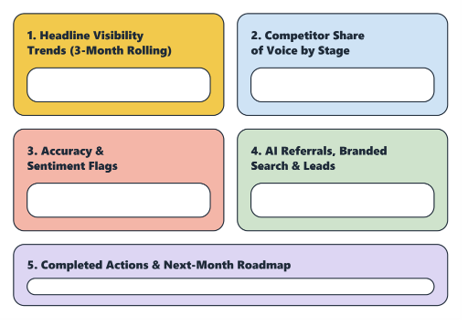
A good AI visibility report answers three questions on one page: are we more visible than last month, are we ahead of competitors, and what is it worth?
- Headline numbers: Appearance rate, citation share and AI share of voice, each with a 3-month trend line.
- Competitor view: Your share against the 2 or 3 closest rivals, split by funnel stage.
- Quality flags: Inaccurate or negative answers found, and what is being done about them.
- Outcomes: AI referral sessions, branded search trend, and AI-assisted leads. Our guide to SEO ROI measurement shows how to connect them to revenue.
- Actions: What was delivered (content, mentions, schema fixes) and what comes next, annotated on the trend lines.
Spot-check weekly, report monthly and re-baseline quarterly. Because answers fluctuate, judge movement on 3-month rolling averages, since a single bad week is noise. If you are hiring an agency, ask to see this report format inside the proposal; our guide on how to evaluate an AI SEO agency lists the other questions worth asking.
Where to Start This Week
Write 30 prompts, run each five times across two or three platforms, and calculate appearance rate and AI share of voice in a spreadsheet. That one afternoon will tell you more than any dashboard demo, and it gives you the baseline every later number needs. Add tools when the spreadsheet becomes the bottleneck, and not before.
Every month without a baseline is a month of trend data you cannot recover later. If you would rather have specialists build and run this system, Justwords’ GEO and AI SEO services include monthly reporting that ties citations and mentions to leads and revenue.
FAQs
1. How do I track ChatGPT referral traffic in GA4?
Create a custom channel group or exploration filter where session source matches chatgpt.com, perplexity, gemini.google, and copilot.microsoft. Treat the total as a minimum, since some AI visits arrive without a referrer and appear as direct traffic.
2. How many prompts do I need to track AI visibility?
Local and small businesses can start with 15 to 20 prompts. Most brands need 30 to 50, and enterprises often track hundreds across markets and product lines. Whatever the size, run each prompt several times before trusting the result.
3. What is the difference between an AI mention and an AI citation?
A mention means the AI names your brand in its answer. A citation means it links to your page as a source. A brand can be mentioned without a link and cited without being named, so track both.
4. Do I need an AI visibility tool?
Not at the start. A spreadsheet handles your first 30 to 50 prompts. Tools become worthwhile when you track multiple platforms, competitors, or markets weekly, because manual runs then take more time than the insights are worth.
5. What is a good AI share of voice?
No universal benchmark exists, because it depends on your category and prompt set. Compare yourself with your two or three closest competitors and watch the three-month trend instead of chasing a fixed percentage.