To get cited in ChatGPT and Google AI Overviews, you need four things: pages that AI crawlers can access, direct answers placed near the top of each page, original evidence that other sources lack, and brand signals that confirm you are a trusted source. No tag, file or trick replaces these. Neither OpenAI nor Google lists any special markup as a requirement for appearing in its AI search features.
Getting cited in ChatGPT and Google AI Overviews has become crucial for Indian businesses. Sam Altman said in February 2026 that India had 100 million weekly active ChatGPT users, and OpenAI’s India managing director said on 3 November 2026 that India had become ChatGPT’s largest market by weekly active users, with its base doubling since January. Google still handled 97.76% of search referrals in India in August 2026, according to StatCounter. Your buyers now use both, and each one picks its sources differently.
In this article, we give you 6 steps to get cited in ChatGPT and AI Overviews, a comparison of how the two work, the mistakes that waste effort and a way to track results.
Key Takeaways
- Allow OAI-SearchBot so ChatGPT search can use your pages. Make sure Google can index them and show snippets, which is the entry ticket for AI Overviews.
- Put the direct answer early. A study of 18,012 verified ChatGPT citations found 44.2% came from the first 30% of a page.
- Add original data, named sources and expert input. Research behind GEO found these raised visibility, while keyword stuffing did not.
- Each AI engine favours different sources, so test ChatGPT, AI Overviews and Perplexity separately.
- Track ChatGPT visits through the utm_source=chatgpt.com tag in GA4, and track mentions with a fixed monthly set of prompts.
How ChatGPT Search and Google AI Overviews Choose Sources
Both ChatGPT and Google AI Overviews share a goal, which is to answer a question with a few trustworthy sources. However, they differ in how they choose those sources.
| ChatGPT search | Google AI Overviews | |
| Crawler access | OAI-SearchBot surfaces sites in ChatGPT search. Sites that have opted out will not show in answers, though they can appear as navigational links. | Googlebot. A page must be indexed and eligible to show a snippet. |
| Where sources come from | OpenAI’s own crawler, as well as URLs obtained from third-party search providers. | Google’s index and ranking systems. |
| Special markup needed | None. OpenAI says any public website can appear. | None. Google lists no additional requirements. |
| How to track | Referral visits carry utm_source=chatgpt.com in GA4. | AI feature appearances are counted in the Web search type in Search Console. |
Step 1: Make Your Pages Accessible to AI Crawlers
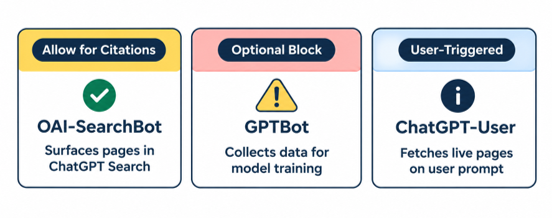
Citation starts with access. Three OpenAI crawlers matter, and OpenAI treats each setting as independent.
- OAI-SearchBot surfaces websites in ChatGPT search. Allow it if you want to appear.
- GPTBot collects content that may be used to train models. Blocking it does not remove you from ChatGPT search.
- ChatGPT-User fetches pages when a person asks ChatGPT to, and robots.txt rules may not apply to it.
A robots.txt that allows search and blocks training looks like this:
User-agent: OAI-SearchBot
Allow: /
User-agent: GPTBot
Disallow: /
Whether to block GPTBot is a business decision for your legal and content teams. In ChatGPT, robots.txt changes can take about 24 hours to affect search results. Also check that your firewall or CDN is not challenging legitimate bots, since robots.txt permission means little if a security rule blocks the request.
For Google, confirm that key pages are indexed and carry no nosnippet directive. Because ChatGPT can draw on third-party search providers, also confirm your pages are indexed across major search engines, including Bing through Bing Webmaster Tools. Fast pages help too, so review your Core Web Vitals.
Step 2: Put the Direct Answer First
AI systems pull passages, and they pull them from the top. Growth Memo’s analysis of 18,012 verified ChatGPT citations found 44.2% came from the first 30% of the cited pages, 31.1% from the middle and only a small share from the last tenth. The pattern, however, varies by topic, so treat it as a strong tendency and not a rule.
Apply it in three ways:
- Lead with the answer: Open each page and each section with a two to three sentence answer to the question in the heading.
- Use question-style headings: “How much does X cost in India?” tells an AI system what the passage answers. This is a core habit of answer engine optimisation.
- Define terms in plain language: One clear definition sentence is easier to quote than a paragraph that circles the point.
A weak opening says, “In today’s fast-moving digital world, businesses are asking about SEO costs.” A citable opening says, “SEO in India typically costs ₹50,000 to ₹1,50,000 per month, depending on competition and scope.” The second one can be lifted whole and still make sense.
Step 3: Add Original Evidence AI Cannot Get Elsewhere
An AI answer can restate generic advice without your help. But it needs a reason to cite you. The 2024 GEO research paper, from Princeton, Georgia Tech, the Allen Institute for AI and IIT Delhi, found that adding statistics, quotations and citations to credible sources raised visibility in generated answers by up to about 40% in its tests, while keyword stuffing showed no benefit.
Start building evidence into your pages. Add:
- Specific numbers with named sources, including India-specific data where it exists.
- Original data, such as survey results, benchmarks or findings from your own work.
- Expert input, with named authors and credentials.
- Real case results, with dates and metrics.
Step 4: Cover the Whole Topic, Not One Keyword
When a person asks a question, AI search often breaks it into related sub-questions and assembles one answer. A page can earn a citation for a sub-question even if it does not rank first for the main phrase.
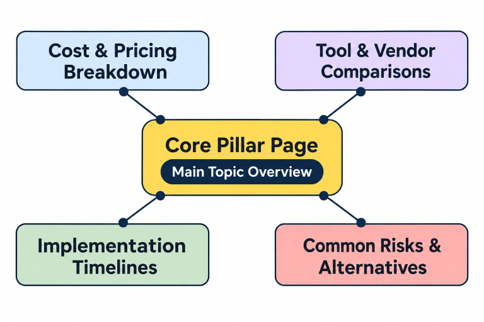
Map the questions and keywords around each target topic, such as, costs, comparisons, risks, timelines and alternatives. Then build a connected cluster of pages to build topical authority, each answering one question well so that pages avoid keyword cannibalisation, with links between them. This approach also strengthens your position in traditional search, and it gives AI systems several chances to find a passage worth citing.
Step 5: Build Brand and Third-Party Signals
AI systems favour sources that others also trust. Branded web mentions correlated strongly with AI Overview visibility in an Ahrefs study of 75,000 brands.
Strengthen these signals:
- Consistency: Keep your company name, description and profiles the same across your site, Google Business Profile, LinkedIn and directories.
- Reviews and mentions: Earn them on credible third-party sites, including review platforms and industry publications.
- Presence where AI engines look: YouTube and community platforms such as Reddit and Quora feature heavily in AI citations, so contribute useful answers there with your affiliation disclosed.
- Original research: A data report that others quote earns mentions that no amount of self-promotion can match.
Step 6: Keep Content Fresh and Track Citations
AI answers need current facts, and an outdated page risks being skipped or quoted wrongly. Refresh statistics, dates, prices and examples on your priority pages on a regular schedule, and show the updated date.
Then measure. Keep a fixed list of 20 to 30 priority prompts and test them monthly in ChatGPT, Google AI Overviews, Google AI Mode and Perplexity. Record whether your brand appears, how it is described and which competitors are named. Several AI tools for SEO can automate this testing. In GA4, filter referral traffic by the chatgpt.com source to see visits ChatGPT sends, and use Search Console to watch impressions and clicks on queries where AI Overviews appear.
Remember that a citation is a mention and not a recommendation. Check how the answer describes you, since an AI answer can cite your page and still favour a competitor.
Common Mistakes That Waste Effort
- Chasing a secret trick: Special files and markup are not requirements. Spend the effort on access, answers and evidence.
- Blocking the wrong bot: Disallowing OAI-SearchBot keeps you out of ChatGPT search answers, and blocking only GPTBot does not.
- Burying the answer: A long introduction pushes the useful passage into the part of the page that attracts fewer citations.
- Faking authority: Paid mentions, fake reviews and spammy community posts risk penalties and rarely carry weight.
- Optimising for one engine: Citation sources differ by platform, so a single-platform plan leaves gaps.
What This Looks Like in Practice
Coloplast Store India, an online store for ostomy care products, shows how steady SEO and content work shows up in AI Overviews. When Justwords began full SEO and content work in December 2024, the site had three keywords in the top 3 positions and no AI Overview appearances. By December 2025 it had 70 top-three keywords and 13 AI Overview appearances. By November 2026, the totals were 93 top-three keywords and 73 AI Overview appearances. Every piece went through the client’s clinical review, so accuracy and sourcing carried as much weight as ranking.
The same principle applies to your own site. Content built around real buyer questions, written with evidence and reviewed for accuracy gives AI systems material worth quoting.
What Next: Start With Your Ten Most Valuable Pages
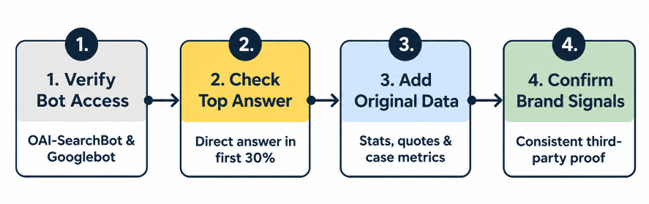
Pick the 10 pages closest to revenue. For each one, check four things: can OAI-SearchBot and Googlebot reach it, does the answer appear in the first few sentences, does it carry original evidence and does a third party confirm your claims. Fix the gaps in that order, then test your priority prompts again next month.
If you want that audit done across your whole site, our team can run it as part of our AI SEO services, and tie the results to your leads.
FAQs
1. Do I need to allow OAI-SearchBot to appear in ChatGPT search?
Yes. OpenAI recommends allowing OAI-SearchBot in robots.txt. Sites that opt out will not be shown in ChatGPT search answers, although they can still appear as navigational links.
2. Does blocking GPTBot remove my site from ChatGPT?
No. GPTBot is used for training data collection, and OpenAI treats its settings independently of OAI-SearchBot. You can allow search visibility and block training if you choose.
3. How do I track visits from ChatGPT?
OpenAI adds utm_source=chatgpt.com to referral URLs from ChatGPT search. Filter for that source in GA4 to see sessions and conversions from ChatGPT citations.
4 Is getting cited in AI Overviews different from ChatGPT?
Yes. AI Overviews draw on Google’s index and require a page to be indexed and snippet-eligible. ChatGPT search uses OpenAI’s crawler and may use third-party search providers, so test each separately.
5. Does structured data help me get cited?
Neither Google nor OpenAI lists structured data as a requirement. It can clarify details such as your organisation and FAQs. So use it where it matches visible content, and focus first on answers and evidence.
6. Can anyone guarantee a ChatGPT citation?
No. Citations depend on the question, the competing sources and the engine’s own selection, and they change between runs. Judge any provider on method and measured visibility, never on promises.