An ecommerce content marketing agency plans, creates, optimises and measures content across the full buyer journey. This ranges from the SEO blog post that first surfaces your brand in search to the category page that ranks for commercial queries to the product copy that closes the sale. The objective is building an organic growth system that reduces dependence on paid acquisition and compounds in value over time.
A good ecommerce content marketing agency goes beyond content production. It builds the SEO architecture, content strategy, internal linking, conversion pathways, and measurement framework that allow an ecommerce brand to grow organic revenue over time.
In this guide, we explain what an ecommerce content marketing agency actually does, when your business should consider hiring one, what separates a strategic agency from a content production service, and how to evaluate potential partners.
Quick Overview
|
What Does Ecommerce Content Marketing Involve and Where Does an Agency Fit In?
Before evaluating an ecommerce content marketing agency, it helps to understand what the agency is actually being hired to manage. Ecommerce content marketing is not merely a monthly blog schedule. It is a full-funnel content architecture across five distinct layers, each targeting a different buyer and a different stage of the purchase journey.
An ecommerce content marketing agency brings these layers together into one strategy, deciding what content to create, where it should live, how different assets should connect, how each piece of content should support the buyer journey, and how performance should be measured. The work is therefore not just content production; it is the planning, execution and optimisation of the organic growth system around that content.
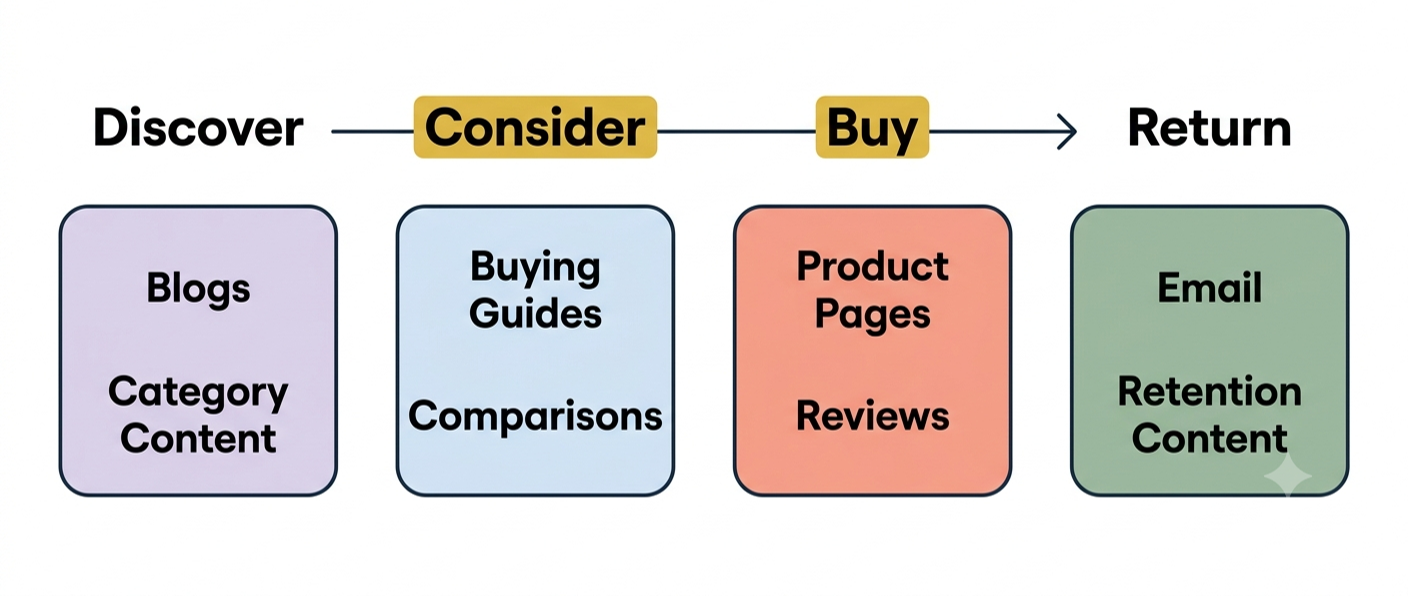
Here are the five layers an ecommerce content marketing agency typically works across:
Layer 1: Awareness content (top-of-funnel blog and editorial)
These are the articles and guides that capture buyers before they know your brand exists. “Best running shoes under ₹5,000,” “how to choose a skincare routine for oily skin in Indian summers,” “complete guide to air purifiers India.” The reader is not looking for your brand. They are looking for an answer. Your content gives it to them, and your brand earns the first touchpoint.
This layer is where most brands start and stop. They publish a few blogs, see no immediate sales, and conclude that content doesn’t work. What they have actually done is build the first room of a house and declared it uninhabitable.
Layer 2: Category page content (the highest-value, most underoptimised asset in ecommerce)
Optimised category pages can drive up to 70% of an ecommerce site’s organic visits. Yet most Indian ecommerce brands have category pages with either no copy at all, or a single boilerplate paragraph stuffed with keywords that reads like it was written by a machine 10 years ago.
A well-structured category page with a genuinely useful buying-guide introduction, internal links to relevant subcategories and top products, FAQ schema that addresses common purchase hesitations, and keyword-mapped copy that helps visitors decide is one of the highest-leverage SEO investments in ecommerce. It ranks for broad, high-volume category keywords and converts the traffic that arrives because the page is built for decision-making.
Layer 3: Product description optimisation
The average Indian ecommerce site uses manufacturer-supplied product descriptions that are word-for-word identical to twenty competitor sites. Google knows this. Readers feel it immediately because manufacturer copy is written to describe a product rather than help a buyer decide.
Ecommerce content that converts does the opposite. It speaks to the buyer’s specific concern (e.g., “ideal for medium-density hair,” “works in Indian humidity,” “fits standard 5-gallon geysers”), pre-empts objections, and creates the sense that someone who understands the product has genuinely explained it. This is the real conversion infrastructure.
Layer 4: Consideration content (comparison pages, buying guides, and “vs” content)
Searches like “Whirlpool vs Samsung washing machine India,” “best laptop for college students under ₹60,000 2026,” “inverter AC vs non-inverter AC: which one is better for Mumbai?” are mid-funnel searches by buyers who have already decided to buy. They are deciding between options. If your brand or your product is not present in this conversation (either by being recommended or by hosting the comparison itself), you have been eliminated from consideration before the buyer even reaches your site.
An ecommerce content marketing agency builds this layer deliberately. It identifies the high-intent comparison and decision-stage queries your buyers actually search, and creates content that positions your products within those conversations.
Layer 5: Post-purchase and retention content
The cheapest customer to acquire is the one you already have. Onboarding sequences, usage guides, care instructions, complementary product recommendations, and re-engagement email content are all content marketing. And in India’s D2C ecommerce market, where LTV is often the difference between a profitable and unprofitable brand, this layer is consistently underbuilt.
The important point is that an agency’s role is not to produce all five layers simply because they exist. It is to determine which layers matter most for a particular ecommerce business, how they should work together, and where content investment is most likely to contribute to organic growth and revenue.
Why Most Ecommerce Brands Get Content Marketing Wrong
Most Indian ecommerce brands have not built an organic growth system. And it is costing them more than they realise.
The typical playbook goes like spend heavily on Meta and Google ads, keep the CAC manageable, scale what works, and think of content later. The problem is that “later” never comes because ad spend keeps rising, margins keep compressing, and content becomes a recurring budget casualty.
Meanwhile, organic search accounts for 43% of ecommerce website traffic and over 23% of all online orders, without a single rupee of ongoing spend once the content ranks. Before purchasing, most consumers today search Google to research products. If your brand is absent from those research-phase searches (e.g., buying guides, category comparisons, “best X for Y” queries), a competitor with a content strategy is capturing that intent. They are earning the consideration your retargeting ads are trying to buy back at a higher cost.
The challenge is even greater in India, where festive shopping periods, regional-language preferences and the rapid growth of Tier-2 and Tier-3 ecommerce audiences create additional search opportunities. A content strategy that ignores these behaviours can miss some of the highest-intent opportunities in the market.
That is the structural problem an ecommerce content marketing agency is built to solve.
What Should an Ecommerce Content Marketing Agency Deliver?
The deliverable should be a connected organic growth system. At a minimum, an ecommerce content marketing agency should deliver:
- A content strategy mapped to business goals: The agency should identify which products, categories, audiences, and commercial priorities deserve content investment rather than simply generating a list of keywords.
- Search and buyer-intent research: Content should be built around what prospective customers actually search at different stages of the buying journey, from informational queries to category, comparison, and product-level searches.
- Content across the ecommerce funnel: This includes blogs and editorial content, category page copy, product descriptions, buying guides, comparison pages, FAQs, and retention content, with each content format serving a specific purpose.
- Ecommerce SEO architecture: The agency should connect these assets through keyword mapping, internal linking, topic clusters, category and product page optimisation, structured data where appropriate, and clear conversion pathways.
- Content production and editorial quality control: Writers should understand the category and buyer, while editors and subject matter experts ensure accuracy, usefulness, brand consistency, and originality.
- Performance measurement and optimisation: The agency should monitor rankings and organic traffic, but also go further into conversions, assisted conversions, revenue contribution, content-level performance, and opportunities for optimisation.
What Separates a Good Ecommerce Content Marketing Agency from a Mediocre One
- They connect content to revenue, not just traffic: A good ecommerce content marketing agency can show you (with specific data) which content piece drove which assisted conversion, which category page drove the most organic revenue, and which blog topic generates traffic but does not convert. If your agency’s monthly report only shows impressions, clicks, and keyword rankings but cannot connect content activity to revenue, they are measuring the wrong things.
- They understand ecommerce SEO architecture: Content for ecommerce is not standalone articles. It is an interconnected system with blogs linking to category pages, category pages linking to products, products linking to buying guides and FAQs, and buying guides capturing email leads. An agency that produces content without building this architecture is creating disconnected assets that individually underperform against a competitor who has built the system.
- They know when not to produce content: More content is not always better. An ecommerce site with 400 thin blog posts that rank for nothing is worse than one with 80 strategically chosen content pieces that own their topic cluster. A good agency will tell you which content to prune, redirect, or consolidate rather than just tell you what to create next.
- They operate across the full content lifecycle: Strategy, keyword research, writing, SEO, publishing, internal linking, performance analysis, and iteration.
Also Read: 10 Common Content Marketing Mistakes to Avoid in 2026 (+ Fixes)
Should You Actually Hire an Ecommerce Content Marketing Agency?
An ecommerce content marketing agency is worth considering when organic search is important to your growth, but your internal team lacks the specialist expertise or capacity to build and manage the system consistently.
You should consider hiring one if your paid acquisition costs are rising, organic traffic is underperforming, your category and product pages are not generating enough search visibility, or your existing content generates traffic without translating into revenue.
You may not need an agency if you already have a strong internal ecommerce SEO and content team with the capacity to handle strategy, production, optimisation and measurement.
The key question is not whether you can produce content in-house. It is whether you can build and continuously optimise an organic growth system in-house.
What to Look for When Choosing an Ecommerce Content Marketing Agency in India
If you are evaluating agencies, these are the questions that reveal actual capability:
- Ask for an ecommerce-specific portfolio: This doesn’t mean general content marketing portfolio. Category pages, product copy, buying guide content, comparison articles. Each requires different skills and a different understanding of buyer psychology.
- Ask how they measure content performance: If the answer is just keyword rankings, push further. Do they track assisted conversions? Revenue from organic? Time-on-page on product description pages? Conversion rate lift from copy changes? The answers tell you whether they think in content or in outcomes.
- Ask what they would not do for your store: An agency that recommends everything is selling, not advising. The agencies worth hiring will look at your current setup and tell you what is working, what to stop, and what the priority sequence should be before they tell you what to produce.
- Ask about their India-specific ecommerce experience: Platform nuances (Shopify, Magento, WooCommerce, custom storefronts), festive season strategy, regional language content, D2C vs marketplace content are some India-specific complexities that generic agencies handle poorly. An agency with genuine experience in the Indian ecommerce market will have clear opinions on these questions.
The right agency will not pitch a content calendar in the first meeting. It will ask about your buyer, your margins, your existing content, your highest-converting product lines, and what is currently not working. Strategy would come before execution. And that sequencing is what creates the difference between an organic growth partner and a publishing service.
What This Looks Like in Practice
The difference between producing ecommerce content and building an organic growth system becomes clearer when you look at what happens on a real ecommerce site. We have seen this consistently across the ecommerce and D2C mandates we manage at Justwords.
Asian Footwears is a good example of what a strategic ecommerce content approach can deliver. When Justwords worked with the brand, we addressed technical SEO issues alongside keyword targeting, category and product content, internal linking and content architecture, rather than treating content as a standalone activity. The result was a 378.8% increase in organic purchases between December 2024 and December 2025, with organic revenue reaching ₹50.28 lakh in December 2025. The takeaway is simple: ecommerce content performs best when it is connected to the wider SEO architecture and measured against business outcomes.
Shiprocket, one of India’s largest logistics and ecommerce enablement platforms, is another such example. The brand came with a challenge that is common among fast-scaling ecommerce brands: high content volume requirements across multiple product verticals, a diverse audience ranging from first-generation Tier-2 sellers to sophisticated D2C brands, and a need for content that could simultaneously build topical authority and serve readers who were at very different stages of their business journey. The strategy was built around search intent before anything else. Problem-first framing rather than product-first. Plain language for first-generation sellers, more technical depth for experienced operators. Strict brand consistency across 10+ product verticals at 120 content pieces per month. The result was 40% year-on-year blog traffic growth, sustained over nearly four years. That kind of compounding does not happen through volume. It happens through architecture that is built on the right content, mapped to the right intent, published with the right structure and internal linking to build authority that accumulates over time.
Also Read: 10 Best Content Marketing Examples to Inspire Your Strategy
Conclusion
The ecommerce brands in India compounding organic revenue right now are those that treated content as a long-term business asset, investing consistently in a strategy that maps to how their buyers actually research, compare, and decide.
A content-first approach to ecommerce marketing does not produce results in weeks. It builds an organic growth engine that reduces CAC over time, compounds authority with every piece of content published, and creates qualified traffic that paid acquisition cannot sustain at equivalent cost.
An ecommerce content marketing agency worth working with owns the strategy, executes the production, optimises the architecture, and measures outcomes in revenue terms. If your current growth depends entirely on paid acquisition, the asset you are not building is the one your competitors will eventually use to outrank and outlast you.
FAQs
1. What does an ecommerce content marketing agency do?
It builds and executes a full-funnel content strategy for online stores, covering blog and editorial content, category page copy, product descriptions, comparison and buying guide content, and post-purchase retention content, all mapped to buyer intent and revenue outcomes.
2. Why does an ecommerce store need a content marketing agency?
Because 43% of ecommerce traffic comes from organic search and 23.6% of all ecommerce orders originate there without ongoing ad spend. A content marketing agency builds the organic infrastructure that compounds over time, reducing dependence on paid acquisition.
3. What type of content drives ecommerce conversions?
Consideration-stage content (buying guides, comparison pages, “best X for Y” articles) has the highest conversion proximity. Category page content drives the most organic traffic volume. Product descriptions close or lose the sale once the buyer arrives. All three must work together.
4. How do I evaluate an ecommerce content marketing agency?
Ask for ecommerce-specific portfolio work, ask how they connect content to revenue (not just traffic), ask what they would not do for your store, and ask about India-specific ecommerce experience. The quality of their answers is the real indicator.
5. Is content marketing cost-effective for ecommerce compared to paid ads?
Yes, and increasingly so. Paid search costs are rising year-on-year while organic traffic compounds at no incremental cost per click once established. Content marketing typically costs more upfront and less over time; paid acquisition costs more over time with no residual asset.
6. What makes an ecommerce content strategy India-specific?
Indian ecommerce buyers are highly research-intensive, festive seasons drive disproportionate revenue requiring advance content preparation, Tier-2 and Tier-3 buyers increasingly prefer regional language content, and platform dynamics across Shopify, custom storefronts, and marketplaces all create India-specific content requirements.