
How to Create Content Marketing Strategy for Web: Use these 8 Main Steps

Table of Contents

Creating more content isn’t the hard part. Creating content that consistently brings in traffic, leads, and customers is.

The difference is strategy.

Many businesses publish blogs, videos, newsletters, and social media posts regularly. But each piece is planned on its own, without a clear goal or a bigger plan. As a result, they end up with a lot of content but very little business impact.

A content marketing strategy helps you avoid that. It gives you a clear direction on who you are creating content for, what topics to focus on, which channels to use, and how each piece of content supports your business goals. It also helps you measure what is working so you can improve over time.

At Justwords, we have been building content strategies for businesses across B2B and B2C industries for more than a decade. While every business needs a strategy tailored to its goals, the process of building one is surprisingly straightforward.

In this guide, we have broken that process down into 8 practical steps. So, if you are creating your first content strategy or even improving an existing one, this framework will help you build a plan that is clear, realistic, and focused on results.

Let’s get started.

Creating more content isn’t the hard part. Creating content that consistently brings in traffic, leads, and customers is.
The difference is strategy.
Many businesses publish blogs, videos, newsletters, and social media posts regularly. But each piece is planned on its own, without a clear goal or a bigger plan. As a result, they end up with a lot of content but very little business impact.
A content marketing strategy helps you avoid that. It gives you a clear direction on who you are creating content for, what topics to focus on, which channels to use, and how each piece of content supports your business goals. It also helps you measure what is working so you can improve over time.
At Justwords, we have been building content strategies for businesses across B2B and B2C industries for more than a decade. While every business needs a strategy tailored to its goals, the process of building one is surprisingly straightforward.
In this guide, we have broken that process down into 8 practical steps. So, if you are creating your first content strategy or even improving an existing one, this framework will help you build a plan that is clear, realistic, and focused on results.
Let’s get started.
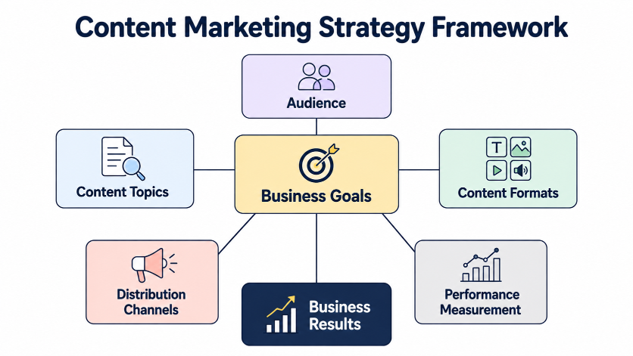
Alt Text: Content marketing strategy framework showing how goals, audience, content, distribution, and measurement work together to drive business results.

Key Takeaways
●	Turn business goals into a content strategy by aligning every piece of content with audience needs, search intent, and funnel stage.
●	Find content opportunities using competitor keyword gaps, CPC data, AI Overviews, and real customer questions.
●	Build a workflow that covers planning, publishing, repurposing, and distribution so content keeps generating value after it goes live.
●	Measure success with the right KPIs and quarterly content audits to improve existing content instead of constantly creating new pieces.

What Is a Content Marketing Strategy?
A content marketing strategy is a documented plan that answers 5 questions:
●	Why are you creating content? (Your goals)
●	Who are you creating it for? (Your audience)
●	What are you creating? (Formats and topics)
●	Where will it be published and distributed? (Channels)
●	How will you measure whether it is working? (KPIs)
Without clear answers to all five, you are not doing content marketing. You are just publishing.
A content strategy is not the same as a content calendar. A calendar tells you when things go live. A strategy tells you why they should exist at all, who they are for, and what you expect them to do for the business. The calendar is an output of the strategy, not a substitute for it.
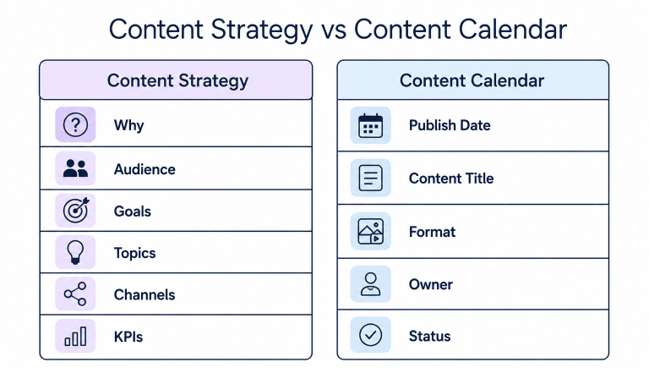
Alt Text: Comparison of a content marketing strategy and a content calendar, highlighting goals, audience, channels, KPIs, and publishing schedule.

Why a Documented Content Strategy Is Non-Negotiable Now
Among B2B marketers who rate their strategy as moderately effective or worse, 42% attribute that in part to a lack of clear goals (Content Marketing Institute). The second most common reason for underperformance is a lack of resources, but the third is almost always the absence of a documented plan that connects content output to business outcomes.
Brands with a documented distribution strategy are 3 times more likely to see strong results than those that just publish without a plan.
In 2026, the case for documentation is even stronger than it was three years ago. AI-generated content has made the internet significantly noisier. Teams seeing the most consistent results are also the ones that are tracking outcomes. 
81% of B2B marketers say measuring content performance is a top priority, with traffic, bounce rates, and return visits guiding future content decisions. Without a documented strategy, there is nothing to measure against, and nothing to improve.
At Justwords, almost every client that comes to us having already tried content marketing without results has the same story: they published consistently for a few months, saw limited traction, and stopped. 
In most cases, the problem was the absence of a strategy. No defined audience, no keyword research, no distribution plan, no measurement. The content existed but had no system behind it.

The 8-Step Content Marketing Strategy Framework
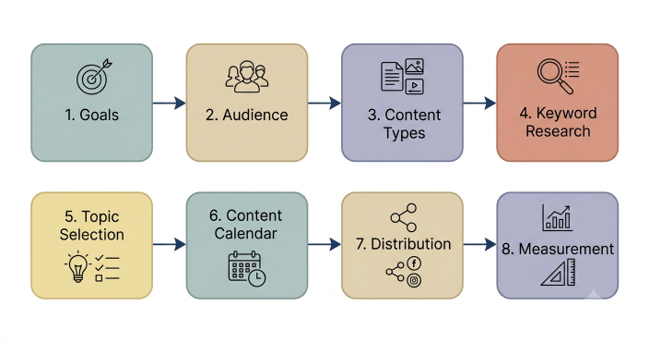
Alt Text: 8-step content marketing strategy framework covering goals, audience, content types, keyword research, topic selection, content calendar, distribution, and measurement.

Step 1: Define Your Goals
Goal-setting does not have to be complicated. What matters is that your goals are specific, measurable, and tied to a real business outcome.
Usually marketers measure the effectiveness of their content marketing strategy through sales. And that is the right instinct. Every content goal should trace back to a business result (traffic, leads, conversions, or revenue) even when the content itself is awareness-focused.
Use the SMART framework to build your goals:
●	Specific: Narrow enough that you know exactly what you are aiming for.
●	Measurable: Attached to a number you can track.
●	Actionable: Achievable with the resources you have or plan to have.
●	Relevant: Connected to actual business priorities.
●	Time-bound: With a clear deadline.
Examples of well-formed content marketing goals:
●	Grow organic website traffic by 40% in 6 months.
●	Generate 50 qualified inbound leads per month from blog content by Q4.
●	Rank in the top 3 positions for 10 high-priority keywords within 12 months.
●	Reduce paid acquisition cost by building organic conversion-focused content over 18 months.
One goal per campaign phase is enough. Trying to achieve brand awareness, lead generation, and retention simultaneously with the same content, without clearly distinguishing them, leads to content that does none of those things particularly well.

Step 2: Define Your Target Audience
Content that tries to speak to everyone speaks to no one. The sharper your audience definition, the more directly useful your content becomes and directly useful content is what earns traffic, trust, and conversions.
If you do not yet have a clearly defined audience, build a buyer persona (a detailed description of the type of person most likely to buy from you). Go beyond demographics. Include their challenges, their information consumption habits, their preferred channels, and most crucially what they are trying to achieve when they search for content in your category.
A practical buyer persona template:
Attribute	Description
Age/role	e.g. Marketing manager, 32–45
Industry/context	e.g. B2B SaaS, 50–200 employees
Primary challenge	e.g. Not generating enough qualified inbound leads
Goal	e.g. Build a content programme that reduces dependence on paid
Content consumed	e.g. Long-form blog posts, LinkedIn, industry newsletters
Preferred channels	e.g. Google, LinkedIn, email
What they distrust	e.g. Generic advice, agencies that do not understand their sector
The buyer persona is a content brief that applies to every piece you create. Every topic, every format, every headline should be filtered through the question: does this serve the specific person described here?
What we have seen at Justwords is that the most useful buyer personas are built from real conversations. Talk to your sales team about the questions they hear most in initial calls. Talk to existing clients about what they were searching for before they found you. That intelligence is worth more than any demographic profile.

Step 3: Decide What Type of Content to Create
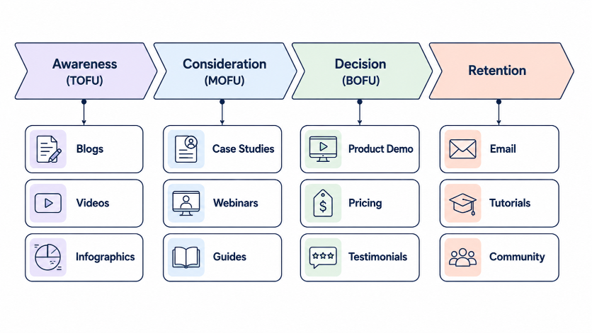
Alt Text: Content types mapped across the buyer journey from awareness and consideration to decision and customer retention. 

Once you know your audience and your goals, you can make an informed decision about which content formats to invest in. This decision should be driven by three factors:
1.	Where your audience is in the buyer journey: Different stages require different content types. Awareness content (informational blog posts, short-form video, infographics) serves people who are just beginning to research a problem. Consideration content (case studies, comparison guides, webinars) serves people evaluating options. Decision content (testimonials, pricing pages, product demos) serves people ready to buy.
2.	What your audience prefers: B2C content marketers primarily invest in social media and community building, with other important areas including content quality improvement, audience research, video content, and SEO. B2B audiences, by contrast, tend to respond to long-form written content, research reports, and case studies. So, always know which camp your audience sits in.
3.	What you can create consistently at quality: A video strategy that you can only sustain for two months is worse than a blogging strategy you can sustain for two years. Choose content formats based on realistic resource availability, not aspirational ambition.
Matching content types to funnel stages:
Funnel Stage	Goal	Content Types
Awareness (TOFU)
Discovery and education	Blog posts, infographics, short-form video, podcasts
Consideration (MOFU)
Evaluation and comparison	Case studies, long-form guides, webinars, white papers
Decision (BOFU)
Conversion	Testimonials, product demos, pricing pages, comparison pages
Retention	Loyalty and repeat purchase	Email newsletters, tutorials, community content

Step 4: Do Your Keyword and Topic Research
This is where strategy becomes executable. Keyword research identifies what your audience is actively searching for, which is the only sustainable basis for a content programme that drives organic traffic.
The goal is to find keywords with meaningful search volume, manageable difficulty for your current domain authority, and clear intent alignment with your content goals. Here is the research process we use:
1.	Start with competitor analysis: Enter your top three to five competitors into a keyword tool (Ahrefs, Semrush, or Moz) and review the keywords they rank for. Identify gaps (keywords competitors rank for that you do not). These are your highest-priority opportunities.
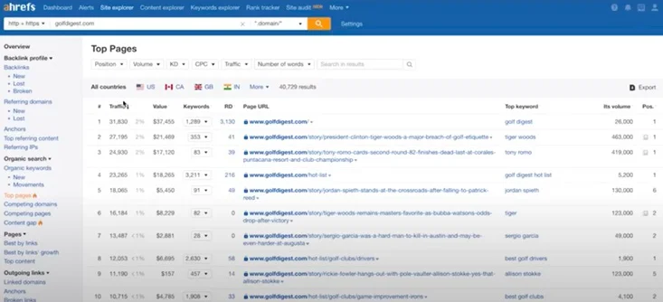
Alt Text: Ahrefs Site Explorer showing the organic keywords a competitor ranks for to identify content opportunities.

2.	Find low-competition, high-intent keywords: Look specifically for keywords with reasonable search volume and a difficulty score achievable at your current authority level. Long-tail keywords (3–5 words, specific intent) are consistently undervalued and overperform for conversion.
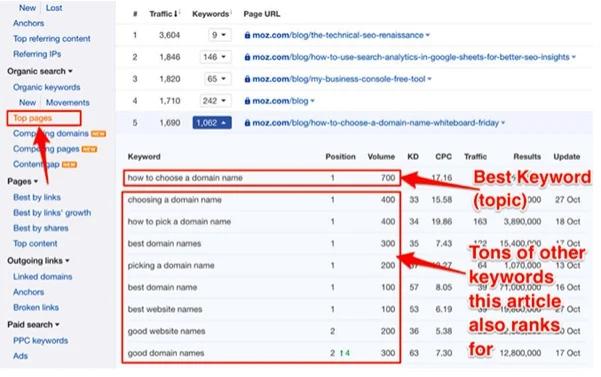
Alt Text: Ahrefs Top Pages dashboard showing the highest-performing pages on a competitor's website based on estimated organic traffic.

3.	Target CPC keywords for BOFU content: Keywords that competitors are bidding on in paid search are high-intent terms with proven commercial value. If you can rank organically for these terms, you capture qualified traffic without ongoing ad spend.
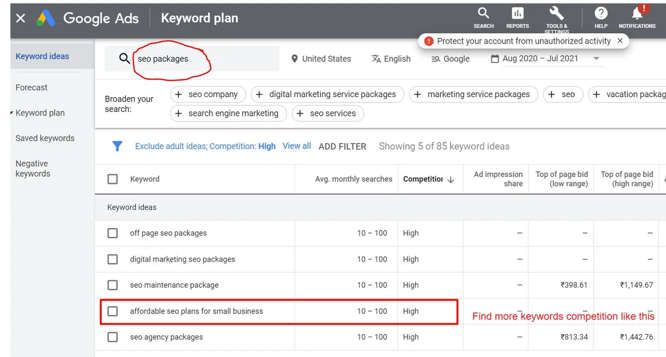
Alt Text: Google Ads Keyword Planner displaying keyword ideas, search volume, competition, and bid estimates for content planning.

4.	Find AI Overviews opportunities: Check which SERP features your competitors own (e.g., AI Overviews, People Also Ask boxes). These placements are winnable regardless of your overall domain authority if your content directly answers the query in the right format.
5.	Fill your content gap: Use Ahrefs’ Content Gap tool (Site Explorer → your domain → Content Gap → add competitor domains) to find keywords they rank for that you have no content covering. These are your most direct organic growth opportunities.
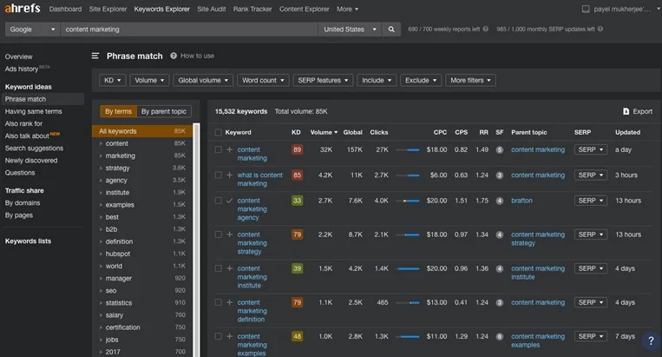
Alt Text: Ahrefs keyword research dashboard showing search volume, keyword difficulty, and other data.

6.	Mine communities for real audience language: Quora, Reddit, and industry forums reveal exactly how your audience articulates their problems. Learn the language that keyword tools miss but creates genuinely resonant content titles.
7.	Refurbish before you create new: Before building new content, audit what already exists. Blog posts that ranked previously but have lost traffic often recover faster with an update and re-optimisation than a new post on the same topic would. Updating old blog posts with new statistics and examples improved traffic by 35% in documented cases. Your existing content library is an underused asset.
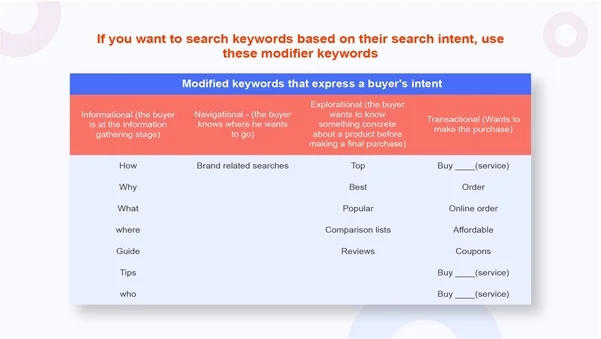
Alt Text: Examples of keyword modifiers such as best, how to, vs, buy, and pricing used to target different search intent.

Step 5: Choose the Right Topics
Keywords give you the raw material. Topics are how you turn that material into content that actually earns traffic and trust.
Good topic selection serves two purposes simultaneously. It captures search demand (by targeting the right keywords) and it serves audience intent (by genuinely answering what the reader came to find). Topics that do only one of these underperform.
How to build a high-quality topic list:
1.	Answer bottom-of-funnel questions first: Your sales team knows exactly what questions prospects ask before making a decision. These questions map directly to high-intent, transactional content that drives conversions, not just traffic. These topics may have lower search volume than awareness keywords, but the traffic they attract converts at significantly higher rates.
2.	Build topical clusters: For every core topic in your niche, there is a cluster of related subtopics. Publishing a pillar post on the main topic, supported by cluster posts on related subtopics, builds topical authority faster than a series of disconnected articles. Google rewards depth of coverage in a topic area.
3.	Look for topics triggering SERP features: Identify which keywords in your research generate AI Overviews or People Also Ask boxes. Structure your content specifically to capture these placements. They can generate visibility and clicks even when you are not ranking in position one.
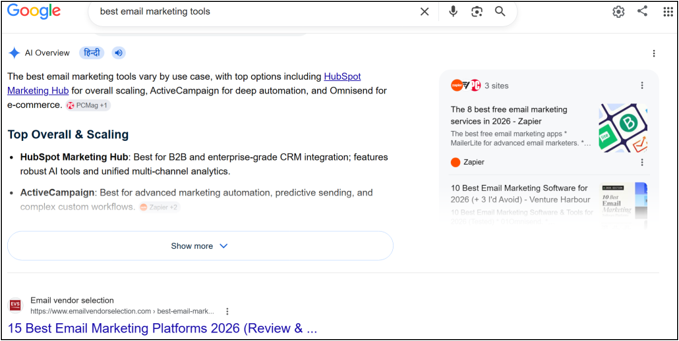
Alt Text: Google search results displaying AI Overviews for a search query.

4.	Pick topics that demonstrate your specific expertise: Some topics are covered so comprehensively by major publications that ranking is unrealistic without significant domain authority. Find the subtopics and angles where your first-hand experience gives you something to say that general content cannot.
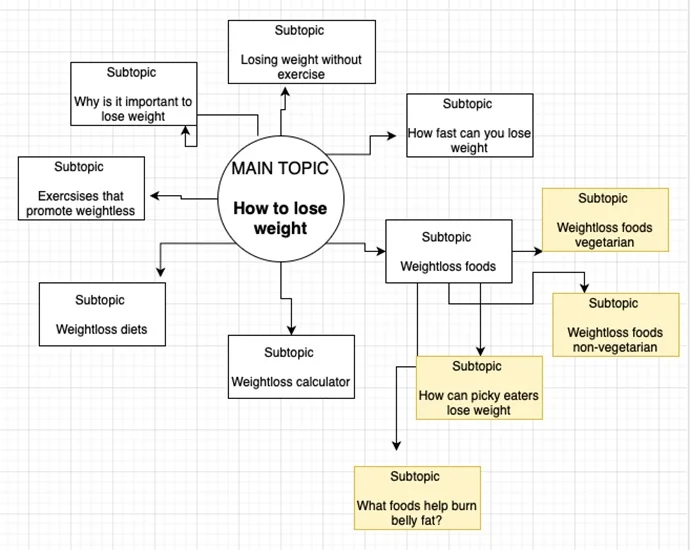
Alt Text: Diagram showing a main topic connected to multiple subtopics to illustrate topic clusters and comprehensive content planning.

Also Read: How to Find Low-Hanging Content Ideas from All Over Web? 

Step 6: Build Your Content Calendar
A content calendar is the operational bridge between your strategy and your publishing schedule. Its purpose is to keep your content programme organised, consistent, and aligned with business priorities.
But remember, a content calendar without strategy behind it is just a schedule. A content calendar built from the keyword research, audience definition, and topic prioritisation in the steps above is a compounding asset.
What a useful content calendar includes:
●	Topics and working titles for each piece
●	Target keyword for each piece
●	Content format (blog post, video, infographic, email, etc.)
●	Funnel stage it is designed to serve (TOFU, MOFU, BOFU)
●	Assigned writer and editor
●	Draft deadline and publish date
●	Distribution plan per piece (which channels, which formats it will be repurposed into)
●	Status tracking (briefed → in draft → in review → scheduled → live)
How far ahead to plan: Start with one month. Once your production process is stable, extend to a rolling three-month plan. Any further ahead and the plan starts to drift from what is actually relevant. Search trends shift, news cycles change, and topics that seemed important in January may be irrelevant by March.
On posting frequency: Publish as consistently as quality allows. 7.5 million blog posts are published every day, which means frequency without quality will remain invisible. One well-researched, properly optimised post per week, published consistently, will outperform three thin posts per week over any meaningful time horizon. So, set a cadence you can sustain.
We have seen content calendars of several clients fail because they were built for an idealised team, not the actual team. If you have one content writer working part-time, a calendar that demands eight posts a week will collapse within a month. Build the calendar around your real capacity, then scale once the process is proven.

Step 7: Build Your Content Distribution Plan
This is where most content marketing programmes fall apart. Content does not distribute itself. Publishing a post and hoping Google finds it is just optimism.
Brands with a documented distribution strategy are 3x more likely to see strong results than those that just publish and forget. Every piece of content you create should have a defined distribution plan before it goes live.
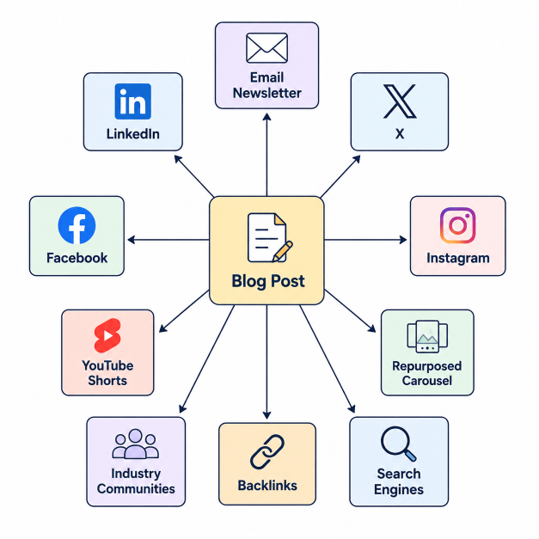
Alt Text: Content distribution strategy showing how one blog post is repurposed across email, social media, search, backlinks, and other channels.

The core distribution channels to build around:
●	Email to your subscriber base: Your email list (people who have already chosen to hear from you) is your highest-converting distribution channel. Send every significant piece of content to your list with a compelling subject line and a brief summary that earns the click. Make sure your email content is high quality; subscribers who open your email and find weak content become non-openers.
●	Organic social media: Do not post a link and move on. A single blog post should generate multiple social posts (different angles, different formats, distributed over weeks). A key statistic one day. A counterintuitive insight the next. A question directed at your audience the week after. Each post should be adapted to the platform’s native format and tone.
●	SEO and backlinks: Strong content earns backlinks over time, but you can accelerate this. Submit content to relevant online communities (Reddit, Quora, LinkedIn groups, industry forums) when it genuinely answers questions being asked there. Reach out to sources you cited in the article and let them know you referenced their work. Guest post on publications your audience reads, linking back to your best content.
●	Repurpose across formats: A blog post becomes a LinkedIn carousel. An interview becomes a podcast episode and a short video clip. A data-heavy report becomes an infographic. Every format reaches a different segment of your audience in a different context. Data says short-form video content delivers the best ROI, which means if your primary content output is written, you are leaving reach on the table by not adapting it into video.
●	Paid amplification for your best content: A small paid budget on Facebook, Instagram, or LinkedIn to boost proven content is a good distribution strategy. It puts your content in front of audiences who would not have discovered it organically, without requiring the ongoing spend that pure paid advertising demands. Use it to amplify content that is already performing well organically, not to test whether content will resonate.
●	Influencer and partner outreach: Identify 3–5 people in your network or industry who would genuinely find the content useful and reach out personally. A relevant share from a credible voice in your niche is worth more than a hundred automated social posts.
Also Read: Best Platforms for Content Distribution in 2026 

Step 8: Track Your Results
Measurement is what separates a content strategy from a content experiment. Without tracking, you cannot know what is working, what to do more of, or where to cut losses.
The core metrics to track by goal:
Goal	Primary Metric	Secondary Metrics
Organic traffic growth	Organic sessions (GA4)	Keyword rankings, impressions
Lead generation	Goal conversions/form fills	Landing page conversion rate
Engagement and authority	Average time on page, scroll depth	Returning visitors, backlinks earned
Content-attributed revenue	Assisted conversions	Pipeline influenced by content
Email distribution	Open rate, click-through rate	Unsubscribes, list growth
Where to look:
●	Google Analytics 4 is the primary tool for understanding how content is performing on your website (traffic sources, page views, average engagement time, and conversion events). Set up goal tracking before your content goes live so you are measuring from day one, not retrospectively.
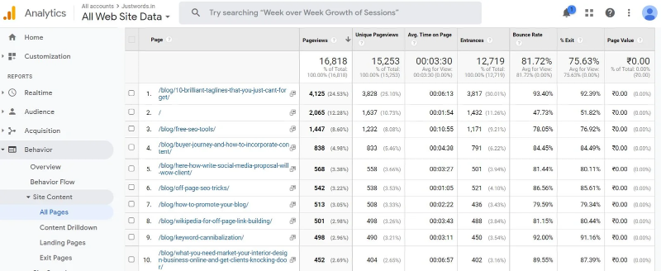
Alt Text: Google Analytics 4 dashboard showing website traffic, user engagement, and content performance metrics.

●	Google Search Console is essential for tracking organic performance. You can track which keywords your content is ranking for, how many impressions it is generating, and what your click-through rate is from search. Review this monthly to identify content pieces that rank but do not convert (CTR problem) and pieces that get clicks but do not rank high enough (optimisation opportunity).
●	Platform analytics for each social channel and email platform give you content-specific engagement data that GA4 cannot. You can learn which specific posts drove clicks, which email subject lines earned opens, and which social formats drove profile visits.
●	UTM parameters on every link you distribute outside your own website. Without UTM tagging, GA4 cannot distinguish between traffic from your email newsletter and traffic from a LinkedIn post. Tag everything so your attribution data is accurate.
What to review and when:
●	Weekly: Content publication on schedule? Any immediate performance signals from recently published pieces?
●	Monthly: Organic traffic trends, keyword ranking changes, email performance, social distribution results. Identify the top three performing pieces and why they worked.
●	Quarterly: Full content audit. Which pieces are driving the most traffic, leads, and conversions? Which are underperforming? Update high-potential pieces that have lost rankings. Cut or consolidate thin content that is not earning its place.
From our experience as a content marketing agency, the quarterly content audit is the single most underused step in content strategy. Most brands publish forward and never look back. But a blog post that ranked on page one 18 months ago and has slipped to page 3 does not need a replacement; it needs an update. Refreshing and republishing high-potential older content consistently delivers faster traffic recovery than producing new posts on the same topic.

Content Marketing Strategy Template: The One-Page Summary
Before you build your full strategy document, complete this single-page summary. If you cannot fill it in, you are not ready to publish content yet.
Section	Your Answer
Primary goal	e.g. Grow organic leads by 50% in 12 months
KPI	e.g. Monthly inbound leads from organic content
Target audience	e.g. Marketing managers at B2B SaaS companies, 50–200 employees
Primary content type	e.g. Long-form SEO blog posts
Secondary content type	e.g. LinkedIn carousels repurposed from blog content
Primary distribution channel	e.g. Organic search + email newsletter
Publishing frequency	e.g. 2 blog posts per week
Keyword strategy	e.g. Targeting 20 priority keywords in first 3 months
Review cadence	e.g. Monthly analytics review + quarterly audit
Who owns it	e.g. Content lead + SEO manager

Wrapping Up
Remember that content marketing is a long-term game. And content marketing without a strategy is the most common reason content programmes fail (not poor writing, not insufficient budget, not the wrong platform). It’s the absence of a documented plan that connects what you publish to why you are publishing it.
The 8 steps above give you that plan. Work through them in order. Document the outputs. Build the calendar from the research. Distribute every content piece deliberately. And measure monthly, so you know what to do more of and what to stop.
If you want help building or auditing a content marketing strategy for your business, the Justwords team has been doing this for over 16 years across B2B and B2C. Talk to us, and we will help you build something that actually compounds.

FAQs
How long does it take to build a content marketing strategy?
A working content marketing strategy can be built in a week if you have access to the right tools and data. The SMART goals, buyer personas, keyword research, and content calendar can all be produced in that timeframe. What takes longer (typically 3–6 months) is seeing the strategy produce measurable results in organic traffic and leads.
What are the most important elements of a content strategy?
The non-negotiables elements of a content strategy are: defined audience (who you are writing for), keyword research (what they are searching for), funnel mapping (which content serves which stage of the buyer journey), a documented publishing calendar, a distribution plan, and a measurement framework. Remove any one of these and the strategy has a structural gap.
How often should I publish content?
Consistency matters more than frequency. One high-quality, well-optimised post per week published consistently for 12 months will outperform a burst of daily publishing followed by a 3-month content drought. Set a frequency your team can sustain at quality, then scale once the production process is stable.
What is a content strategy framework?
A content strategy framework is the structural model that organises your content creation and distribution decisions. The most widely used framework is the pillar-cluster model: one comprehensive pillar page covering a core topic, supported by cluster posts on related subtopics. This structure builds topical authority faster than isolated articles and signals to search engines that your site has depth of expertise in a given area.
Do I need a content marketing strategy if I am a small business?
Yes, arguably more so. A small business cannot afford to publish content that does not compound toward a goal. A documented strategy, even a simple one-page version, ensures every piece of content you produce serves a clear purpose and audience. Small businesses that are most successful with content marketing are typically the ones that focus on a narrow topic area, build deep expertise in that area, and distribute consistently to a defined audience rather than trying to cover everything for everyone.


Key Takeaways

●      Turn business goals into a content strategy by aligning every piece of content with audience needs, search intent, and funnel stage.

●      Find content opportunities using competitor keyword gaps, CPC data, AI Overviews, and real customer questions.

●      Build a workflow that covers planning, publishing, repurposing, and distribution so content keeps generating value after it goes live.

●      Measure success with the right KPIs and quarterly content audits to improve existing content instead of constantly creating new pieces.


What Is a Content Marketing Strategy?

A content marketing strategy is a documented plan that answers 5 questions:

  • Why are you creating content? (Your goals)
  • Who are you creating it for? (Your audience)
  • What are you creating? (Formats and topics)
  • Where will it be published and distributed? (Channels)
  • How will you measure whether it is working? (KPIs)

Without clear answers to all five, you are not doing content marketing. You are just publishing.

A content strategy is not the same as a content calendar. A calendar tells you when things go live. A strategy tells you why they should exist at all, who they are for, and what you expect them to do for the business. The calendar is an output of the strategy, not a substitute for it.

Comparison of a content marketing strategy and a content calendar, highlighting goals, audience, channels, KPIs, and publishing schedule.

Why a Documented Content Strategy Is Non-Negotiable Now

Among B2B marketers who rate their strategy as moderately effective or worse, 42% attribute that in part to a lack of clear goals (Content Marketing Institute). The second most common reason for underperformance is a lack of resources, but the third is almost always the absence of a documented plan that connects content output to business outcomes.

Brands with a documented distribution strategy are 3 times more likely to see strong results than those that just publish without a plan.

In 2026, the case for documentation is even stronger than it was three years ago. AI-generated content has made the internet significantly noisier. Teams seeing the most consistent results are also the ones that are tracking outcomes.

81% of B2B marketers say measuring content performance is a top priority, with traffic, bounce rates, and return visits guiding future content decisions. Without a documented strategy, there is nothing to measure against, and nothing to improve.

At Justwords, almost every client that comes to us having already tried content marketing without results has the same story: they published consistently for a few months, saw limited traction, and stopped.

In most cases, the problem was the absence of a strategy. No defined audience, no keyword research, no distribution plan, no measurement. The content existed but had no system behind it.


The 8-Step Content Marketing Strategy Framework

8-step content marketing strategy framework covering goals, audience, content types, keyword research, topic selection, content calendar, distribution, and measurement.

Step 1: Define Your Goals

Goal-setting does not have to be complicated. What matters is that your goals are specific, measurable, and tied to a real business outcome.

Usually marketers measure the effectiveness of their content marketing strategy through sales. And that is the right instinct. Every content goal should trace back to a business result (traffic, leads, conversions, or revenue) even when the content itself is awareness-focused.

Use the SMART framework to build your goals:

  • Specific: Narrow enough that you know exactly what you are aiming for.
  • Measurable: Attached to a number you can track.
  • Actionable: Achievable with the resources you have or plan to have.
  • Relevant: Connected to actual business priorities.
  • Time-bound: With a clear deadline.

Examples of well-formed content marketing goals:

  • Grow organic website traffic by 40% in 6 months.
  • Generate 50 qualified inbound leads per month from blog content by Q4.
  • Rank in the top 3 positions for 10 high-priority keywords within 12 months.
  • Reduce paid acquisition cost by building organic conversion-focused content over 18 months.

One goal per campaign phase is enough. Trying to achieve brand awareness, lead generation, and retention simultaneously with the same content, without clearly distinguishing them, leads to content that does none of those things particularly well.


Step 2: Define Your Target Audience

Content that tries to speak to everyone speaks to no one. The sharper your audience definition, the more directly useful your content becomes and directly useful content is what earns traffic, trust, and conversions.

If you do not yet have a clearly defined audience, build a buyer persona (a detailed description of the type of person most likely to buy from you). Go beyond demographics. Include their challenges, their information consumption habits, their preferred channels, and most crucially what they are trying to achieve when they search for content in your category.

A practical buyer persona template:

Attribute Description
Age/role e.g. Marketing manager, 32–45
Industry/context e.g. B2B SaaS, 50–200 employees
Primary challenge e.g. Not generating enough qualified inbound leads
Goal e.g. Build a content programme that reduces dependence on paid
Content consumed e.g. Long-form blog posts, LinkedIn, industry newsletters
Preferred channels e.g. Google, LinkedIn, email
What they distrust e.g. Generic advice, agencies that do not understand their sector

The buyer persona is a content brief that applies to every piece you create. Every topic, every format, every headline should be filtered through the question: does this serve the specific person described here?

What we have seen at Justwords is that the most useful buyer personas are built from real conversations. Talk to your sales team about the questions they hear most in initial calls. Talk to existing clients about what they were searching for before they found you. That intelligence is worth more than any demographic profile.


Step 3: Decide What Type of Content to Create

Content types mapped across the buyer journey from awareness and consideration to decision and customer retention.

Once you know your audience and your goals, you can make an informed decision about which content formats to invest in. This decision should be driven by three factors:

  1. Where your audience is in the buyer journey: Different stages require different content types. Awareness content (informational blog posts, short-form video, infographics) serves people who are just beginning to research a problem. Consideration content (case studies, comparison guides, webinars) serves people evaluating options. Decision content (testimonials, pricing pages, product demos) serves people ready to buy.
  2. What your audience prefers: B2C content marketers primarily invest in social media and community building, with other important areas including content quality improvement, audience research, video content, and SEO. B2B audiences, by contrast, tend to respond to long-form written content, research reports, and case studies. So, always know which camp your audience sits in.
  3. What you can create consistently at quality: A video strategy that you can only sustain for two months is worse than a blogging strategy you can sustain for two years. Choose content formats based on realistic resource availability, not aspirational ambition.

Matching content types to funnel stages:

Funnel Stage Goal Content Types
Awareness (TOFU) Discovery and education Blog posts, infographics, short-form video, podcasts
Consideration (MOFU) Evaluation and comparison Case studies, long-form guides, webinars, white papers
Decision (BOFU) Conversion Testimonials, product demos, pricing pages, comparison pages
Retention Loyalty and repeat purchase Email newsletters, tutorials, community content


Step 4: Do Your Keyword and Topic Research

This is where strategy becomes executable. Keyword research identifies what your audience is actively searching for, which is the only sustainable basis for a content programme that drives organic traffic.

The goal is to find keywords with meaningful search volume, manageable difficulty for your current domain authority, and clear intent alignment with your content goals. Here is the research process we use:

  • Start with competitor analysis: Enter your top three to five competitors into a keyword tool (Ahrefs, Semrush, or Moz) and review the keywords they rank for. Identify gaps (keywords competitors rank for that you do not). These are your highest-priority opportunities.


Ahrefs Site Explorer showing the organic keywords a competitor ranks for to identify content opportunities.


  • Find low-competition, high-intent keywords: Look specifically for keywords with reasonable search volume and a difficulty score achievable at your current authority level. Long-tail keywords (3–5 words, specific intent) are consistently undervalued and overperform for conversion.

Ahrefs Top Pages dashboard showing the highest-performing pages on a competitor's website based on estimated organic traffic.

  • Target CPC keywords for BOFU content: Keywords that competitors are bidding on in paid search are high-intent terms with proven commercial value. If you can rank organically for these terms, you capture qualified traffic without ongoing ad spend.

Google Ads Keyword Planner displaying keyword ideas, search volume, competition, and bid estimates for content planning.

  • Find AI Overviews opportunities: Check which SERP features your competitors own (e.g., AI Overviews, People Also Ask boxes). These placements are winnable regardless of your overall domain authority if your content directly answers the query in the right format.
  • Fill your content gap: Use Ahrefs’ Content Gap tool (Site Explorer → your domain → Content Gap → add competitor domains) to find keywords they rank for that you have no content covering. These are your most direct organic growth opportunities.

Ahrefs keyword research dashboard showing search volume, keyword difficulty, and other data.

  • Mine communities for real audience language: Quora, Reddit, and industry forums reveal exactly how your audience articulates their problems. Learn the language that keyword tools miss but creates genuinely resonant content titles.
  • Refurbish before you create new: Before building new content, audit what already exists. Blog posts that ranked previously but have lost traffic often recover faster with an update and re-optimisation than a new post on the same topic would. Updating old blog posts with new statistics and examples improved traffic by 35% in documented cases. Your existing content library is an underused asset.

Examples of keyword modifiers such as best, how to, vs, buy, and pricing used to target different search intent.

Step 5: Choose the Right Topics

Keywords give you the raw material. Topics are how you turn that material into content that actually earns traffic and trust.

Good topic selection serves two purposes simultaneously. It captures search demand (by targeting the right keywords) and it serves audience intent (by genuinely answering what the reader came to find). Topics that do only one of these underperform.

How to build a high-quality topic list:

  • Answer bottom-of-funnel questions first: Your sales team knows exactly what questions prospects ask before making a decision. These questions map directly to high-intent, transactional content that drives conversions, not just traffic. These topics may have lower search volume than awareness keywords, but the traffic they attract converts at significantly higher rates.
  • Build topical clusters: For every core topic in your niche, there is a cluster of related subtopics. Publishing a pillar post on the main topic, supported by cluster posts on related subtopics, builds topical authority faster than a series of disconnected articles. Google rewards depth of coverage in a topic area.
  • Look for topics triggering SERP features: Identify which keywords in your research generate AI Overviews or People Also Ask boxes. Structure your content specifically to capture these placements. They can generate visibility and clicks even when you are not ranking in position one.

Google search results displaying AI Overviews for a search query.

  • Pick topics that demonstrate your specific expertise: Some topics are covered so comprehensively by major publications that ranking is unrealistic without significant domain authority. Find the subtopics and angles where your first-hand experience gives you something to say that general content cannot.

Google search results displaying AI Overviews for a search query.

Also Read: How to Find Low-Hanging Content Ideas from All Over Web?

Step 6: Build Your Content Calendar

A content calendar is the operational bridge between your strategy and your publishing schedule. Its purpose is to keep your content programme organised, consistent, and aligned with business priorities.

But remember, a content calendar without strategy behind it is just a schedule. A content calendar built from the keyword research, audience definition, and topic prioritisation in the steps above is a compounding asset.

What a useful content calendar includes:

  • Topics and working titles for each piece
  • Target keyword for each piece
  • Content format (blog post, video, infographic, email, etc.)
  • Funnel stage it is designed to serve (TOFU, MOFU, BOFU)
  • Assigned writer and editor
  • Draft deadline and publish date
  • Distribution plan per piece (which channels, which formats it will be repurposed into)
  • Status tracking (briefed → in draft → in review → scheduled → live)

How far ahead to plan: Start with one month. Once your production process is stable, extend to a rolling three-month plan. Any further ahead and the plan starts to drift from what is actually relevant. Search trends shift, news cycles change, and topics that seemed important in January may be irrelevant by March.

On posting frequency: Publish as consistently as quality allows. 7.5 million blog posts are published every day, which means frequency without quality will remain invisible. One well-researched, properly optimised post per week, published consistently, will outperform three thin posts per week over any meaningful time horizon. So, set a cadence you can sustain.

We have seen content calendars of several clients fail because they were built for an idealised team, not the actual team. If you have one content writer working part-time, a calendar that demands eight posts a week will collapse within a month. Build the calendar around your real capacity, then scale once the process is proven.

Step 7: Build Your Content Distribution Plan

This is where most content marketing programmes fall apart. Content does not distribute itself. Publishing a post and hoping Google finds it is just optimism.

Brands with a documented distribution strategy are 3x more likely to see strong results than those that just publish and forget. Every piece of content you create should have a defined distribution plan before it goes live.

Content distribution strategy showing how one blog post is repurposed across email, social media, search, backlinks, and other channels.

The core distribution channels to build around:

  • Email to your subscriber base: Your email list (people who have already chosen to hear from you) is your highest-converting distribution channel. Send every significant piece of content to your list with a compelling subject line and a brief summary that earns the click. Make sure your email content is high quality; subscribers who open your email and find weak content become non-openers.
  • Organic social media: Do not post a link and move on. A single blog post should generate multiple social posts (different angles, different formats, distributed over weeks). A key statistic one day. A counterintuitive insight the next. A question directed at your audience the week after. Each post should be adapted to the platform’s native format and tone.
  • SEO and backlinks: Strong content earns backlinks over time, but you can accelerate this. Submit content to relevant online communities (Reddit, Quora, LinkedIn groups, industry forums) when it genuinely answers questions being asked there. Reach out to sources you cited in the article and let them know you referenced their work. Guest post on publications your audience reads, linking back to your best content.
  • Repurpose across formats: A blog post becomes a LinkedIn carousel. An interview becomes a podcast episode and a short video clip. A data-heavy report becomes an infographic. Every format reaches a different segment of your audience in a different context. Data says short-form video content delivers the best ROI, which means if your primary content output is written, you are leaving reach on the table by not adapting it into video.
  • Paid amplification for your best content: A small paid budget on Facebook, Instagram, or LinkedIn to boost proven content is a good distribution strategy. It puts your content in front of audiences who would not have discovered it organically, without requiring the ongoing spend that pure paid advertising demands. Use it to amplify content that is already performing well organically, not to test whether content will resonate.
  • Influencer and partner outreach: Identify 3–5 people in your network or industry who would genuinely find the content useful and reach out personally. A relevant share from a credible voice in your niche is worth more than a hundred automated social posts.

Also Read: Best Platforms for Content Distribution in 2026

Step 8: Track Your Results

Measurement is what separates a content strategy from a content experiment. Without tracking, you cannot know what is working, what to do more of, or where to cut losses.

The core metrics to track by goal:

Goal Primary Metric Secondary Metrics
Organic traffic growth Organic sessions (GA4) Keyword rankings, impressions
Lead generation Goal conversions/form fills Landing page conversion rate
Engagement and authority Average time on page, scroll depth Returning visitors, backlinks earned
Content-attributed revenue Assisted conversions Pipeline influenced by content
Email distribution Open rate, click-through rate Unsubscribes, list growth

Where to look:

  • Google Analytics 4 is the primary tool for understanding how content is performing on your website (traffic sources, page views, average engagement time, and conversion events). Set up goal tracking before your content goes live so you are measuring from day one, not retrospectively.

Google Analytics 4 dashboard showing website traffic, user engagement, and content performance metrics.

  • Google Search Console is essential for tracking organic performance. You can track which keywords your content is ranking for, how many impressions it is generating, and what your click-through rate is from search. Review this monthly to identify content pieces that rank but do not convert (CTR problem) and pieces that get clicks but do not rank high enough (optimisation opportunity).
  • Platform analytics for each social channel and email platform give you content-specific engagement data that GA4 cannot. You can learn which specific posts drove clicks, which email subject lines earned opens, and which social formats drove profile visits.
  • UTM parameters on every link you distribute outside your own website. Without UTM tagging, GA4 cannot distinguish between traffic from your email newsletter and traffic from a LinkedIn post. Tag everything so your attribution data is accurate.

What to review and when:

  • Weekly: Content publication on schedule? Any immediate performance signals from recently published pieces?
  • Monthly: Organic traffic trends, keyword ranking changes, email performance, social distribution results. Identify the top three performing pieces and why they worked.
  • Quarterly: Full content audit. Which pieces are driving the most traffic, leads, and conversions? Which are underperforming? Update high-potential pieces that have lost rankings. Cut or consolidate thin content that is not earning its place.

From our experience as a content marketing agency, the quarterly content audit is the single most underused step in content strategy. Most brands publish forward and never look back. But a blog post that ranked on page one 18 months ago and has slipped to page 3 does not need a replacement; it needs an update. Refreshing and republishing high-potential older content consistently delivers faster traffic recovery than producing new posts on the same topic.

Content Marketing Strategy Template: The One-Page Summary

Before you build your full strategy document, complete this single-page summary. If you cannot fill it in, you are not ready to publish content yet.

Section Your Answer
Primary goal e.g. Grow organic leads by 50% in 12 months
KPI e.g. Monthly inbound leads from organic content
Target audience e.g. Marketing managers at B2B SaaS companies, 50–200 employees
Primary content type e.g. Long-form SEO blog posts
Secondary content type e.g. LinkedIn carousels repurposed from blog content
Primary distribution channel e.g. Organic search + email newsletter
Publishing frequency e.g. 2 blog posts per week
Keyword strategy e.g. Targeting 20 priority keywords in first 3 months
Review cadence e.g. Monthly analytics review + quarterly audit
Who owns it e.g. Content lead + SEO manager


Wrapping Up

Remember that content marketing is a long-term game. And content marketing without a strategy is the most common reason content programmes fail (not poor writing, not insufficient budget, not the wrong platform). It’s the absence of a documented plan that connects what you publish to why you are publishing it.

The 8 steps above give you that plan. Work through them in order. Document the outputs. Build the calendar from the research. Distribute every content piece deliberately. And measure monthly, so you know what to do more of and what to stop.

If you want help building or auditing a content marketing strategy for your business, the Justwords team has been doing this for over 16 years across B2B and B2C. Talk to us, and we will help you build something that actually compounds.


FAQs

1. How long does it take to build a content marketing strategy?

A working content marketing strategy can be built in a week if you have access to the right tools and data. The SMART goals, buyer personas, keyword research, and content calendar can all be produced in that timeframe. What takes longer (typically 3–6 months) is seeing the strategy produce measurable results in organic traffic and leads.

2. What are the most important elements of a content strategy?

The non-negotiables elements of a content strategy are: defined audience (who you are writing for), keyword research (what they are searching for), funnel mapping (which content serves which stage of the buyer journey), a documented publishing calendar, a distribution plan, and a measurement framework. Remove any one of these and the strategy has a structural gap.

3. How often should I publish content?

Consistency matters more than frequency. One high-quality, well-optimised post per week published consistently for 12 months will outperform a burst of daily publishing followed by a 3-month content drought. Set a frequency your team can sustain at quality, then scale once the production process is stable.

4. What is a content strategy framework?

A content strategy framework is the structural model that organises your content creation and distribution decisions. The most widely used framework is the pillar-cluster model: one comprehensive pillar page covering a core topic, supported by cluster posts on related subtopics. This structure builds topical authority faster than isolated articles and signals to search engines that your site has depth of expertise in a given area.

5. Do I need a content marketing strategy if I am a small business?

Yes, arguably more so. A small business cannot afford to publish content that does not compound toward a goal. A documented strategy, even a simple one-page version, ensures every piece of content you produce serves a clear purpose and audience. Small businesses that are most successful with content marketing are typically the ones that focus on a narrow topic area, build deep expertise in that area, and distribute consistently to a defined audience rather than trying to cover everything for everyone.

About the author

About the author

Table of Contents

Is your content good enough to beat your competitors

Get solutions to your most pressing content problems

3 REASONS TO SUBSCRIBE TODAY
  • You get free access to information, tips, hacks, processes that have been distilled from our decade of content marketing expertise.
  • We keep looking for exciting news about marketing and share that through our blog in our aim to help people understand and do better content and marketing.
  • We will never ever flood your inbox with frequent, unnecessary mails.

We will never share your email with anyone. You can unsubscribe any time.

reason-to-subscribe
footer-cta-jwc

Talk Strategy with Expert

Get expert advice on the right strategy for your business