The best way to evaluate an AI SEO agency is to ask how it earns, measures, and proves visibility in AI-generated answers (Google AI Overviews, ChatGPT, Gemini, Perplexity) and whether that work rests on a sound SEO foundation. An agency that answers with method, data and plain language is doing real AI search work. One that answers with buzzwords is selling a rebadged SEO retainer.
That test matters more now because nearly every agency now lists AI SEO services on its website. In many pitch meetings, the slides have changed while the deliverables have not – keyword lists, link quotas, and monthly ranking reports. The label on a proposal therefore tells you very little, and two agencies quoting the same fee can deliver very different work.
This guide gives you 10 questions to put to every shortlisted agency, what a strong answer sounds like and which answers should end the conversation. It also shows which questions matter most for your type of business, so the final decision rests on evidence instead of the best presentation. Treat it as an SEO agency selection checklist for AI search, built on top of our general guide to how to choose an SEO agency.
Quick Overview
- AI search work is SEO work plus new measurement and off-site effort. An agency selling it as a separate mystery discipline deserves suspicion.
- Ask which AI search tactics the agency has tested itself. Experience beats advice recycled from social media.
- AI answers change almost every time they run, so one screenshot or a single “AI rank” proves nothing. Look for repeated-prompt tracking and citation share.
- Demand baselines, dates and data sources for every result, including honest context when traffic dips.
- No AI SEO agency can guarantee a place in AI Overviews or ChatGPT answers. Walk away from any that does.
-
What an AI SEO Agency Actually Does
An AI SEO agency improves a brand’s visibility in traditional search results and in AI-generated answers. The same service is sold under several names like AI search optimisation, generative engine optimisation (GEO) and answer engine optimisation (AEO). A generative engine optimisation agency and an answer engine optimisation agency are usually describing overlapping work, which our guide to AI search optimisation explains in more detail.
Buyer behaviour explains why AI SEO matters so much today. YouGov’s India Web Search and AI Report 2026 classed 89% of surveyed online searchers in India as AI searchers, against 48% in the US and 54% in Great Britain. That means Indian buyers are ahead of most markets when it comes to using AI for search. The report says 27% of those surveyed described AI as their starting point. Another 36% use it after other forms of search, and 26% use it alongside other sources. So, buyers move between AI and classic search constantly. That means one team needs to own both SEO and AI SEO for a business.
The stakes also show up in clicks. Ahrefs analysed 300,000 keywords and found that the top-ranking page earned a 58% lower click-through rate where an AI Overview appeared, comparing December 2023 with December 2025. In practice, ranking first no longer guarantees the visit, so being named inside the answer has become part of the job, and an agency has to show how it gets you there.
3 Ideas Every Buyer Should Understand Before the Pitch Meeting
An agency that cannot explain these in plain language probably lacks the depth to manage this work.
- Entities: AI systems organise the web around entities (companies, products, people and categories). When your brand details, descriptions and associations stay consistent across your site and trusted third-party pages, the system becomes more confident about where you belong.
- Structured data: Schema markup translates page content into explicit, machine-readable facts about what you sell, who wrote the page and which questions it answers. It removes ambiguity for any crawler or model that reads it.
- Retrieval: Many AI answer tools fetch live pages, pull relevant passages and compose an answer with links to the sources they used. Pages that are accessible, clearly written and backed by independent mentions are the ones that get pulled.
Why Lists of the Best AI SEO Agencies Cannot Choose for You
Roundups of the best AI SEO agencies and top AI SEO agencies are a fine way to build a longlist. But they cannot do more than that, because a list cannot see your site, your category, your competitors, or your budget. The 10 questions below do that job. Put the same questions, in writing, to every agency on your shortlist and compare the answers side by side.
The 10 Questions to Ask Before You Hire an AI SEO Agency
The first three questions below filter out most weak proposals. Questions 4 to 10 separate good agencies from great ones.
1. Which AI search tactics have you tested yourself, and what did the results show?
AI search is full of advice that gets repeated on social media long before anyone tests it. llms.txt files, content chunking, AI-specific page rewrites, and schema bundles are the usual examples. Some of it works in certain situations and some of it does nothing. So, an honest agency can tell you which is which because it has run the experiments.
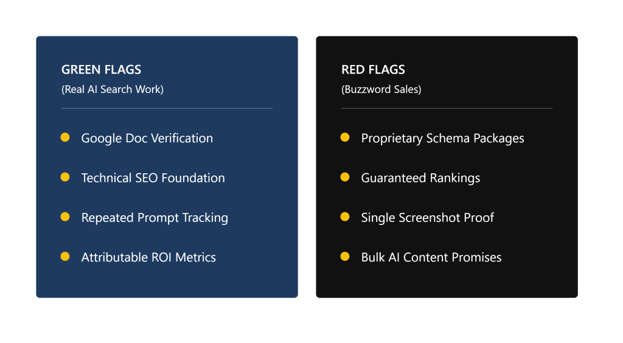
Strong answer: The agency shares what it has tested on its own site and on client sites, what moved citations, what made no difference, and what it is still testing. It holds a clear view on tactics like llms.txt and can defend that view with results.
Red flag: A “proprietary” method nobody can explain, tactics repeated from industry hype with no results behind them, or llms.txt files and “AI schema packages” sold as the reason you will appear in AI answers.
2. What will you fix in my SEO foundation, including schema, before any AI-specific work starts?
AI answers are built from pages that search engines and AI crawlers can find, read, and trust. Google’s own documentation says a page needs to be indexed and eligible to appear as a snippet to show up in AI Overviews or AI Mode. That makes crawlability, indexation, site architecture, page experience and content quality the real entry ticket. And it also makes schema and entity signals the next layer.
Schema tells machines exactly what a page is about, who published it and how your brand connects to its category, and plugin defaults rarely go beyond the basics. AI-specific work on a site that machines cannot read properly has nothing to build on.
Strong answer: The agency starts with a technical SEO audit, shows specific issues found on your site before the contract is signed, and ranks fixes by business impact. It also explains its schema approach in plain language. For example, which types it deploys, how they are nested and how your brand details stay consistent across your site and the web.
Red flag: The first deliverable is a prompt list or a tool dashboard, and nobody has looked at your indexation, rendering or site structure, or the whole schema plan is “the plugin handles it”.
3. How do you measure AI search visibility when answers change every time?
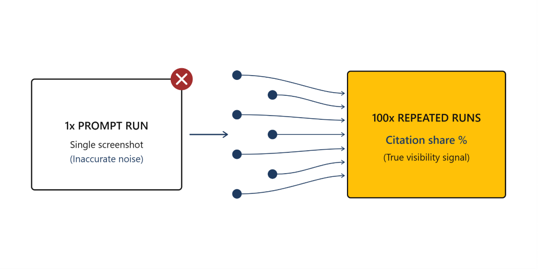
AI tools rarely give the same answer twice. Ask the same buying question ten times and the list of recommended brands, and its order, will shift. SparkToro and Gumshoe.ai gave ChatGPT, Claude and Google’s AI the same brand-recommendation prompts again and again. There was less than a 1-in-100 chance of getting the same list twice, and roughly a 1-in-1,000 chance of the same list in the same order.
One screenshot of one answer, or a single “AI rank”, is therefore just a shortcut that is highly inaccurate. How often a brand appears across many prompts and repeated runs (often called share of model or citation share) is a steadier signal.
Strong answer: A prompt set built from your buyers’ real questions at each funnel stage, repeated runs, appearance rate and citation share against named competitors, a check on whether the AI describes you accurately, and a trend line over months. AI tools for SEO can help automate the collection, but the method matters more than the dashboard.
Red flag: One-off screenshots, no competitor benchmark or a proprietary score that cannot be explained.
4. How will you report results when clicks fall but visibility grows?
Some click loss is now structural. Going by the Ahrefs figure above, a brand can hold position one and still lose well over half its clicks on queries that trigger an AI Overview. The goal then shifts to being cited in the answer, winning the clicks that remain and reporting both in business terms.
Strong answer: Reports that connect impressions, citations, clicks, leads and revenue, with data-backed explanations when traffic dips and a clear view of branded search and assisted conversions. Our guide to measuring SEO ROI shows what that reporting looks like.
Red flag: Traffic-only decks, forecasts that ignore AI Overviews or every dip blamed on Google without evidence.
5. How do you decide what to publish, and what stops it from becoming bulk AI content?
AI engines cite pages that add something to the conversation. Mass-produced and rewritten content adds nothing, which is why AI content rewriting fails in Google too. This question exposes the real quality of a retainer faster than any other.
Strong answer: A topic map built from buyer questions and competitor gaps, named subject experts, original data or first-hand experience, a direct answer near the top of each page in ordinary readable prose, question-led subheadings, tables where data is compared, a refresh cycle, and human editorial review.
Red flag: Volume promises such as 100 to 200 articles a month, AI drafts with a light edit, or the same article reshuffled for every city.
6. What is your plan for getting my brand mentioned beyond my own website?
AI systems rarely rely on your website alone. When someone asks for a recommendation, the answer draws on reviews, news coverage, forums, YouTube, and directories, and a brand that only talks about itself on its own pages is easy to leave out. Citable digital PR builds the consensus that makes a recommendation feel safe – independent sources saying the same thing about who you are and what you do.
Strong answer: Digital PR with substance (original research, case studies, expert commentary, reviews, relevant forums and YouTube, accurate listings, and for local businesses an up-to-date Google Business Profile). Quality backlink strategies still apply, and the agency should explain how they connect to mentions.
Red flag: Fixed monthly guest-post quotas, directory blasts, purchased mentions, or fake reviews. These tactics carry penalty risk, and Google names inauthentic mentions as something to skip.
7. Who owns my strategy, and how do the SEO, content and technical teams work together?
Everything above has to run as one plan. A digital marketing agency that bolts AI work onto an old retainer as a separate team, with separate reports and a separate fee, creates duplicated effort and conflicting priorities. A single specialist cannot cover it either, as our comparison of an SEO agency vs a freelancer explains.
Strong answer: A named senior strategist owns the plan end to end. Technical, content and link specialists work to one roadmap, and your team supplies brand context and approvals rather than strategic direction.
Red flag: Seniors appear only in the pitch, the account manager cannot explain the plan, or GEO sits in a different silo from SEO.
8. How do you audit crawler access and rendering for AI platforms?
AI platforms use their own crawlers, and text that only appears after heavy JavaScript runs may never reach them. Robots.txt rules matter as well. Some crawlers collect data for model training; others fetch pages to answer a live question. And blocking the wrong ones can remove you from AI answers. Which bots to allow is a business decision, and it should be made with you.
Strong answer: The agency reviews robots.txt and server logs for specific bots, separates training crawlers from search and retrieval crawlers, checks that key text renders in the HTML, and asks about your content policy before recommending changes.
Red flag: The topic never comes up, or the agency recommends allowing or blocking every AI bot without asking what your content is worth to you.
9. Can you show verified AI visibility results, with baselines and dates?
Proof is where most pitches fall apart. Ask for named clients, start dates, baseline numbers, the data source (Search Console, Semrush, Ahrefs), screenshots of real AI Overview citations, and context when the numbers wobble.
Here is what that standard looks like in practice. Justwords documented three recent programmes this way:
- Coloplast Store India (healthcare ecommerce, every article clinically reviewed): Between December 2024 and October 2026, keywords in Google’s top three rose from 3 to 93, and AI Overview presence grew from none to 73 keywords, according to Semrush estimates. During this time, estimated monthly organic visits rose from 199 to 9,937, after peaking at 16,246 in December 2025. Traffic eased while AI visibility kept growing, which is the pattern question 4 prepares you for.
- Autoxperia (new automotive platform, started May 2026): Between 1 June and 6 September 2026, ranking keywords went from 41 to 4,491, keywords in the top three from none to 209, and AI Overview presence from none to 554 keywords, driven by a content programme built around high-volume buyer questions. (Semrush estimates)
- Vivahnam (destination wedding venue platform, full SEO from June 2026): Search Console shows 2.93K clicks and 222K impressions between late May and late October 2026, at an average position of 10.4. The platform now appears as a cited source in Google AI Overviews for venue queries such as wedding costs at Alila Fort Bishangarh.
Each example carries a baseline, a date range, a named data source and an honest note where the trend is not a straight line. You should hold every agency to that standard.
Red flag: Logos without numbers, screenshots with no dates, or traffic charts for unrelated keywords with no AI visibility data at all.
10. What do you commit to in writing, and what will you refuse to promise?
Any agency that guarantees top placement is selling certainty it cannot deliver. No agency controls what Google, ChatGPT or Gemini shows on a given day, and AI answers shift even from one run to the next. The contract should reflect that honesty.
Strong answer: A written scope that lists deliverables and reporting, forecast ranges with their assumptions, short initial terms or month-to-month flexibility, and AI visibility work included in the core retainer. Fees should trace back to team seniority and scope; our guide to SEO cost in India shows how that reasoning works.
Red flag: Guaranteed AI Overview or ChatGPT mentions, “first page in 30 days”, long lock-ins, or SEO packages with a premium GEO add-on and no distinct, listed scope.
Which Questions Matter Most for Your Business
All ten apply to everyone. But their weight changes with your model.
| Your situation | Weigh these most | Why |
| Small business or local service | 2, 6, 10 | A clean foundation, accurate local listings, and a clear scope protect a limited budget. Our local SEO guide covers the basics. |
| Ecommerce | 2, 5, 8 | Product page quality, content depth, and rendering decide whether catalogue pages get read and cited. |
| B2B and SaaS | 3, 6, 9 | Buyers research vendors inside AI tools, so measurement, third-party mentions, and proof carry the most weight. |
| Healthcare and finance | 5, 7, 9 | Accuracy, expert review, and verified results matter more than volume. |
Choose the Agency That Can Prove Its Answers
Start the first call with questions 1, 3 and 9. An agency that answers the first from real experience, the second with a method, and the third with dated numbers has earned a deeper conversation. One that stumbles on all three will not be rescued by a better deck.
Then send all ten questions in writing to every AI SEO agency on your shortlist and give them a week. The proposal shows how an agency sells; the answers show how it works. Agencies that take the time to answer well usually report honestly later, which matters more than any fee difference once the work starts.
Delay carries a cost. Every month spent with an agency that cannot measure AI visibility is a month your competitors spend getting cited while you guess.
If you are shortlisting agencies right now, bring these ten questions to a call with Justwords and hold us to the same standard. We will answer each one in writing, with baselines and dates, and show you how our AI SEO services turn that evidence into measurable AI search visibility.
FAQs
1. What does an AI SEO agency do?
An AI SEO agency improves a brand’s visibility in traditional search and AI-generated answers such as Google AI Overviews, ChatGPT, and Perplexity. The work covers technical SEO, content, off-site mentions, and tracking how often AI tools cite the brand.
2. Is a GEO agency different from an SEO agency?
Mostly in name. GEO builds on SEO, so a capable SEO agency already covers it by adding AI visibility tracking and off-site mentions. Splitting the two usually creates duplicate fees and conflicting plans.
3. How much does AI SEO cost in India?
Full-service SEO retainers from capable agencies in India typically run from ₹50,000 to ₹2,00,000+ per month. AI visibility work should sit inside that scope. A separate GEO fee needs a written list of what it adds.
4. How long does AI SEO take to show results?
Early ranking and citation movement often appears within 60 to 90 days on lower-competition topics. Consistent AI visibility usually builds over 6 to 12 months, and competitive categories take longer. Judge progress against a baseline, never a single month.
5. Is AI SEO worth it for a small business?
Yes, once the foundation is solid. Small businesses gain most from accurate Google Business Profile details, local listings, reviews, and helpful service pages. Avoid paying for AI add-ons before basic local SEO is working.
6. Which AI platforms should an agency track?
Google AI Overviews, AI Mode, ChatGPT, Gemini, and Perplexity cover most buyer research. Add Microsoft Copilot and Claude for B2B audiences. Track the platforms where your own customers research, and ask the agency to justify its list.
7. How many AI SEO agencies should I compare before choosing one?
Compare around three agencies. Send each the same 10 questions in writing, score the answers, and ask for client references with baseline data. Fewer agencies limit comparison, and more create noise and slow the decision.