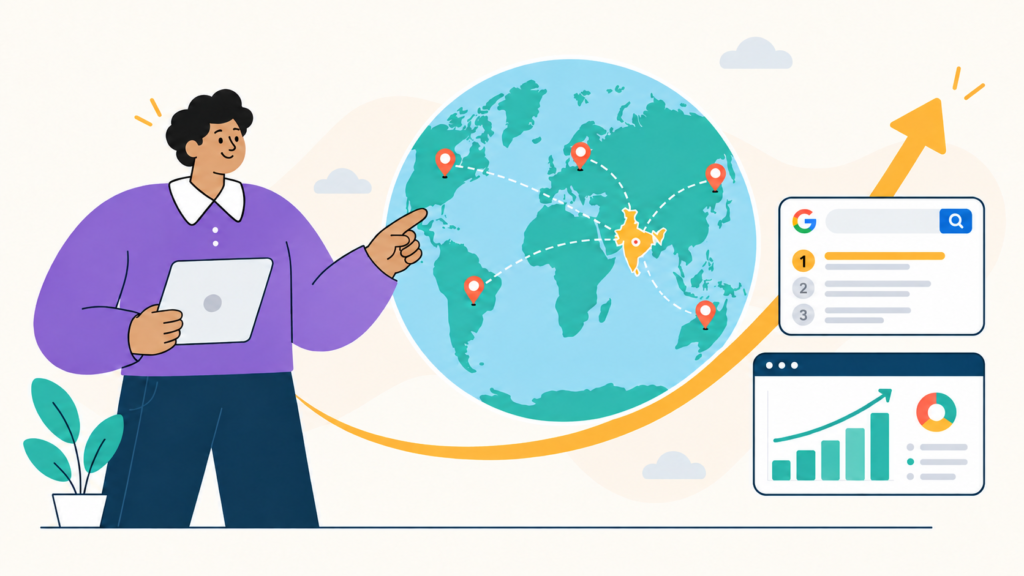
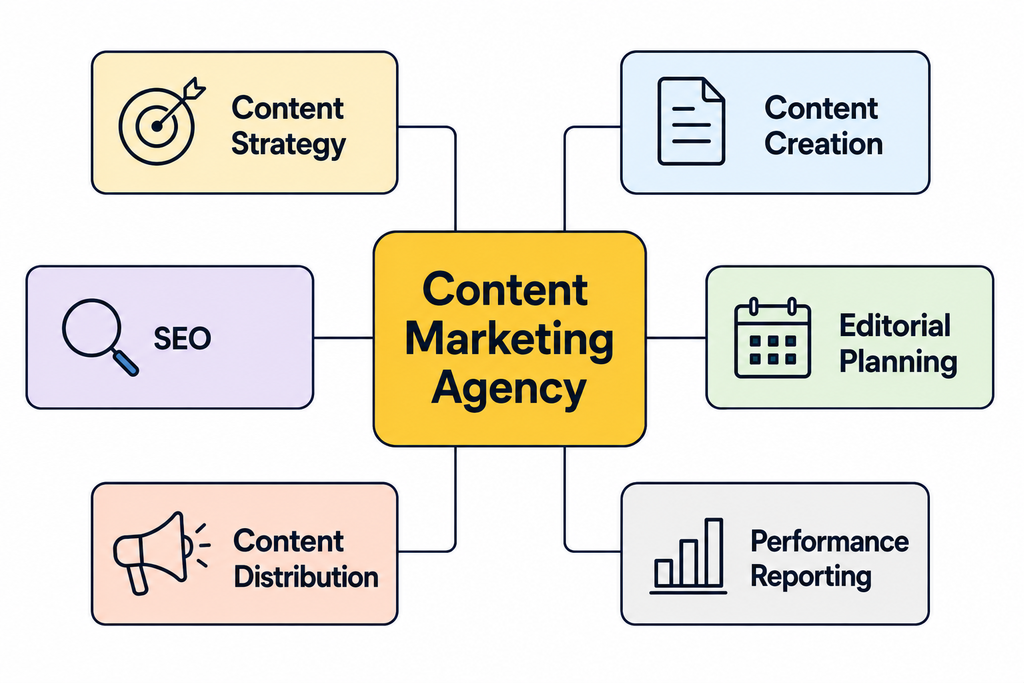
A content marketing agency plans, creates, optimises, distributes, and measures content that is designed to attract your target audience and move them toward a business decision. Its core services include content strategy, blog and long-form content writing, on-page and off-page SEO, editorial planning, content distribution, and performance reporting.
But what separates agencies that deliver that outcome from those that simply produce content is the structure behind the work: who owns the strategy, how SEO is integrated, whether distribution is treated seriously, and how performance is reported back to the business.
Most businesses that reach out to a content marketing agency are not confused about what content marketing is. They have usually tried it in some form, either through a freelancer, an in-house hire, or a previous agency. What they are trying to establish is whether the agency in front of them is built to do the right things, in the right sequence, and at a quality that actually moves the needle.
This article breaks that down service by service, beyond the basic explanations you have probably read elsewhere.
Key Takeaways
- A content marketing agency handles strategy, content creation, SEO (on-page and off-page), distribution, and performance reporting.
- SEO is not just a technique applied to content. In a serious agency, SEO runs from keyword strategy to link building.
- The most important thing an agency does is decide what to produce and why, before they start writing content.
- In 2026, agency value is increasingly measured by visibility in AI Overviews and LLM-cited content, not just Google rankings.
What Problems Does a Content Marketing Agency Actually Solve?
The reasons businesses say they hire a content marketing agency are usually that they need more content or they want to improve their SEO. However, we find from clients that the real reasons tend to be something like organic traffic has plateaued, the in-house team is too stretched to publish consistently, previous content efforts produced no measurable return, or a competitor is visibly outranking them on commercially important search terms.
A content marketing agency solves these problems by producing the right content, at the right frequency, and with the structure that builds compounding organic value. But volume without strategy is just noise. So, the agency’s job is to make sure every piece of content earns its place with the target audience.
A Content Marketing Agency’s Core Services Explained
1. Content Strategy
The first thing a content marketing agency should do is build a strategy.
This means auditing your existing content to identify what is ranking, what is underperforming, and what gaps exist. It means mapping your buyer journey so content is created for the right stages of the funnel. It means doing keyword and topic research that reflects actual search demand. And in 2026, it also means identifying which topics your brand should own to be cited by AI systems.
The audit phase often reveals that a business has been publishing consistently for years with little business results, because the content was never built around search intent or buyer psychology. It was built around what the marketing team thought was interesting or trending. Those are rarely the same thing.
Strategy is also where audience definition gets specific. For example, writing for “business owners” is not a strategy. Writing for a procurement head at a mid-sized Indian manufacturing company who is evaluating ERP solutions for the first time is a strategy. The narrower the audience definition, the more precisely the content can address what that person actually needs to read before they make a decision.
2. Content Creation
Content creation is the most visible service, but the quality of output depends entirely on what happens before a writer receives a brief.
A serious agency assigns writers with genuine domain familiarity, not generalists who rotate between writing about skincare, logistics, and B2B SaaS in the same week. The brief each writer works from should already include keyword intent, audience stage, competitor gaps, internal linking opportunities, and the specific business outcome the content is meant to support.
Writer quality is where most agencies quietly cut corners. At Justwords, only about 2% of applicants make the cut, and every writer is matched to a domain.
For Tally Solutions, that model helped us scale from 20–25 pieces a month to 300+, across India, the UAE, and Saudi Arabia. We wrote for everyone from chartered accountants to first-generation small-business owners, giving each audience a distinct voice while maintaining compliance accuracy across three regulatory environments.
That kind of volume, consistency, and domain precision doesn’t come from generalist writers. It comes from building the right specialist writing team.
The formats a content marketing agency produces typically include:
- Long-form blog articles and pillar pages for organic search
- Bottom-of-funnel content: comparisons, case studies, service pages, and buyer guides
- Thought leadership and B2B editorial content
- Email sequences and nurture content
- Social media content adapted from long-form assets
A good content marketing agency also writes content optimised for AI visibility. These are structured, entity-rich writing designed to be cited in Google AI Overviews and LLM responses. This matters because search isn’t purely about ranking on page 1 anymore. A growing share of search queries, particularly informational and commercial-intent queries, are resolved by AI-generated answers. Agencies that are not building content with this in mind are leaving a significant visibility gap open.
Also Read: Content Marketing Types Explained: 9 Formats That Drive Results
3. SEO
A content marketing agency that treats SEO as something that happens after the writing is done is not doing SEO. It is doing formatting. Real SEO that drives organic growth over time is a programme-level discipline that runs parallel to content strategy from day 1.
We are being specific about this because most businesses underestimate how much SEO scope a serious content marketing agency should own.
- Keyword research and topic strategy: A content marketing agency maps the full universe of terms your buyers use across every stage of the funnel, identifying which clusters represent genuine ranking opportunities given your domain authority and building a multi-month content roadmap around those clusters. This research phase directly determines what gets written, in what order, and why.
- On-page SEO: Every piece of content should be structured around search intent from the start. It needs the right heading hierarchy, internal linking that reinforces site architecture, meta elements that improve click-through, and content depth that signals topical authority to both search engines and AI systems. This isn’t retrofitted after writing; it is done before.
- Off-page SEO and link building: Domain authority is built through credible external links. A content marketing agency should own a sustained editorial outreach programme: identifying relevant publications, pitching and placing guest articles, and building the backlink profile that makes your site more competitive over time. This is one of the most underdelivered services in the industry. Most agencies mention it, but few execute it consistently.
Hero Housing Finance is a case in point. Over 3 years of integrated SEO and content work, organic traffic grew by 752%, peaking at 60,000+ monthly visitors with 270+ monthly home loan conversions at its highest point. That result did not come from content alone. It came from content, on-page optimisation, and sustained link building working together.
A good content marketing agency also flags technical SEO issues it sees. For example, duplicate pages, crawlability issues, and structural problems that undermine the content investment. At Justwords, we flag technical issues and work alongside a client’s website development team to resolve them, because producing strong content on a technically broken site is wasted effort.
The compounding effect of all this is significant. An article written correctly today, with the right intent targeting, internal linking, and off-page authority behind it, can generate traffic and leads 2 or 3 years from now without additional investment. In the Indian B2B market, where organic search is an increasingly critical acquisition channel for scaling businesses, this is often the highest-ROI thing an agency delivers
4. Editorial Planning and Content Calendar Management
Inconsistent publishing is one of the most common reasons content programmes fail across industries. Businesses start with good intentions, publish frequently for a month or two, and then let the frequency slip when other priorities take over. The result is a blog that looks abandoned and an SEO programme that never builds momentum.
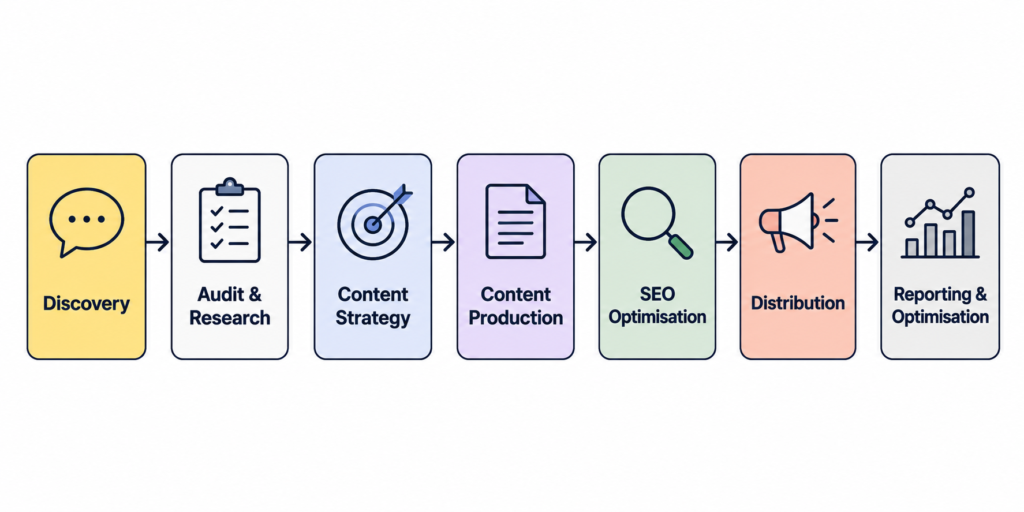
A content marketing agency removes this problem by owning the production pipeline. This includes editorial planning (what gets written and when, based on strategy), content calendar management, briefing, writing, editing, client review coordination, and publishing. You do not chase writers for drafts or manage multiple freelancers across different time zones. The agency handles the workflow, and you receive finished content that is ready for review.
Over the years of working with clients across sectors, from B2B technology to healthcare to professional services, one consistent pattern stands out: the businesses that see the strongest results are the ones that commit to a consistent publishing cadence and let the agency manage the operational complexity of maintaining it.
5. Content Distribution
Publishing a well-written, well-optimised piece of content is necessary but not sufficient. How that content reaches your audience beyond organic search is where most agencies underdeliver.
Distribution includes social media amplification across the platforms where your audience actually spends time. It includes email promotion to existing subscribers. It includes outreach to relevant publications for guest posting and editorial backlinks, which remain one of the stronger signals for domain authority. It includes content repurposing: turning a long-form article into a LinkedIn carousel, a short video script, an email newsletter section, or a set of social posts that keep the original investment working harder.
When evaluating an agency, ask specifically how they handle distribution. A vague answer like “we share it on social media” tells you a lot about how seriously they take post-publication performance.
6. Performance Reporting
A content marketing agency should report on outcomes, not just outputs. The number of articles published is not a performance metric. Neither is a list of keywords that have moved from position 47 to position 38.
Meaningful reporting connects content activity to business outcomes: organic traffic trends over time, keyword rankings for commercially relevant terms, engagement metrics that indicate whether content is resonating, lead contribution from organic channels, and where the data allows, revenue influenced by content-driven traffic.
Reporting should also be honest about what is not working. Content that is not ranking after a reasonable window should be diagnosed to see whether it is a targeting problem, a quality problem, a competition problem, or a distribution problem. Each answer leads to a different response. An agency that only reports the positive numbers and quietly lets underperforming content sit is not managing your programme; it is managing your perception of the programme.
What Deliverables You Actually Receive Each Month
A well-run content agency should tell you precisely what you get each month. Expecting finished articles is obvious. But beyond that, you should also expect a performance report tied to business metrics, an updated content calendar for the next cycle, SEO briefs or strategy notes where the plan has been adjusted, and distribution reporting that shows how individual content pieces performed.
If the only monthly deliverable is a set of finished articles and a brief email, the scope of what the agency is actually managing is narrow (it’s just content writing). Deliverables are also the paper trail that shows whether the strategy is working and where it needs to change.
Also Read: 8 Agency Secrets for Hiring Best Content Agency
Content Marketing Agency vs. In-House Team: The Realistic Assessment
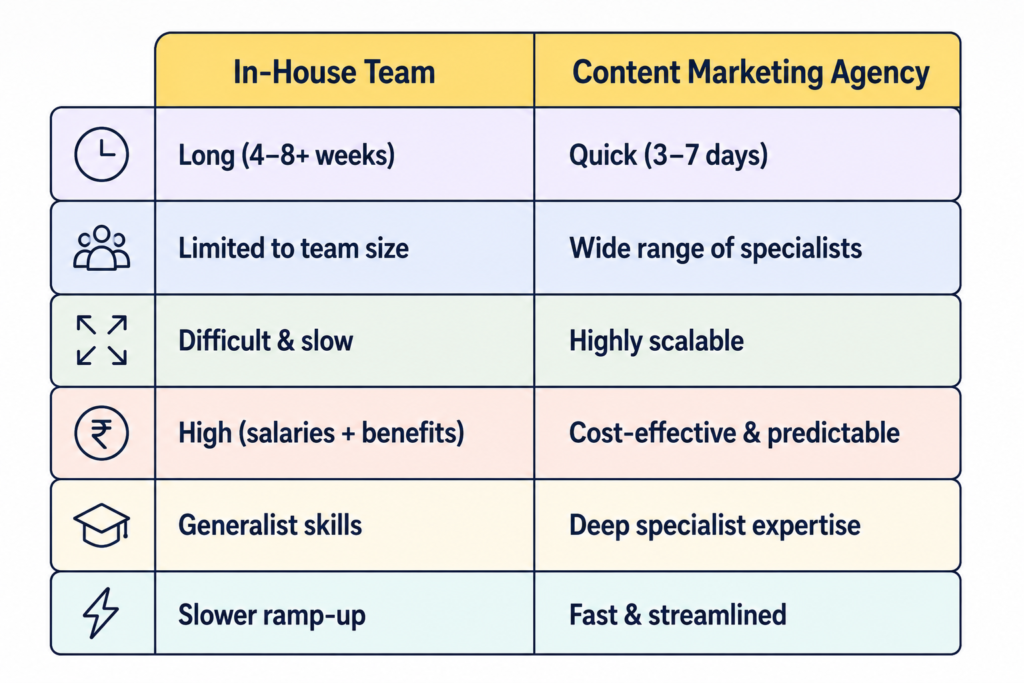
The agency versus in-house question does not have a universal answer, but it does have a practical one.
Building an in-house content team that can genuinely handle strategy, writing, SEO, distribution, and reporting requires hiring a content strategist, one or more experienced writers, an SEO specialist, and someone to manage the production workflow. In most Indian cities, that is a significant salary commitment before you have published a single piece of content. And hiring well in this space is harder than it looks; the market for genuinely skilled content and SEO professionals is tight.
An agency gives you access to that full capability immediately, at a fraction of the cost of hiring it internally, and with the operational infrastructure already in place.
The hybrid model, which is common among the businesses that see the best results, involves an internal marketing manager who provides brand direction and approves content, working alongside an agency that owns strategy, production, SEO, and distribution. This combines internal brand knowledge with external execution capability without the overhead of building a full team.
Read More: Outsource Content Marketing or Build In-House? What Works Best
What to Realistically Expect from a Content Marketing Agency in the First 90 Days
Content marketing is not a short-term channel, and any agency that promises rapid ranking improvements or guaranteed leads within weeks is telling you what you want to hear rather than what is true.
A serious agency should complete the audit and strategy in the first 30 days, begin production, and establish the publishing cadence. By 60 days, early SEO signals should be visible with crawl improvements, initial indexing of new content, and keyword tracking baselines established. By 90 days, there should be measurable movement in rankings for target terms, improving organic traffic trends, and a content pipeline that operates without requiring you to manage the day-to-day.
The businesses that become frustrated with content marketing are usually the ones that expected results in month two and disengaged before the compound effect had a chance to build. Six months of consistent, well-executed content, built on a sound strategy and properly integrated with SEO, consistently outperforms six months of inconsistent publishing driven by gut instinct.
Also Read: Content Marketing for Small Business: Strategy, Tips & Best Practices
Conclusion
A content marketing agency does far more than write blog posts. Its role is to develop a strategy, create content aligned with business objectives, integrate SEO throughout the production process, distribute that content effectively, and measure its impact over time.
While the content marketing services offered by most agencies may look similar on paper, the quality of execution varies significantly. The difference between average and high-performing agencies is rarely the quality of a single article. It is the consistency of the process behind every piece of content and the ability to connect content activity to measurable business outcomes.
If you are evaluating whether a content marketing agency is the right fit for your business, look beyond the list of services. Assess the agency’s process, the quality of its strategic thinking, and its ability to demonstrate measurable business outcomes. Those factors will have a far greater impact on long-term success than the number of articles published each month.
If you would like to explore what a strategy-led content marketing programme could look like for your business, the team at Justwords can assess your current content performance and recommend a practical roadmap based on your goals. Connect with us to learn how.
Further reading: Top 11 Content Marketing Agencies in India for Growth
FAQs
1. What is the difference between a content marketing agency and a digital marketing agency?
A digital marketing agency typically covers paid advertising, social media, email, SEO, and content as a combined offering. A content marketing agency specialises in content strategy, creation, SEO integration, and distribution. The depth of expertise in content and organic search is usually significantly higher at a specialist agency. If you want to understand in detail, check out this article: Digital Marketing vs Content Marketing: What’s the Difference?
2. How long does it take for content marketing to show results?
Meaningful organic traffic growth typically begins to appear between 3 and 6 months of consistent, strategy-led publishing. Competitive categories may take longer. The timeline is influenced by domain authority, publishing frequency, content quality, and how well SEO is integrated into production.
3. Can a content marketing agency help with AI search visibility in 2026?
Yes, AI search visibility is increasingly a core part of what serious agencies need to deliver. Content structured around entities, written with depth and authority, and covering a topic comprehensively is more likely to be cited in AI Overviews and LLM-generated responses. Agencies still building purely for traditional search rankings are behind the curve.
4. How do I evaluate whether a content marketing agency is right for my business?
Ask three questions: How do they decide what content to produce? How do they measure whether it is working? What do they do when it is not? The depth and specificity of the answers will tell you more than any case study or testimonial.